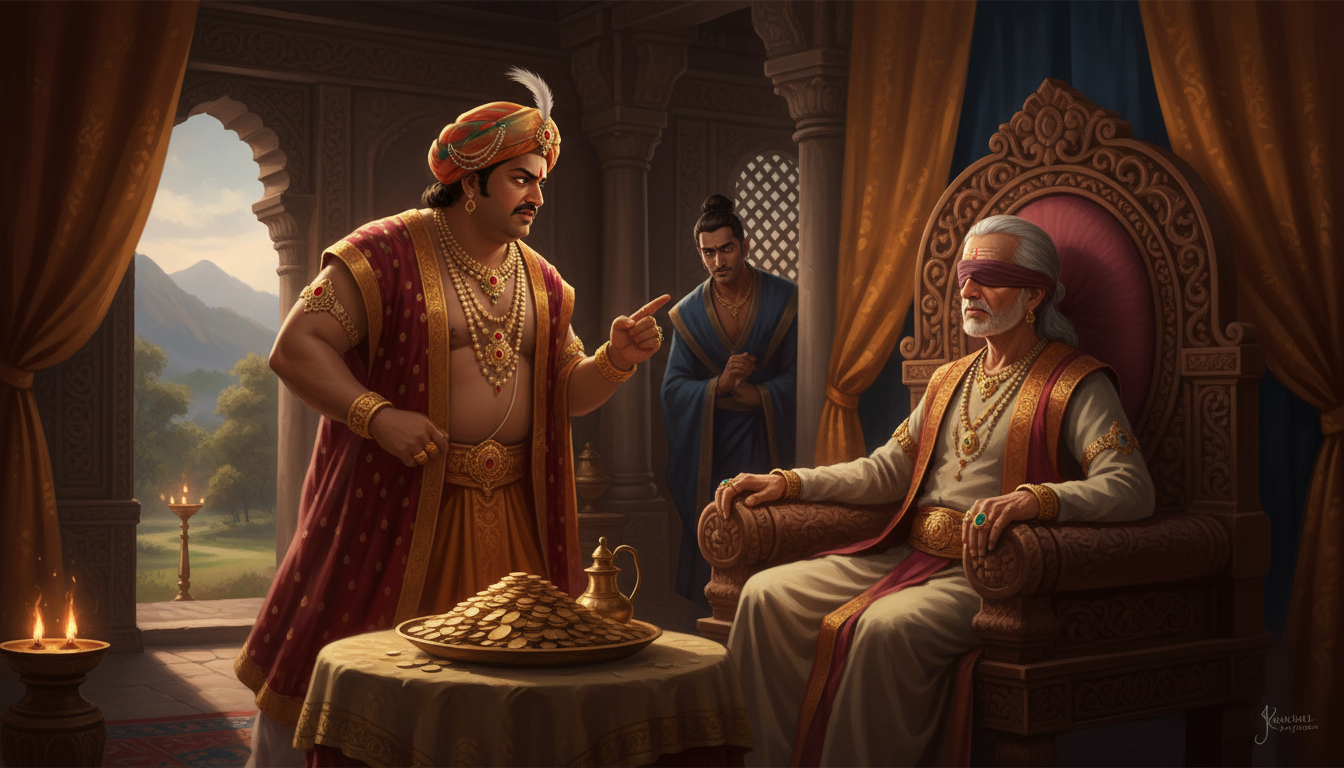
What the Blind King Was Told
Duryodhana's inventory of the rajasuya, and the quarrel it started
Have Nothing To Do With Dice
Janamejaya said, "How did that game at dice take place, which was so fraught with evil to the cousins, and through which my grandsires were plunged into such sorrow? Who among the kings present approved of it, and who forbade it?"
Vaishampayana said: Listen, O best of the Bharatas, and I will narrate it again from the beginning.
Dhritarashtra had asked Vidura what he thought and received an answer he did not like. So he called Duryodhana to him privately, in a room with no counsellors in it, and tried the only thing a father in that position can try.
"O son of Gandhari, have nothing to do with dice. Vidura does not speak well of it. He is possessed of great wisdom and he will never give me advice that is not for my good. He knows, with all its mysteries, that science of political morality which Vrihaspati unfolded long ago to the chief of the immortals. As Uddhava is regarded among the Vrishnis, so is Vidura esteemed among the Kurus. Dice sows dissensions, and dissensions ruin a kingdom."
Duryodhana said nothing, so his father tried the other approach.
"You have obtained from us what it is ordained that a father and a mother should give a son: ancestral rank and possessions. You are educated and clever in every branch of knowledge. You were born the eldest among all your brothers and you live within your own kingdom. Why do you regard yourself as unhappy? You obtain food and clothing of the very best kind, such as ordinary men cannot obtain at all. Ruling a large ancestral kingdom swelling with people and with wealth, you shine as splendidly as the chief of the celestials shines in heaven. Tell me what can be the root of this grief that has made you so melancholy."
That was the invitation. Duryodhana took it, and the answer went on for the better part of an evening.
The Water That Was Not There
"I am a sinful wretch, O king," said Duryodhana, "because I eat and I dress while beholding the prosperity of my foes. It has been said that a man is a wretch who is not filled with jealousy at the sight of his enemy's prosperity. This prosperity of mine does not gratify me. Beholding that blazing prosperity of the son of Kunti, I am very much pained. Strong must be my vitality, since I am living even at the sight of the whole earth owning the sway of Yudhishthira."
"The whole earth is a large phrase," said Dhritarashtra.
"The Nipas, the Chitrakas, the Kukkuras, the Karaskaras, the Lauha-janghas: they live in his palace like bondsmen. The Himavat, the ocean, and the numberless other regions that yield jewels have all acknowledged the superiority of his mansion. And regarding me as the eldest and entitled to respect, Yudhishthira appointed me to receive the tribute. My hands were fatigued with receiving that wealth. When I was tired, they who had carried it from distant regions waited until I was able to resume my labour."
He had come to the part he had been circling.
"Bringing jewels from the lake Vindu, the Asura architect Maya made for them a lake-like surface of crystal. Beholding the lotuses with which it was filled, I mistook it for water. And seeing me draw up my clothes to cross it, Vrikodara laughed at me, regarding me as a man wanting in jewels who had lost his head at the sight of his enemy's affluence. If I had the ability I would have slain Bhima for it. But if we endeavour to slay him now, ours will be the fate of Sisupala. That insult burns me.
"Then, beholding a similar surface really full of water but which I took for crystal, I walked out onto it and fell in. Bhima laughed, and Arjuna laughed with him, and Draupadi, with the other women, joined in the laughter. My clothes were wet, and at the king's command the menials brought me other clothes. That also is my great sorrow.
"And hear of one more mistake. In attempting to pass through what is exactly of the shape of a door, but through which there is really no passage, I struck my forehead against the stone and injured myself. The twins Nakula and Sahadeva, beholding from a distance that I had been hit at the head, came and supported me in their arms and expressed great concern for me. And Sahadeva told me repeatedly, as if with a smile, 'This, O king, is the door. Go this way.' And Bhimasena, laughing aloud, said, 'O son of Dhritarashtra, this is the door.' I had not even heard the names of the gems I saw in that mansion. It is for these reasons that my heart so aches."
The Queue at the Gate
"Listen now," said Duryodhana, "to the costly articles I saw belonging to the sons of Pandu, brought one after another by the kings of the earth. Beholding that wealth of the foe, I lost my reason."
And then, in a small room, to a man who had never seen anything at all, he began the catalogue.
"The king of Kamboja gave innumerable skins of the best kind, and blankets made of wool, of the soft fur of burrowing animals, and of the hair of cats, all of them inlaid with threads of gold. He gave three hundred horses of the Titteti and Kalmasha breeds, with noses like parrots, and three hundred camels and as many she-asses, fattened upon olives and the Pilusha.
"Brahmanas without number waited at the gate with three hundred millions of tribute and were denied admission. Hundreds more came with their golden Kamandalus filled with clarified butter, and they too were refused. The Sudra kings of the sea coast brought a hundred thousand serving girls of the Karpasika country, decked in golden ornaments, and skins of the Ranku deer worthy even of Brahmanas. The Vairamas and Paradas and Tungas waited at the gate and were refused permission to enter, with goats and kine and camels and honey and blankets and gems of every kind on the ground beside them."
He let that sit a moment, because the next name was one his father knew.
"And king Bhagadatta, the brave ruler of Pragjyotisha, sovereign of the mlechchhas, at the head of a body of Yavanas, waited at the gate unable to enter, with horses of the best breed possessing the speed of the wind. Beholding the concourse, Bhagadatta went away from that gate. He left behind him a number of swords with handles of the purest ivory, adorned with diamonds and with every kind of gem, and he went home.
"Tribes came from every region. Some possess two eyes, some three, some have their eyes upon their foreheads. There were the Aushmikas and the Nishadas and the Romakas, and some who eat men, and many who possess only one leg. Those with one leg gave wild horses, some as red as the cochineal, some white, some like clouds in the evening, all endued with the speed of the mind. The people of Valhika gave ten thousand asses with black necks that run two hundred miles in a day, and blankets manufactured in Chin, and cloth woven from threads spun by insects, and battle-axes made in the western countries. The Sakas and Tukharas and the men with horns brought elephants and ten thousand horses and hundreds of millions of gold, and waited at the gate, refused permission to enter."
Gold Raised Out of the Earth by Ants
"They that dwell by the river Sailoda, which flows between the mountains of Meru and Mandara, and who enjoy the shade of the topes of Kichaka bamboo, brought heaps of gold measured out in jars. That gold is raised from underneath the earth by ants, and is therefore called after those creatures.
"The mountain tribes brought long brushes of chamara hair, some soft and black, others white as a moonbeam, and honey from the flowers of the Himavat and the Mishali champaka, and garlands from the region of the northern Kurus, and plants out of the north, even from Kailasa. They waited with their heads bent down at the gate, refused permission to enter. The Kiratas came, armed with cruel weapons, attired in skins, with loads upon loads of sandal and aloe and black aloe, and ten thousand serving girls of their own race, and beautiful animals and birds of remote countries. They also were refused.
"The Vangas and Kalingas and Magadhas and Tamraliptas presented themselves, and the gatekeepers told them, at the command of the king, that if they could wait and bring good tribute they would obtain admission. So each of those kings gave a thousand elephants with tusks like the shafts of ploughs, decked with girdles of gold, darkish as rocks and always musty, procured from the sides of the Kamyaka lake. Having made those presents, they were permitted to enter.
"Chitraratha, king of the Gandharvas, gave four hundred horses gifted with the speed of the wind. Tumvuru gave a hundred horses of the colour of mango leaf. Virata of Matsya gave two thousand elephants decked in gold. Yajnasena presented fourteen thousand serving girls and ten thousand serving men with their wives, and also his whole kingdom. And Vasudeva of the Vrishni race, merely in order to enhance the dignity of Arjuna, gave fourteen thousand elephants.
"The kings of Chola and Pandya brought jars of gold filled with fragrant sandal juice from the hills of Malaya, and loads of aloe wood from the Dardura hills, and fine cloths inlaid with gold, and did not obtain permission to enter. The king of the Singhalas gave those best of sea-born gems called lapis lazuli, and heaps of pearls, and hundreds of coverlets for elephants.
"Only two peoples on this earth pay him no tribute, father. The Panchalas, by marriage. The Andhakas and Vrishnis, by friendship."
What It Costs To Feed That House
"And now I will tell you of the servants of the Pandavas," said Duryodhana, "the people for whom Yudhishthira supplies food, both cooked and uncooked.
"There are elephants and cavalry beyond any counting I can give you, and cars by the hundred million, and foot soldiers without number. At one place raw provisions are being measured out, at another cooked, at another distributed. The notes of festivity are heard everywhere in it, at every hour. And among men of all orders I did not behold one person in that mansion who had not food and drink and ornaments.
"Eighty-eight thousand Snataka Brahmanas leading domestic lives are supported by him, with thirty serving girls given to each, and gratified by the king they pray with complacent hearts for the destruction of his foes. Ten thousand other ascetics, with their vital seed drawn up, eat daily off golden plates in his palace.
"And Yajnaseni, without having eaten herself, goes through that house every day and sees whether everybody has eaten. Everybody. Including the deformed. Including the dwarfs. She does not sit down to her own food until she has seen it."
He stopped there, and what he said next he said differently from all the rest of it.
"Beholding the kings of the earth presenting such gifts to my foes, I wished for death out of grief."
It is worth noticing what the inventory had done to him. He had stood at that gate for days receiving the wealth of the world into his hands, and the thing his mind had kept was not the gold. It was the woman who would not eat until the dwarfs had eaten. It was the twins picking him off the floor and asking whether he was hurt. Every kindness done to him in that house had gone in and turned, and lay in him now beside the mockery, and he could not tell one from the other.
The Conch Out of the Northern Sea
"For the bathing of Yudhishthira at the conclusion of the sacrifice," said Duryodhana, "the kings themselves brought the jars, in a state of purity, with the greatest alacrity. King Bahlika brought a car decked with pure gold. King Sudakshina himself yoked to it four white horses of the Kamboja breed. Sunitha fitted the lower pole with his own hands, and the ruler of Chedi set the flagstaff. Magadha held the garlands and the head-gear. Vasudana brought an elephant sixty years old. Matsya brought the side-fittings of the car, encased in gold. King Eklavya brought the shoes. Avanti brought the waters for the final bath. Chekitana carried the quiver, Kasi the bow, and Salya a sword whose hilt and straps were adorned with gold.
"Then Dhaumya and Vyasa, with Narada and Devala the son of Asita, performed the sprinkling of the sacred water. Satyaki held the umbrella over his head. Dhananjaya and Bhima fanned him, and the twins stood with chamaras in their hands.
"And the Ocean himself brought, in a sling, that great conch of Varuna which the celestial artificer Viswakarman had constructed out of a thousand nishkas of gold, and which Prajapati had presented to Indra in a former age. It was with that conch that Krishna bathed Yudhishthira. And beholding it, father, I swooned away.
"Men go to the eastern sea and to the western, and also to the southern. But none except birds can ever go to the northern sea. The Pandavas have spread their dominion even there. I heard hundreds of conches brought from that sea blown together in the sacrificial mansion, and while they blew my hair stood on end, and those among the kings who were weak in strength fell down where they stood. And Dhrishtadyumna and Satyaki and the sons of Pandu and Kesava, beholding the kings deprived of consciousness and beholding me in that plight, laughed outright.
"Yudhishthira has obtained a prosperity such as neither Rantideva obtained, nor Nabhaga, nor Manu, nor king Prithu the son of Vena, nor Bhagiratha, nor Yayati, nor Nahusha. Beholding it, I do not see the least good in continuing to live. O ruler of men, a yoke that is tied to the bullock's shoulders by a blind man becomes loosened. Even such is the case with us. The younger ones are growing while the elder ones are decaying. And beholding all this I cannot enjoy peace even with the aid of reflection. It is for this that I am plunged into grief, and am becoming pale and emaciated."
The Sons of Pandu Are As Your Arms
Dhritarashtra had heard all of it, every gate and every jar and every tribe with one leg, and when his son finally stopped speaking he answered him gently, which was the only way he ever answered him.
"You are my eldest son, and born also of my eldest wife. Therefore, my son, be not jealous of the Pandavas. He that is jealous is always unhappy, and suffers the pangs of death. Yudhishthira knows no deception. He possesses wealth equal to yours, and he is not jealous of you. Why then should you be jealous of him? Why should you covet, out of folly, the property of your brother? Cease to be jealous. Do not grieve.
"If you covet the dignity that attaches to the performance of a sacrifice, let the priests arrange for you the great sacrifice called the Saptatantu. The kings of the earth will then cheerfully, and with great respect, bring wealth and gems and ornaments for you also."
He was offering him the thing itself: the same rite, the same gate, the same queue of kings, in his own city, at his own door. Both of them knew he did not want it, because it had never been the tribute that he wanted.
"O child, coveting the possessions of others is exceedingly mean. He enjoys happiness who is content with his own, being engaged in the practices of his own order. Never striving to obtain the wealth of others, persevering in one's own affairs, and protecting what has been earned: these are the indications of true greatness. "The sons of Pandu are as your arms. Do not lop off those arms of yours. Do not plunge into internal dissensions for the sake of that wealth of your brothers. There is great sin in quarrelling with friends. They that are your grandsires are theirs also. Give away in charity on occasions of sacrifice, gratify every dear object of your desire, disport in the company of women freely, and enjoy peace."
Discontent Is the Root of Prosperity
"He that is devoid of intellect but has merely heard of many things," said Duryodhana, "can scarcely understand the real import of the scriptures, like the spoon that has no perception of the taste of the soup it touches. You know everything, and yet you confound me. Like a boat fastened to another boat, you and I are tied to each other. Are you unmindful of your own interests? Or do you entertain hostile feelings toward me?
"These sons of yours are doomed, inasmuch as they have you for their ruler, for you describe as attainable in the future what is to be done at the present moment. He often trips whose guide acts under the instructions of others.
"Vrihaspati has said that the usages of kings are different from those of common people. The attainment of success is the sole criterion that should guide the conduct of a Kshatriya. Whether the means is virtuous or sinful, what scruples can there be in the duties of one's own order?
"Those used to handling weapons say that a weapon is not simply an instrument that cuts. It is a means, whether covert or overt, by which a foe can be defeated. Who is a foe and who a friend does not depend upon a man's figure or his dimensions. He that pains another is to be regarded a foe by him that is pained.
"Discontent is the root of prosperity. Therefore, O king, I desire to be discontented. He that strives after the acquisition of prosperity is a truly politic person. Nobody should be attached to wealth, for the wealth that has been hoarded may be plundered. It was during a period of peace that Sakra cut off the head of Namuchi, after having given a pledge to the contrary, and it was because he approved of this eternal usage toward an enemy that he did so. Like a snake that swallows the frogs and the other creatures living in holes, the earth swallows up a king who is peaceful and a Brahmana who does not stir out of his home.
"He is one's foe, and nobody else, who has common pursuits with one. He that from folly neglects a growing foe has his vitals cut off, as by a disease he has cherished without treatment. A foe, however insignificant, if suffered to grow in prowess, swallows one up like the white ants at the root of a tree eating off the tree itself.
"Coveting as I do the prosperity of the Pandavas, I have not yet made it my own. At present I am a prey to doubts in respect of my ability, and I am determined to resolve those doubts. I will either obtain that prosperity of theirs, or I will lie down having perished in battle. When the state of my mind is such, what do I care now for life, since the Pandavas are daily growing while our possessions know no increase?"
Betting Is My Bow
Shakuni had been waiting for that, and he spoke into the silence after it.
"O foremost of victorious persons, I will snatch for you this prosperity of Yudhishthira, at the sight of which you grieve so. Let the son of Kunti be summoned. By throwing dice, a skilful man, himself uninjured, may vanquish one that has no skill. Know, O Bharata, that betting is my bow, the dice are my arrows, the marks upon them my bowstring, and the dice-board my car."
"This Shakuni is skilled at dice," said Duryodhana, "and is ready to snatch the prosperity of the son of Pandu by means of dice. It behoves you to give him permission."
"I am obedient to the counsels of my brother Vidura," said Dhritarashtra. "Consulting with him, I shall tell you what should be done."
"Vidura is always engaged in doing good to the sons of Pandu," said Duryodhana at once. "He will without doubt withdraw your heart from the proposed act. No man should set himself to any task depending upon the counsels of another, for the minds of two persons seldom agree. The fool who lives shunning all causes of fear wastes himself like an insect in the rainy season. Neither sickness nor Yama waits until one is prosperous. So long as there is life and health, one should accomplish his purpose."
"Hostility with those that are strong never recommends itself to me," said Dhritarashtra. "Hostility brings about a change of feelings, and that itself is a weapon, though not made of steel. You regard as a great blessing, O prince, what will bring in its train the terrible consequences of war. If once it begins, it will create sharp swords and pointed arrows."
"Men of the most ancient times invented the use of dice," said Duryodhana. "There is no destruction in it, nor any striking with weapons. Let your command be issued for the speedy construction of the assembly house. The door of heaven will be opened to us by gambling, and the Pandavas will become your equals instead of, as now, your superiors."
"The words uttered by you do not recommend themselves to me," said Dhritarashtra. "Do what may be agreeable to you, O ruler of men. But you shall have to repent for acting according to these words, for words fraught with such immorality can never bring prosperity in the future. Even this was foreseen by the learned Vidura. Even the great calamity, destructive of the lives of the Kshatriyas, comes as destined by fate."
Having said this, the weak-minded king regarded fate as supreme and unavoidable, and deprived of reason by Fate and obedient to the counsels of his son, he commanded his men in a loud voice.
"Carefully construct, without loss of time, an assembly house of the most beautiful description. Let it be called the crystal-arched palace. A thousand columns, decked with gold and with lapis lazuli, furnished with a hundred gates, two miles in length and the same in breadth."
Thousands of artificers erected it with the greatest alacrity, covered it with many-coloured carpets inlaid with gold, and came cheerfully to report that it was finished. Then Dhritarashtra summoned Vidura, the chief of his ministers, and gave him the errand he had spent all this while refusing to give.
"Repair to Khandavaprastha, and bring prince Yudhishthira here without loss of time. Let him come with his brothers and behold this handsome assembly house of mine. And let a friendly match at dice commence here."
Dharma Lesson
Envy described in detail is envy rehearsed. A father who asks his son to be content while listening greedily to the whole inventory has already agreed with him, and the sacrifice he offers as a substitute is refused because the tribute was never the thing wanted.