The Vow of the Soft Tongue
Vyasa's warning, and the promise Yudhishthira made instead
The Grandfather Asks Leave to Go
The Rajasuya was over. That foremost of sacrifices, so difficult of accomplishment that most kings die without attempting it, had been completed to its last syllable, and the guest houses of Indraprastha were emptying as the monarchs of the earth went home.
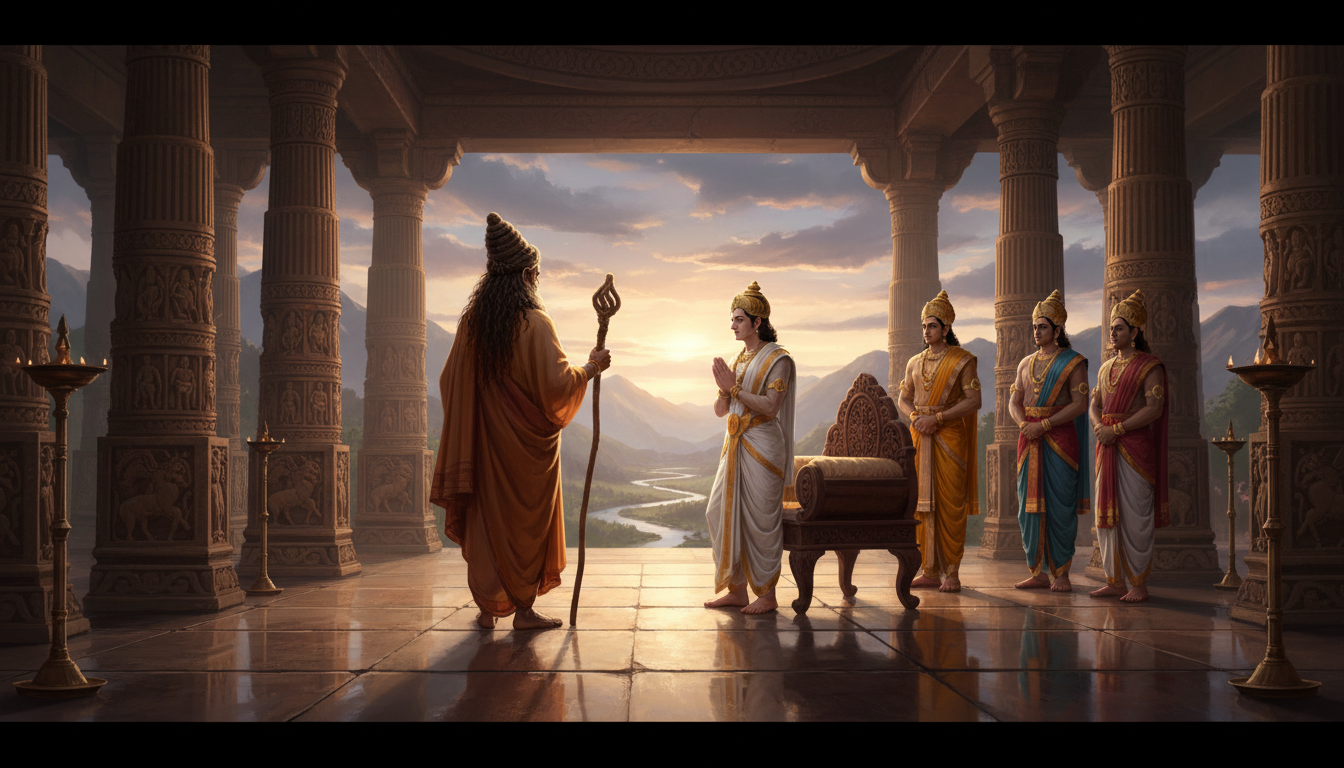
Into the hall, surrounded by his disciples, came Vyasa.
Yudhishthira rose from his seat the moment he saw him, and his brothers rose with him, and the king of the whole earth went down the steps himself to bring water for the washing of an old man's feet. He gave him a seat, a costly carpet inlaid with gold, and did not sit until the sage had settled on it. This was his grandfather. Everything in the room, the hall itself, the throne, the empire, came out of a chain of events that this dark-hued man had begun long ago in a fisherman's daughter's house.
"Take your seat," said Vyasa.
Yudhishthira sat, with his four brothers about him.
"O son of Kunti," said Vyasa, who was truthful in speech and did not say pleasant things merely to be pleasant, "you grow from good fortune. You have obtained imperial sway, which is difficult of acquisition. O perpetuator of the Kuru race, all the Kauravas have prospered in consequence of you. I have been duly worshipped here. I desire now to go, with your leave."
It was a farewell, and it should have taken a minute. Yudhishthira came down and touched his feet and did not let him go.
"O chief of men, a doubt has risen in me that is difficult to dispel. Except for you there is nobody who can remove it."
The Question About the Portents
"Ask it," said Vyasa.
"The illustrious Rishi Narada told me," said Yudhishthira, "that as a consequence of the Rajasuya sacrifice three kinds of portents occur. Celestial, atmospheric, and terrestrial. Signs in the heavens, signs in the air, signs upon the ground. He said it plainly, in this hall, and I have carried it since."
He had carried it through the whole of the sacrifice, in fact, and everyone who had watched him closely knew it. He had carried it while the kings brought their tribute and while Krishna received the first honour, and he had been carrying it on the day the king of the Chedis stood up in the middle of the hall and abused Krishna in front of every crowned head in the world until the discus went and took his head off, and the light went out of Shishupala and into Krishna's feet in the sight of them all.
"That was a terrible thing," said Yudhishthira. "A king was killed in my house, at my sacrifice, before my guests. I have been telling myself since that this was what Narada meant. That the portents have discharged themselves already, and are finished. O grandsire, have those portents been ended by the fall of the king of the Chedis?"
He wanted to be told yes. He was a man who had done everything correctly, at enormous cost, and he wanted one old sage to tell him that the bill had been paid and there was nothing further owing.
Vyasa, the son of Parasara, the island-born, of dark hue, heard the question through and did not soften it.
Thirteen Years
"For thirteen years, O king," said Vyasa, "those portents will bear mighty consequences, ending in the destruction of all the Kshatriyas."
Nobody in the hall moved.
"In course of time, O bull of the Bharata race, making you the sole cause, the assembled Kshatriyas of the world will be destroyed. For the sins of Duryodhana, and through the might of Bhima and Arjuna, O Bharata, they will be destroyed."
Thirteen years. Not thirteen days, or thirteen months, but a stretch of time long enough for a child born that night to be nearly grown before the end of it. And in that count of years the sacrifice just completed was not a discharge of the omens but the opening of them.
Yudhishthira heard the shape of the sentence before he heard its sense. Making you the sole cause. Not Duryodhana the cause, though the sins were named as Duryodhana's. Not Bhima and Arjuna the cause, though the might was named as theirs. Him. The one who had never in his life done a thing he believed to be wrong, who had refused a throne he was owed rather than quarrel over it, who had built a city out of a burnt wilderness because his uncle asked him to be content with half.
He looked at Bhima, whose hands were on his knees, and at Arjuna, who had gone very still.
"Through the might of my brothers," he said.
"Through their might," said Vyasa. "None of this is a fault in them. A thing may be brought about by the best men in the world and still be a ruin."
"Then tell me what to do," said Yudhishthira. "You have told a hundred kings before me what to do. Tell me which act, done now, this evening, unmakes it."
"I have told you the count of the years," said Vyasa. "That is what a Rishi is for. What is done inside them is what a king is for."
The Dream He Would Have That Night
Then Vyasa told him what he would see in his sleep, before he saw it, which is a hard kindness.
"In your dream, O king of kings, toward the end of this night, you will behold the blue-throated Bhava. The slayer of Tripura, ever absorbed in meditation, having the bull for his mark. He will be drinking from the human skull. He is fierce and terrible, that lord of all creatures, that god of gods, the husband of Uma, who is also called Hara and Sarva and Vrisha, armed with the trident and with the bow called Pinaka, and attired in a tiger skin."
The hall was quiet enough to hear the lamps.
"And you will behold Siva tall and white as the Kailasa cliff, seated upon his bull, gazing unceasingly toward the south. Toward that direction which is presided over by the king of the Pitris. That is the dream you will dream today, O king of kings."
South is the quarter of Yama. A god who does not look away from the country of the dead is a god who is being served something, and the sacrifice that would serve it had not yet been lit.
"Do not grieve for dreaming such a dream," said Vyasa. "None can rise superior to the influence of Time. Blessed be you."
Bhima said afterwards that he had never heard a blessing sound so much like a door closing. Nakula asked, quietly, whether a dream that has been announced in advance is still a warning or has already become a receipt. Nobody answered him.
Yudhishthira said nothing at all. He had asked one question, hoping for a small clean answer, and had been handed the next thirteen years of the world, and a picture of the god of destruction sitting on a white bull with his face turned toward the south, to be delivered to him privately in a few hours by his own sleeping mind.
The Road to Kailasa
"I will now proceed toward the Kailasa mountain," said Vyasa, and rose.
That was all. He had come to take his leave, he had taken it, and he had left behind him on the floor of the finest hall on earth a thing that could not be picked up or put down.
Yudhishthira walked out with him as far as the gate, as a grandson does, and the disciples fell in behind, those disciples who followed the dictates of the Vedas in every particular, and the whole quiet company went out of the city and turned north.
At the gate the sage stopped and gave his last instruction, and it was not a comfort and was not intended as one.
"Rule the earth with vigilance and with steadiness," he said, "patiently bearing every privation."
Then he went. The road he took ran north out of the Yamuna country toward the crystal mountain, and Yudhishthira stood in the gateway of Indraprastha and watched him until the dust of the disciples was gone, and the guards on either side of him stood at attention and looked straight ahead and pretended not to notice that the emperor of the world was not moving.
Afterwards the king went back inside, afflicted with anxiety and with grief, and began to think continuously upon what the Rishi had said, and went on thinking about it, turning it over and over.
"Indeed," he said to himself at last, "what the Rishi has said must come to pass. And yet. Shall we not succeed in warding off the fates by exertion alone?"
It is the oldest question a good man asks, and he asked it that evening in an empty corridor of a palace that had cost the earth to build.
What He Said to His Brothers
He sent for them that same evening, all four, and they came expecting to be told about the packing up of the sacrifice and found their eldest brother sitting alone with no attendants in the room.
"You tigers among men," said Yudhishthira, "you have heard what the island-born Rishi told me."
They had heard it. They had been sitting beside him.
"Having heard the words of the Rishi, I have arrived at a firm resolution. It is this. That I should die."
Bhima's head came up.
"I am ordained to be the cause of the destruction of all the Kshatriyas," said Yudhishthira. "He said it in front of you. Making you the sole cause. My dear ones, if Time has intended so, what need is there for me to live? Let the cause be removed and the effect may not follow. It is the only exertion I can see that would answer."
He said it calmly, as a policy, which was the most frightening part of it.
Arjuna spoke first, and spoke to him the way you speak to a man standing near an edge.
"O king, do not yield yourself to this terrible depression, which is destructive of reason. Mustering fortitude, O great king, do what would be beneficial."
Do what would be beneficial. Not do what is glorious, or what is right in the abstract, or what the omens seem to demand. Do the thing that helps.
Yudhishthira sat with that for a while, thinking all the while of Dwaipayana's words, and the four of them waited, and nobody in that room went to fetch a lamp when the light began to fail.
The Vow
At last the king said, "Blessed be you. Listen to my vow, from this day."
They listened.
"For thirteen years, whatever purpose I have to live for, I shall not speak a hard word. Not to my brothers. Not to any of the kings of the earth. Not one hard word for thirteen years."
The number was the sage's number, exactly. He had taken the length of the prophecy and made it the length of the discipline.
"Living under the command of my relatives, I shall practise virtue, exemplifying my vow. If I live in this way, making no distinction between my own children and others, there will be no disagreement between me and anybody. And it is disagreement that is the cause of war in the world."
There it was. That was the whole of his reasoning, and it was a good piece of reasoning, and it was wrong.
He had looked at the coming destruction of every Kshatriya on earth and asked what such a thing is actually made of, and had answered: quarrels. Wars do not fall out of the sky. They are assembled, one insult at a time, out of hard words between men who are related to each other. Very well. Then a man who never supplies a hard word has withdrawn his contribution from the manufacture of the thing, and if enough is withdrawn the thing cannot be built.
"Keeping war at a distance," he said, "and ever doing what is agreeable to others, evil reputation will not be mine in the world, you bulls among men."
What he had not weighed, and what no man of that temperament ever weighs, is that the quarrel does not require two. It requires one, and a second man willing to be commanded. Living under the command of my relatives was in the vow. He put it in himself. He would keep every syllable of it, and in a hall in Hastinapura a few years later he would be summoned to dice by an old uncle he was not willing to contradict, and he would go, because he had promised he would not be hard.
Bhima, who had killed Jarasandha with his hands and would one day keep a vow of his own about blood, said only that if the eldest would not speak hard words there were four other mouths in the family that could. Arjuna said nothing, and was the only one of them who looked as though he had followed the argument all the way to its end.
The brothers, always engaged in doing what was agreeable to him, approved of the vow.
The Pledge in the Assembly
He did not keep it private. Yudhishthira the just, having pledged so, went with his brothers into the midst of that assembly and made it there, aloud, before whoever was left of the guests of the sacrifice, and then gratified his priests and the gods with the due ceremonies.
Dhaumya was there, who had brought this family through worse mornings than this one. The fires were fed. The gifts were made. The king moved through it all with the particular steadiness of a man who has just found something to do.
Afterwards the monarchs went away. They went in ones and twos over the following days, taking their households and their standards, and the great courtyards that had been crowded for weeks were swept and were empty, and the city that had been the centre of the world became a large quiet city on the Yamuna again.
Some of them came to take their leave of him in person, and to each of them, without exception, the king said something mild and pleasant, and several went away privately puzzled, because they had expected the master of the Rajasuya to be grander with them and he had been almost apologetic instead. They put it down to the fatigue of the sacrifice. It was in fact the first day of the vow, and it was being kept.
Then Yudhishthira, having performed the usual auspicious rites, accompanied by his ministers, entered his own palace with his brothers.
He had asked whether the omens were finished. He had been told they had thirteen years to run and that he was their cause. He had proposed to die, been talked out of it by Arjuna, and settled instead on a vow of gentleness that he would keep so perfectly that it would ruin him.
And in the guest wing of the assembly house, king Duryodhana and Shakuni the son of Suvala continued to dwell.
The Two Who Stayed
They had not gone home with the others. That was the detail nobody in Indraprastha thought worth reporting to the king, and the king would not have thought it worth hearing, because he had just sworn never to be hard with a relative.
They stayed on in that delightful assembly house, the crystal hall that Maya had built out of the wealth of Bindu lake, walking its floors day after day, and one of them was a cousin who could not sleep for what he had seen in it and the other was an uncle who was extremely good with dice.
So the vow began its work on the same night the counter-plan began its work, in the same building, under the same roof, and neither party knew what the other was doing.
Vyasa had said thirteen years. He had not said thirteen years from the war; he had said thirteen years from that evening, and the count had started while the guests were still leaving. Yudhishthira would spend those years exactly as he had promised, speaking softly to everyone, refusing every quarrel offered him, obeying his elders, treating other men's children as his own. Not one word of the vow would be broken.
And at the end of it, thirteen years to the season, the Kshatriyas of the world would ride out onto a level plain at Kurukshetra and destroy one another almost to the last man, for the sins of Duryodhana and through the might of Bhima and Arjuna, with Yudhishthira the just as the sole cause, exactly as the old man had said standing in the doorway with his disciples behind him, on his way to the mountain.
Gentleness in one man cannot cancel greed in another. That is the whole of what the vow proved, and it took thirteen years and eighteen days to prove it.
Dharma Lesson
A vow made against a prophecy can be kept perfectly and still fail, because gentleness in one man cannot cancel greed in another. Yudhishthira reasoned that quarrels make wars and that a soft tongue withholds the raw material, and he was right about the material and wrong about the number of people a quarrel requires.