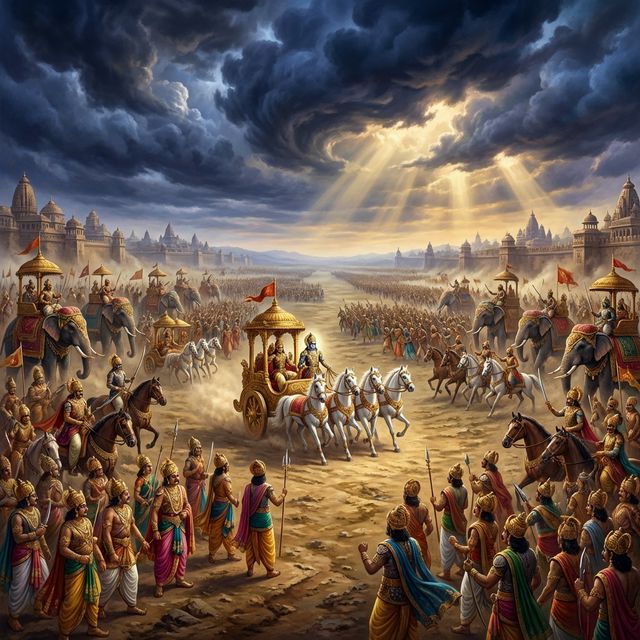
The Kingdom Given Back
Dhritarashtra releases the Pandavas and returns everything they lost
Hands Joined in the Hall
Vaishampayana was telling the whole of it to Janamejaya, whose ancestors these men were, and he had come to the moment when the assembly hall at Hastinapura went quiet.
Everything that could happen there had happened. Draupadi had been dragged into that hall and had asked her question about who was staked first, and the blind king had given her two boons, and with them her husband and his four brothers had walked out of slavery with their weapons and their cars given back to them. The dice were still on the board. The men who had thrown them were still sitting where they had sat all afternoon.
Bhima had wanted to finish it in the hall. He had asked whether he should kill them all where they stood or drag them outside and do it there, and Arjuna had talked him down with looks rather than arguments, and Yudhishthira had put his arms round his brother and told him to stay in silence and peace. The fire was still coming out of Vrikodara. It had simply been made to keep still.
Then the eldest of them crossed the floor, alone, and stood in front of his uncle with his hands joined in entreaty.
He had just been freed. By every reckoning he was owed something, and by the reckoning of the hall he was owed a great deal, and what he said was this.
"O king, thou art our master. Command us as to what we shall do. O Bharata, we desire to remain always in obedience to thee."
There is no complaint in it and no claim. A man who has just been given back his liberty stands in front of the man who took it and asks to be given an order. Whether that is the highest form of dharma or the last refuge of a man who cannot bring himself to say what he thinks, the Mahabharata leaves standing, and it lets both readings live in the same sentence.
Dhritarashtra could not see where his nephew was. He heard where the voice had come from, and he turned his face toward it, and he answered.
Go Thou in Peace and Safety
"O Ajatasatru," he said, "blest be thou. Go thou in peace and safety. Commanded by me, go, rule thy own kingdom with thy wealth."
Ajatasatru is the name that means the man who has no enemy born, and it is Yudhishthira's oldest title, and Dhritarashtra used it first, before he said anything else. It was the kindest word available to him and he reached for it in a hall where his son had spent the day proving that the name was no longer true.
Then, in one sentence, the whole afternoon was undone. Go and rule thy own kingdom with thy wealth. The kingdom that had been lost cast by cast, the cities and the villages, the treasury, the horses, the elephants, the servants, the brothers, the wife, everything that had been staked and everything that had been won, was handed back across the floor to the man who had gambled it away, by the father of the man who had won it, without conditions and without any accounting.
It is worth stopping on how strange that is. The dice had been fair by the rules of the hall. Shakuni had cheated, and everybody knew it, and nobody had said so in a way that could be acted upon. Nothing had been overturned by argument. Nothing had been judged. Vidura had spoken all day and had not moved the outcome by a hair. What moved it was a woman asking a legal question that nobody could answer, and after that an old man's two boons, and after that this, which was not a boon at all but simply a command from the head of the house.
"And, O child, take to heart this command of an old man, this wholesome advice that I give, and which is even a nutritive regimen."
A regimen is what a physician prescribes and what a sick man takes daily whether he wants it or not. Dhritarashtra was not offering an opinion. He was handing over a course of treatment, and then he began to name the doses.
The Axe Falls on Wood, Not on Stone
"O Yudhishthira, O child, thou knowest the subtle path of morality. Possessed of great wisdom, thou art also humble, and thou waitest also upon the old. Where there is intelligence, there is forbearance. Therefore, O Bharata, follow thou counsels of peace."
Where there is intelligence, there is forbearance. That is the whole of Dhritarashtra's political science in six words, and it is not sentimental. He is not saying that patience is nice. He is saying that patience is what understanding looks like from the outside, and that a man who cannot bear an insult has, by that fact, failed to understand something.
Then he gave the image that the hall would remember.
"The axe falleth upon wood, not upon stone."
Ganguli puts the meaning in a bracket immediately afterwards, because the old man did not say it aloud and everyone in the hall heard it anyway. Thou art open to advice, not Duryodhana.
That is a father in an assembly of his own court telling his nephew, in a figure, that counsel is being spent on him because it is the only surface it will bite into. He had a son sitting a few feet away who had just stripped that nephew of everything he owned. He did not turn his face toward that son. He did not prescribe a regimen for him. He gave the medicine to the man who was already well, and he said, in a manner that could be denied afterwards, that he knew perfectly well which of the two needed it.
Every reader of the epic arrives at this speech carrying what comes later, and it is tempting to hear the whole of it as hypocrisy. It is more uncomfortable than that. The counsel is good. It is, line for line, some of the soundest advice in the Sabha Parva. The trouble with it is not in the words. It is in the direction the old man was facing when he spoke them.
They That Are Good Remember Only Good Deeds
What followed was a portrait of the man Dhritarashtra wanted his nephew to be, and it was drawn in a series of plain propositions, each of them about the memory of injury.
They are the best of men who remember not the acts of hostility of their foes. Who behold only the merits, and not the faults, of their enemies. Who never enter into hostilities themselves. The good remember only the good deeds their enemies have done them, and not the hostile acts their enemies might have done. The good, besides, do good unto others without any expectation of good in return.
Then he sorted the world by how it handles harsh words, and he did it in three ranks.
It is only the worst of men that utter harsh words in quarrelling. Those who are indifferent reply to such words when others speak them. But they that are good and wise never think of such words at all, and never recapitulate them, caring very little whether the words may or may not have been uttered by their foes.
Three kinds of men in a quarrel: the one who starts it, the one who answers it, and the one in whom it finds nothing to catch on. Notice which of the three had been on show in that hall all day, and which of the three had been standing silent at the pillar while it went on.
Then the reason underneath the whole list. "They that are good, having regard to the state of their own feelings, can understand the feelings of others, and therefore remember only the good deeds and not the acts of hostility of their foes."
The ground of forbearance is not law and it is not calculation. It is that a man who has looked honestly at what goes on inside himself is no longer surprised by what goes on inside anybody else.
"Thou hast acted even as good men of prepossessing countenance do, who transgress not the limits of virtue, wealth, pleasure and salvation."
That is the verdict on Yudhishthira's conduct, delivered by the only man in the hall whose verdict counted, and it is an acquittal.
Look at Me, Who Am Thy Father
"O child, remember not the harsh words of Duryodhana. Look at thy mother Gandhari and myself also, if thou desirest to remember only what is good. O Bharata, look at me, who am thy father unto you and am old and blind, and still alive."
It is the most naked sentence the old man speaks in the Sabha Parva. He does not defend his son. He asks to be looked at instead of him. Set the day aside, he is saying, and set the boy aside, and count what is left in this house that you have any reason to love: a blind man and a blindfolded woman, both old, both still here.
And then, having asked for that, he explained himself, and the explanation is the thing readers of this chapter never quite get over.
"It was for seeing our friends and examining also the strength and weakness of my children, that I had, from motives of policy, suffered this match at dice to proceed."
Policy. He had let it happen on purpose. Not out of weakness, he says, and not because Shakuni was clever, but as a test: to see who in that hall would stand up and who would not, and to find out what his own sons were made of. He had spent a day and a kingdom and his nephew's wife on an audit of his court.
He may even be telling the truth. The audit certainly returned results. Vikarna had stood up. Vidura had spoken until his voice was of no further use. Bhishma and Drona had sat with their heads down and could not answer a woman's question about law. And Duryodhana had shown his father exactly what he was, in public, at length, and had been answered with a bracketed remark about an axe and a stone.
"O king, those amongst the Kurus that have thee for their ruler, and the intelligent Vidura conversant with every branch of learning for their counsellor, have, indeed, nothing to grieve for."
Then he went through the five brothers one at a time, the way a man counts what is still sound in a house after a fire. "In thee is virtue, in Arjuna is patience, in Bhimasena is prowess, and the twins, those foremost of men, is pure reverence for superiors."
Cars the Colour of Cloud
"Blest be thou, O Ajatasatru. Return to Khandavaprastha, and let there be brotherly love between thee and thy cousins. Let thy heart also be ever fixed on virtue."
Khandavaprastha is the burnt tract of forest the Pandavas were sent to when the kingdom was divided, and Indraprastha is the city they raised on it, and Dhritarashtra used the older name, which is the name of the wasteland rather than the name of the capital. Then he told a man who had been called a slave that morning to feel brotherly love toward the cousins who had called him one.
Yudhishthira did not argue with any of it. Vaishampayana says that the foremost of the Bharatas, king Yudhishthira the just, thus addressed by his uncle, went through every ceremony of politeness, and set out with his brothers for Khandavaprastha.
Every ceremony. He was leaving the hall where his wife had been dragged by the hair, and on his way out he performed each courtesy the occasion required, in full, to the men who had watched it happen. It is the same instinct that made him ask for orders instead of asking for justice, and by now the reader knows better than to call it either strength or weakness, because in Yudhishthira the two things are not separable.
Then they went out to the cars.
"And accompanied by Draupadi and ascending their cars which were all of the hue of the clouds, with cheerful hearts they all set out for that best of cities called Indraprastha."
That is how the chapter ends, and the last three words of it are the ones that hurt. Cheerful hearts. Not grim, not vengeful, not plotting the war. Five men and a woman in cloud-coloured chariots, going home, with everything they owned restored to them and an old man's blessing behind them, glad.
The road from Hastinapura to Indraprastha is not a long one. They did not get to the end of it.
Dharma Lesson
Dhritarashtra's counsel is not false. Line for line it is among the soundest advice in the Sabha Parva, and a man who lived by it would be very hard to injure. What is wrong with it is that the old man aimed every word of it at the nephew who had been wronged and not one word at the son who had done the wrong, and then said aloud that he knew the difference, because the axe falls upon wood and not upon stone. Advice given only to the person who will take it is not counsel. It is a way of leaving the room without having decided anything.