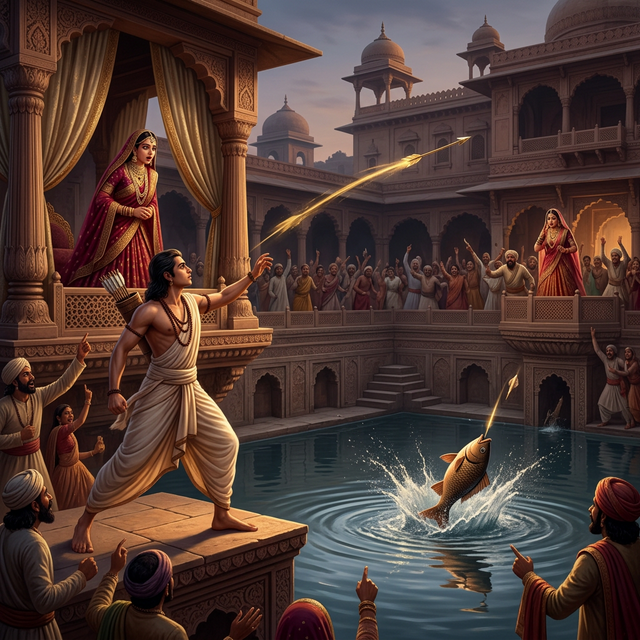
The Ochre Robe at Prabhasa
A vow of his own making had put Arjuna on the road, twelve months of wandering accepted without argument for a rule he had broken to recover a brahmin's stolen cattle, and that year had carried him the length of the country before it brought him west at last to the sea.
He came to the shore at Prabhasa in the dress of a man who has renounced the world: ochre cloth, hair matted and bound up, a staff, a begging bowl, a deerskin across one shoulder. Nothing about him announced the archer of Indraprastha. Pilgrims stepped around him on the sand without troubling to look twice, and he let them.
Word of it reached Dwaraka before nightfall, because Krishna kept the kind of household where such reports arrived ahead of the traveller. He came out along the coast road himself, found his friend sitting where the tide ran up over his feet, and did not pretend for even a moment to be deceived.
'All of Bharatavarsha is repeating that Arjuna walks the roads as a beggar,' Krishna said, 'and here he sits letting the ocean wash him. Come up. Whatever your vow forbids, it does not forbid you a roof.'
They climbed Raivataka together that evening, the hill that stands above Dwaraka with the sea laid out grey and enormous beneath it, and passed the night there under the trees, talking the way men talk who have not seen one another in years. Below them the city burned with its lamps, ring inside ring, until the water and the sky went the same colour and there was nothing to look at but each other.
In the morning Krishna brought him down through the gates. Dwaraka turned out for the guest as for a festival, and the guest walked through it barefoot in his ochre, a mendicant honoured like a king, which was a joke only two men in the procession were entirely in on.
Four Months of Rain
The rains broke over the sea a few days later and closed the roads, and a wandering ascetic who has been offered shelter for the monsoon is bound by his own order to accept it. Arjuna was lodged in Krishna's own house, in rooms that looked out over the water, and kept every outward form of the vow he was under: the ochre, the single meal, the hard bed, the silence at certain hours. Nobody in that household was foolish enough to mention how odd it was that a holy man's forearms were scarred in bands where a bowstring returns.
Balarama loved the guest without reservation and for the simplest of reasons. Here was a man who ate what he was given, praised the wine of the house without drinking it, listened to a long story to its end, and could be induced, on a slow afternoon, to say something intelligent about the handling of a mace. The elder Yadava was generous with anyone who let him talk, and he took the ascetic's presence as a compliment paid to Dwaraka.
And in the passages of that house Arjuna kept meeting Krishna's sister.
Subhadra was of an age to be married and had not been, which in a family as watched as that one was a fact the whole city had opinions about. She brought the guest his food because that was the courtesy of the house, and she stayed to ask him questions because that was her own, and the questions were not the ones an ascetic is usually asked. Where the eastern rivers ran. What the Kuru country looked like in the dry season. Whether it was true that the man who won Drupada's daughter had shot at a target he could see only in water.
Arjuna answered carefully. Four months of rain is a long time to answer carefully. By the end of it he was watching for her step in the corridor, and he had said nothing at all to Krishna, and Krishna had noticed everything.
What Krishna Advised
The rains passed, and the Yadavas went up Raivataka for the festival they kept there every year, the whole clan moving out of the city with its wine and its music and its tents until the hill was a second Dwaraka pitched among the trees. Subhadra went up with the women to make her offering at the shrine on the height. Arjuna watched her go, and forgot, for the length of that watching, to look like a man who had renounced anything.
Krishna read him in a glance and steered him away from the crowd to a place where the sea wind came up over the rock.
'You want my sister,' he said. It was not a question, and Arjuna, who had spent four months not saying it, found he had nothing left to put in front of it.
'Then hear the shape of the thing,' Krishna went on. 'The proper road is a swayamvara. Balarama would arrange it gladly and the whole earth would come. And a swayamvara is a lottery. I have watched a hall of kings and I cannot tell you beforehand what a woman standing in front of them will do, and neither can you, and neither can she. You would be staking her on a public throw of the dice. Our house has an appetite for those. I do not share it.'
'There is another road,' he said, 'and the law of kshatriyas does not blush at it. Seizure. Carry her off by force, in the open, and let anyone who objects come and take her back. Our own teachers count that marriage as high, higher than the one bought with gifts, because it costs the man something to make it.'
Arjuna said that it was still theft from a house that had sheltered him through the rains.
'It is,' Krishna agreed. 'So do not steal from her as well. She should know before the chariot moves. Send word to your eldest brother first, and I will speak to her myself.'
The Reins
Messengers went east to Indraprastha and came back with Yudhishthira's approval, which was given in one line and without conditions. Krishna spoke to his sister on the hill, in a room with the shutters open, and what passed between them was never repeated by either of them afterwards. Only this was certain: when the day came, Subhadra knew the hour, knew the road, and knew which chariot would be standing at the turn below the shrine.
It was Krishna's own chariot, lent for the purpose with the horses Sainya and Sugriva in the traces, and Arjuna had spent the morning quietly putting his weapons into it under a covering of cloth. He put off the ochre last of all. The ascetic went into a bundle behind the seat and the man who came out of it wore mail.
Subhadra came down from the shrine with her attendants around her in the middle of the afternoon, with the festival loud on the slope above and the sea flat and bright below. Arjuna brought the chariot across the road in front of her. He said her name once. She stepped up onto the floor of it without being lifted and without looking back, and her women began to scream, which was expected, and which nobody had asked them not to do.
The guards of the shrine came running. Arjuna turned to face them and found the reins gone out of his hands.
Subhadra had taken them. She had them gathered short in both fists and her feet braced, and she brought the horses around on the narrow road as neatly as a charioteer of thirty years, and put them down the hill at a gallop. Arjuna set his feet, strung the Gandiva, and stood over her shoulder shooting the pursuit off the road behind them, and the two of them went out of Raivataka that way, the bride driving and the groom shooting, and the dust of it visible from the walls of Dwaraka.
The Arithmetic in the Sudharma
The scattered guards came into Dwaraka at a run and the war drum in the Sudharma hall was sounding before the dust on the hill road had settled. The Yadavas armed. Bhoja and Andhaka and Vrishni poured into the hall half dressed and shouting, and at the head of them stood Balarama, white with a fury that had nothing calculated in it.
'He ate in my house,' he said. 'Four months. In ochre. He took our salt and our shelter and our respect, and repaid it by carrying a daughter of this clan off a hill on a festival day in a chariot borrowed from this family. Arm. All of you. I will bring him back through that gate on foot.'
The hall roared with him. Krishna let it roar until it began to run down of its own weight, and then he asked, in the voice of a man raising a matter of accounts, what they proposed to do next.
'Consider it plainly,' he said. 'Arjuna did not insult this house. He did not haggle for her like a merchant, and he did not stand in a hall waiting to see whether she would choose him, which would have been a slight to us either way it fell. He took her by the arm of the law that our own teachers rank highest. What is the insult? That he is not rich enough for us? He is the son of Pandu and the archer of the Gandiva.
'And if you go after him. He is one man on a road with a woman driving for him, and he will hold that road, and we will spend Yadava lives all afternoon proving that we cannot take it from him. If we win we have killed the best friend this city has and made an enemy of Indraprastha for a generation. If we lose we have done all that and been beaten in front of the world.'
The hall went quiet. Balarama stood in the middle of it for a long moment with his hands opening and closing, and then he laughed once, without much humour, and sat down. Riders went out that evening to bring the two of them back, not as prisoners but as guests, and the Yadavas gave Subhadra away with a train of gifts that took days to count.
Dharma Lesson
The law called it an abduction, and the law was not wrong about the form of the thing. But the woman carried off was the one holding the reins, which means the only person whose consent the ceremony never asks for had already given it in advance. Krishna's second lesson is quieter: a family standing at the edge of a war can still be counted out of it, if someone is willing to say plainly who would win and what the winning would cost.