The Word From Panchala
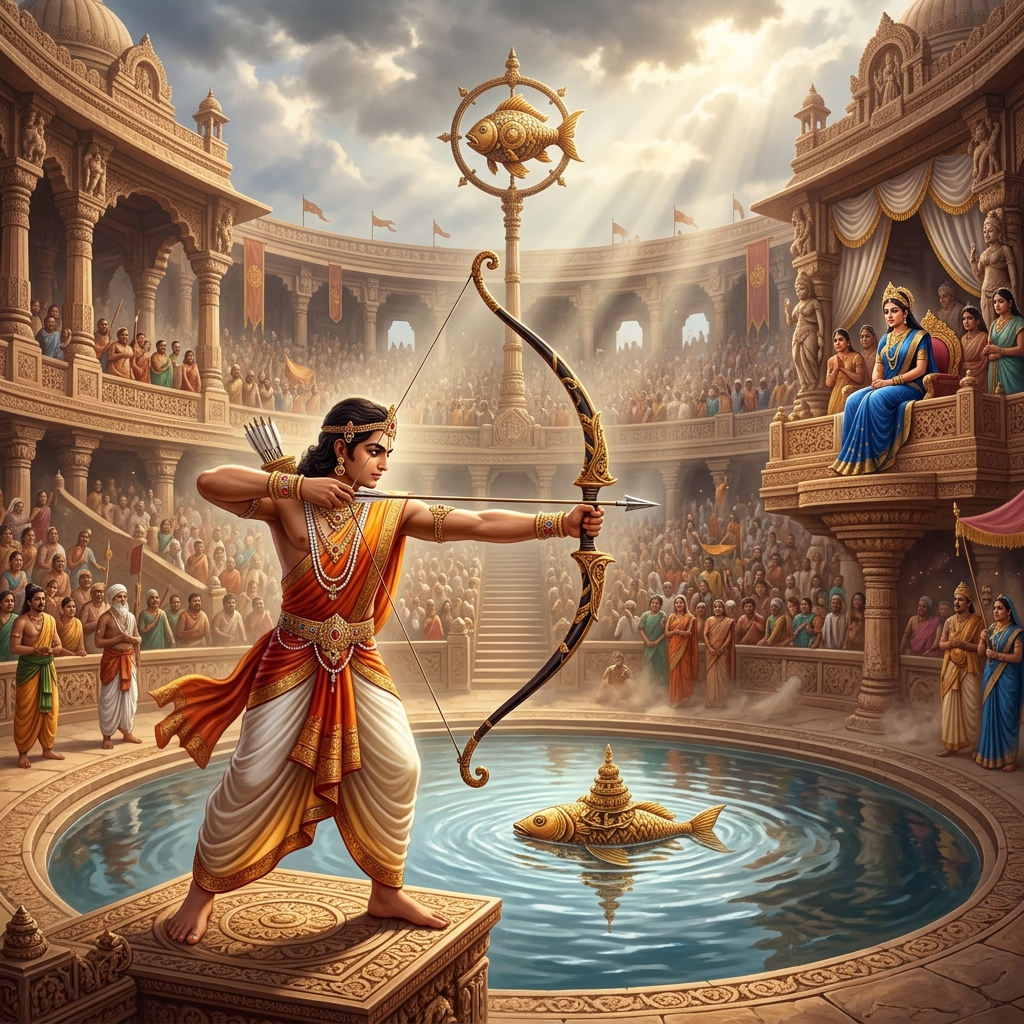
For a year the court of Hastinapura had worn mourning for five princes and their mother, burned in a house of lac at Varanavata, and the mourning had been comfortable. Then a trader's rumor came up the eastern road, and behind it a certainty. At Drupada's swayamvara in Panchala a young brahmana had bent the great bow and struck the turning fish, and the brahmana was Arjuna, and his brothers were beside him, and Kunti lived, and Drupada had given Draupadi to all five of them.
Vidura carried the news into the hall himself, and he came in smiling, which nobody in that hall had seen him do for a year.
'The house of Kuru grows, king,' he said. 'The sons of Pandu are alive. They have taken the daughter of Drupada, and Drupada is their kinsman now, and the Panchalas and the Somakas stand at their shoulder.'
Dhritarashtra came up out of his seat with both hands stretched toward the voice. 'Excellent,' he said. 'Excellent news. The sons of my brother live. Let the city be told.'
Vidura went out to see it done. Duryodhana came in.
He had heard the news on the stair, and he had brought Karna up with him, and the two of them stood before the blind king in a hall that had emptied itself the way halls do when they sense what is coming. When Duryodhana spoke, the grief he had carried all year had gone out of his voice, and what was left was very cold.
'Father, you called it excellent. Understand what you have just praised. The fire did not take them. Bhima is alive, the man who ate our poison at the river and came back up the bank. Arjuna is alive, and he has strung a bow that no crowned king at that swayamvara could lift off the ground. A month ago they were beggars sleeping in a potter's yard. Today they have the whole strength of Panchala behind them. Whatever this house is going to do about it must be settled in this room, and it must be settled today. Give it a month and the alliance will be an old fact in the minds of men, and what men are used to cannot be undone.'
Duryodhana Counts His Remedies
'Then tell me what you would have me do,' said Dhritarashtra.
Duryodhana had his answers ready, and he set them out the way a merchant reads an inventory, one item and then the next, without heat.
'Send men we trust into Drupada's house, wise men, secret men, and divide the brothers from one another. They have been one thing only because they have had nothing. Give them something and watch how the seams show. Work on Bhima, who is strength without patience, and through Bhima on Yudhishthira, who cannot bear to be disagreed with by his own blood. Work on the twins through Kunti.'
'Or buy Drupada. Buy his ministers first, which is cheaper, and let them tell him every morning that the Kuru throne is mine and that an alliance with landless men is a debt and not a gift.'
'Or let them stay where they are. Make Panchala sweet to them. Houses, honors, a hunting country, all of it in Drupada's gift and none of it here, until coming home is a journey they keep putting off. Set beautiful women before them there, many of them, until men who agreed to share one wife begin to think about having five.'
'Or work on that marriage directly. Five husbands and one woman is a knot, father, and any patient hand can pick a knot apart. Let each of them be told, quietly and often, which of the others she prefers.'
'Or poison. Bhima eats more at one sitting than the other four together, and a cook costs less than a regiment. Take Bhima out and the rest are a hand without a thumb.'
'Or seize them when they come to this city, since they will come, and hold them where nobody can see them held.'
He turned his head slightly toward the man standing at his right.
'Or the simplest of all. Set Karna on them. He has wanted Arjuna since the day of the tournament, and Arjuna is the only one of the five who has ever frightened me.'
'Choose any of these, father. Choose them in order if the first fails. But choose something today.'
Karna Answers
Karna laughed, and it was not a courtier's laugh.
'Prince,' he said, 'your reasoning is not sound, and every one of those plans has been tried already by better hands than ours.'
'Divide them? They were divided from their kingdom, their father, and their house, and they were not divided from each other. Men who have slept five in a cave under one blanket are not going to be set quarrelling by a spy with a purse. Buy Drupada? Drupada refused the whole treasury of Panchala rather than forgive one insult from Drona; he has been living for a son who would kill his enemy, and you propose to outbid that with gold. Estrange them over Draupadi? She chose them in a hall full of kings while they were dressed in bark. Poison? Your poison went into the Ganga with Bhima tied to it, and Bhima came back stronger than he went in, and the lac house you burned so carefully burned nobody. Every secret thing this family has attempted has failed, and each failure has left them cleaner and us dirtier in the sight of the world.'
'And keep them in Panchala? They will not stay. Yudhishthira wants Hastinapura, and while he waits for it to be handed to him, Arjuna will be putting the alliance in order. Every month you spend plotting is a month they spend arming. Dhrishtadyumna was born for war. Krishna of the Vrishnis has already gone to their door.'
'There is one course, and it is the old course. Prowess. Strike now, before the marriage has children in it, before the Somakas and the Vrishnis and the Chedis and the Matsyas have arranged themselves into one shape and given it a name. March on Panchala while it is still surprised, while the Pandavas are still guests in another man's house with another man's army around them. Beat them in the open field and the earth is yours and the talk stops, because nobody argues with a man who has won. Do that, and I will ride in front. Do anything else, and you will find yourself doing all of it, one squalid scheme after another, until the world decides what we are.'
'That,' said Duryodhana, 'is what a man says. Father?'
The Elders Speak In An Open Door
Bhishma had come in during the laughing, and the hall had stopped being private the moment he did. Drona came behind him, and Vidura behind Drona, and the great door was left open.
'War with the Pandavas has no part of my approval,' Bhishma said. 'Hear me, king, and then do as you like, since you always have. Pandu was my son as much as you are, and this kingdom was in his hand and prospered there. What was his is his sons'. That is not policy, it is arithmetic. Give them their father's share. Half the kingdom. Send for them with honor, and let the world say that the Kurus kept faith with orphans. Half a kingdom held in peace is larger than the whole of it held in a war against Arjuna.'
'It is the counsel of a father,' said Drona, 'and I say the same. Send an envoy they will believe. Send gifts to Drupada and speak to him as an equal, because he is one now. Conciliation costs a treasury; war costs a generation.'
'These two eat the king's bread,' Karna said, 'and speak for the king's enemies. The grandfather loves Pandu's sons. The teacher loves his best pupil. What either of them calls dharma is only affection wearing better clothes.'
'Then hear it from a man who loves nobody in this room more than he loves this house,' said Vidura, and he had raised his voice, which he almost never did. 'King, I agree with Bhishma and with Drona, and I will give you the reason they are too courteous to give. This will not be decided in secret. It is already outside. The city wept for those boys for a year and the city has not stopped loving them. If Hastinapura refuses them now, it will not be a policy that men see, it will be a theft, and every king from Panchala to Magadha will know exactly what to think of the man on this throne. A court can survive doing a wrong thing. It cannot survive being watched while it does one. Give them their share and you keep both the kingdom and the name. Refuse, and you keep the kingdom for a while.'
Dhritarashtra sat with his hands on the arms of the seat and said nothing for a long time, and the hall let him have the silence.
The Wild Half
What he said at last was neither yes nor no, and it was the shape of everything that followed.
'Bring them home,' he said. 'Vidura, go yourself. Bring my brother's sons and their mother and their bride, and let the city meet them at the gate.'
So it was done, and it was done beautifully. Yudhishthira touched the old king's feet and Dhritarashtra held him a long time, and the citizens stood on the roofs and shouted, and for four days Hastinapura behaved like a family. On the fifth day the king had the brothers brought to him, and he made his gift.
'Live at Khandavaprastha,' he said. 'Take half the kingdom and go there. It is a wilderness now, but no man of this house has ever thought Arjuna small, and what you make of it will be yours, and there will be no quarrel between cousins in one city.'
Half the kingdom. The half with no roads, no revenue, and no city in it: a burnt-over forest tract with the bones of an old capital in the middle of it, given to five princes and their mother and their wife, with the elders all agreeing that it was generous and the young men all agreeing that it was an insult. Yudhishthira took it without a word of complaint, because he had decided long before that he would never be the one who refused. They went out with Krishna beside them and they built a city there, and how Indraprastha rose out of that waste belongs to another telling.
Nobody in the hall was satisfied. Duryodhana had wanted them dead and got them settled forty leagues away with a title. Karna had wanted a war and got a land grant. Bhishma had wanted half the kingdom given and watched the word half do work that the word never should have done. Vidura had wanted the house to be seen keeping faith, and the house had been seen keeping the letter of it. Only Dhritarashtra was content, because he had done a thing that could be defended, and he could always defend it, and he would spend the rest of his life defending it.
That was the sitting. It looked like a settlement. It was the war being given its terms.
Dharma Lesson
Dhritarashtra never says no to anyone in that hall, and that is precisely how he wrongs everyone in it. A compromise that satisfies nobody is still a decision, and it carries all the consequences of the decision it was designed to avoid. Dharma is not the middle point between two demands; it is the share that was already owed, and half-paying a debt does not halve it, it only postpones the reckoning and adds interest.