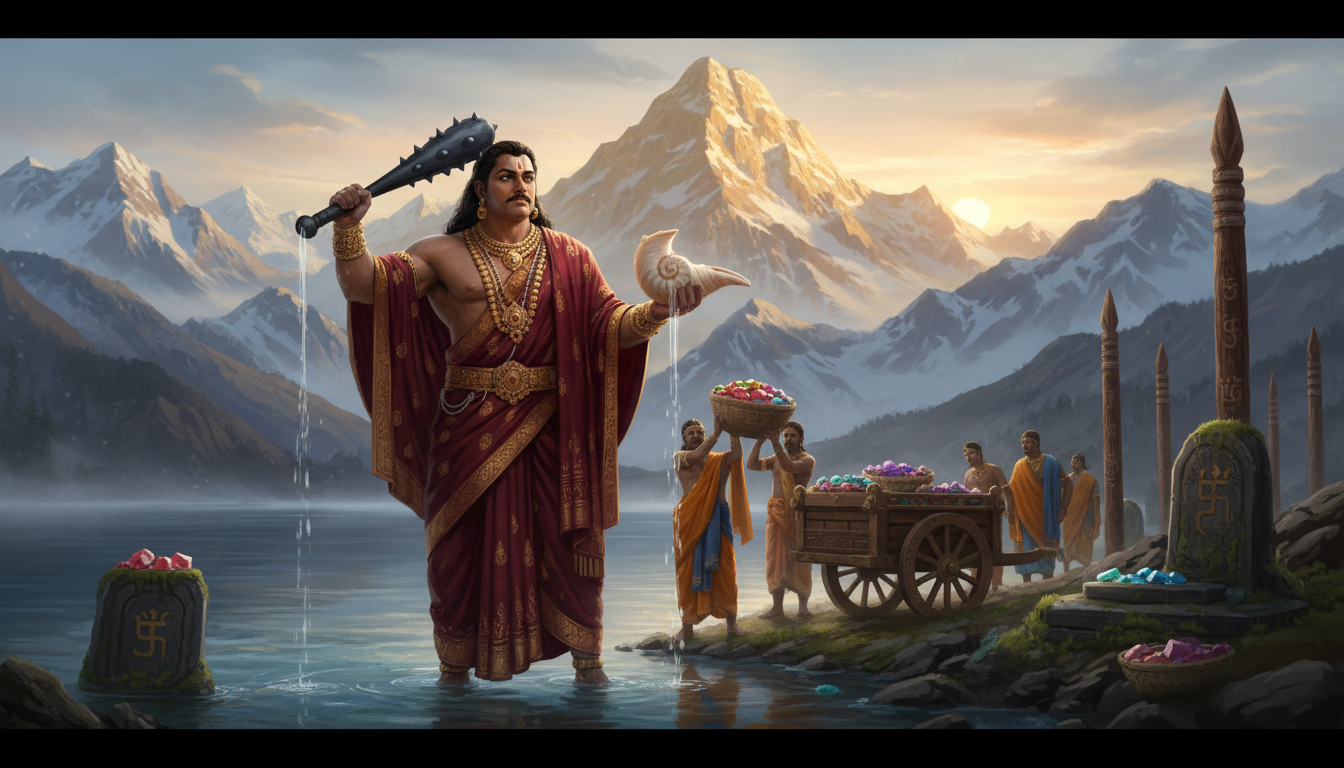
The Danava Who Would Not Simply Go
Vaishampayana said: When the fire had finished with Khandava, O Janamejaya, one creature walked out of that forest alive, and he would not go away.
Maya the Danava came before Arjuna with his hands joined and Vasudeva standing by, and spoke to him again and again in amiable words. "O son of Kunti, saved have I been by you, from Krishna in spate and from Pavaka who desired to consume me. Tell me what I am to do for you."
"Everything has already been done by you," Arjuna said, "even by the making of that offer. Blessings on you. Go wherever you like. Be kind and well disposed toward me, as we are kind toward you and well pleased with you."
But the Danava would not take the release. "What you say is worthy of you, O exalted one. Yet I desire to do something for you, and to do it cheerfully. Understand what I am. I am a great artist. Among the Danavas I am what Viswakarma is among the gods. Being what I am, I wish to make something with my hands for you."
"You regard yourself as a man saved from imminent death," Arjuna said. "Even if that is so, I cannot make you do anything for me. At the same time I do not wish to frustrate your intention. Do something for Krishna. That will be a sufficient requital for whatever service I did you."
So Maya turned and pressed his offer upon Vasudeva, and Krishna, the lord of the universe, reflected for a moment on what should be asked of an asura who could build.
"Let a sabha be built," he said at last, "a hall of assembly such as you choose, if you truly wish to do good to Yudhishthira the just. Build such a palace that persons belonging to the world of men may not be able to imitate it, even after examining it with care while seated inside it. And build a mansion, O son of Diti, in which we may behold a combination of godly and asuric and human designs."
Maya heard that and became exceedingly glad, for it was the largest commission ever given to any craftsman of his race. Krishna and Partha went to Yudhishthira and narrated the whole of it, and brought the Danava before the king, and Yudhishthira received him with the honour due to him, which Maya accepted and thought highly of.
The History of Vrishaparva
Then the great son of Diti rested a while, and before he lifted a single measuring cord he recited to the sons of Pandu the history of the Danava Vrishaparva.
He told them of a king of his own people who was called, by asuras and by gods alike, the one ever devoted to truth; and of the sacrifice the Danavas had held long ago on the banks of a lake in the far north, where the whole race had gathered as men gather for a wedding. He told them what had been gathered there and what had been left there, and that everything he would need for their hall was lying in that place still, if it had not been carried off in the ages since.
"There is a thing you should know about builders," Maya said. "We do not begin with the drawing. We begin with the stone. A design is only a wish until you know what is in your hands, and what I have in my hands here is timber and brick and the ordinary jewels of your ordinary kings. With those I can raise you a fine house. Krishna has not asked me for a fine house."
Then he set himself to the planning, and it took him much thought. When he had finished thinking he chose an auspicious day and performed the propitiatory rites of foundation, and gratified thousands of Brahmanas learned in the Vedas with sweetened milk and rice and with rich presents of many kinds. He measured out a plot of land five thousand cubits square, delightful and exceedingly handsome to behold, ground that was favourable for a building well suited to the exigencies of every season.
And then, with the ground marked and the priests fed and the whole city waiting to see the first course laid, Maya went to Arjuna and told him he was leaving.
I Go With Your Leave
"I now go with your leave," the Danava said, "but I shall come back soon.
"On the north of the Kailasa peak, near the mountains of Mainaka, there is a lake called Bindu. While the Danavas were engaged in their sacrifice on its banks I gathered there a huge quantity of vanda, rough material of the delightful and variegated kind, composed of jewels and of gems. It was not spent. It was placed for keeping in the mansion of Vrishaparva, who was ever devoted to truth. If it be yet existing, O Bharata, I shall come back with it. And then I shall commence the construction of the delightful palace of the Pandavas, which is to be adorned with every kind of gem and celebrated all over the world."
Arjuna asked how far it was, and how long, and whether the Danava wished for an escort of men.
"It is as far as the place where the rivers begin," Maya said, "and no escort of yours could follow me there or help me if it did. What guards that hoard is not a garrison you can treat with. As for how long, that is not a question about the road. It is a question about how much of what I left is still lying where I left it."
Yudhishthira, listening, asked what a man of the Kuru country was to understand by vanda, since no mason of his had ever used the word.
"Rough stuff," said Maya. "Uncut, unsorted, unpolished. You would look into that heap and see a spoil pile and set a boy to sweep it out. Jewel in the rough is variegated, which is a courteous way of saying that no two pieces of it agree with one another, and the whole of the art is in the sorting. I gathered it for a rite that finished before it was spent. It has lain in a dead king's house through more ages than your house has names for, waiting for somebody with a reason to want it."
"Then go," Arjuna said, "and come back."
"There is one more thing," said Maya, "and it is the reason I am telling you all of this instead of simply going. What is in that lake is not only stone."
A Club and a Conch
"There is also, I think, O you of the Kuru race, a fierce club lying in the lake Bindu," Maya said. "It was placed there by the King of the Danavas himself, after he had slaughtered with it all his foes in battle. It is heavy and it is strong, and it is variegated with knobs of gold. It is capable of bearing great weight and of slaying every enemy, and in strength it is equal to a hundred thousand clubs.
"It is a fit weapon for Bhima, even as the Gandiva is fit for you."
Bhimasena, who had been standing by with the half attention of a man listening to talk about masonry, came fully into the conversation at that.
"There is also in that lake," the Danava went on, "a large conch shell of loud sound. It is called Devadatta. It came from Varuna. I shall give all of these to you, and no doubt about it: the stone for the hall, the club, and the shell."
"You were asked for a building," Arjuna said.
"I was asked for a building by Krishna," said Maya. "I was saved by you. A Danava who reckons those two debts as one debt is a poor accountant. Your brother has never yet held a mace that was the equal of his arms. He has broken the others. I have seen the wrecked iron of them stacked behind your armoury like firewood."
Bhima laughed aloud, and did not deny it.
Having spoken so to Partha, the Asura went away in a north-easterly direction, and the sons of Pandu watched him out of sight over the plain, and then went back to a city with a marked plot of ground in the middle of it and nothing standing on it at all.
North of Kailasa
Hear now, O king, what sort of place it was that Maya went to.
On the north of Kailasa, in the mountains of Mainaka, there rises a huge peak made of gems and jewels, and it is called Hiranyasringa, which is to say the Peak of Gold. It is not a mountain with treasure in it. It is a mountain that is treasure, and the light comes off its faces at dawn as though the rock itself had been struck.
Near that peak lies a delightful lake, and the name of the lake is Bindu.
It is not a large water. Men who have gone up that far and come back have said that a strong archer could shoot across it, and that the surface of it is so still under the shelter of the peaks that a man kneeling to drink sees the gold of Hiranyasringa lying in the water beside his own face. There is nothing there to work a boat for and nothing there to farm. The banks are stone and cold sand.
What it has instead of use is quiet. There is no wind in that hollow to speak of, because the peaks take it, and a sound made on one shore arrives on the other with nothing worn off it. It is the kind of water beside which a man notices that he can hear his own blood.
And yet, for a place with no city near it and no road to it worth the name, there is hardly a bank of any river or lake in all the worlds where more has happened.
The Danava went up the passes toward it alone, as he had said he would, and he was not going to a wilderness. He was going to the oldest occupied ground he knew.
Where Bhagiratha Waited
On the banks of that lake, in an age before the one the Danavas held their sacrifice in, a king had sat down and refused to get up.
He had come north because there was a thing his house needed that no army could take and no treasury could buy, and because the only power that could give it to him was a river that had never yet consented to touch the earth. So he sat by the water at Bindu and waited for the goddess Ganga to show herself to him, and he waited for many years. Not a season. Not a vigil of the kind kings perform where the court can see them doing it. Years, in the cold, at the foot of a peak of gems, with no company but the spirits of that place.
She came at last, and she came down, and because she came for that man the great river carries his name to this day: Bhagirathee, after the king Bhagiratha, and it is by that name that men who have never heard of Bindu still call her when they stand in her water at Kashi and Prayaga and pour it out for their dead.
That was the first thing that happened on those banks. It fixed the character of the place. Bindu is not where things are found. It is where things are waited for.
A Hundred Sacrifices and the Stakes of Gems
There too, on those same banks, Indra the illustrious lord of every created thing performed one hundred great sacrifices.
A hundred is the number that makes a Sata-kratu, and it is the count that no other being has ever completed, and every one of them was made at that water. And there, for the sake of beauty and not because the ordinance anywhere directs it, the sacrificial stakes were made of gems and the altars were of gold.
That detail is worth stopping on. The scriptures say what a stake shall be cut from and how tall it shall stand, and nowhere do they say it shall be cut from jewel. Indra had them made of jewels because the place deserved it and because he could, and the priests who tied the beasts to those posts must have looked at what their ropes were resting against. It was the one rite in all the worlds where the fittings were finer than the offerings.
And there, having performed those hundred sacrifices, the thousand-eyed lord of Sachi became crowned with success and took the sovereignty of heaven.
There also the fierce Mahadeva, the eternal lord of every creature, took up his abode when he had finished creating all the worlds, and there he dwells, worshipped with reverence by thousands of spirits. So the shore that Maya was climbing toward with an empty pack and a builder's list in his head was, in plain fact, an altar ground of Indra and a house of Shiva, and the jewelled stakes of the hundred sacrifices had been driven into that same sand.
At the Expiration of a Thousand Yugas
And there, O Bharata, at the expiration of a thousand yugas, five come to that bank and perform their sacrifice.
Nara comes, and Narayana with him. Brahma comes. Yama comes. And Sthanu, the motionless one, is the fifth. They do not come often. A thousand yugas is not a span that any lineage of men measures, and no witness has ever seen two of those rites; the world that watched the first is dust before the second is prepared. But the fire is laid on that shore and the offerings are poured there, on schedule, by the five who do not miss appointments.
And there, for the establishment of virtue and religion, Vasudeva with pious devotion performed his own sacrifices, and they extended for many and many long years. Keshava set up on that ground thousands and tens of thousands of sacrificial stakes adorned with golden garlands, and altars of great splendour, until the bank of that small cold lake stood thicker with posts than a forest stands with trees.
All of which is to say: when Krishna sat in Khandavaprastha and told an asura to build a hall combining godly and asuric and human designs, and the asura answered that he would have to go north of Kailasa first, the two of them were speaking about a place they both knew, and only one of them was pretending it was merely a quarry.
What the Yakshas Were Keeping
The hoard had not been left unwatched.
What Vrishaparva's house had held, and what the lake had taken, was guarded by Yakshas and by Rakshasas, and they had been at it a long time, in a country where nothing rots and nobody comes. Guards like that do not grow slack from boredom. They grow strange.
The Yakshas of the northern mountains are the keepers of buried wealth, and they keep it the way a miser keeps it, which is to say for nobody, forever, and with a temper. The Rakshasas set beside them were there for the part of the work that required teeth. Between them they had held a treasury for an age against a country in which there was nothing whatever to hold it against, and the whole of their history was that they had never once had to give anything back.
Maya went there and possessed himself of the whole of that great wealth. The account of it is short, and men who have wondered how a single Danava took a treasury out from under such a garrison have generally decided that he did not take it as a thief takes a thing. He had gathered the vanda in the first place. He had walked in the sacrificial procession on that bank. The wealth had a rightful custodian and a rightful purpose, and both of them had come back up the mountain in person after an age away.
He brought out the crystalline articles that had belonged to king Vrishaparva, the variegated jewels and gems he had gathered and stored, enough of them to face a palace.
He brought out the club with the golden knobs, out of the lake where the King of the Danavas had let it sink when there was no longer anyone left alive for it to be used on.
And he brought out the conch shell called Devadatta, which had come from Varuna, and which nobody at that lake had ever sounded.
The Giving and the Fourteen Months
He came back as he had said he would, and the giving was done before the building was begun.
To Bhimasena he gave that best of clubs, and Bhima took the weight of it in both hands and then in one, and the man who had broken every mace ever fitted to him held one that would not break. To Arjuna he gave the most excellent conch shell, at whose sound all creatures trembled in awe. What that meant was not fully known on the day it was handed over. It would be known on a plain at Kurukshetra, when the Devadatta was lifted and blown beside Krishna's Panchajanya, and two armies heard the sound of an object taken out of a cold lake below the Peak of Gold.
Then Maya built.
He raised the hall on columns of gold across the five thousand cubits he had measured, of gems and precious stones entirely, and it shone like Agni or Surya or Soma, and it darkened the bright rays of the sun with its own brilliance, and by the mixture of celestial and terrestrial light it exhibited it looked as though it were on fire. Eight thousand Rakshasas called Kinkaras, huge bodied and red of eye and arrowy of ear, able to range the air, were set to guard it. Within it he laid a tank whose lotuses had leaves of dark gems and stalks of bright jewel, with crystal stairs going down to the water and slabs of costly marble set with pearls along the bank, and its bottom was without mud and its water was clear. Around the hall he planted tall trees of many kinds, of green foliage and cool shade and ever blossoming, and laid out artificial woods that gave off a delicious fragrance always, and dug tanks in the grounds where swans and Karandavas and Chakravakas came to swim, so that the breeze that reached the Pandavas in their new house carried the smell of lotuses growing in water and of lotuses growing on land at the same time.
In beauty it surpassed the Sudharma of the Dasarha race, and it surpassed the mansion of Brahma himself.
Having constructed such a palatial hall within fourteen months, Maya reported its completion to Yudhishthira, and the debt he had insisted on paying was paid, and rather more than paid. He had been asked for a house. He had brought back a house, a mace, and a conch, and in the corpus of what men remember it is the mace and the conch that outlasted the building.
Dharma Lesson
Maya was asked for a house and came back with a house, a mace and a conch, because a debt honestly acknowledged tends to return more than was lent. The finest things a builder carries home are rarely the ones he was sent for. And nothing worth building begins with the drawing; it begins with going to find out what is actually in your hands.