Vidura Comes with a Request
Vaishampayana said: after that night had passed, Dhritarashtra, the son of Amvika, sent Vidura to Yudhishthira's mansion.
He went as he always went, on foot, early, without announcement, and the guards let him through because it was Vidura. He found Yudhishthira in the outer hall with Arjuna beside him and Bhima not far off, and he did not sit down before he had delivered the message, because he knew the shape of what he was carrying.
"King Dhritarashtra has undergone the preliminary rites," Vidura said. "He will set out for the woods on the coming day of the full moon in the month of Kartika. Before he goes he solicits from you, foremost one of Kuru's race, some wealth."
"He may have it," Yudhishthira said. "For what?"
"He wishes to perform the shraddha of the high-souled son of Ganga," said Vidura. "And of Drona. And of Somadatta and of Valhika of great intelligence. And of all his sons. And of all those well-wishers of his who were slain."
He stopped there, one name short, and Yudhishthira waited, and Vidura finished it.
"And, if you permit it, of that wicked-souled wight, the ruler of the Sindhus."
Jayadratha. The man who had held five armies at the mouth of a gate for one afternoon so that a boy could be surrounded and killed inside it, and whose head Arjuna had cut off before sunset the next day to keep from burning alive.
Yudhishthira was glad. Arjuna of curly hair was glad, and said so, and applauded the request highly. But Bhima, of great energy and unappeasable wrath, did not take those words of Vidura in good spirits, because he was remembering the acts of Duryodhana, and everyone in the hall could see him remembering them.
Arjuna Bends His Face Downward
The diadem-decked Phalguna understood the thoughts of Bhimasena, and bent his face slightly downward, and spoke before his brother could.
"O Bhima. Our royal father, who is advancing in years, has resolved to retire into the woods. He wishes to make gifts for advancing the happiness of his slain kinsmen and well-wishers, who are now in the other world. He wishes to give away wealth that belongs to you by conquest. It is for Bhishma and the others that the old king desires to make those gifts. It behoves you to grant your permission."
Bhima said nothing yet. Arjuna went on, and what he said next was the argument of a man who had thought about the shape of the years.
"By good luck it is, mighty-armed one, that Dhritarashtra today begs wealth of us, he who was formerly begged by us. Behold the reverse brought about by Time. That king who was before the lord and protector of the whole Earth now desires to go into the woods, his kinsmen and his associates all slain by foes. Let not your view deviate from granting the permission asked for. Refusal, besides bringing infamy, will be productive of demerit. Learn your duty in this matter from the king, your eldest brother, who is lord of all. It becomes you to give instead of refusing, O chief of Bharata's race."
Yudhishthira applauded him. He said nothing to Bhima at all, which was itself a kind of pressure, and the hall waited to see whether Bhima would take it.
He did not. He yielded to wrath instead.
Bhima Counts the Years
"O Phalguna," Bhima said, "it is we that shall make the gifts. In the matter of Bhishma's obsequies, and of king Somadatta, and of Bhurisravas, and of the royal sage Valhika, and of the high-souled Drona, and of all the others. Our mother Kunti shall make the obsequial offerings for Karna. Let not Dhritarashtra perform those shraddhas. Even this is what I think."
He was not finished. He had come to the part he wanted.
"Let not our foes be gladdened. Let Duryodhana and the others sink from a miserable position to a more miserable one. It was those wretches of our race who caused the whole Earth to be exterminated. How have you been able to forget that anxiety of twelve long years? Our residence in deep incognito, that was so painful to Draupadi? Where was Dhritarashtra's affection for us then?"
He turned on Arjuna directly, because Arjuna had been the one to speak.
"Clad in a black deer-skin and divested of all your ornaments, with the princess of Panchala in your company, did you not follow this king out of that gate? Where were Bhishma and Drona then, and where was Somadatta? You had to live thirteen years in the woods, supporting yourself on the products of the wilderness. Your eldest father did not then look at you with eyes of parental affection."
And then the sentence he had been carrying for eighteen years, the one that had nothing to do with armies.
"Have you forgotten, Partha, that it was this wretch of our race, of wicked understanding, who asked Vidura while the match at dice was going on: what has been won?"
The hall was very quiet. Vidura, who had been in the room that day and had been the man asked, stood there and did not defend himself and did not defend the king.
Yudhishthira, the son of Kunti, endued with great intelligence, rebuked his brother and told him to be silent.
They Remember Only the Benefits
Arjuna answered him gently, and did not press.
"O Bhima, you are my elder brother, and therefore my senior and my preceptor. I dare not say anything more than what I have already said."
He said one thing more.
"The royal sage Dhritarashtra deserves to be honoured by us in every respect. They that are good, they that are distinguished above the common level, they that break not the distinctions which characterise the good, remember not the wrongs done to them but only the benefits they have received."
It was not a rebuttal of anything Bhima had said. Every fact Bhima had listed was true, and Arjuna did not contest one of them. The twelve years had happened. The thirteenth in disguise had happened. The question at the dice had been asked in front of witnesses, and Draupadi had been dragged by the hair in that same hall by a man whose funeral rites were now being budgeted for. Arjuna simply declined to let any of it decide the matter.
What Arjuna was proposing was not that the wrongs be denied but that they be set down and left on the floor, and he was proposing it to the one brother in that house who had never in his life set anything down. Bhima had kept an oath about Dussasana's blood for thirteen years and had honoured it with his hands. Forgetting was not a discipline he had been trained in.
Bhima cast angry glances at Dhananjaya and did not speak again. He did not withdraw a word either. He simply stopped, the way a man stops arguing with the weather.
And Yudhishthira, the righteous-souled son of Kunti, having heard the high-souled Phalguna, turned to Vidura, who had been standing through the whole of it with a message still only half delivered.
As Much as He Wishes to Give Away
"Instructed by me, Kshattri, say to the Kuru king that I shall give him as much wealth from my treasury as he wishes to give away, for the obsequies of his sons, and of Bhishma, and of the others among his well-wishers and benefactors."
That was the whole answer, and it took four breaths. Then Yudhishthira spent considerably longer on the harder half.
"Let not Bhima be cheerless at this. And it behoves not king Dhritarashtra to be angry with Bhimasena. This Bhima of great intelligence was greatly afflicted by cold and by rain and by heat, and by a thousand other griefs, while residing in the woods. All this is not unknown to you."
He was arranging a peace between two men who would never be in the same room again after the full moon, and he did it with the same care he gave to a treaty.
"Say to the king, instructed by me, that he may take from my house whatever articles he wishes, and in whatever measure he likes. Tell him also that he should not allow his heart to dwell on this exhibition of pride in which Bhima, deeply afflicted, has indulged. Whatever wealth I have, and whatever Arjuna has in his house, the owner of it is king Dhritarashtra. Even this you shall tell him."
And he sent the last of it, the sentence a nephew sends to an uncle he is about to lose.
"Let the king make gifts to the Brahmanas. Let him spend as largely as he likes. Let him free himself from the debt he owes to his sons and to his well-wishers. And let him be told besides: O monarch, this very body of mine is at your disposal, and all the wealth I have. Know this, and let there be no doubt in it."
Bhima stood at the side of the hall with his arms folded and heard his own name used four times in a message he had lost.
The Message Carried Back
Vidura, that foremost of all intelligent persons, returned to Dhritarashtra and reported words of grave import.
"I first reported your message to king Yudhishthira. Reflecting on your words, Yudhishthira of great splendour applauded them highly. Vibhatsu also, of great energy, places all his mansions, with all the wealth in them, as also his very life-breaths, at your disposal. Your son, king Yudhishthira, offers you his kingdom, his life-breath, his wealth, and all else that belongs to him."
He did not omit the other thing, because he was Vidura.
"Bhima, however, of mighty arms, recollecting all his innumerable sorrows, has given his consent with difficulty, breathing many heavy sighs. That mighty-armed hero was solicited by the righteous king and by Vibhatsu, and induced to assume relations of cordiality toward you. King Yudhishthira the just has prayed you not to give way to dissatisfaction for the improper conduct which Bhima displayed at the recollection of former hostilities. This is generally the behaviour of Kshatriyas in battle, O king, and this Vrikodara is devoted to battle and to the practices of Kshatriyas. Both myself and Arjuna repeatedly beg you for pardoning Vrikodara. Be gracious to us. You are our lord."
Then he delivered the inventory, which Yudhishthira had dictated with a steward's precision.
"Whatever wealth we have, you may give away as you like. You are the master of this kingdom and of all lives in it. Let the foremost one of Kuru's race give away, for the obsequial rites of his sons, all those foremost of gifts which should be given to the Brahmanas. Let him make those gifts to persons of the regenerate order, taking from our mansions jewels and gems, and kine, and slaves both male and female, and goats and sheep. Let gifts be made also to those that are poor, or sightless, or in great distress, selecting the objects of his charity as he likes. Let large pavilions be constructed, rich with food and drink of diverse tastes collected in profusion. Let reservoirs of water be constructed for enabling kine to drink, and let other works of merit be accomplished. These were the words said to me by the king, and by Pritha's son Dhananjaya. It behoves you to say what should be done next."
Dhritarashtra was highly pleased, and set his heart on making large presents on the day of the full moon in the month of Kartika.
What Was Gathered in the Courtyards
Thousands of deserving Brahmanas were invited, after proper examination, and superior Rishis with them, for the sake of Bhishma and of the old king's sons and friends.
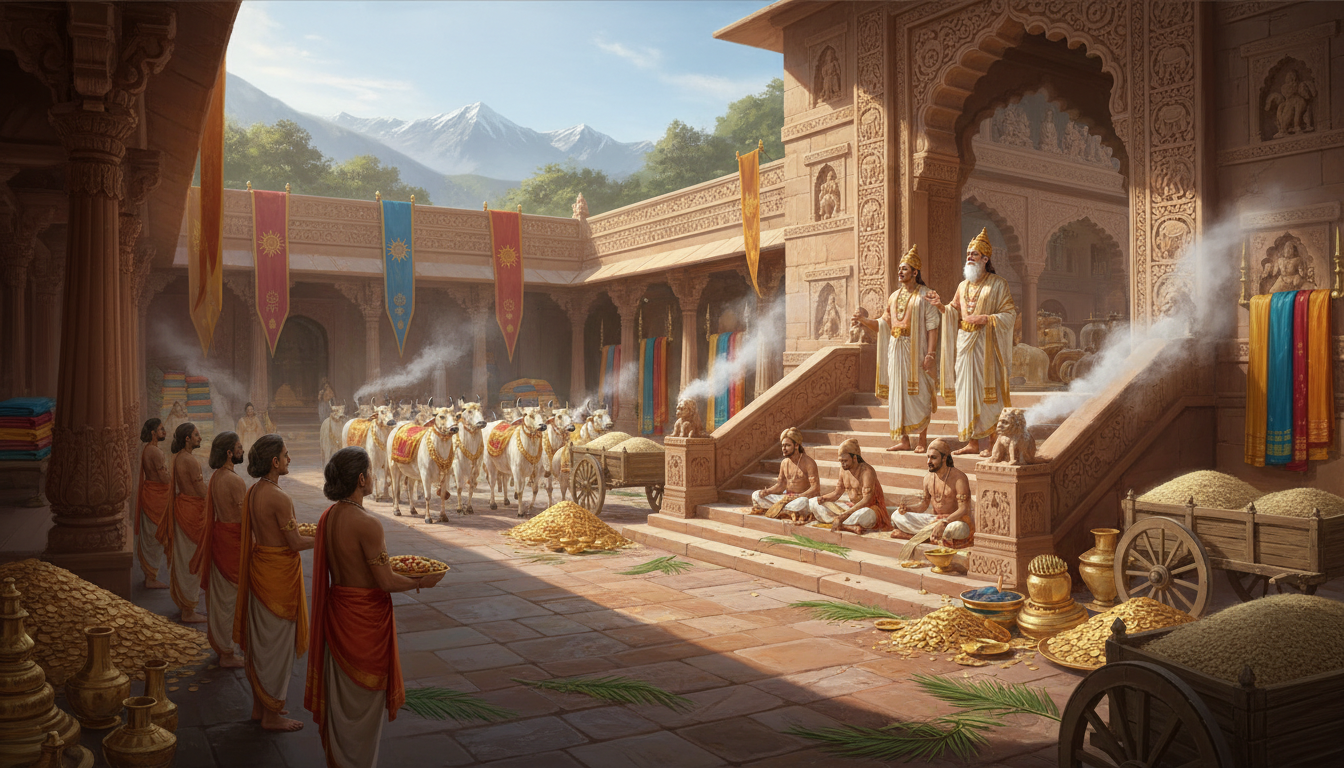
Then the goods began to come in, and for days Hastinapura was a city being unpacked. A large quantity of food and drink was prepared. Cars and other vehicles were drawn up in lines. Clothes were stacked by the bale. Gold, and jewels, and gems. Slaves both male and female. Goats and sheep, herded into pens outside the walls because there was no room for them inside. Blankets and costly articles. Villages and fields were listed on the scribes' boards and kept ready, because a village is given by naming it and by handing over the accounting of it. Elephants and steeds decked with ornaments stood in the shade with their keepers. And many beautiful maidens, who were the best of their sex, were brought to be given away as the custom of that age permitted.
And then Dhritarashtra gave them away for the advancement of the dead, naming each of them in due order as the gifts were made.
That was the thing that made it a gift-sacrifice rather than a distribution. Nothing left his hands unlabelled. He named Drona. He named Bhishma. He named Somadatta, and Valhika. He named king Duryodhana. He named each one of his other sons in turn, and there were a hundred of them, and he had never seen any of their faces, and he had all their names.
And he named all his well-wishers, with Jayadratha numbering first among them.
Yudhishthira stood by and approved it. The gifts he had funded were being announced in the names of the men his brothers had killed, and one of those names belonged to the man who had cornered Abhimanyu, and the king of the Pandavas did not interrupt the naming once.
Tenfold at the King's Command
The shraddha-sacrifice became characterised by large gifts of wealth and by profuse presents of jewels and gems and other kinds of treasure, and it became so because of a standing order Yudhishthira had given to the men holding the ledgers.
Tellers and scribes sat at the tables all day, and under Yudhishthira's orders they ceaselessly asked the old king the same question, over and over, until it became a kind of chant across the courtyards.
"Do thou command, O monarch. What gifts should be made to these? All things are ready here."
And as soon as the king spoke, they gave away what he directed. But not the amount he directed. To him that was to receive a hundred, a thousand was given. To him that was to receive a thousand, ten thousand was given, at the command of the royal son of Kunti. The old man could not see the tally boards and did not know that every figure he named was being multiplied ten times before it left the table.
Like clouds vivifying the crops with their downpours, that royal cloud gratified the Brahmanas with downpours of wealth. After the gifts had been distributed, the king deluged the assembled guests of all four orders with repeated surges of food and drink of diverse tastes, until men who had come for a handful went away carrying what they could not lift alone.
Verily the Dhritarashtra-ocean swelled high: jewels and gems for its waters, villages and fields and the foremost of gifts for its verdant islands, heaps of precious articles for its rich caves, elephants and steeds for its alligators and its whirlpools, the sound of the mridangas for its deep roars, and clothes and wealth and precious stones for its waves. It deluged the Earth.
Ten Days, and the Debt Discharged
It went on for ten days.
Actors and mimes danced and sang continually and contributed to the merriment of the guests, because a gift-sacrifice is not a funeral and is not supposed to look like one. Food and drink of diverse tastes were given away in large quantities. The pavilions stayed up. The water reservoirs built for the cattle filled and were drunk down and filled again. Men came in from provinces four days' walk away because word had gone out that the blind king was giving in the names of the dead and that nobody was being turned away.
And through all ten days the old king sat and named names. His sons. His grandsons. His Pitris before them. Bhishma, who had raised him. Drona. Somadatta and Valhika. Jayadratha of the Sindhus. Himself, in the end, and Gandhari, since the gifts were also for their own advancement in the other world, and there was nobody left who would be making them on their behalf.
At last he became tired with the task of making gifts in such profusion. That was how it ended: not at a fixed hour and not at the exhaustion of the treasury, which was still standing open, but when the man doing the naming could no longer do it. And so that great gift-sacrifice came to an end.
Even thus, Vaishampayana said, did that king of Kuru's race perform his gift-sacrifice. Making gifts in this way for ten days, the royal son of Amvika became freed from the debts he owed to his sons and to his grandsons.
He had asked his subjects for their pardon and been given it. He had asked his nephews for the money to bury his hundred sons, and the nephews who had killed them had opened the treasury and then quietly multiplied every gift tenfold. There was nothing left owing in either direction, which is a rarer condition than peace and does not feel like it.
On the day of the full moon of Kartika he had the minor rites performed by Brahmanas conversant with the Vedas, and had the fire he worshipped daily taken up and carried out ahead of him. He left off his usual robes and put on deer-skins and barks. He worshipped the mansion in which he had lived with fried paddy and with excellent flowers of diverse kinds, and honoured every one of his servants with a gift of wealth, down to the last of them, because the ledgers were still open and he had learned in ten days how to leave nothing unnamed. Then he set out from that abode, with Gandhari's hand on his shoulder, and Bhima watched him go.
Dharma Lesson
To pay for the funeral rites of the men you killed is the hardest form of generosity, because it asks the victor to admit that the dead also had a debt owing to them. Bhima is not wrong about a single fact he lists; he is simply outvoted by a brother who holds that the good remember benefits and not injuries.