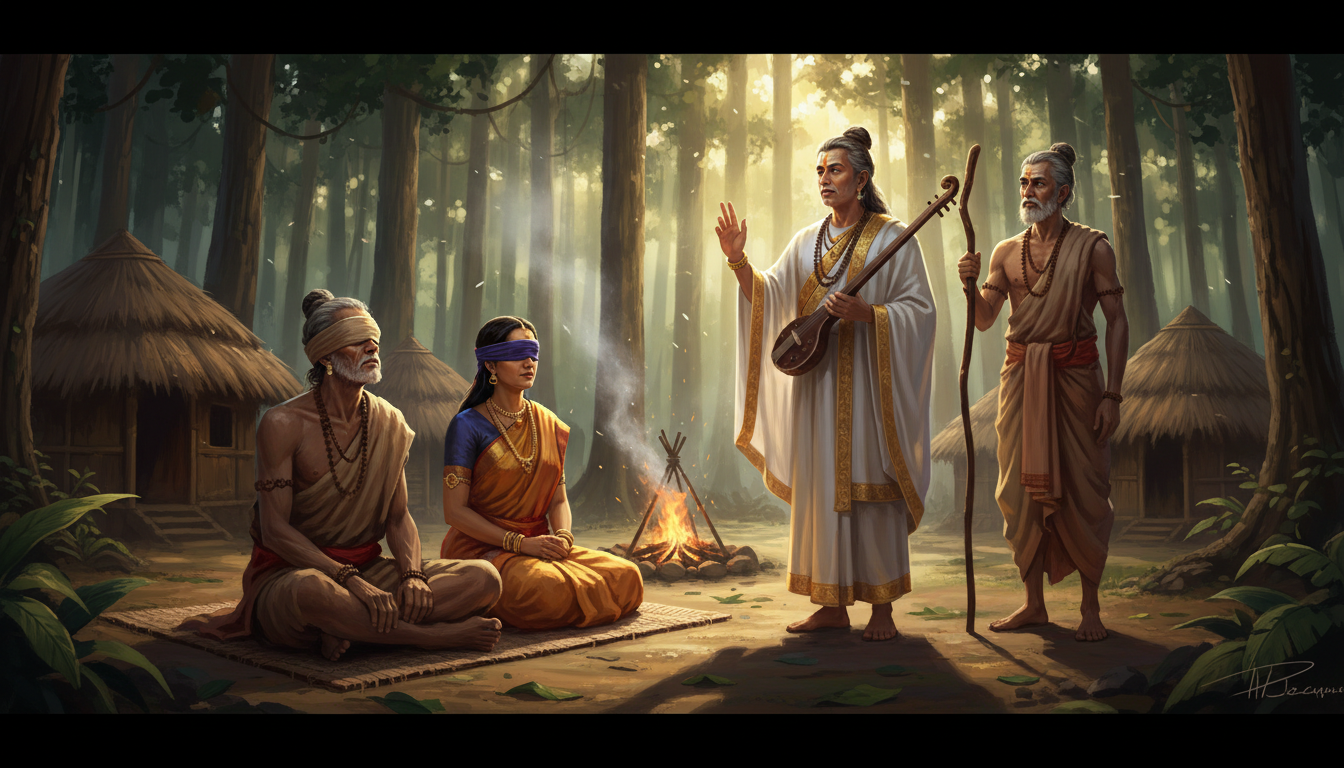
Satayupa and the Forest Kings
Narada Names the Rulers Who Chose the Woods
The First Night Out of the City
They had already lost the argument about Kunti. She had refused to be turned back, and the Pandavas, ashamed by what she said to them, had stopped following her, and the princess of Panchala had stopped with them. The old king himself, leaning on Gandhari and Vidura, had told her to go home to her sons and enjoy the prosperity they had won, and Gandhari had carried that message to her and added her own words of grave import to it, and had failed. So the brothers walked round the king in salutation and gave up, and the Kuru ladies set up a loud wail, and everybody who was going back went back. Hastinapura held no festivals that day. The Pandavas came home on their cars with their wives, cheerless, like calves whose mothers have been taken away.
The others got clear of the city on the first day and stopped at evening on the bank of the Bhagirathi, and there the old king rested for the night.
The Brahmanas who knew the Vedas kindled their sacred fires in that ascetics' retreat, and the fires blazed up beautifully all round in the dark. The king's own sacred fire was kindled with them. He sat down by it and poured his libations according to the rites, and then worshipped the thousand-rayed sun as it was going down, which he had done every evening of his life without once having seen it.
Vidura and Sanjaya made a bed for him by spreading blades of kusa grass on the ground. Next to it they made another for Gandhari. And close beside Gandhari, Kunti lay down, the mother of Yudhishthira, who had walked out of a kingdom that morning and would not be talked back into it. Within hearing of those three, Vidura and the rest slept. The Yajaka Brahmanas and the followers of the king lay down on their own beds. The foremost of the twice-born chanted sacred hymns aloud, and the sacrificial fires burned all around them, and the night was as delightful to them as a night in the world of Brahma.
When it passed, they got up and went through the morning acts, poured libations on the sacred fire, and went on.
That first day of the forest was very painful to them, and not because of the road. It was painful because of the people. The inhabitants of the city and the provinces of the Kuru kingdom came out along the way and grieved at them, and there is nothing harder to walk through than the sorrow of people you have already left.
The Bank Where the Righteous Live
It was Vidura's advice that settled them where they settled. On his word the king took up his abode on the banks of the Bhagirathi, which are sacred and deserve to be peopled by the righteous.
And there the visitors began. Brahmanas who had made their homes in those woods came to look at the old monarch, and Kshatriyas came, and Vaisyas, and Sudras. A blind man who had ruled the earth for a lifetime was sitting on the ground among them in a hermitage, and they came from every direction to see it. He sat in the middle of them and gladdened them all with his talk, and he had always been good at that; it was the one royal skill he had never lost. When he was done he worshipped the Brahmanas with their disciples according to the rites and dismissed them.
In the evening the king and Gandhari went down into the stream of the Bhagirathi and performed their ablutions for purification. Vidura bathed, and the others with him, and they went through the usual rites of religion.
Then came a small thing that the story stops to record. When the king had purified himself with his bath, the daughter of Kuntibhoja gently led them both out of the water and up onto the dry bank: her father-in-law by one hand and Gandhari by the other. Kunti, the mother of the men who had killed their sons, taking the blind man and the blindfolded woman out of a river.
The Yajakas had built a sacrificial altar for the king on that bank. He was devoted to truth, and he poured his libations on the fire there. Then, with his followers, observing his vows, with his senses restrained, he left the Ganga and went towards Kurukshetra.
The King Who Was Already There
At Kurukshetra there was a retreat belonging to a royal sage of great wisdom named Satayupa, and Dhritarashtra went to it and had an interview with him.
Satayupa had been the great king of the Kekayas. He had not been driven out and he had not been beaten. He had handed the sovereignty of his kingdom over to his son and walked into the woods, which was the ordinary and honourable thing for a man of his line to do when the years came on him, and which was the very thing Dhritarashtra had refused to do at the one moment in his life when doing it would have saved eighteen armies.
So the blind king came to that hermitage on the field where his hundred sons had died, and was received there with due rites by a man who had given up a throne without being asked to.
Nobody in the account says any of this out loud. Satayupa was too courteous a host, and Dhritarashtra had said everything he had to say on the subject in the assembly at Hastinapura. But the two of them stood in the same forest by two different roads, and the second man had arrived at the age of eighty-odd, blind, in rags, with his wife and his brother's widow behind him and a hundred graves behind them.
What Satayupa gave him was not a lecture. It was lodging, and then instruction.
The Initiation
First they went together to the retreat of Vyasa, Satayupa accompanying him, and there the delighter of the Kurus received his initiation into the forest mode of life.
It is a formal thing and it has a shape. A man does not simply stop being a king; he is taken through the rite by which the fires he has kept as a householder are gathered up, and the vows of the third stage of life are laid on him, and what he was is closed like a book. Vyasa, who had fathered his father and had been coming to sit with him for fifteen years in the palace to recite the histories of old rishis to a man who could not sleep, performed it.
Then Dhritarashtra went back and took up his abode in Satayupa's hermitage, and Satayupa, at Vyasa's command, instructed him in all the rites of the forest mode.
That is the arrangement the story is careful to spell out: the sage authorises, and the retired king teaches. The instruction did not come from a Brahmana who had never held anything. It came from another Kshatriya who had once had a treasury and an army and a son to hand them to, and who therefore knew exactly which habits would have to go and in what order, and what a man misses first.
And in this way Dhritarashtra set himself to the practice of penances, and all his followers set themselves to the same course of conduct with him.
Bark and Deer-Skin
Gandhari put on bark and deer-skin for her robe, and so did Kunti, and both of them took up the same vows the old king had taken.
They restrained their senses in thought, in words, in deeds, and by the eye, which for two of the three of them was a formality and for the third was not. They practised severe austerities.
Dhritarashtra went at it like a great rishi, with no confusion left in his mind about what he was doing or why. He wore matted locks on his head. He was clad in barks and skins. His flesh dried up on him until his body was skin and bones, and the fasting he had been doing in secret in the palace for fifteen years, at the fourth division of the day or the eighth, hiding it from his attendants and from Yudhishthira, was now simply his open daily rule, with nobody left to hide it from.
Vidura, who understood the true interpretations of righteousness better than anyone alive, waited on the old king and his wife. Sanjaya waited on him too. Both of them had their souls under subjection, and both of them reduced their bodies as their master did, and put off whatever they had been wearing and wore barks and rags instead.
A charioteer, a minister, a king, a queen and a queen's rival: five people in bark on the field of Kurukshetra, doing the only work left to them.
The Ascetics Come to Look
Then the visitors came again, and this time they were not villagers.
Narada came, and Parvata, and Devala of the austere penances: three of the foremost ascetics in the world, arriving to see king Dhritarashtra. The Island-born Vyasa came with all his disciples. Others came who were endued with great wisdom and crowned with ascetic success. And the royal sage Satayupa came, advanced in years and possessed of great merit, from his own retreat nearby.
Kunti worshipped them with the due rites. Not Gandhari, and not the king: Kunti, who had been the guest in that household and had made herself its servant, did the honours of the hermitage. The ascetics were highly gratified with the worship she offered them.
And then they did what such men do when they come to a grieving house. They gladdened the old king with discourses on religion and on righteousness. There was no consolation offered and no reference made to the war. There was talk about duty, going round the circle, for as long as it took, on a piece of ground where the bones were not yet fifteen years under.
At the end of it, Narada, who beholds all things as though they stood directly in front of him, began to speak about kings.
The Roll of Those Who Walked In Here Before
"There was a ruler of the Kekayas," Narada said, "possessed of great prosperity and perfectly fearless, whose name was Sahasrachitya. He was the grandfather of this Satayupa sitting here. He resigned his kingdom to his eldest son, who had a large measure of righteousness in him, and went into the woods. He reached the far end of blazing penances, and that lord of earth attained to the region of Purandara and lives there in Indra's company still. I have seen him there myself, many times, when I have gone visiting that region: a monarch whose sins have all been burnt off.
"In the same way king Sailalaya, the grandfather of Bhagadatta, reached the region of Indra by the power of his penances and nothing else.
"There was another king named Prishadhra, who was like the wielder of the thunderbolt himself. He also went from the earth to heaven by his penances.
"In this very forest, king, in the wood you are sitting in, Purukutsa the son of Mandhatri attained to high success. The foremost of rivers, the Narmada, became the consort of that king. He performed his penances here and went to heaven from here.
"There was another highly righteous king named Sasaloman. He too underwent severe austerities in this forest, and ascended."
It was a roll-call, and it was meant as one. The old king had come to this place thinking of himself as the last of a ruined line, the man who had emptied the earth. Narada was telling him, with names and grandfathers and a river taken to wife, that the road he had just started down was a well-worn one, that kings had been coming to this exact wood to die out of the world for ages, and that not one of them had been brought here by disgrace.
"You also, having arrived at this forest," Narada said, "shall attain, through the grace of the Island-born, to a goal that is very high and hard to reach."
What Will Become of the Rest of Them
He did not stop with the king. He went round the hermitage and disposed of every person in it.
"At the end of your penances," he said to Dhritarashtra, "you will become endued with great prosperity, and, accompanied by Gandhari, you will reach the goal those high-souled ones reached.
"Pandu, dwelling in the presence of the slayer of Vala, thinks of you always. He will certainly help you towards it."
That was said in front of Kunti, who had been Pandu's wife, and in front of Gandhari, whose husband had held the kingdom because Pandu could not.
"And through serving you and Gandhari," Narada went on, turning to that daughter-in-law, "this lady of great fame will attain to residence with her husband in the other world. She is the mother of Yudhishthira, who is the eternal Dharma.
"Vidura will enter into the high-souled Yudhishthira. Sanjaya, through meditation, will ascend from this world into heaven.
"We behold all this, king, with our spiritual vision."
So the charioteer standing at the back in rags was told, in the middle of a conversation between sages and a king, exactly how he would end: not on a bed, not in a battle, but going up out of the world by his own concentration. And Vidura was told that he would not die in the ordinary sense at all, but pass into the body of the nephew he had been protecting since the boy could walk. Neither man is recorded as having answered. There was nothing to answer.
Satayupa Asks the Question Nobody Else Will
The Kuru king and his wife praised those words and worshipped Narada with unprecedented honours. The conclave of Brahmanas filled up with joy and, wanting to gladden Dhritarashtra, worshipped Narada themselves with profound regards and praised what he had said.
And then the royal sage Satayupa, the host, the man who had already done this himself and had nothing left to lose by asking, spoke up.
"Your holy self has enhanced the devotion of the Kuru king, and of all these people, and of me," he said. "But I have a wish to ask you something. Hear me.
"It has reference to king Dhritarashtra. You are acquainted with the truth of every affair. You have celestial sight, and you see what the various goals of human beings are. You have told us the goal of the kings you named, which was association with the chief of the celestials. You have not declared what regions this king will acquire. I wish to hear it from you: what region will be his, and when he will reach it. Tell me truly."
It is a startling thing to say in a man's own hearing, in the middle of a courtesy visit, in front of his wife. It is the question that everybody in that circle wanted answered and that not one of the Kurus could have asked without it sounding like impatience for a death. Only a stranger, and only a king who had made the same journey, could put it as a plain request for information.
And Narada, of celestial sight, endued with austere penances, answered it in the middle of the assembly.
Three Years, and Then Kuvera
"Going at my will to the mansion of Sakra," Narada said, "I have seen Sakra the lord of Sachi, and there, royal sage, I saw king Pandu. A talk arose there about this Dhritarashtra and about the severe penances he is performing. And there I heard from the lips of Sakra himself that there are three years remaining of the period of life allotted to this king.
"After that, king Dhritarashtra, with his wife Gandhari, will go to the regions of Kuvera, and be highly honoured by that king of kings. He will go there on a car that moves at his will, with his person adorned in celestial ornaments. He is the son of a rishi. He is highly blessed. He has burnt all his sins by his penances. With a righteous soul he will rove at will through the regions of the gods, and of the Gandharvas, and of the Rakshasas.
"What you have asked about is a mystery of the gods. It is out of affection for all of you that I have declared this high truth. You are all possessed of the wealth of the Srutis, and you have consumed your sins by your penances."
Three years. Said out loud in a hermitage, to a blind man sitting on kusa grass in bark cloth, with the number fixed and the destination named and the vehicle described.
And the strange thing, the thing the narrator insists on, is what it did to the room. Hearing those sweet words of the celestial rishi, every person there assembled, and king Dhritarashtra with them, became greatly cheered and highly pleased.
Not one of them took it as a sentence. To that assembly it was the best news the old king had received in sixteen years: an end with a date on it, a wife going with him, a dead brother waiting in Indra's hall and thinking of him, and a place in the treasure-house of Kuvera at the far end of it.
Having cheered Dhritarashtra with such talk, they got up and left the spot, wending away by the path that belongs to those who are crowned with success.
Dharma Lesson
Renunciation is not exile. It is a road with a long line of kings already walking on it, and a man who arrives there in disgrace arrives at the same place as those who came in honour. To be told the hour of your own death, in that company, is a mercy and not a sentence.