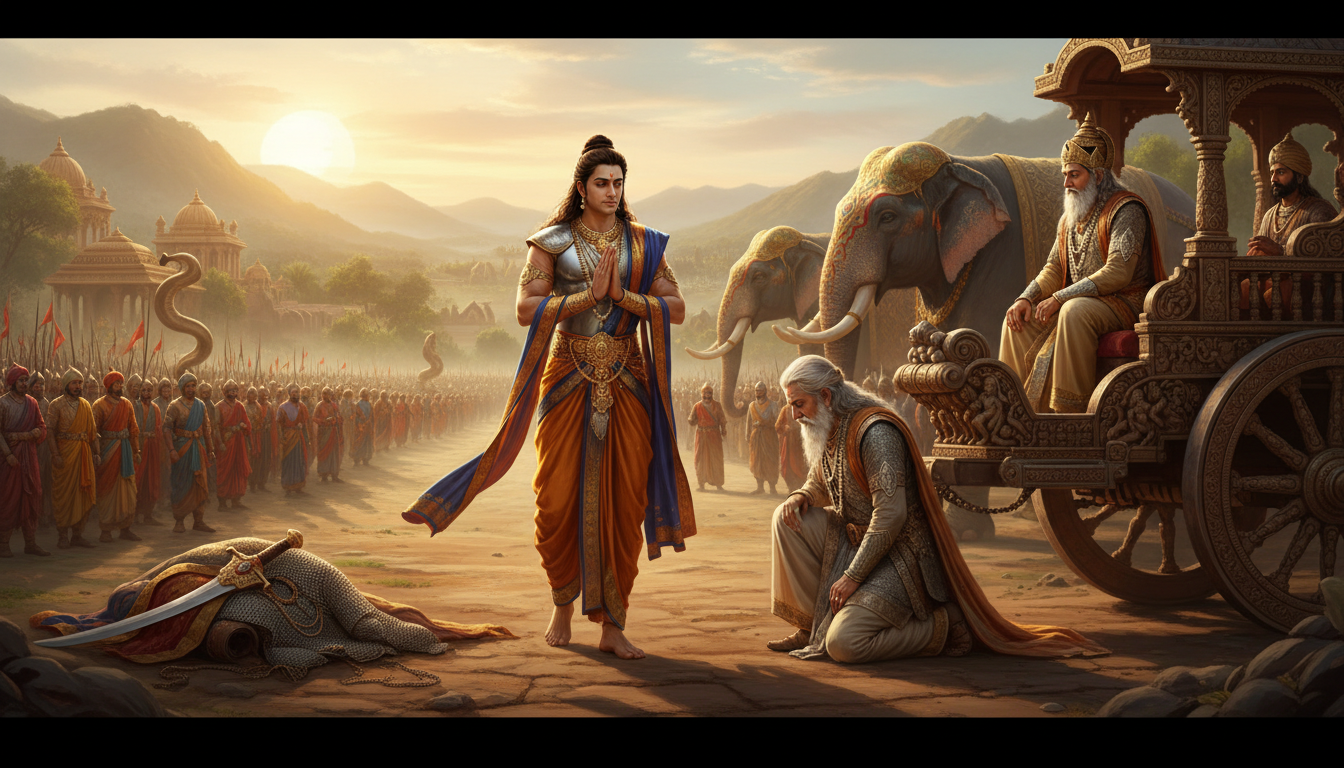
The Walk Across the Field
The king who laid down his armour before the first arrow
The Armour Set Down
Sanjaya said: Arjuna took up his arrows and the Gandiva once more, and the great car-warriors of the Pandava party sent up a shout that ran the whole length of their line. The Somakas and all who followed them blew their sea-born conches. Drums and Pesis and Karkachas and cow-horns were beaten and blown together until the uproar was one solid sound.
And the sky filled. The gods came, with the Gandharvas and the Pitris and the hosts of the Siddhas and the Charanas, to see it. The blessed Rishis came in a body with the god of a hundred sacrifices at their head, to look down upon the slaughter that was about to begin.
Then, O king, the two armies stood facing each other like two oceans, moving and never still, and in the middle of that noise your enemy the son of Dharma did a thing that no one on either side had any way of expecting.
He unfastened his coat of mail and put it off. He set aside his excellent weapon. He came down from his car, and with his hands joined together in front of him he began to walk, on foot, facing the east, toward the place where the hostile host was standing.
He kept his eyes on the grandsire. He said nothing to anyone.
Arjuna saw him go and jumped down off his own car and came after him, and the others came after Arjuna. The Lord Vasudeva followed behind them. The principal kings of that army, filled with anxiety, left their chariots too and walked in the same path, because their king was walking and no one could think of a reason for it.
Four Questions and One Answer
"What is this act of yours, O king?" Arjuna said, keeping pace with him. "You abandon your brothers and go on foot, face eastwards, into the hostile host."
"Where will you go, king of kings?" said Bhimasena. "You have cast off your coat of mail and your weapons, and the warriors you are walking toward are cased in mail. You have left your brothers behind you. Where are you going?"
"You are my eldest brother," Nakula said. "Seeing you proceed in this way, fear troubles my bosom. Tell us. Where will you go?"
"These hostile divisions are terrible and they are numerous," Sahadeva said, "and we are here to fight them. Where do you go, O king, in the direction of our foes?"
Yudhishthira, of restrained speech, said nothing at all to any of them, and continued to walk.
It was Vasudeva who answered them, and he was smiling when he did it.
"His object is known to me. He will pay his respects to all his superiors first, to Bhishma and Drona and Kripa, and to Shalya also, and then he will fight the foe. It is heard in the histories of olden times that a man who first salutes his preceptors according to the ordinance, and those revered in years, and his kinsmen, and only then goes to battle against those who are his superiors, is sure to obtain victory. That is my opinion too."
So the four brothers walked with him, and Krishna walked with them, and none of them said anything more.
What the Kaurava Line Said
In your ranks, O king, a loud noise went up, Alas, and Oh, and the other army stayed perfectly still.
Your son's heroic warriors watched an unarmed man in a plain garment walking across open ground toward them, and they knew at once what they were looking at.
"This one is an infamous wretch of his race," they said to one another. "It is plain. The king is coming in terror to Bhishma's side. Yudhishthira and his brothers have become seekers after the grandsire's shelter."
"But why? Dhananjaya protects him, and Vrikodara, and Nakula and Sahadeva. Why does the eldest son of Pandu come here in fear?"
"Because he is weak, whatever they say of him in the world, and his bosom is full of fear at the prospect of battle. Such a man could never have been born in the Kshatriya order."
And they praised the Kauravas, all of them, and their hearts became cheerful, and they took hold of their garments and waved them over their heads at him. They censured Yudhishthira and every one of his brothers, and Kesava with them, and cried Fie at the five men walking toward them across the field.
Then the noise died all at once, and your army, O monarch, became perfectly still again.
Because the man had not turned back. He was still coming. And a different question began to move along the line: what will this king say? What will Bhishma say in reply to him? What will Bhima say, who is so boastful of his powers in battle, and what will Krishna and Arjuna? What, indeed, has he to say at all?
Great was the curiosity then in both the armies, O king, and eighteen armies stood still in the sun and waited to hear it.
The Grandsire's Wheel
He went into the array. It bristled with arrows and darts and every man in it had a weapon in his hand, and he walked through it with his brothers around him until he came to the car of Santanu's son, who stood there ready for battle.
Then he took hold of Bhishma's feet with both his hands.
"I salute you, invincible one. With you we will do battle. Grant us your permission in that matter. Give us also your blessing."
"If you had not come to me like this, O lord of the earth," Bhishma said, "I would have cursed you, and your defeat would have followed. I am gratified with you, son. Do battle, and obtain victory. Whatever else may be desired by you, obtain it in battle. And ask me for a boon besides, son of Pritha, whatever boon you wish. If you do that, great king, then defeat will not be yours."
He was silent a moment, and then he said the thing he was to say four times over that morning, in four mouths, in the same words.
"A man is the slave of wealth, but wealth is no one's slave. That is very true, O king. I have been bound by the Kauravas with their wealth. It is for that reason, son of Kuru's race, that I am speaking to you like a eunuch, and saying: bound I am by the Kauravas with wealth. Battle excepted, what do you desire?"
"Consult my interests, you who are so wise, from day to day, and desire my welfare. Fight, however, for the sake of the Kauravas. That is always my prayer to you."
"What aid can I render you in this, son of Kuru's race? I shall of course fight for your foes. Tell me what you have to say."
So Yudhishthira asked him the question he had come across the field to ask.
"Therefore I ask you, sire. I bow to you, grandsire. How shall we in battle vanquish you, who are invincible? Tell me this that is for my benefit, if indeed you see any good in it."
"I do not see the person, son of Kunti, who can defeat me in battle when I fight," Bhishma said. "Not if he were the chief of the celestials himself."
"My salutations to you, grandsire. Therefore I ask you this. Tell us how your own death may be compassed by foes in battle."
The old man looked at him for a while.
"I do not see the person, sire, who can vanquish me in battle," he said. "The time also of my death is not yet come to me. Come to me once again."
Yudhishthira saluted him a second time and accepted the words with a bend of his head, and did not ask again.
The Preceptor Names His Own Death
Then the mighty-armed one went through the middle of all those soldiers, who stood eyeing him as he passed, toward the car of the preceptor, and his brothers went with him. He saluted Drona and walked round him from left to right, and then spoke to that invincible warrior words that were for his own benefit.
"I ask you, invincible one: how may I fight without incurring sin, and how, with your permission, regenerate one, may I vanquish all my foes?"
"If, having resolved to fight, you had not come to me like this," Drona said, "I would have cursed you, O king, for your complete overthrow. But I am gratified, Yudhishthira, and honoured by you, sinless one. I permit you. Fight, and obtain victory. I will also fulfil your wish. Say what you have to say. Under these circumstances, battle excepted, what do you wish?" And then, exactly as the grandsire had said it: "A man is the slave of wealth, but wealth is not one's slave. Bound I have been with their wealth by the Kauravas. It is for this that like a eunuch I shall fight for the sake of the Kauravas. I shall fight for the Kauravas, but I will pray for your victory."
"Pray for my victory, then, and counsel me what is for my good. Fight, however, for the Kauravas. This is the boon I ask."
"Victory is certain for you who have Hari for your counsellor," Drona said. "I also grant it: you will vanquish your foes in battle. Where righteousness is, there is Krishna, and where Krishna is, there is victory. Go, fight, son of Kunti. Ask me. What shall I say to you?"
"I ask you, foremost of the regenerate. Listen to what I have to say. How shall we in battle vanquish you, who are invincible?"
"As long as I will fight, so long victory can never be yours," said Drona. "Therefore, O king, seek with your brothers for my speedy slaughter."
"Alas. For this, mighty-armed one, tell us the means of your death. O preceptor, I prostrate myself and ask you this. My salutations to you."
And the son of Bharadwaja told him, standing in his own chariot in the middle of his own army, on the morning of the first day.
"The foe I do not see who may slay me while I stand in battle engaged in fight, with my wrath excited, scattering my arrowy showers continually. Except when I am addressed for death. Having abandoned my arms and withdrawn from all surrounding sights in Yoga meditation, then, and only then, may I be slain, and none will be able to do it otherwise. This that I tell you is true. And I tell you truly also that I will cast off my arms in battle, having heard something very disagreeable from someone of credible speech."
Yudhishthira honoured the preceptor and went on. Fifteen days later a sentence would be spoken on that field that was disagreeable enough, and the man who spoke it would be the one man on the Pandava side whose word Drona could not doubt, and he had just been told which man that was.
The One Who Could Not Be Killed
He came next to the son of Saradwat, and saluted Kripa, and walked round him, and being accomplished in speech he said what he had said twice already.
"Obtaining your permission, preceptor, I will fight without incurring sin, and permitted by you, sinless one, I will vanquish all my foes."
"If, having resolved on fight, you had not come to me like this, I would have cursed you, O king, for your complete overthrow," said Kripa. "A man is the slave of wealth, but wealth is no one's slave. That is very true, and bound I have been with wealth by the Kauravas. I must fight for their sake. That is my opinion. I therefore speak to you like a eunuch when I ask: battle excepted, what do you desire?"
"Alas. I ask you, therefore, preceptor. Listen to my words."
And then the king stopped.
He stood in front of the man who had taught him and his brothers to string a bow before any of them was tall enough to draw one, and he could not finish the sentence. He was greatly agitated, and deprived of his sense, and he stood there silent, with his hands still joined.
Kripa understood what he had intended to say, and answered the question that had not been asked.
"I am incapable of being slain, O king," he said. "Fight, and obtain victory. I am gratified with your coming. Rising every day from my bed I will pray for your victory, monarch. I say this to you truly."
And of the four men Yudhishthira went to that morning, this was the only one who could grant him everything he had come for without also handing him a way to kill an old teacher, and he did it by being the only one of them the war could not touch.
The king paid him due honour, and went on toward the place where the ruler of the Madras was standing.
The Boon Asked of an Uncle
Shalya was his mother's brother, and the uncle of Nakula and Sahadeva, and he had come to this field with an army because he had been intercepted on the road with hospitality and flattery and had given his word before he understood whose word he was giving.
Yudhishthira saluted him and walked round him and said, "Obtaining your permission, invincible one, I will fight without incurring sin, and permitted by you, O king, I will vanquish my valorous foes."
"If, having resolved on fight, you had not come to me like this, I would have cursed you for your overthrow in battle," Shalya said. "I am gratified, and I am honoured. Let it be as you wish. I grant you permission. Fight, and obtain victory. Speak, hero. What do you have need of? What shall I give you? Under these circumstances, O king, battle excepted, what do you desire? A man is the slave of wealth, but wealth is no one's slave. This is true. Bound I have been with wealth by the Kauravas, nephew, and it is for this that I am speaking to you like a eunuch. I will accomplish whatever desire you may cherish. Battle excepted, what do you wish?"
"Think, O king, daily of what is for my great good. Fight, according to your pleasure, for the sake of the foe. This is the boon I solicit."
"Under these circumstances, best of kings, say: what aid shall I render you? I shall of course fight for the sake of your enemy, for I have been made one of their party by the Kauravas with their wealth."
And Yudhishthira asked for the thing he had asked for once already, before the armies ever came to this plain, when the messages were still going back and forth and the boon had been given in private and might have been forgotten.
"Even that is my boon, Shalya, which was solicited by me during the preparations for the fight. The energy of the Suta's son should be weakened by you in battle."
"This wish of yours shall be accomplished, son of Kunti," Shalya said. "Go, fight according to your pleasure. I shall look after your victory."
Fifteen days later, on the morning the Suta's son was made commander of what was left of your host, Karna would ask for a driver who was Krishna's equal with horses, and there would be exactly one such man on the field, and he would agree to hold the reins on the condition that he might say whatever he pleased while he held them. He had made this promise first, in the open, on the first morning, to a man standing in front of him without armour.
Krishna Goes to Radha's Son
Having obtained the permission of his maternal uncle, the ruler of the Madras, the son of Kunti came out of that vast army surrounded by his brothers.
But Vasudeva did not come out with them. The elder brother of Gada turned aside, on the field of battle, and went to Radha's son, and spoke to him for the sake of the Pandavas.
"It has been heard by me, Karna, that from hatred of Bhishma you will not fight."
Karna said nothing. It was true, and both of them knew where it had been said and in front of whom: the grandsire had gone down the muster naming every man on the field at his true worth, and had priced Karna at half a chariot, and Karna had walked out of the tent swearing not to take up a bow until Bhishma was down.
"Come to our side, son of Radha," Krishna said. "Stay with us as long as Bhishma is not slain. After Bhishma is slain, you may then engage in battle again on Duryodhana's side, if you have no preference for any of the parties."
It was an offer that cost Karna nothing at all. He was not going to fight for ten days in any case. He was being asked only to spend those ten idle days on the other bank of the same field.
"I will not do anything that is disagreeable to Dhritarashtra's son, Kesava," Karna said. "Devoted to Duryodhana's good, know that I have cast off my life for him."
Hearing those words, Krishna ceased, O Bharata, and turned back, and rejoined the sons of Pandu headed by Yudhishthira.
He Who Will Choose Us
Then, standing between the two armies with nothing on him, the eldest son of Pandu turned around to face your host and called out so that both lines could hear it.
"He who will choose us, him we shall choose for our ally!"
Nothing moved. Eleven armies stood in front of him with their weapons up.
Then one man came out of the Kaurava line.
He was your son, O king, and he was not Gandhari's. He had been born to you of a woman of the Vaishya order in the same year as Duryodhana, he had grown up in the same house as the hundred, he had eaten at their table and stood at their shoulder in their assembly, and no one on either side had thought to count him as anything but one more of Dhritarashtra's sons.
He cast his eyes over them all, and then he spoke with a cheerful heart to Kunti's son, king Yudhishthira the Just.
"I will fight under you in battle, for the sake of you all, against the sons of Dhritarashtra, if, O king, you will accept me, sinless one."
"Come, come," said Yudhishthira. "All of us will fight with your foolish brothers. Yuyutsu, both Vasudeva and all of us say to you: I accept you, mighty-armed one. Fight for my cause. On you rests, it seems, the thread of Dhritarashtra's line, and his funeral cake as well. O prince, O you of great splendour, accept us who accept you. The wrathful Duryodhana of wicked understanding will cease to live."
And Yuyutsu abandoned the Kurus, your sons, and went over to the army of the Pandavas, and he did it with beat of drums and cymbals, in the open, in front of everybody, so that no man on that field could afterwards say he had not seen it.
One man out of a hundred and one. And the funeral cake, O king, would come to be offered by him, exactly as Yudhishthira said it that morning, because he was the only one of them who would be alive at the end to offer it.
The Mail Put On Again
Then king Yudhishthira of mighty arms, filled with joy, put on again his shining coat of mail of golden effulgence, and those bulls among men mounted their respective cars. They counter-arrayed their troops in battle-array exactly as before. Drums and cymbals in many hundreds were sounded, and those men set up diverse leonine roars.
And when the kings of that side, with Dhrishtadyumna and the others, saw the sons of Pandu back on their chariots, they shouted again for joy.
But the strange thing, O king, and the thing I was sent to tell you, is what happened in the space between the armies afterwards.
All the kings who were present applauded them. They had watched the sons of Pandu pay due honour to men they were about to try to kill, and the monarchs on both sides talked to one another about it, about the friendship in it, and the compassion, and the kindness to kinsmen displayed at the proper season by those high-souled persons. Excellent, excellent, was heard everywhere, delightful words coupled with hymns of praise about those famous men, and the minds and hearts of everyone there were drawn toward them.
And the Mlechchhas and the Aryas alike who witnessed that behaviour of the sons of Pandu, or only heard of it afterwards from someone standing nearer, all wept with choked voices.
Then those warriors, endued with great energy, caused large drums and Pushkaras by hundreds upon hundreds to be sounded, and blew their conches, all of them white as the milk of cows.
Nothing had changed. Bhishma still commanded your host and had promised nothing except a prayer. Drona would fight for you and pray for them. Kripa would fight for you and pray for them. Shalya would drive for your side and speak against it. Not one arrow had been withheld and not one man had been spared by anything that happened in that hour.
And yet every man on that plain had just been shown what your son could have had for nothing, at any point in thirteen years, and would not take: a nephew who would come to him bareheaded and unarmed across open ground and take hold of his feet.
Dharma Lesson
A man who honours the elders he must fight has already won the only victory that outlasts the battle. Yudhishthira gained no arrow and no advantage by walking across that field, only four blessings and one hint, and both armies wept for him. Reverence costs nothing at the moment it is offered and is the last thing anybody remembers.