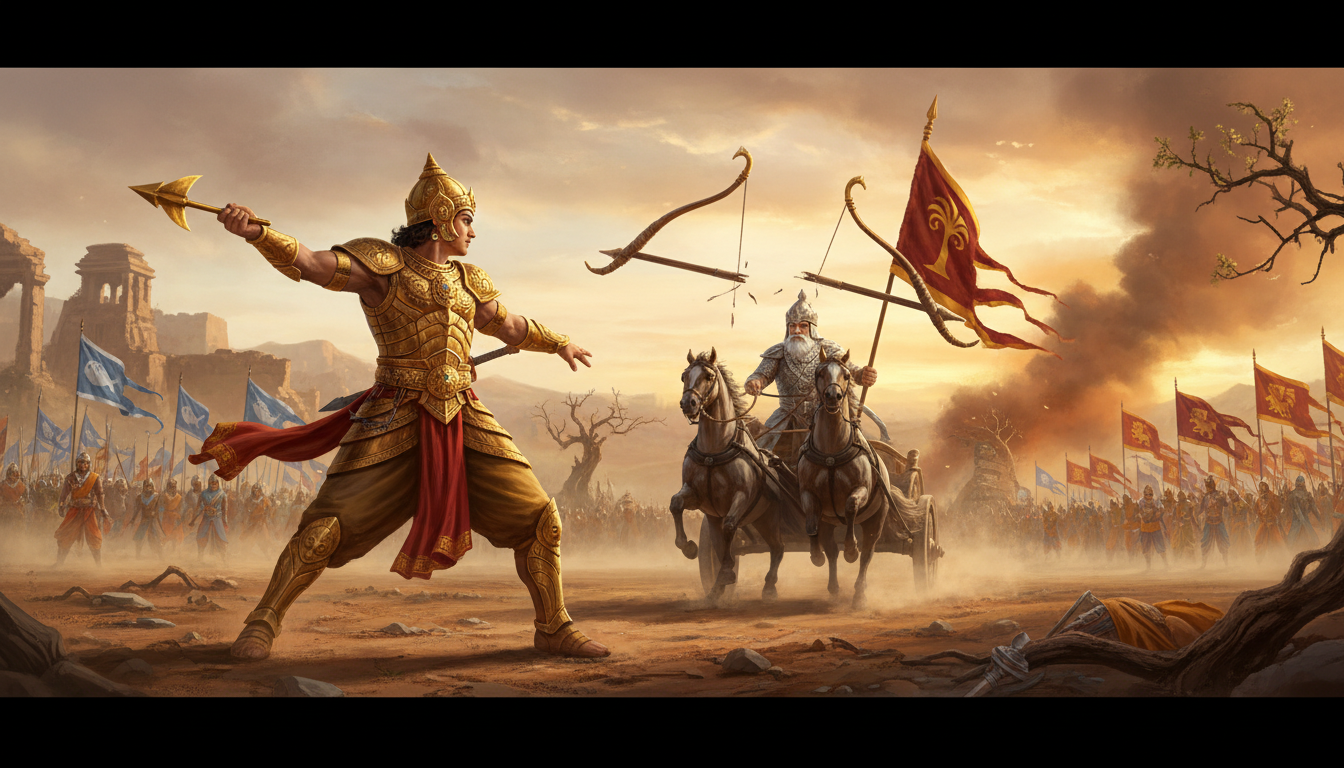
Shveta Against the Grandsire
The Matsya prince who broke Bhishma's bow again and again
Five Men Around One Old Man
"The greater part of the forenoon had worn away," Sanjaya said, "and the killing had settled into its shape. Then five of your car-warriors were sent forward at your son's word to stand around Bhishma and keep him alive: Durmukha, Kritavarman, Kripa, Shalya of Madra, and Vivinsati. With those five at his wheels the grandsire went straight into the Pandava host."
The palmyra standard was the thing everyone watched. It was tall, made of silver, decked with jewels, and it did not stop moving. It slid through the Chedis and then through the men of Kashi, and then through the Karushas, and then into the Panchalas, and behind it the broad-headed shafts came out perfectly straight and took off heads, and yokes, and standards, so that a chariot passed and its driver was still upright and had no head. Elephants struck in the vital parts shrieked and went down on their knees.
"He seemed to dance on that car," Sanjaya said. "I am telling you what I saw, O king. A man of that age, on a car running at speed, and he moved on the terrace of it as though the ground under him were still."
Dhritarashtra said nothing. He had asked for the account and now he had to have it.
On the other side of the field a young man watched the palmyra slide through his father's allies and turned his horses towards it. Abhimanyu's steeds were of a tawny colour and his standard bore a karnikara tree worked in pure gold, and he came at the five with no support at all.
The Boy Who Cut the Palmyra Down
He struck the palmyra standard first, with one keen-edged shaft, to say what he had come for. Then he took the five of them apart in order: Kritavarman with one arrow, Shalya with five, his own great-grandfather with nine. One shaft from a bow drawn to its fullest stretch cut away a standard worked in pure gold. One broad-headed shaft, capable of penetrating every cover, took the head off Durmukha's charioteer. One keen-edged arrow cut Kripa's gold-decked bow in two.
He was smiling. He seemed to be dancing on his own car as he shot, and his bow, drawn and drawn again, made a circle like a wheel of fire, and it twanged the way Gandiva twanged. The car-warriors around Bhishma looked at that lightness of hand and every one of them thought the same thing, which was that this was Dhananjaya come back young.
Bhishma rushed him and pierced him with nine arrows and cut off his standard with three and struck his charioteer, and Kritavarman and Kripa and Shalya all pierced him too, and none of it made him waver. He stood like the Mainaka mountain and went on shooting at five men at once.
Then he cut Bhishma's bowstring shafts out of the air, and then, with nine arrows, he cut down the palmyra itself.
The tall silver standard with the device of the palm tree came over and fell on the earth. A shout went up from the whole Pandava line, and Bhima's voice was in it, roaring for Subhadra's son. Ten great bowmen drove out to cover the boy: Virata with his son, Dhrishtadyumna of Prishata's race, Bhima, the five brothers of Kekaya, and Satyaki.
Bhishma took the Kekayas and the Panchala prince and Satyaki as they came, and with one winged arrow, whetted and sharp as a razor, he cut off Bhimasena's standard, and the golden lion came down off the car and into the dust.
Uttara and the Elephant
Virata's younger son took an elephant into it. Uttara came at the king of Madra on a tusker with its trunk raised, and Shalya's driver could not turn out of the way in time.
The beast put one leg up on the yoke of Shalya's car and killed all four of his steeds where they stood.
Shalya, standing in a chariot that was now nothing but a box on the ground, took up a dart made wholly of iron, shaped like a snake, and threw it up at the boy on the elephant's neck. It went through the coat of mail. Uttara lost his senses entirely and came off the neck, and the hook and the lance fell out of his hands before he hit the earth.
Then Shalya took his sword, jumped down from the useless car, walked up to the elephant, and cut off its trunk. The animal, its hide already full of arrows, screamed once and fell over and died. The king of Madra climbed up onto Kritavarman's car and went on with the day.
"That was the first of Virata's sons," Sanjaya said. "He was young, O king, and he had boasted a great deal in his father's hall about what he would do in a war, and he had come to Kurukshetra to do it. He lasted until the middle of the first afternoon."
A little way off, his elder brother saw the elephant fall and saw Shalya alive on Kritavarman's chariot, and blazed up the way fire blazes up when clarified butter is poured into it.
Seven Bows in Half a Wink
Shveta was the commander of the Pandava host, and he did not send for orders. He stretched a bow that was as large as Indra's own and drove at Shalya with a whole division of cars behind him, pouring arrows the entire way.
Seven of your warriors closed around the king of Madra, who by then was plainly inside the jaws of Death. They were Brihadbala the ruler of the Kosalas; Jayatsena of Magadha; Rukmaratha, who was Shalya's own son; Vinda and Anuvinda of Avanti; Sudakshina the king of the Kambojas; and Jayadratha the ruler of the Sindhus. Seven stretched bows painted in seven different colours, and they looked like lightning in cloud, and they all rained on Shveta's head at once.
He answered with seven broad-headed arrows and cut all seven bows.
"In less time than a man takes to blink," Sanjaya said, "they had seven other bows up and strung and shooting. And he cut those too, with seven more shafts, and I do not know how he saw them all."
So the seven took up darts instead and shouted and hurled them together, seven blazing things that went through the air like meteors with the sound of thunder in them, and he cut every one of them out of the sky before it arrived.
Then he chose an arrow that would go into any part of a body and put it into Rukmaratha, and the king of Madra's son sat down on the floor of his own car in a deadly swoon and had to be driven off the field in front of everyone by a charioteer who did not lose his nerve. Six more gold-decked arrows took the tops off six standards. Then Shveta killed their horses and their drivers, buried the six of them under shafts, and went on towards Shalya's car.
A sound of oh and alas went up out of the Kaurava army. Duryodhana went forward himself with Bhishma at his head and a mass of troops behind, and pulled the king of Madra out of the mouth he had walked into.
Everything Turns Toward the Gold-Decked Car
Dhritarashtra said, "When that great bowman went for Shalya's car, what did the Kauravas and the Pandavas do? And what did Bhishma the son of Santanu do? Tell me, who ask thee, all of it."
"Bulls among Kshatriyas by hundreds and by thousands," Sanjaya said, "put the commander Shveta in the van and Shikhandi at their head, and went at one target. They wanted Bhishma. They came at that car decked with gold to kill the man standing in it, and the battle that followed was a terrible thing.
"He emptied the terraces of chariots. He shot with the energy of the Sun and shrouded the Sun with what he shot, and he cleared the ground around himself the way morning clears the dark. Arrows went out of that bow in hundreds and in thousands and took the lives of Kshatriyas nobody afterwards counted. Heads came off by hundreds. Elephants in mail went down like mountain summits struck by the bolt of heaven.
"Cars ran up onto cars. Horses lay across horses. Riders who were dead went on being carried about the field by their own chargers, hanging out of the saddle with the bow still shut in the hand. Men lay in rows with their quivers still strapped on and their armour loosened, sleeping on the bed that is proper for heroes.
"And then the dust came up and there was nothing to see by. Men shot at the sound of a bowstring, and at the sound a division makes, and knew who was in front of them by the press of a body against theirs. You could not hear an arrow hiss. The drums were so loud they seemed to go through the ear. A man shouted his own name while he was doing something worth a name, and nobody heard it. A father, O king, could not recognise the son of his loins in that."
What Sanjaya Admitted
"And in that battle," Sanjaya said, "Shveta made a slaughter of the Kurus. He killed noble princes by hundreds upon hundreds. He cut off the heads of car-warriors by hundreds upon hundreds, and their arms with the angadas still on them, and their bows lying all around. Car-warriors and wheels and the men who ride on cars and the cars themselves, standards both cheap and costly, whole bodies of horse, crowds of chariots, crowds of men - Shveta destroyed them.
"I will tell you the rest of it plainly, O king, because you asked. We ran.
"From fear of Shveta we abandoned Bhishma, the best of our car-warriors, and left the battle, and went to the rear. That is why your lordship still has me here to speak to you. All the Kurus stood back out of the range of arrows, armed for the fight, and watched it like spectators, and left Santanu's son where he was.
"He was cheerful. That is the thing I cannot get out of my mind. In an hour when there was no cheer anywhere in the world, that tiger among men stood alone out of our whole army, immovable as the mountain Meru, taking lives the way the Sun takes moisture at the close of winter, and the golden rays of his car were around him so that he looked like the Sun with his own rays. Devoted to Duryodhana's good, careless of a life that is very hard to throw away, he set about consuming the Pandava army by himself, and those who were being killed broke out of their ranks and ran from him as men run from a fire that has been given fuel.
"But wherever he went, Shveta was in the way of it. And so at last your father, who is called Devavrata, saw the commander cutting his divisions to pieces, and drove at him."
Bow After Bow After Bow
They covered each other in nets of arrows and then came on roaring like two bulls, or two elephants in rut, or two tigers, each one meaning to have the other's life, and each one's weapons cancelling the other's.
"In one single day," Sanjaya said, "Bhishma in that temper could have burned the whole Pandava army to ash. He did not, because Shveta was standing in front of it."
Duryodhana saw the grandsire turned aside and lost his colour. He came in with a crowd of kings behind him and threw himself at the Pandava host, and Shveta simply left the son of Ganga where he stood, went across, and knocked your son's troops down like wind going through trees. Then, senseless with anger, he came back to the place where Bhishma was.
Seven arrows into the old man, drawn to the full stretch. Bhishma checked him the way one rutting elephant checks another. Shveta struck again; Bhishma answered with ten; Shveta stood under them like a hill and did not move; then he put twenty-five straight arrows into Santanu's son, and every man who saw it wondered.
Then, smiling, licking the corners of his mouth, he cut Bhishma's bow into ten pieces with ten arrows. Then he took a plumed shaft made wholly of iron and crushed the palmyra on the top of the standard.
Your sons saw that standard come down and believed Bhishma was dead. The Pandavas blew their conches all around the field.
"Either Shveta dies today," Duryodhana said to the men standing idle, "or Bhishma the son of Santanu. I say this truly."
So they went in with four kinds of forces to shield him: Valhika, Kritavarman, Kripa, Shalya, the son of Jarasandha, Vikarna, Chitrasena, Vivinsati, all around him, all shooting. Shveta held the lot of them off with sharp arrows, the way a lion holds off a herd of elephants, and while he was doing it he cut Bhishma's bow again. Bhishma took up another and shot Kanka-feathered arrows into him, and the commander of the Pandava army put a great many shafts into Bhishma in the sight of everyone, and cut, with a broad-headed shaft, the third bow out of the old man's hands.
The Dart, the Mace, and the Voice
Bhishma threw that broken bow aside and took up a larger one, and he was senseless with anger now, and he aimed seven great broad-headed arrows whetted on stone.
Four of them killed Shveta's four horses. Two of them cut down his standard. The seventh took off his charioteer's head.
Shveta jumped down from a chariot that had nothing left to pull it and nobody to drive it. Bhishma began to smite him on all sides where he stood, and Shveta left his bow behind on the dead car and picked up a dart decked with gold, a terrible thing like the fatal rod of Death, of which men said that it could kill Death himself.
"Wait a little," he called across to Bhishma, "and behold me, O best of men."
Then he threw it. It went like a snake that has just come out of its slough, and it fell through the air with the weight of a large meteor, and your sons cried out oh and alas when they saw what was coming.
Bhishma was not afraid of it. He cut it into nine fragments with eight sharp winged arrows while it was still burning in the air, and the whole Kaurava army shouted.
Shveta looked at the pieces of his dart coming down and could not settle what to do, like a man whose hour has arrived. Then he laughed, and took up a mace, and his eyes went red, and he came at Bhishma like a second Yama, like a swollen torrent coming down on rock.
Bhishma, who knew exactly what he was looking at, stepped down off his chariot onto the ground to get out of the path of that blow.
Shveta whirled the mace and threw it. It hit the car and reduced it to ashes, standard and charioteer and horses and shaft together.
And then, while Bhishma stood in the dirt on his own feet and Shalya and the others rushed to cover him, and while he was mounting another car and stringing his bow without any joy in it, he heard a voice in the sky. It was celestial, and it was speaking for his good.
"O Bhishma, O thou of mighty arms, strive without losing a moment. This is the hour appointed by the Creator of the Universe for success over this one."
The Shaft That Went Into the Ground
They all came for him then. Satyaki, Bhimasena, Dhrishtadyumna of Prishata's race, the five Kekaya brothers, Dhrishtaketu, Abhimanyu, every one of them driving to get a chariot under Shveta before it was finished. Bhishma, with Drona and Shalya and Kripa beside him, held them the way a mountain holds the wind.
And while they were held, Shveta took a sword and cut the grandsire's bow one more time.
Bhishma cast the ruined bow away. He had heard the voice and had made up his mind. He took another that shone like Indra's own and strung it in a moment, and though the commander of the Pandava host was standing surrounded by tigers among men with Bhimasena at their head, the son of Ganga advanced steadily and only for him.
Bhima put sixty shafts into Bhishma to stop him and it did not stop him. He checked Bhima and Abhimanyu and the rest with terrible arrows, struck Bhima with three straight ones, struck Satyaki with a hundred, Dhrishtadyumna with twenty, the Kekayas with five each, and went on walking his horses towards the one man.
Then he drew out a shaft like Death itself, one that would bear any strain and could not be resisted, laid it on the string, and charged it with the Brahma weapon.
The gods saw it. So did the Gandharvas, and the Pisachas, and the Uragas, and the Rakshasas. It left the bow with the light of a fire on it, went through the coat of mail, went through the body, came out the other side and struck into the earth with a flash like the bolt of heaven. It carried his life out with it the way the Sun, going quickly to his western chambers, takes his rays away with him.
Shveta fell like the loosened crest of a mountain.
The Withdrawal in Silence
The Kshatriyas of the Pandava side stood over him and gave way to lamentation. Your sons and all the Kurus were filled with delight, and Dushasana came out onto the open field and danced there, with conches and drums keeping time for him, in front of both armies.
The great bowmen with Shikhandi at their head trembled. Then Dhananjaya and he of Vrishni's race, seeing the sun going and the commander dead, drew the troops off slowly for the night. Both hosts withdrew together, roaring at one another as they went, and the mighty car-warriors of the Parthas came into their quarters cheerless, thinking about a single combat that had gone on for most of an afternoon and had ended one way.
Dhritarashtra could not leave it alone. "Hearing of our victory, thy words please my heart," he said, "and my heart feels no shame in remembering our transgression. Bhishma never liked this war. Nor the preceptor. Nor Kripa. Nor Gandhari. Nor I. Nor Vasudeva of Vrishni's race, nor that just king the son of Pandu, nor Bhima, nor Arjuna, nor the twins. Forbidden by me, by Gandhari, by Vidura, by Rama the son of Jamadagni, by the high-souled Vyasa, that wicked-minded boy went on with Dushasana at his ear and Karna and Suvala's son at his shoulder. Why, then, O Sanjaya, has Shveta been slain, who was devoted to Yudhishthira?"
"Hear about your own transgressions quietly, O king," Sanjaya said, "and do not lay the fruit of them on Duryodhana. Your understanding is like an embankment built after the waters have gone down. It is like digging a well when the house is already burning."
And he went on with the account, because there was more of that day left. Virata's third son Sankha saw Shalya standing on Kritavarman's car and blazed up exactly as his brother had, and drove at the king of Madra with an arrowy downpour, and seven car-warriors closed around Shalya again, and Bhishma came roaring like the clouds with a bow six cubits long, and Arjuna put his own chariot in front of Sankha's to keep the old man off him. Shalya got down with a mace and killed Sankha's four horses, and Sankha took a sword and ran for Arjuna's car and got up onto it and was safe.
After that Bhishma left Arjuna and went for Drupada, and covered his own dear relative with arrows until the Panchala troops burned like a forest at the end of winter, and the Pandavas looked around for a protector and found none, and stood like cattle in the cold. He named the car-warriors he intended to kill before he killed them. Then the sun set, and there was nothing to be seen, and the Parthas took their army home.
Dharma Lesson
The measure of a fighter is not whether he won but how long the unbeatable man had to work. Shveta lost, and the losing took an afternoon, three bows, a burned chariot, a message from heaven and a celestial weapon. A defeat bought at that price is not the same thing as being beaten.