Blood in a Golden Bowl
The dice went badly for the king of the Matsyas all that afternoon, and he did not care, because the news from the northern pastures had reached the palace ahead of his son and it was better than any throw.
"My female slaves and my kine, my gold and whatever other wealth I have," Virata said, sweeping a hand across the board, "nothing of all this shalt thou be able to protect today, even if I do not gamble."
"What business hast thou with gambling, O bestower of honours?" said Kanka, who had kept the ivories for him for a year and had never once been seen to want to win. "It is attended with numerous evils and should therefore be shunned. Thou hast seen, or at the least heard of, Yudhishthira the son of Pandu. He lost an extensive and prosperous kingdom at dice, and his god-like brothers with it. For that reason I am averse to the game. But if thou likest, O king, I will play."
They played. The king could not keep off the subject that was warming him. "Lo," he said, "the Kauravas, who are so formidable, have been vanquished in battle by my son."
"Why should he not conquer," said Kanka, without lifting his eyes from the board, "who has Brihannala for his charioteer?"
Virata's hand stopped above the dice. "Wretch of a brahmana. Dost thou compare one of the third sex with my son? Hast thou no knowledge of what is proper and what is improper for one to say? Without doubt thou disregardest me. For friendship only I pardon thee this offence. Thou must not, however, say so again, if thou wishest to live."
A prudent servant would have bowed his head. The courtier went on.
"There where Bhishma is, and Drona, and Drona's son, and the son of Vikartana, and Kripa, and king Duryodhana, and other royal and mighty car-warriors are assembled, or there where Indra himself stands surrounded by the Maruts, what other person than Brihannala could fight, encountering them all? None has been his equal in strength of arms, and none will be. It is he alone whose heart is filled with joy at the sight of a terrible conflict. With such a one for his ally, why should thy son not conquer the foe?"
"Forbidden by me repeatedly, thou dost not yet restrain thy tongue," Virata said. "If there is none to punish, no one would practise virtue."
He took up a die and struck the courtier in the face with it.
Blood ran from Kanka's nose. He did not put a hand up to stop it. He cupped both palms beneath his own chin and caught the blood there before a drop of it could reach the floor, and over his full hands he looked at the sairindhri standing behind his seat. She understood him without a word being said, went out, and came back with a golden vessel, and knelt, and held it under his face until the bleeding stopped.
The Vow Whispered to the Doorkeeper
While she was still holding the bowl, a porter came in and said that the prince Uttara waited at the gate with Brihannala for his companion.
"Usher in both," said Virata, cheerful again. "I am very anxious to see them."
The man turned to go, and the bleeding courtier said his name, quietly, and the porter bent down to him.
"Let Uttara enter alone," Yudhishthira whispered. "Brihannala must not come in. Such is the vow of that hero of mighty arms, that whoever causes a wound on my person or sheds my blood, except in battle, shall not live. Inflamed with rage, he will never bear patiently to see me bleeding. He will slay Virata this very hour, with his counsellors and his troops and his steeds."
So Bhuminjaya, the king's eldest son, came in by himself. He worshipped his father's feet and then went across to the courtier, and stopped. Kanka was sitting on the ground at one end of the court, covered in blood, and the queen's sairindhri was crouched beside him with a golden vessel in her hands.
"By whom, O king, has this one been struck?" the prince said. "By whom has this sinful act been perpetrated?"
"This crooked brahmana has been struck by me," Virata said. "He deserves even more than this. When I was praising thee, he praised that person of the third sex."
"Thou hast committed an improper act," said Uttara. "Do thou speedily propitiate him, so that the virulent poison of a brahmana's curse may not consume thee to thy roots."
Virata heard his son and went to work at once on the man he had just struck, coaxing him, apologising, asking pardon of a fire that was hidden in ashes and did not look like fire at all.
"O king, I forgave it long ago," the Pandava said. "Anger I have none. Had this blood from my nostrils fallen upon the ground, then without doubt thou wouldst have been destroyed, O monarch, and thy kingdom with thee. I do not, however, blame thee for having struck an innocent person. They that are powerful generally act with unreasoning severity."
When the bleeding had stopped, Brihannala came in, saluted the king and the courtier both, and stood without speaking. Nobody in that hall thought anything of it. A dancing master had come in from the door, that was all, with a braid down her back and bangles on her arms, and had taken up a position where she could see the blood.
The Son of a Deity Who Would Not Stay
Then the king began to praise his son, and he took his time about it, because Brihannala was standing there and a father likes an audience.
"O enhancer of the joys of Kekaya's princess, in thee I have truly a son. I never had, nor shall have, a son that is equal to thee. How, indeed, couldst thou encounter that Karna, who leaves not a single mark unhit among even a thousand that he may aim at all at once? How couldst thou encounter that Bhishma, who has no equal in the whole world of men? How couldst thou encounter Drona, that foremost of all wielders of weapons, who may be regarded as the preceptor of all the Kshatriyas? How couldst thou meet in battle the celebrated Aswatthaman? How couldst thou encounter that Duryodhana, who is capable of piercing even a mountain with his mighty arrows? My foes have all been thrashed."
"The kine have not been recovered by me," Uttara said, "nor have the foe been vanquished by me. All that was accomplished by the son of a deity. Beholding me running away in fear, that youth of celestial origin stopped me and himself mounted upon my car. It was by him that the kine were recovered and the Kauravas vanquished. The deed, O father, is that hero's and not mine. He repulsed with arrows Kripa and Drona and Drona's son and the Suta's son and Bhishma. He said to Duryodhana, who was running away like the leader of a herd of elephants, 'O prince of the Kuru race, I do not see that thou art safe by any means even at Hastinapura. Protect thy life by putting forth thy might. Thou shalt not escape me by flight.' Beholding all this, venerable sire, my thighs began to quake. He pierced that crowd of cars, and laughed at them, and robbed them of their clothes and their attires. Six great car-warriors of the Kurus were vanquished by that one hero, as herds of animals ranging in a forest by a single tiger in rage."
"Where is that mighty-armed and famous youth of celestial origin?" said Virata. "I am anxious to behold and worship the warrior who has saved thee, and my kine also."
"The mighty son of a deity disappeared there and then," Uttara said. "I think, however, that he will show himself either tomorrow or the day after."
The king of the Matsyas nodded and let it go, and the son of Pandu who had done all of it stood four paces from his elbow with a braid hanging down his back. Later, permitted by the king, Brihannala carried in the fine garments taken from the routed Kurus and put them into the hands of the princess Uttaraa herself, and the girl was delighted with them, and so was her brother.
The Third Morning
Vaishampayana said: Then, on the third day, O king, the five brothers bathed, and finished their morning rites, and did not put on the clothes they had worn for a year.
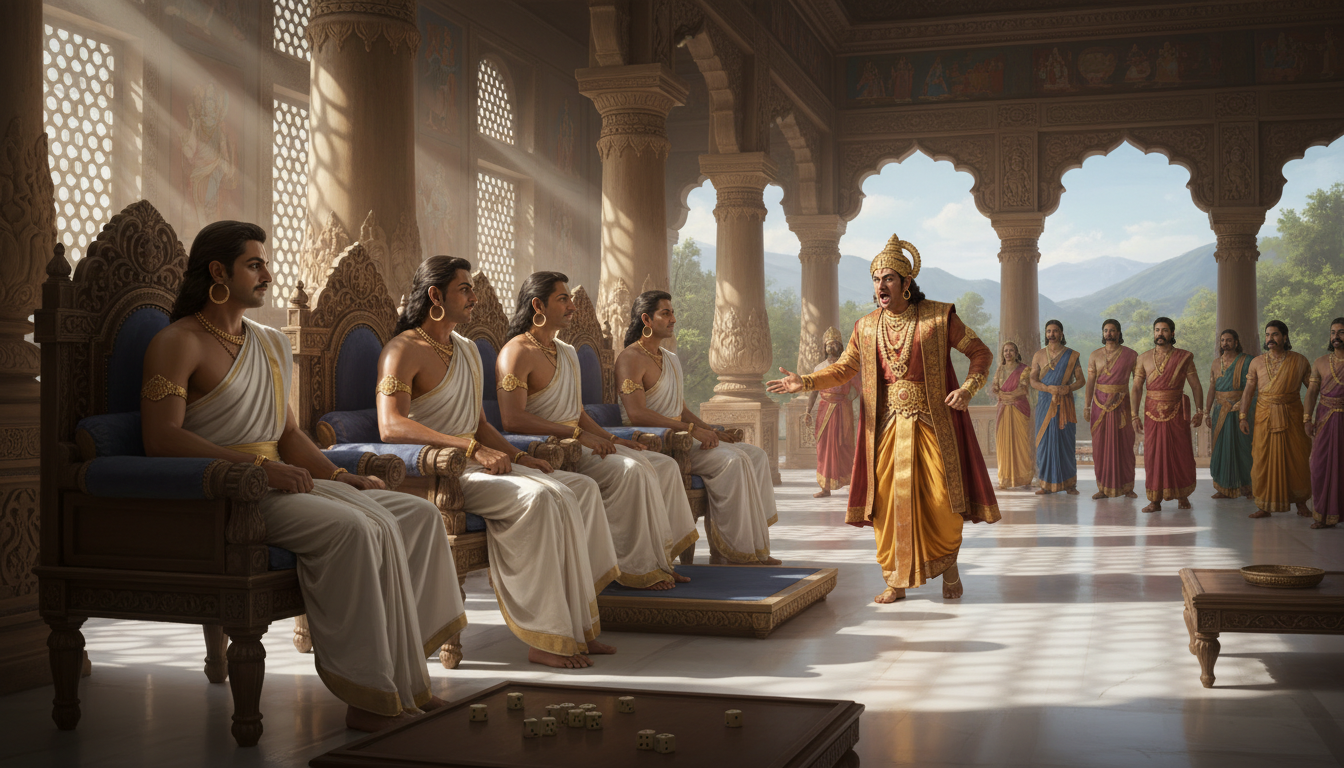
They dressed in white robes. They put on ornaments of all kinds, ear-rings and armlets and chains, the sort of things a cook and a groom and a cowherd do not own and had kept hidden somewhere in that palace for twelve months and three days. Then those five great car-warriors, with Yudhishthira at their head, walked in through the palace gate like five intoxicated elephants, went into the council hall of Virata, and sat down on the thrones that were reserved for kings.
They did not speak. They sat there and shone, like fires on a sacrificial altar.
The counsellors saw them and said nothing. The servants who had carried their food to them saw them and said nothing. Word went along the corridors the way water goes along a crack.
Then Virata came in, in his own time, to hold his council and discharge the other offices of a king, and stopped in his own doorway. Five men were sitting on his kings' seats, blazing like fires, and he knew every one of their faces and not one of their names. He reflected for a moment. Then the anger came up in him, and it fixed, as anger does, on the smallest and safest of the five things in front of him: on the dice-player he had struck two days ago, who was seated there like a celestial and looking like the lord of the celestials surrounded by the Maruts.
"A player at dice thou wert, employed by me as a courtier," the king of the Matsyas said. "How couldst thou occupy the royal seat, attired thus in handsome robes and ornaments?"
Nobody moved. Then the tall one at Yudhishthira's left, the one who had been teaching the king's daughter to dance since the last rains, began to smile, because he had been waiting a year for somebody to ask him a question like that one.
This One Deserves to Sit With Indra
"This person, O king," Arjuna said, "deserves to occupy the same seat with Indra himself."
Virata began to answer and did not get to it, because the dancing master had not stopped.
"Devoted to the brahmanas, acquainted with the Vedas, indifferent to luxury and to carnal enjoyments, habitually performing sacrifices, steady in vows, this one is the very embodiment of virtue. He is the foremost of all persons endued with energy and superior to everybody on earth in intelligence. Devoted to asceticism, he is conversant with various weapons. No other person among the mobile and the immobile creatures of the three worlds possesses, or will ever possess, such knowledge of weapons as he. There is none even amongst the gods, or the Asuras, or men, or Rakshasas, or Gandharvas, or the chiefs of the Yakshas, or the Kinnaras, or the mighty Uragas, who is like him.
"Endued with great foresight and energy, beloved by the citizens and by the inhabitants of the provinces, he is the mightiest of car-warriors amongst the sons of Pandu. A performer of sacrifices, devoted to morality, of subdued passions, like unto a great Rishi, this royal sage is celebrated over all the worlds. Possessed of great strength and great intelligence, able and truthful, he has all his senses under complete control. Equal to Indra in wealth and to Kuvera in hoarding, he is the protector of the worlds, like Manu himself."
Somewhere behind the throne a counsellor put a hand over his mouth. The king had asked how a servant dared to sit down, and the answer coming back was a catalogue of virtues delivered in the tone in which heralds announce an emperor, and the man himself sat quite still on the seat in question with a healing cut across the bridge of his nose.
The Count of What He Had
"The achievements of this king resemble the sun himself of blazing effulgence," Arjuna went on, "and his fame has travelled in all directions like the rays of that luminary. Like the rays that follow the risen sun, ten thousand swift elephants followed him, O king, when he dwelt among the Kurus. Thirty thousand cars, decked in gold and drawn by the best of steeds, used to follow him then. Full eight hundred bards, adorned with ear-rings set with shining gems and accompanied by minstrels, recited his praises in those days, as the Rishis adorn Indra. The Kauravas and the other lords of earth waited upon him always like slaves, as the celestials wait upon Kuvera. This eminent king made all the lords of earth pay tribute to him like men of the agricultural class. Eighty-eight thousand high-souled Snatakas depended for their subsistence upon this king of excellent vows. This illustrious lord protected the aged and the helpless, the maimed and the blind, as though they had been his sons, and he ruled over his subjects virtuously.
"Steady in morality and in self-control, capable of restraining his anger, bountiful, devoted to the brahmanas, and truthful: this one is the son of Pandu. The prosperity and the prowess of this one afflict king Suyodhana and his followers, Karna and the son of Suvala among them. And, O lord of men, the virtues of this one are incapable of being enumerated. He is devoted to morality and always abstains from injury. He is kind to all creatures. He is no other than the bull of the Kuru race, king Yudhishthira the just."
Arjuna let the name stand in the hall by itself for a moment.
"Possessed of such attributes, does not this bull among kings, this son of Pandu, deserve, O monarch, to occupy a royal seat?"
Virata did not answer that. A man does not answer that. He was standing in his own council hall looking at a courtier he had won at dice and kept for entertainment, and he was doing arithmetic with two days and one thrown die and the blood that a woman had caught in a golden vessel so that it should not touch the floor of his house.
Then Which of These Is Bhima
"If this one, indeed, be the Kuru king Yudhishthira, the son of Kunti," Virata said at last, and his voice had changed, "then which amongst these is his brother Arjuna, and which the mighty Bhima? Which of these is Nakula, and which Sahadeva, and where is the celebrated Draupadi? After their defeat at dice the sons of Pritha have not been heard of by any one."
"Even this one, O king, who is called Vallava and is thy cook," Arjuna said, "is that Bhima of mighty arms and terrible prowess and furious impetus. It was he who slew the furious Rakshasas on the mountains of Gandhamadana and procured for Krishna celestial flowers of great fragrance. Even he is that Gandharva who slew the Kichaka of wicked soul, and it was he who killed the tigers and the bears and the boars in the inner apartments of thy palace.
"He who has been the keeper of thy horse is that slayer of foes called Nakula, and this one is Sahadeva, the keeper of thy kine. Both these sons of Madri are great car-warriors, possessed of great fame and beauty of person, and these two bulls of the Bharata race, attired in handsome robes and decked in excellent ornaments, are a match between them for a thousand great car-warriors.
"And even this lady of eyes like lotus petals, of slender waist and sweet smiles, is Drupada's daughter, thy wife's sairindhri, for whose sake, O king, the Kichakas were slain.
"I am Arjuna, who, it is evident, thou hast heard is that son of Pritha, Bhima's junior and the senior of the twins. We have, O king, happily passed in thy abode the period of non-discovery, like infants in the womb."
The cook. The groom of horses. The boy who slept in the cow-pen. The maidservant whose Gandharva husbands had killed a hundred and six Sutas in one night, and who stood now against the same pillar she had stood against on the morning they took her out to the burning ground.
What the Prince Saw From the Chariot
Then Virata's son spoke, and he identified the sons of Pritha a second time, because he had spent a day on a chariot floor watching one of them and he had learned to look at men.
"That one whose complexion is bright like pure gold, who is stout like a full-grown lion, whose nose is so prominent, whose eyes are large and expansive, and whose face is broad and of a coppery hue, is the king of the Kurus. And behold, that one whose tread is like that of an infuriate elephant, whose complexion is like heated gold, whose shoulders are broad and expanded, and whose arms are long and thick, is Vrikodara. And he who stands by his side, that youth of darkish hue, like a leader of a herd of elephants, whose shoulders are broad like a lion's and whose eyes are large and expansive like lotus leaves, is Arjuna, that foremost of bowmen. And close to the king are those foremost of men, the twins, like Vishnu and Indra, who have no equals in the world of men in beauty, in might, or in behaviour. And close by them, behold, stands Krishna, beautiful as gold, like the very embodiment of light, having the complexion of the blue lotus, resembling the living embodiment of Lakshmi herself."
Then he described what that dark youth had done in front of him.
"Even this one is he that slew the foe, like a lion devastating a flock of deer. He ranged through crowds of hostile cars, slaying their best of car-warriors. By him was a huge and infuriate elephant slain by means of a single arrow, and that great beast, its flanks adorned with an armour of gold, fell down piercing the earth with its tusks. By him have the kine been recovered and the Kauravas vanquished in battle. My ears have been deafened by the blare of his conch. It was by this hero of fierce deeds that Bhishma and Drona, along with Duryodhana, were vanquished. That achievement is his, and not mine."
It was the second time in three days the boy had said that last sentence in that hall. The first time nobody had believed him.
The Sceptre, the Treasury and the City
The king of the Matsyas heard his son out and understood, all at once and completely, what he had done with a die two days ago.
"I think the time has come for me to propitiate the sons of Pandu," he said to Uttara, low. "And, if thou likest, I shall bestow my daughter Uttaraa upon Arjuna."
"Worthy of our adorations and our worship and our respect," the prince answered. "The time has come for worshipping the illustrious sons of Pandu, who deserve to be worshipped by us."
Then Virata turned and spoke to the whole hall, and to the five men on the thrones.
"When I was brought under the subjection of the foe in battle, it was Bhimasena that rescued me. My kine also have been recovered by Arjuna. It is through the might of their arms that we obtained our victory. Such being the case, all of us, with our counsellors, shall propitiate Yudhishthira the son of Kunti. Blessed be thou, with all thy brothers, O bull among the sons of Pandu. If, O king, we have ever said or done anything in ignorance to offend thee, it behoves thee to forgive us. The son of Pandu is virtuous."
He came down to Yudhishthira and made an alliance with him, and offered him his whole kingdom, with the sceptre and the treasury and the metropolis, in front of his court.
Then he could not stop talking. "By good luck it is that I see you," he said, again and again. He embraced Yudhishthira, and Bhima, and the two sons of Madri, and smelt their heads as a father does, and stood back and looked at them and was not satisfied with looking, and embraced them again. "By good luck it is that I see you safe out of the woods. By good luck it is that ye have accomplished, with such difficulty, the period of exile, undiscovered by those wicked wights. I make over my entire kingdom to the sons of Pritha, and whatever else I have. Let the sons of Pandu accept it without the slightest hesitation."
As My Daughter-in-Law
"And let Dhananjaya, who is called also Savyasachin, accept the hand of Uttaraa," Virata finished. "For that best of men is fit to be her lord."
It was the highest thing the king had left to give, and he gave it to the one who had recovered his cattle. Everyone in the hall looked at Arjuna. Arjuna looked at his eldest brother, and Yudhishthira met his eyes and said nothing at all, which was permission.
"O monarch," Arjuna said, "I accept thy daughter as my daughter-in-law. An alliance of this kind between the Matsyas and the Bharatas is, indeed, desirable."
He had lived a year in the women's apartments of that palace. He had dressed the girl's hair and corrected her steps and let her lean against him unafraid, and men had watched her come and go from his rooms and thought nothing of it, and he would not now take as a wife a girl who had trusted him as she would have trusted a father. He would take her for his son, and the son's name was Abhimanyu, and Uttaraa would go to him instead.
So the year ended. Not with a discovery, not with a spy at a door or a name shouted in the street, but with five men who chose one morning to bathe, and dress, and walk in, and sit down on the seats that were theirs, and wait to be asked why.
Vaishampayana said: thus, O Janamejaya, did the sons of Pandu complete the thirteenth year, and the king of the Matsyas, who had housed them, and fed them, and struck one of them in the face, became their kinsman and their ally. From that hall the messengers went out to Dwaraka and to Panchala, and the war that had been waiting thirteen years for them began to gather its kings.
Dharma Lesson
A disguise ends not when it is discovered but when the wearer chooses to set it down. Yudhishthira endured a die thrown in his face and forgave it, because the vow he had made covered the insult and the year was not yet complete; when the year was complete he did not announce himself, he simply sat where he belonged. Virata's greatness is that on learning the truth he did not defend himself but asked forgiveness and handed over everything he had.