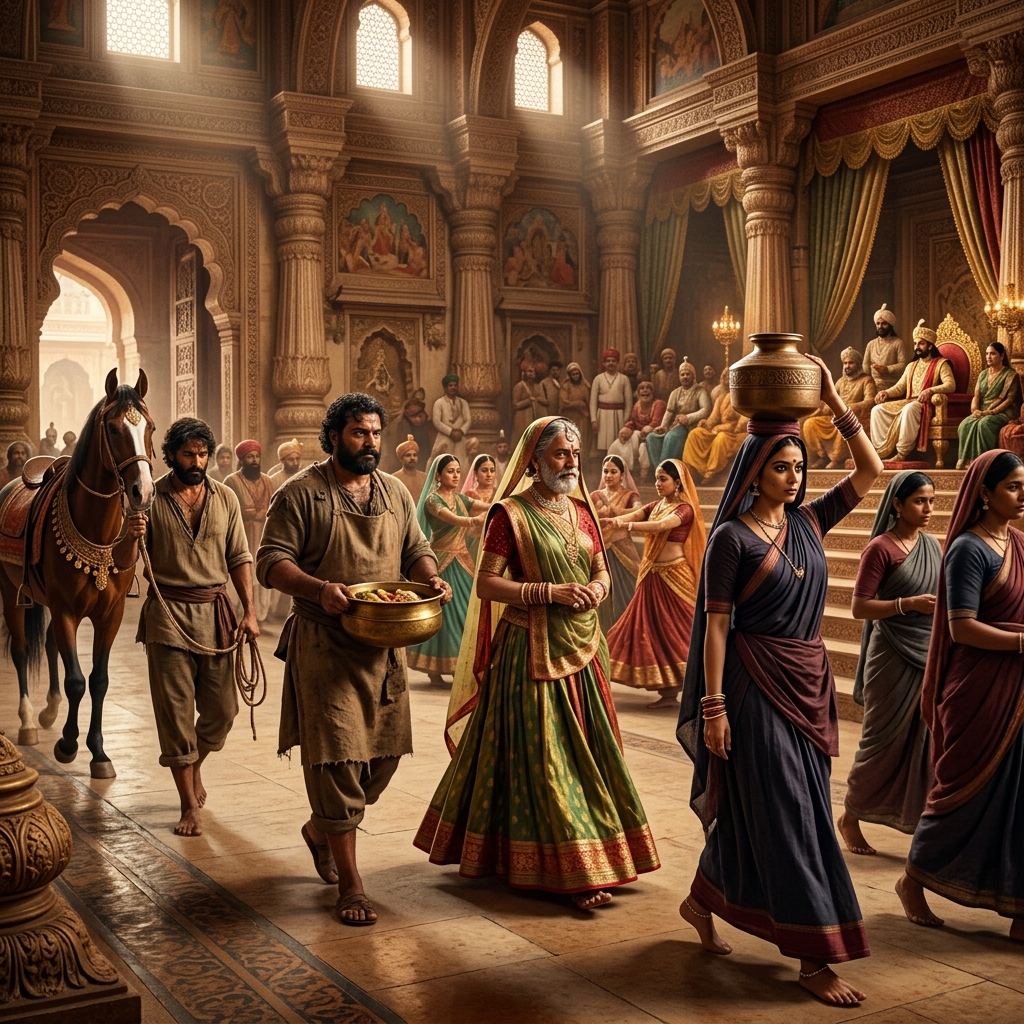
The Dice Master's Disguise
Of the five Pandavas doomed to spend a thirteenth year of their exile hidden from every eye that might know them, none carried a stranger penance into hiding than Yudhishthira. The others took disguises that hid what they were, Bhima becoming a cook, Arjuna a eunuch dance teacher, the twins grooms of horse and cattle, Draupadi a queen's maid, but Yudhishthira, the man whose weakness for a game of dice had once cost his brothers a kingdom and his wife her honor before the whole Kuru court, chose to walk into King Virata's hall as Kanka, a brahmin courtier whose one professed skill was exactly that: dice. Of all the roles the year demanded, it was the one no counselor would have advised, a wound worn openly rather than hidden.
It was a strange choice only until one understood the man making it. The old dice game at Hastinapura, where Shakuni's loaded throws had stripped Yudhishthira of his kingdom, his brothers' freedom, and very nearly Draupadi's dignity, was not a story Kanka needed retold in Virata's court, its weight rode silently under every game he played there. To take up dice again, this time for nothing but a provincial king's evening amusement, with no throne and no wife staked on the outcome, was Yudhishthira's own chosen penance: a jest worn as discipline, the emperor who had once gambled away an empire now rolling bones for the pleasure of a minor Matsya king who had no idea whom he was entertaining, and who would have been astonished to learn that the empire the brahmin once ruled had been larger than his own kingdom many times over.
The Conscience of Virata's Court
Kanka settled into the Matsya court more completely than his brothers could manage in their own disguises. Virata, delighted with a brahmin companion who could match him game after game without ever demanding a real stake, kept Kanka close, consulting him on matters well beyond dice, a dispute between courtiers, a question of how to receive an envoy, the fair division of some minor tribute. Kanka answered every question with the same measured judgment that had once made Yudhishthira famous as the most honest man among kings, and within months the brahmin dice player had become, without anyone quite noticing the shift, something like the conscience of Virata's hall. Even Virata's own ministers, jealous at first of a newcomer's easy access to the king, learned to bring him their disputes before bringing them to the throne, trusting his rulings more than they would have admitted aloud.
The role suited him and cost him nothing he had not already learned to give up. He played for small stakes and never for anything that mattered, watching his own old hunger for the game rise and pass without ever again reaching for more than the throw in front of him. His brothers, scattered through the same palace under their own names and faces, saw him only at a careful distance, Bhima swinging cleavers in the kitchens, Arjuna teaching dance and music to the princess and the women of the court, Nakula and Sahadeva out among the horses and cattle, Draupadi serving Queen Sudeshna as her hairdresser, each of them keeping to a separate corner of the same charade, waiting out the year Duryodhana's spies were sworn to end in disaster the moment any one of them was recognized.
A Year of Silence
The months passed slowly and, for the most part, safely. Kanka watched Virata's kingdom from the vantage of a man with nothing left to protect and no throne to defend, and something in that watching steadied him in ways his own crown had never managed to. He had entered the year still raw from thirteen years of exile and the memory of the dice game that had started it all; he left it, month by month, less a dispossessed king wearing a disguise and more simply a man who had learned to sit quietly in someone else's hall and do good with the little influence a brahmin courtier actually had. There was, in that small good, something closer to the dharma he had studied all his life than any throne had ever let him practice.
It was not an easy peace. Word reached the hidden Pandavas, through allies who knew where to look, that Duryodhana's spies were combing every kingdom in reach for five men and one woman who had vanished too completely to have simply died in the forest, and each report of a near discovery, a rumor here, a suspicious glance there, tightened the year's last months into something close to dread. Kanka bore that dread the way he bore everything else that season, without letting it show in a single unsteady throw of the dice, playing out his own private penance to its very last week even as the kingdom around him edged, without his household even faintly suspecting it, toward the one crisis that would finally test whether the disguise could hold.
The Raid on Virata's Cattle
That crisis arrived in the year's final days, when a Kaurava raiding force struck deep into Matsya territory and drove off great herds of Virata's cattle almost within sight of the capital. Virata rode out himself to answer the raid and, in his absence, a second and far more dangerous force appeared: Duryodhana's own army, come not merely for cattle but, it was quietly understood among those who knew the truth, hoping to smoke the hidden Pandavas out of whatever Matsya corner they were using as a refuge.
Prince Uttara, Virata's young son, boasted in the hall that he alone would drive off this second army if only he had a competent charioteer, and Kanka, seated nearby, suggested that Brihannala, the dance teacher lodged in the women's quarters, whom the household knew as a eunuch and nothing more, had once served as Arjuna's own charioteer and might do the job. Uttara, more comfortable boasting before the ladies of the court than actually facing the Kuru army, rode out with Brihannala at the reins and immediately lost his nerve at the size of the force arrayed against him. What followed on that battlefield, Brihannala's dropped disguise, the retrieval of a bow no ordinary dance teacher should have known how to string, and a single chariot holding an entire army at bay, belongs to its own telling. What matters here is only its ending: the cattle recovered, the Kaurava army driven off, and Uttara riding home no longer a boasting boy but a prince who had watched, at very close range, exactly what his kingdom's rescue had actually cost someone else to achieve.
The Dice Board and the King's Blood
Virata returned from his own smaller victory over the cattle raiders to find the capital buzzing with news of the second battle, and that evening, seated once more across the dice board from Kanka, he could not stop boasting of his son. Uttara had beaten back the entire Kuru army alone, Virata said, thrilled at the thought of a boy prince matching Bhishma and Drona and Karna on the same field, and by the arrangement Arjuna himself had asked for, Uttara had said nothing publicly to correct his father's version of events, protecting Brihannala's secret for the disguise's last precious days.
Kanka, listening to Virata's pride swell past what the truth could bear, made the one remark the year's entire discipline should have taught him to swallow: that a boy could not likely have driven off that army alone, and that the true credit more probably belonged to Brihannala, who had ridden out as his charioteer. It was, in its way, the plainest and most honest thing anyone had said in Virata's hall all evening, and it was also, to a proud father in the flush of his son's glory, an unforgivable insult. Virata, dice board still in hand, struck Kanka across the face with it before the words had fully left the brahmin's mouth, opening a cut that began, at once, to bleed toward the floor.
Yudhishthira did not strike back, and did not even flinch away. He caught the blood in his cupped hands before a single drop could touch the ground, for it was held among kings that royal blood spilled onto bare earth by another king's hand brought a doom on the striker that no penance could lift, and Kanka, brahmin courtier and hidden emperor both, would not let Virata's temper cost him that price for a truth spoken too soon. The Matsya king never learned, that night, whose blood he had so nearly let fall.
Dharma Lesson
Even in disguise and playing a game that once ruined him, Yudhishthira cannot help choosing truth over a courtier's comfortable silence, and pays for it in his own blood rather than let it fall and doom the man who struck him. The episode shows dharma as a habit deeper than circumstance: a king with nothing left to lose still protects the very man who wrongs him.