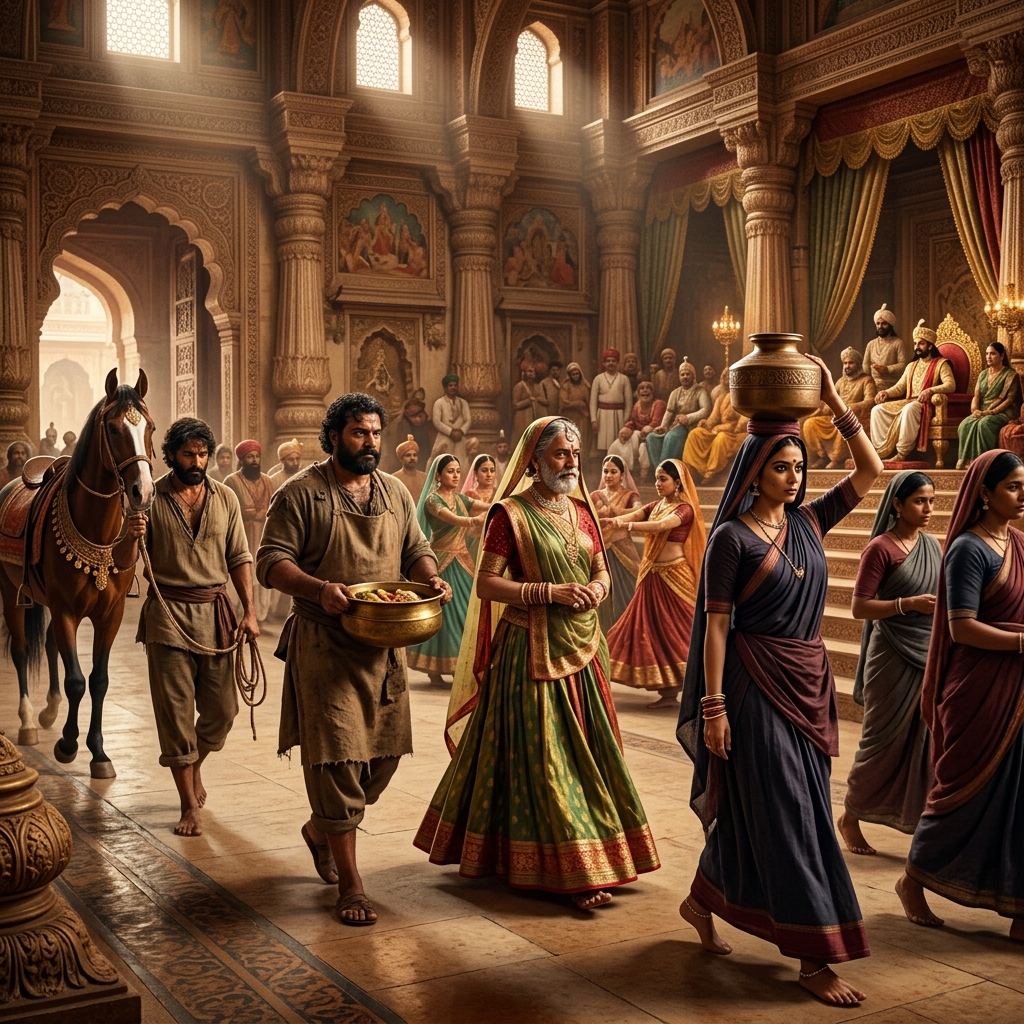
The Two Who Chose Last
When the brothers divided the year among themselves under the tree outside Matsya, the two youngest waited until everyone else had spoken.
Yudhishthira would be a Brahmana who played dice for a king's amusement. Bhima would cook. Arjuna would dance. Draupadi would dress hair for a queen. And then there were the twins, who had spent thirteen years of exile being the two nobody wrote down.
"Horses," Nakula said. "I will keep his horses. I know them. I know how to break them and how to feed them and what to do when they sicken, and there is not one part of it I would have to pretend."
"Cattle," said Sahadeva. "I will count his cows."
Yudhishthira looked at the pair of them for a moment and did not argue, because it was true of both of them, and had always been true, and this was the first time in thirteen years that anybody had thought to ask.
Nakula walked into the city some days after the others, in an ordinary cloth, and made his way to the stables before he made his way to the hall. He stood a while at the fence watching the king's horses move about the yard. Then he went in.
"I am a horsekeeper, great king. Granthika is my name. I served Yudhishthira the Pandava and had charge of his stable, and there is no horse in the world I cannot handle and no sickness of horses whose cure I do not know. I have never yet let a vicious animal stay vicious."
Virata came down and looked at him the way he had looked at all of them.
"You have the bearing of a king," he said. "You stand like one. It disturbs me. Why should a man like you want my stables?"
"Because horses are what I love," Nakula said, which was the only entirely true sentence any of the five of them spoke that week.
Virata gave him the horses.
Tantipala Counts the Herds
Sahadeva came last of all of them, and he came smelling of a cowshed, because he had spent the previous nights in one.
He wore the dress of a cowherd and he stood in the hall with the ease of a man who genuinely did not care whether anybody in it thought him important.
"What are you looking for?" the king said.
"Work with your cattle, great king. My name is Tantipala. I was keeper of the herds of Yudhishthira the Pandava, and I know cattle the way other men know their own families. I can look once at a herd of a thousand moving and tell you the number of it. I know the marks that show a bull will breed and the marks that show he will not. I know the medicines. Under my hand cows that had never conceived have conceived, and no herd I ever kept has grown smaller."
Virata laughed, because the man was entirely serious.
"I have a hundred thousand kine," he said, "in eight herds, and the men who keep them come to me every season with excuses. If half of that is true I will hand the whole business to you tomorrow. But answer the thing everyone in this hall is thinking. You are not a cowherd. Nobody speaks about cows like that."
"I am a man who had a good master," Sahadeva said, "and nowhere else to go."
Virata gave him the cattle.
He was the youngest of the five. He was the one Yudhishthira had called the wisest of them, who could read the future and had been told to keep his mouth shut about it. He had been born a prince of two royal houses. He spent the next twelve months in the pens and the dust, wrist deep in the ordinary work of it, and what the epic records of that year is that he did it well and complained to nobody.
That is all it says about him. It is more than it says about most kings.
The Stable Year
There is a reason Nakula asked for the horses, and it reaches back further than the exile.
His mother was Madri, princess of Madra, and Madra was horse country. The Madras bred them and traded them and knew them the way coastal people know boats, and the princes of that house learned the whole craft before they learned anything else. Whatever the sons of Kunti took from Kunti, the twins had this from their mother, and Nakula had it more deeply than his brother did. In the Pandava household he had always kept the stable himself. At the great sacrifice at Indraprastha, when kings arrived from every direction of the world, it was Nakula who took charge of their animals.
So the year was not, for him, an ordeal. It was a demotion he barely noticed.
He learned every horse in Virata's stable inside a fortnight. He knew which ones bit and which only threatened to, which of the grooms was watering short, which chariot pair pulled unevenly because one of the two had an old strain in the shoulder that nobody had ever found. He changed the feed. He changed the shoeing and the harness. He walked the lines at night when he could not sleep, which was often, and the horses stopped shifting when he came down them, the way they will for one person in a stable and no other.
Virata began to notice that his chariots were faster that year. He put it down to the season.
Once, in the fourth month, a groom watching Granthika quiet a stallion that had killed a man said aloud that no servant ever born had hands like that. Nakula answered that he had been well taught, and handed him the halter to hold, and asked him about his village, and by the end of the conversation the groom had forgotten he had said anything at all.
That was the whole of it. That was the nearest either twin came, in twelve months, to being found.
The Pen Year
Matsya had a very good year.
The cows calved and the calves lived. The eight herds came in fatter off the same grass. The counts that went up to the palace at the end of each season were higher than the counts before them and, for the first time in anyone's memory, were also accurate, because the man making them could stand at a gate, watch a thousand animals go past and give a number that was right.
Virata was pleased in the vague way of a king whose accounts have improved. He praised his cattle keeper once or twice in the hall. He never asked why any of it was happening, because prosperity does not invite questions the way disaster does, and here is the quiet joke the epic keeps making all through this parva: the king of Matsya was the most fortunate man alive that year and had not the least idea what he was housing.
His dice partner was the eldest son of Pandu. His cook had killed Baka. His daughter's dance teacher had burned the Khandava forest. His stable master and his cattle master were the sons of the Ashvins. His wife's maid had been empress of the world.
And of the five, the twins were the ones the disguise cost least and protected best, because in their case there was nothing that could slip. Bhima had to hold his temper down with both hands. Arjuna had to hold a voice and a walk. Yudhishthira had to sit at a board across from a king and be careful to lose sometimes. The twins simply did the work, and the work was work they knew, and a man doing what he is good at does not look like a man pretending.
Twelve months went by. Nobody in Matsya ever gave Granthika or Tantipala a second look, which makes theirs the most complete success in the whole of the Virata Parva.
The Southern Pastures
Then Kichaka died in the dancing hall, and Matsya lost its commander, and Susharma of Trigarta heard of it inside a week.
Trigarta had been beaten by Kichaka too many times to forget any of it. Susharma went to Hastinapura and put the case to Duryodhana in plain words: the Matsyas are rich, the Matsyas are now undefended, and the wealth of the Matsyas walks about on four legs in open country. Take the southern herds, he said. I will go in first.
The southern herds were Sahadeva's.
The Trigartas crossed the border and swept the pastures bare, and a cowherd got away and ran to the city, and the news that reached the hall was, in the flat language such news always has, that the king's cattle had been taken. Virata called for his armour and his brothers and every man who could ride. And then, in front of the whole court, he turned to the four servants who had stood at the edges of his life for a year.
"Kanka. Ballava. Damagranthi. Tantipala. Not one of you is what you say you are. Will you come?"
They came. Somebody found armour that would go round the cook. Nakula went out in a chariot behind horses he had trained with his own hands, and Sahadeva went out to bring back cattle he had counted himself, and the two of them fought that night by moonlight on the southern plain in the open, side by side, as they did everything.
It was Bhima who ended it, running down Susharma's chariot and lifting him off it by the hair. But the year ended out there on those pastures. Four men who had been servants at breakfast were warriors by moonrise, and the next morning the Kauravas came for the northern cattle, and the last of the five disguises came down off a chariot in front of the entire Kuru army.
Dharma Lesson
The safest disguise is the one that is not a disguise at all. The twins survive the year untested because they ask for work they genuinely love and already know, and a man doing what he is good at does not look like a man pretending. Service done well is not a demotion from princehood; in the Virata Parva it is the only form of princehood that keeps four brothers and a queen alive.