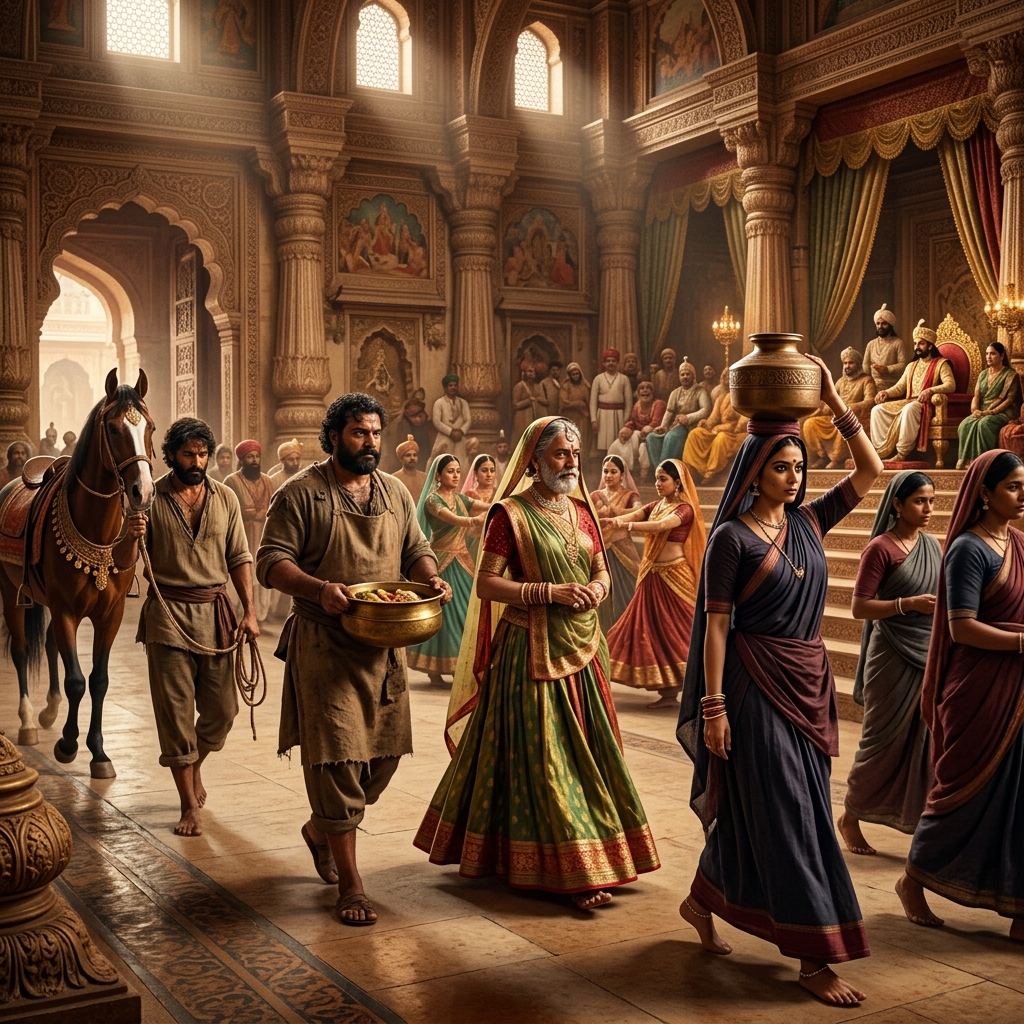
The Curse He Had Been Saving
On the last day before they walked into Matsya, the brothers sat under a tree and each of them said what he would become, and when it came round to the third of them he said a thing that made the other four go quiet.
"I will be a woman," Arjuna said.
He held up his arms. The wrists were a mess of old scar where the Gandiva's string had come back into them ten thousand times, and the forearms beneath were not a woman's forearms at all.
"Bangles," he said. "Conch shell, wrist to elbow. Braids. I will say I am neither man nor woman, and I will teach singing and dancing to the girls of the inner apartments, and I will sleep in the one part of that palace where no man is permitted to go. Nobody will look at me twice."
"And how," Yudhishthira said, "will you manage the voice?"
"I will not have to manage anything."
Because the thing had already been done to him, five years earlier, in the sky.
He had gone up to Amaravati to learn weapons from his father, and Indra had shown him off to the whole court, and one of the apsaras had watched him a little too long. Urvashi came to his rooms at night dressed for it, and Arjuna stood up and folded his hands and called her mother, because she had been the wife of Pururavas, who founded his line, and that made her an ancestor and nothing else in the world.
Beautiful women are not always graceful about being refused.
"You stand there like a eunuch," she said, "and lecture me about mothers. Then be one. Go among women as a dancer, without honour among men, without your manhood."
Indra came to him afterwards and put a hand on his shoulder.
"It cannot be taken back," he said, "but it can be shortened. One year, of your own choosing, whenever you have need of it. And when the year ends you will be yourself again."
Arjuna had thanked him politely, put the thing away, and not thought about it since.
He unrolled it now, under a tree, at the edge of a kingdom he had never seen.
The King Who Could Not Believe It
What walked into Virata's hall the following day was very tall.
It wore a woman's cloth and heavy conch bangles from wrist to elbow, and its hair hung in a single long braid, and it had earrings, and it crossed the court with a swing that was almost right and not quite. The court did not know where to put its eyes.
"What are you?" said the king.
"Brihannala, great king. I sing. I dance. I know the drum and the vina and the steps of every measure worth learning. I taught them once in Yudhishthira's household to Draupadi the queen herself. I am neither man nor woman. Put me among your daughter's companions and I will make her the finest dancer in the world."
Virata came down off the throne and walked all the way around him.
"This is a lie," the king said, not unkindly. "Look at yourself. You are built like the god who carries the thunderbolt. Your shoulders would fill a chariot. Put a bow in those arms and I would follow you into any field on earth. Take my kingdom, whoever you are, and rule it, and I will serve under you."
"You are generous," said Brihannala, "but I can do nothing at all except sing and dance, and I would make a poor sort of king. Ask your women, if you doubt me."
So Virata sent him to be examined, and the women came back and confirmed what he had said of himself, and the king put his head in his hands for a moment at the waste of it, and then did the sensible thing.
"Take Uttaraa," he said. "Teach her. The inner apartments are yours, and nobody will question you there, and no man goes in but me."
They gave him a room among the girls. He hung the bangles on a peg at night and lay in the dark listening to the palace settle, and thought about five bundles of weapons hanging in a tree outside the city, with the great bow wrapped at the centre of them like a body.
He had eleven months and some days in which to be nobody. He had never in his life been nobody.
The Year in the Guarded Quarters
The lessons began at the cool end of the morning.
Uttaraa was a princess of about fifteen, quick and loud and easily bored, and she had never in her life been taught by anyone she could not charm. She could not charm Brihannala. The teacher was patient and entirely immovable, would make her do the same eight steps forty times, and had a way of saying "again" that no amount of pouting shortened.
She loved him inside a month. They all did. The whole floor of girls loved the tall strange person who taught them songs out of countries they had never heard named, who could tune anything with a string on it, who told them stories through the heat of the afternoon about a burning forest and a fish turning on a wheel and a game of dice, and who told them so well that not one of them ever asked how a dancing teacher came to know such things.
There is a comedy in it that the epic relates without laughing. The best archer alive spent a year with his hands full of a girl's hands, counting her back into time. The man who had emptied Khandava, and wrestled a mountain hunter who turned out to be Shiva, and stood in his father's own chariot against the danavas of the sea, now spent his days settling arguments about who would stand in the front row.
And the disguise held for exactly this reason. Spies went through Matsya all year looking for five men. They watched the roads and the temples and the arms markets and the gambling halls. It occurred to nobody to walk up to a eunuch in the women's wing, take hold of her forearms and turn them over to look for the flat hard callus a bowstring leaves, and in any case the conch shells came down past the elbow and covered everything there was to see.
The tradition does not mock him for that year. It records the curse, records the shelter the curse gave him, and moves on. Of the five disguises it was the only one in which a man was safe precisely because the world had decided he was not worth examining.
The Boy Who Needed a Driver
In the last week of the year the Kauravas came for the northern cattle, and Matsya's army was already gone south, and the only male of the royal house left inside the city was Uttara.
He was young. He announced, in front of the women, that if he only had a driver he would go out alone and take the entire Kuru army apart and bring the cows home before dark, and he announced it several times, and his sister heard him.
"Take Brihannala," Uttaraa said. "She used to drive for Arjuna. She told us so."
So the prince of Matsya went to war with a dance teacher holding his reins, and the girls came out onto the wall to watch and called down that he should bring them back some Kaurava cloth for their dolls, and the tall figure at the front of the chariot turned and promised gravely that it would.
Then the chariot came over the rise and Uttara saw the army.
It was not an army in the way he had imagined armies. It filled the whole northern horizon, and at the front of it, unmistakable and unhurried, stood the old man with white hair, and the teacher, and Karna, and the son of Drona. The boy dropped his bow and went off the back of the chariot at a dead run.
Brihannala caught him. He caught him by the hair a hundred paces out, braids flying and bangles on both arms, and the Kaurava line watched a woman run down a prince across open ground, and one man among them began, very slowly, to smile.
"Get in," Arjuna said. "You will drive. I will fight."
"Who are you?"
"Take me to that tree first."
What came down out of the tree was wrapped in cloth and had hung there a year, and what happened afterwards on that field is a longer story than this one. It ended with the cattle walking home, and a boy telling his father the truth in front of the entire court, and a man in the hall taking off his bangles at last.
Not a Bride
Virata's apology took the shape such apologies always take with kings. He offered his daughter.
The court was assembled, the thirteenth year was finished, the five were seated on the seats they had earned back, and the king of Matsya stood in front of Arjuna and said that Uttaraa was his, with the kingdom for a dowry, and that nothing less would settle what he owed.
Arjuna said no.
"For a year," he said, "I lived in your daughter's apartments. She dressed and undressed in front of me. She fell asleep with her head on my knee in the afternoons. She told me things she has told nobody else alive. She trusted me the way a girl trusts a woman, and she was right to, and I will not now turn round and take her as a wife."
The hall did not follow him. Virata's face said so plainly.
"Great king, think what the world would make of it. It would say I lived up there in order to get her. Every day of that year would be turned into a story about a man hiding among women, and her name would carry it and mine would carry it, and once that kind of talk begins there is no answer to it."
"Then what do you want?"
"A daughter," Arjuna said. "I have been her teacher and I would like to be her father. Give her to my son. Abhimanyu is Subhadra's child and Krishna's nephew, he is the right age, and he is better at sixteen than I was. Let her come to me as a daughter-in-law, and the year stays exactly what it was."
Virata thought about it, and understood it, and agreed. Krishna came for the wedding, and the kings who gathered at Upaplavya for it did not go home afterwards; the alliance that formed around that marriage was the shape of the army that marched to Kurukshetra.
The curse of Urvashi had been meant to take something away from him. It gave him a hiding place, a kingdom, an ally, and a daughter.
Dharma Lesson
A curse given in anger becomes the exact shelter its victim needs, which is the epic's way of saying that no one can see the shape of their own life from inside a single year. Arjuna's disguise works because the world refuses to examine what it has decided is beneath notice. And the year is only worth anything because he keeps it clean: having been trusted as a woman, he will not afterwards take the trust as a prize.