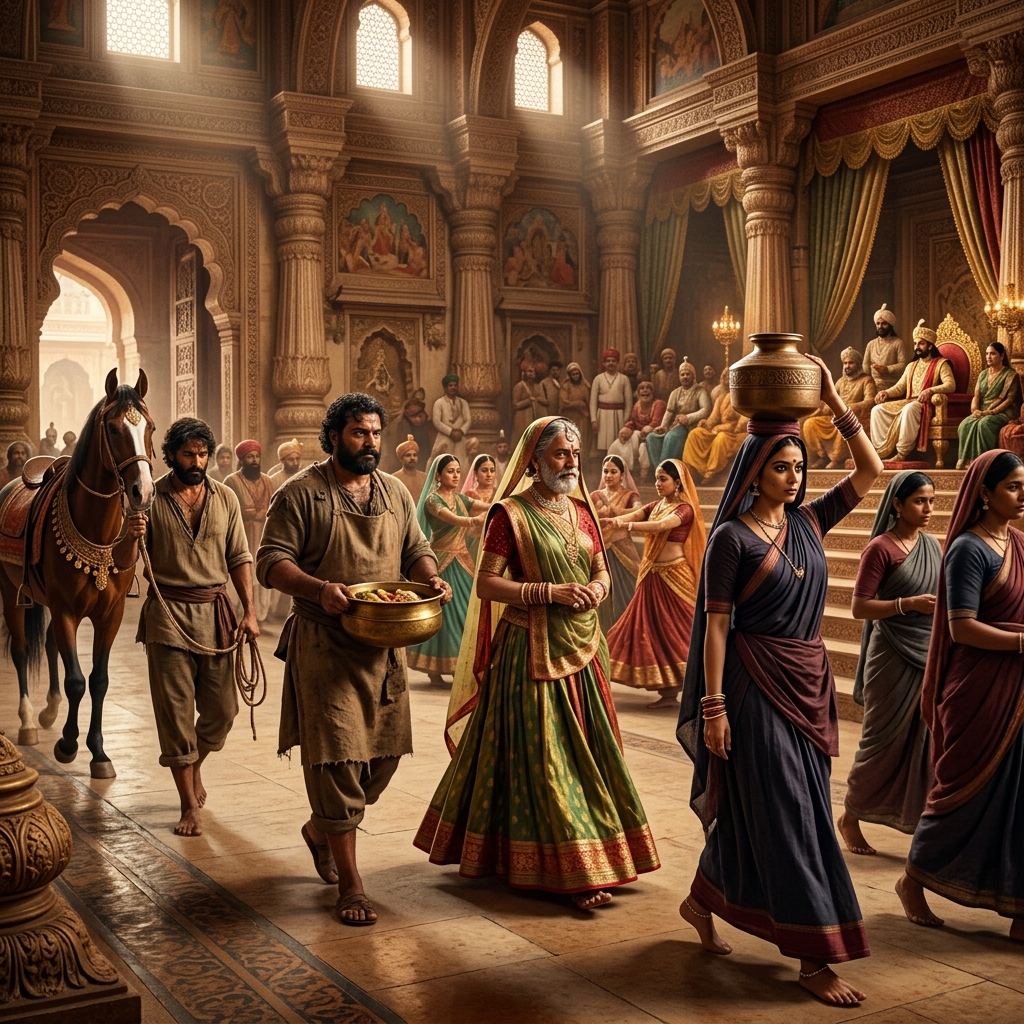
The Cook with a Lion's Shoulders
Bhima came into the city of Virata in the middle of the morning, and he came alone.
He had put on a cook's cloth, black at the hem where the fire had eaten it, and he carried a ladle in one hand and a long iron spoon in the other, and a blade of the kind used for cutting meat and nothing else. He walked the way heavy men walk when they are trying not to be looked at, and every head in the market turned anyway.
Virata was in his hall when the man came in and stood before the throne, and the king sat forward.
"Who is this?" he said. "Where has this bull come from? I have never seen shoulders like that on anyone who was not a king."
"I am a cook, great king," Bhima said. "Ballava is my name. I made the soups for Yudhishthira son of Kunti in his kitchen, and he praised my flavours, and now he is gone from his country and I am looking for a fire to stand at."
Virata looked at him a long time.
"You are no cook," he said. "You look like Indra with the thunderbolt in his hand. There is nothing of a servant in you. Your neck, your arms, the way you walk into a room - you look like a man who has taken cities."
"Then take me for a wrestler as well," Bhima said, "and I will throw whoever you put in front of me, and the city can watch. But feed me first, and let me cook, for I am also a great eater, and no house I have worked in has complained of me."
The court laughed, and the laugh saved him, because a man who makes a room laugh is not a man a room examines. Virata gave him the kitchens.
"Ballava," the king said. "You will have the fires. And on festival days you will fight for us."
Neither of them knew what the second half of that sentence was going to cost.
A Year of Stirring Pots
The palace of Matsya ate better that year than it had ever eaten in its history.
Ballava's kitchen sent out rice that fell apart at a touch, meat cooked in curd and sour fruit, sweets of milk boiled down half a day, soups that made old men at the far tables send back for more. Virata took to praising him in front of guests. The queen sent her women down to learn from him. There is a kind of fame a cook can have inside one building, and Bhima had all of it.
He hated every hour of it.
He was a man built along one line, from the shoulders down, for a mace. He had killed Hidimba and Baka with his hands. He had carried his mother and four brothers on his back out of a burning house and run all night with them. Now he stood in steam with his hair tied back, tasting a sauce off the back of a spoon, while somewhere outside the city a tree held five bundles of weapons wrapped in cloth and hung high in its branches like a corpse, and he was not allowed to go and look at it.
The worst of it was the corridors. He would pass a thin dark man in a Brahmana's white who was the eldest king of the world, and neither of them would slow. He would pass a tall figure in braids and bangles going up to the women's floor with a drum under one arm, and the figure would not turn its head. He would pass a woman carrying his wife's face and his wife's walk, in the plain cloth of a maid, and she would step aside for him, because he was a servant and she was a servant and the corridor was narrow.
Thirteen years of exile had been hard in every way a year can be hard. This one, he told himself each morning, was only twelve months long. He counted them off the way Sahadeva was counting cows.
Jimuta on the Sand
The great festival came round in its season, and with the festival came the wrestlers.
They came from everywhere, thick-necked men with cropped hair and ears like folded leather, and they fought in a ring of sand in front of the king's platform while the city stood on the roofs to watch. One by one Virata's champions put them down. Then a man came out whom nobody put down.
His name was Jimuta. He had come from a country far to the west and he had not lost anywhere, and by the third day there was no one in Matsya willing to walk out onto the sand against him. He stood in the middle of the ring turning slowly with his arms spread, and the crowd went quiet in the way crowds go quiet when they are being shamed.
Virata leaned over the rail.
"Ballava," he said. "Come out of the kitchen."
Bhima came out with the sleeves of his cloth still wet. The crowd laughed at the cook, and then stopped laughing when he pulled the cloth down off his shoulders.
They took hold of each other and the sound was like two doors slamming. Jimuta was a wrestler and Bhima was not. Bhima was a man who had spent his life killing things larger than himself, and he had no interest in holds or points. He let Jimuta get a grip, walked into it, lifted him off the sand by the waist and swung him about his head until the man's own weight had done half the work, and then he brought him down.
Jimuta did not get up, and did not move, and was carried out.
The roar went on a long time. Virata came down himself and put gold on his cook in front of the whole city, and Ballava bowed with his head low and his jaw shut, because he was thinking, very clearly, that no cook alive had ever done that, and that a hundred thousand people had just watched him do it.
After that the king found other uses for him. Lions were brought in, and tigers, and once an elephant, and Ballava went in against them unarmed for the amusement of the queen's women, who watched from behind a lattice. One of them watched with her hands pressed flat against the screen and never made a sound.
The Appointment in the Dancing Hall
All that year she came to him at night.
It was an arrangement they had never once spoken aloud. Yudhishthira could not be seen with a maid. The twins were out among the king's men all day. Brihannala could not leave the women's floor without a reason. But a maid may go down to a kitchen at any hour, because a kitchen is where food is, and so Draupadi came down the back stair in the dark, and Ballava fed her, and she told him what the day had been.
Mostly he listened. Sometimes he could not.
"Sandalwood," she said once, and held her hands out to the firelight so that he could see them. "Look at these. They were washed with water from four seas at the Rajasuya. Now they smell of another woman's paste, and they ache from the grinding stone, and I am learning to sleep with them curled."
"Say the word," he said, "and this palace has no roof by morning."
"Not yet," she said. "Not yet. Not yet."
It held until the queen's brother saw her.
Kichaka was the commander of Matsya's armies and the reason Matsya had never been invaded, and he was accustomed to taking whatever he wanted inside his sister's house. He wanted the maid. When words failed he tried his hands, and when his hands failed he followed her into the king's own hall and knocked her down in front of the throne and kicked her while the king looked at the floor, and a cook standing in the doorway ground his teeth so hard that the man beside him turned around to look.
She came down the stair that night and did not sit down.
"Tomorrow," she said.
So the maid smiled at Kichaka in the morning and told him to come alone at midnight to the dancing hall, which stands empty once the dancers have gone home, and to tell nobody.
He came. He found a shape lying on the bed in the dark and put his hand on it, and it sat up.
What was carried out of that hall at dawn could not be identified as a man. The city decided a gandharva had done it. The city was, in its way, not wrong.
Susharma by the Hair
Kichaka dead meant Matsya undefended, and that news travelled fast to the men who most wanted to hear it.
Susharma of Trigarta came up out of the south with the Kauravas behind him and took the cattle off the southern pastures in a single afternoon, and a cowherd ran the whole way to the city with blood on his feet to say so. Virata called for his armour. He called also for the four servants who had stood quietly at the edges of his court all year, because it had never quite left him that they did not look like servants.
"Kanka. Ballava. Damagranthi. Tantipala. Will you fight?"
"We will fight," said the thin Brahmana in white.
At the edge of the field Bhima put both arms around a tree.
"Put it down," Yudhishthira said, without raising his voice. "A man who fights with trees has a name, and we have four days left. Take a bow like everybody else."
So Bhima took a bow like everybody else, and used it badly, and then threw it away and took up a mace, and the Trigartas discovered that the king of Matsya had acquired a cook.
They fought into the dark and then on by moonlight, and somewhere in the confusion Susharma cut Virata out of his own guard, pulled the old man down and ran with him toward the southern road. That was the end of the disguise as a comfortable thing. Bhima went after the chariot on foot, came up alongside it at a dead run, reached across the rail, took Susharma by the hair and lifted him bodily off his own car into the dirt while the horses ran on empty. He had a knee on the man's chest and a fist raised before Yudhishthira arrived and told him, again, to stop.
They brought Virata home at dawn to a city that had already begun to wonder about its cook. Four days later a frightened boy asked a dancing teacher to drive his chariot, and the year was over.
Dharma Lesson
Strength that cannot be shown is still strength, and holding it is harder than spending it. Bhima's year in the kitchen is the epic's study of restraint in the one brother who has none: every hour he does not act is a choice, and the choices accumulate into a discipline he never had before. When he is finally released to fight, he is not a wilder man than he was but a governed one, stopping the instant Yudhishthira tells him to.