Two Children of a Fish
Long before Hastinapura had a queen named for truth, the river Yamuna carried a strange gift to a fisherman's nets. King Uparichara Vasu of Chedi, they say, let his own seed fall into the river during a lapse of concentration; a cursed apsara named Adrika, trapped in the form of a fish, swallowed it and in time bore two children in a single day, one a boy and one a girl, both drawn living from a fisherman's catch.
The boy was given to King Vasu and grew into a ruler in his own right, founding a line of kings who took their name from the manner of his birth: the Matsyas, the Fish-people, ruling a wide, well-watered country of grazing land south of the Himalayan foothills. The girl, dark and fragrant, stayed with the fisherman who had found her; the world would come to know her as Satyavati, who left her river-island one day to become queen of Hastinapura and, before that, mother to the sage Vyasa who himself would father the entire Kuru line. Brother and sister by that one strange birth, they founded two kingdoms that the epic would one day braid back together.
Generations later, when this telling truly begins, the throne of the Fish-people belonged to an old king named Virata: a mild, capable ruler with herds beyond counting and a city that smelled of milk and dust in equal measure. His queen, Sudeshna, kept a disciplined court; his young son Uttara had not yet been tested by anything sharper than his own boasting. But the real strength behind Virata's throne was neither king nor queen. It was the queen's brother, Kichaka, commander of the Matsya armies, a man whose ambition and cruelty had grown far past what his rank allowed, and whom even Virata had learned to indulge rather than restrain.
A Kingdom to Hide In
It was exactly this modesty, this middling greatness, that made Matsya the perfect place to disappear. When the Pandavas' twelve years of forest exile ended, a thirteenth year remained, one that the terms of their wager with the Kauravas required them to spend undiscovered, on pain of starting the whole exile over. Of all the kingdoms open to them, Virata's seemed made for hiding: wealthy enough to offer good service, provincial enough to escape notice, and ruled by a king who asked few questions of skilled strangers.
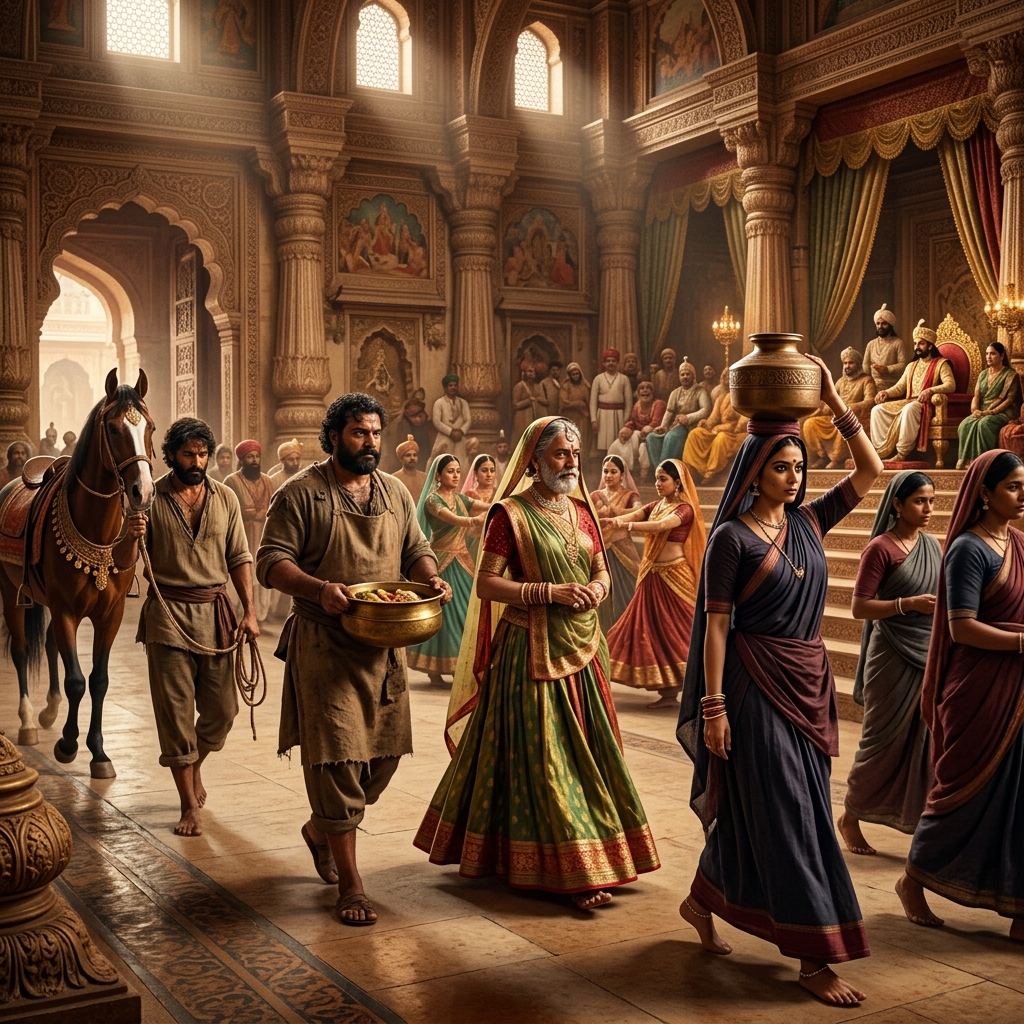
So five kings and their queen walked into Virata's court as nobody at all. Yudhishthira arrived as Kanka, a courtier who taught the king dice; Bhima as Vallabha, a cook whose strength at the kitchen fire was explained away as an old wrestler's habit; Nakula and Sahadeva took up the horses and the cattle, the wealth Matsya prized most; Draupadi entered Sudeshna's own chambers as Sairandhri, a hairdresser of uncertain origin who begged the queen to keep other men away from her. And into the women's apartments, to teach Uttara's sister dance and song, came a tall, soft-spoken teacher of uncertain sex named Brihannala, bangles at the wrist, hair worn long: Arjuna, the world's greatest archer, folded inside a disguise no one thought to question twice.
For most of a year the deception held. Virata's court gained a wise counselor, a formidable cook, capable herdsmen, a devoted hairdresser and a gentle dance teacher, and lost nothing, or so it seemed. Only Sudeshna's brother threatened the peace: Kichaka's eye fell on Sairandhri, and his pursuit of her would end, before the year was out, in his own death at hands he never once suspected. That reckoning, and all it nearly cost the Pandavas, belongs to a story of its own.
Two Armies Come for the Herds
Matsya's wealth was cattle, and cattle draw raiders the way blood draws jackals. Word of Virata's herds reached two enemies at once, and both struck in the final weeks of the thirteenth year, as though the exile itself were being tested to its very edge.
First came the Trigartas under King Susharma, sweeping in from the south and driving off herds while Virata rode out to stop them; the old king was captured in the fighting until his disguised cook, Vallabha, broke ranks to free him with his bare hands, a feat of strength Virata could only marvel at and not quite explain. Virata, grateful and unknowing, offered his rescuer half his kingdom, which Bhima, still in his cover as a servant, gently refused.
No sooner had that raid been driven off than word came from the north: the Kauravas themselves, hearing of the southern attack, had moved on Matsya's remaining herds, certain the kingdom's defenders were spent. With every seasoned warrior away chasing the Trigartas, only young Uttara remained in the city, boasting to the women of the court that he would rout the Kuru host himself if only he had a charioteer worthy of him. His courage lasted until the Kaurava banners actually came into view across the plain, at which point his nerve broke entirely, and it was Brihannala who took the reins, drove him back onto the field by main force, and revealed, only when the boy could bear no more fear, exactly who rode beside him. What the city of Virata watched from its walls that afternoon, one lone charioteer holding off Bhishma, Drona, Karna and the massed Kuru army, is a story told fully elsewhere; it is enough to say here that Matsya's herds were saved, and its prince came home in a chariot he had not driven himself.
Upaplavya, City of Alliance
When Brihannala's identity became known, so did everyone else's, and the year of disguise ended not in disgrace but in celebration. Virata, mortified at how he had nearly married his own daughter to a woman who was in fact a man, and delighted to learn what warriors had served in his hall unrecognized, offered his daughter in marriage instead to Arjuna's son Abhimanyu, sealing the discovery with an alliance rather than an apology. Arjuna, for his part, declined the bride himself, as her teacher, but accepted her for his son with evident pleasure.
The wedding was held not in Virata's own capital but at Upaplavya, a lesser town on Matsya's border that the kingdom now offered the Pandavas outright as their base of operations. It was a shrewd choice: near enough to Hastinapura to gather allies quickly, far enough from the Kuru heartland to be defensible, and entirely Virata's to give. Kings arrived from every direction that had ever owed the Pandavas a debt: Drupada of Panchala with his sons, Krishna and the Yadava chiefs, Satyaki, Kekaya princes, until Upaplavya, a town that had never been more than a name on Matsya's edge, briefly held the largest gathering of kings the age had seen.
It was here, in that same crowded season, that war councils were held and the final embassy to Hastinapura was debated and sent, seeking nothing more than five villages for five brothers and receiving, in return, Duryodhana's famous refusal of land enough to fit a needle's point. From Upaplavya the Pandava armies mustered and marched. Virata, old as he was, marched with them, his kingdom's cattle and his own house now bound irreversibly to a war he had done nothing to start beyond offering shelter to strangers who turned out to be kings.
What the Fish King Left Behind
The alliance Matsya had staked its future on cost the kingdom almost everything it had. At Kurukshetra, Virata commanded a division of the Pandava host and fought with a vigor that surprised men half his age; his sons, including Uttara, who had once quailed at the sight of the Kaurava banners and grown steadier for it since, rode beside him. On different days of the eighteen, both father and son fell: Uttara struck down by the Kuru general Shalya, King Virata himself killed later by the hand of Drona, along with his surviving sons, so that the ancient line of Fish-kings that had sheltered five hidden monarchs went out in the same fire it had helped to kindle.
Yet the kingdom's blood did not end with its king. Virata's daughter, wed to Abhimanyu at Upaplavya in the season of celebration, was left carrying his child when Abhimanyu himself died trapped inside the chakravyuha formation partway through the war, one more grief layered onto Matsya's account. After Kurukshetra, an attempt was made to erase her unborn son entirely: Ashwatthama, in a final act of vengeance, loosed a weapon meant to burn out every remaining line of the Pandavas, and it found her womb. The child was born lifeless and was restored, tradition says, by Krishna's own power, so that a boy named Parikshit, grandson of Matsya's princess and great-grandson of old Virata, lived to inherit the throne of Hastinapura itself.
A modest cattle kingdom on the map's edge, remembered mostly for a queen's kitchen and a year of hidden kings, had in the end supplied the blood that carried the entire Kuru dynasty into its next generation. Every ruler who came after Parikshit, down to the line's last kings, descended as much from Virata's fish-born house as from Kuru's own.
Dharma Lesson
Matsya's greatness lay not in power but in willingness: a modest kingdom that sheltered strangers without asking too many questions became, by that single act of hospitality, the hinge on which a dynasty's survival turned. Dharma here is quiet and unglamorous, service given honestly even in disguise, cattle guarded, a household kept, and it proves as decisive as any battlefield. What a kingdom lends without knowing the full cost, it may receive back a hundredfold, in blood as much as in gratitude.