A Sairandhri at the Gates
Queen Sudeshna sat in her private hall at Virata, attended by her maids, when the door-keeper announced a stranger seeking service: a woman of extraordinary beauty, wrapped in a plain shawl, calling herself Sairandhri, a hairdresser skilled in braiding and perfume. Sudeshna's first response was not welcome but wariness. "No woman with such a form," she said, "belongs among servants. Kings will ransom kingdoms for a face like yours, and my husband is a man, after all."
The woman answered that she was no threat to any household; she had known five gandharva husbands, invisible protectors sworn to strike down any man who touched her without leave, and she wished only for shelter through a single year in disguise, in service to a queen she had heard was gracious. Something in her bearing, straight-backed, and in the calluses hidden under her sleeves, suggested more than a servant's history, but Sudeshna did not press it. Uttaraa, watching, was already delighted, tugging at her mother's arm to keep this beautiful stranger who spoke like a queen despite her rags.
Sudeshna relented, against her own foreboding. She told herself the gandharva story would be answer enough should any man in the palace look at Sairandhri with wrong intent; she told herself a year would pass quickly, and Virata's court, ruled by an aging king and swollen with his brother-in-law's soldiers, was orderly enough to keep any woman safe. She did not yet know that her own brother Kichaka, commander of Virata's armies, terror of neighboring kings, was the one danger her foreboding should have named first.
She set Sairandhri to dressing her hair and perfuming her chambers, and for a season the arrangement held. The queen found herself trusting hands that never once faltered, a woman who moved through the palace with a composure that servitude should have worn away long before. Sudeshna, without knowing why, began to feel less like a mistress and more like a woman confiding in an equal - not yet suspecting that the equal she had taken in was Draupadi, wife of five kings in hiding, and that the year of disguise was already half spent.
Her Brother's Eye
Kichaka, commander of Matsya's forces, victor over kings who dared raid Virata's herds, saw the sairandhri crossing the palace grounds one evening and could not look away. He came that night to his sister's chambers not as a general reporting on his armies but as a suitor reporting his heart, urging Sudeshna in the soft, wheedling voice she remembered from their childhood to send the beautiful servant to him.
Sudeshna knew her brother's appetites too well to mistake this for a passing fancy. Kichaka had never learned refusal; every border kingdom he had subdued had taught him that strength earns whatever it wants, and no one at Virata's court, not even King Virata, dared correct him, since the kingdom's safety rested on his sword. Still, Sudeshna hesitated. She had seen Sairandhri's composure, heard her calm claim of gandharva husbands who would kill any man who forced her, and some instinct told the queen this was not a servant to be handed over lightly.
But Kichaka pressed, and pressing was what Kichaka did best. He reminded Sudeshna of every favor his army had bought her, every enemy his spear had turned back from Virata's gates, and framed his request as the smallest of debts owed a sister to a brother who had given the kingdom its safety. He did not ask permission so much as collect on an unspoken account, and Sudeshna, who governed a court but not her brother, found herself unable to simply say no.
She told herself Sairandhri's warning about the gandharvas would protect her, that sending wine to Kichaka's hall on some pretext was not the same as delivering the woman into danger, that her brother's desire, unfed, might in time exhaust itself. Each excuse was thinner than the last, and she knew it even as she reached for it. That night, alone, Sudeshna felt the particular helplessness of a woman with a throne under her and no power to use it, caught between the brother who had made her queen and the servant she had sworn, in taking her in, to protect.
Wine to Kichaka's Hall
The command came the next morning, dressed as household necessity: Sudeshna bid Sairandhri carry a jar of wine to Kichaka's hall, ostensibly at the general's request for entertainment he was hosting. Sairandhri went pale and refused outright, reminding the queen of the warning she had given at the palace gate months before, that any man who touched her without leave would not survive the encounter, gandharva husbands or no.
Sudeshna answered as a queen answers, not as the woman who had begun, over months of shared mornings, to feel something like friendship for her sairandhri. "It is not for you to refuse a queen's order," she said, though her voice caught on the words. "Go, and if he offends you, your husbands will avenge it. That is no fault of mine." It was the excuse of someone choosing to believe what was convenient rather than what she already suspected: that sending this particular woman into a private hall with a man of Kichaka's appetites was not household duty but abandonment dressed as one.
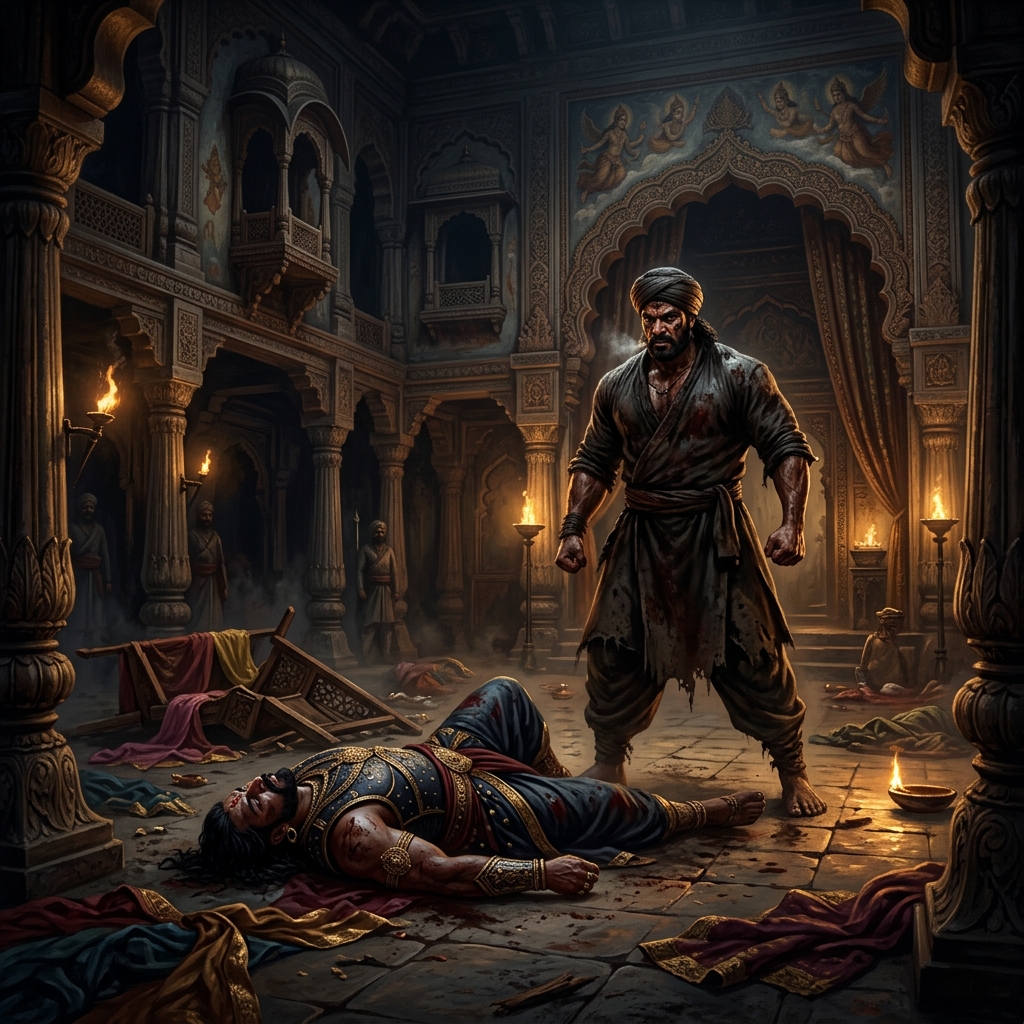
Sairandhri went, weeping, and did not return that night to serve wine as ordered. Instead she found her way, in secret, to the one among her hidden protectors capable of ending the danger outright, and what happened in Kichaka's hall in the dark hours before dawn is a night the epic tells elsewhere in full: a reckoning that left Matsya's fearsome commander broken beyond recognition by morning, his body found crushed into a shape no human enemy could account for.
Sudeshna heard the news before the sun was fully up, and her first feeling was not grief for her brother but a cold understanding of what she had done. She had known, in the moment she gave the order, that something in Sairandhri's composure promised a reckoning she could not predict. She had sent a woman she half-suspected of hidden strength into a room with a man she fully knew to be dangerous, and called it duty because the alternative was to defy her own brother.
The Kinsmen's Dread
Kichaka's kinsmen, a hundred and five brothers and cousins who had shared in his power and now inherited his fury, seized on Sairandhri as the cause of his death and dragged her toward the cremation ground, intending to bind her to her patron's pyre and burn her alongside him. Her screams reached the one gandharva husband still watching over her, and by the time the kinsmen's rage was spent, all hundred and five lay dead in the same field, a slaughter so total that all of Matsya spoke of it in whispers before the funeral fires had cooled.
Sudeshna heard the count and felt her earlier unease harden into genuine terror. A hundred and five men, however violent, however deserving of judgment for what their clan had attempted, did not die in an afternoon by any power the queen understood. She had welcomed this sairandhri into her household on instinct, ignored her own foreboding for the sake of a servant's steady hands, and now stood at the center of a mystery large enough to unmake her family's standing in the kingdom overnight.
Fear, when it finally caught up with Sudeshna, did not make her braver. She went to Sairandhri and, queen to servant, begged her to leave Virata before the kingdom's terror curdled into blame. "Whatever protects you," Sudeshna said, "protects you at a cost I cannot bear to keep paying. Go, and go quickly, before my people ask why a hairdresser commands the death of a hundred and five soldiers." It was, in its way, the same weakness that had sent Sairandhri to Kichaka's hall in the first place: a queen managing danger by moving it elsewhere rather than confronting what it meant.
Sairandhri asked for thirteen more days, no more, promising that the trouble would end and no further harm would fall on Matsya. Sudeshna, uncertain and afraid but out of better options, granted the delay, not knowing that those thirteen days were the last of a year-long vow, and that Duryodhana's armies were already marching toward Virata's northern herds to test whether the exiles hiding somewhere in Matsya had truly run out their term.
Kin Instead of Strangers
The thirteen days ended in a battle Virata's court still could not fully explain: Prince Uttara, boasting to Sairandhri's companion Brihannala that he alone could turn back Duryodhana's raiders, rode out with a eunuch dance master for a charioteer and returned instead beside a warrior in golden armor who had put the finest bowmen of Hastinapura to flight. Sudeshna's household spent that day in the particular dread of women waiting on news of a war they had not chosen, and when the news came, it came sideways, in rumors that grew stranger with every retelling.
The truth surfaced in the royal hall days later, when King Virata, still marveling at his son's improbable victory, made ready to honor the dice-master Kanka above his own household. It was then that the four disguised Pandavas revealed themselves before the court, and Sairandhri, who had served Sudeshna's chambers with a hairdresser's patience for nearly a year, stood forward as Draupadi, empress of Indraprastha and wife to the eldest of them.
Sudeshna's first reaction was not shame at how she had treated a queen as a servant, though shame came soon after; it was the vertigo of understanding, all at once, that her own fear and complicity had placed an empress in her brother's path, and that only luck and unseen power, not her own courage, had spared the household worse consequences than it deserved. She thought of every order she had given, every excuse she had reached for rather than protect the woman under her roof, and understood now precisely what those excuses had nearly cost.
What redeemed the queen, in the epic's telling, was not an apology but an offering: her own daughter, Uttaraa, given in marriage to Abhimanyu, son of Arjuna and Subhadra, sealing Matsya to the Pandavas' cause not as former captors and captive but as kin bound by blood and gratitude (that wedding, held at Upaplavya, belongs to its own telling). Sudeshna, who had once seen only danger in a beautiful stranger's face, found in the end that the same face had brought her family into alliance with gods and kings, and that her weakness, however costly, had not been beyond mending.
Dharma Lesson
Sudeshna's story turns on complicity through weakness: a queen who senses danger yet defers to her brother's demands and her own comfort, again and again choosing the easier wrong over the harder right. Power that extends courtesy without protection is no shelter at all, and gratitude offered after the fact does not undo the harm risked before it.