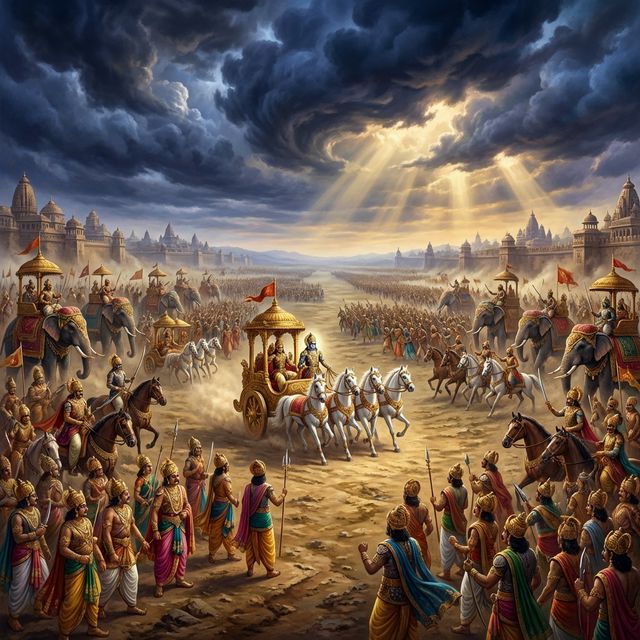
The Lineage of Gandiva
Brihannala names five sets of weapons and the six who held the great bow
The Questions at the Burning Ground
Vaishampayana told this part slowly, because nothing in it moves.
The Kuru host had driven off the cattle of Matsya, and the only man left in the city to answer them was Virata's son, and the only charioteer left for him was the dancing master out of the women's quarters, a person in braid and bangles who called himself Brihannala. The prince had seen the array, and the array had emptied him, and afterwards, when he had been brought back to the shami tree that stands beside the cemetery outside the city, he had climbed it at his driver's word and taken down the long bundle that had been sleeping in its branches for a year.
What came out of the wrapping stopped him. Not one weapon but five sets of them, bows and arrows and quivers and swords, and every piece of it made for a hand richer and heavier than any hand he knew.
So he began to ask, and he did not stop for a long time.
Whose was the excellent bow with a hundred golden bosses on it and ends that gave off light. Whose was the one with golden elephants shining on the staff. Whose the one adorned with three score golden Indragopakas, the small red insects of the rainy season, set at proper intervals along the back. Whose the bow furnished with three golden suns of great effulgence. Whose the thousand winged arrows with golden heads in their golden quivers, and the sable quiver with five images of tigers on it, and the seven hundred long shafts like crescent moons that were made to drink an enemy's blood. Whose the sword with the mark of a toad on it. Whose the scimitar out of the country of the Nishadas. Whose the blade just longer than the breadth of thirty fingers, polished smooth by constant clash with other men's weapons.
"Asked by me, Brihannala," the boy said at the end of it, "do thou answer me truly. Great is my wonder at the sight of all these excellent objects."
The dancer had waited a year to be asked that question. He began with the largest bow.
The Bow Without a Knot or Stain
"That about which thou hast first enquired," he said, "is Arjuna's bow, of world-wide fame, called Gandiva, capable of devastating hostile hosts."
He did not begin with the man. He began with the object, and he described it the way a herald describes a king.
Embellished with gold, this Gandiva, the highest and largest of all weapons. Alone equal unto a hundred thousand weapons. Always capable of extending the confines of kingdoms. It is with this that Partha vanquisheth in battle both men and celestials.
Read that list again for what it claims. The first clause is about size and the second about worth, and the third is about what a bow does to a map, which is a thing a bow does only when the man holding it does not lose. And the fourth clause puts gods and men quietly on the same side of the account, as two kinds of opponent that this one weapon has already dealt with.
Worshipped ever by the gods, the Danavas and the Gandharvas. Variegated with excellent colours. This large and smooth bow is without a knot or stain anywhere.
That last is the detail to hold, because it is the only one a person standing in a cemetery could check for himself. Any stave grown out of wood carries the memory of the tree in it somewhere, a knot where a branch went out, a darkening where the sap ran. Uttara was turning a length of the thing in his two hands in the light, and there was nothing on it. No flaw, no join, no mark of the making. It had not been cut from anything. It had been given.
"Endued with great energy and of high celestial origin," said Brihannala, "this is the best of all bows. Adored among gods and men, it hath a handsome form."
Then he told him where it had been.
The history of Gandiva is short in the telling, because it is only a list of owners and the number of years each of them held it. It is not short in any other way.
The Six Who Held It
Shiva held it first, for a thousand years.
Afterwards Prajapati held it, the lord of creatures, the Grandsire whom men call Brahma, and he held it for five hundred and three years. Then Sakra, which is the name the gods use for Indra when they are speaking of the office rather than the person, and Sakra held it for eighty-five years. Then Soma, who is the moon and also the drink of the sacrifice, and he held it for five hundred years. Then Varuna, lord of the waters and keeper of oaths, for a hundred years. And finally Partha, surnamed Swetavahana, which means he of the white horses, who has held it for sixty-five.
Set the numbers beside each other and the shape of the thing appears. Two thousand one hundred and eighty-eight years of divine ownership, handed down in a descending order, from Shiva to the Grandsire to the king of the gods to the moon to the sea, and then out of the sea into the hands of a man. Of the five who held it before him, only Sakra had it for a shorter term than Arjuna has had it, and Arjuna is not finished.
"Partha obtained this beautiful bow from Varuna," Brihannala said.
He did not give the boy the circumstances, and there is no need for more than a line of them here. Agni came to two young men on the bank of the Yamuna wanting to eat a forest, and could not eat it while Indra sent rain on it, and Varuna was asked for the arms that would let two men hold off the sky. The bow came out of the water that day, with two quivers that never empty and a car with an ape on its banner. The gods had been keeping it for somebody, in the way that things are kept, and the somebody turned out to be a man of twenty.
Uttara stood in the burning ground with the smooth bow in his hands and no idea yet whose hands he was standing next to.
Brihannala went on to the second bow.
The Bows of the Other Four
"This other bow of handsome sides and golden handle is Bhima's," he said, "with which that son of Pritha, that chastiser of foes, had conquered the whole of the eastern regions."
That is how the four remaining bows were named. Not by their beauty, though the beauty is given, but by the ground each of them has already taken. The boy had asked whose they were. What he got back was a map.
The bow of beautiful shape adorned with the images of Indragopakas, the one with the sixty golden insects along its back, belongs to king Yudhishthira. Brihannala said it exactly that way, king Yudhishthira, standing at the edge of a cemetery outside a city where a man of that name was at that hour dealing dice for Virata and being spoken to as a servant.
The bow with golden suns of blazing splendour shedding a dazzling effulgence around belongs to Nakula.
And the bow adorned with golden images of insects and set also with gems and stones belongs to that son of Madri who is called Sahadeva.
Madri was Pandu's second queen and the mother of the twins, and she went into the fire when her husband died, and her two boys were brought up by Pritha, the elder queen, whom the world calls Kunti. Brihannala named her without explaining her, the way a man names a woman his own household has always known, and if the prince noticed that, he did not say so.
Five bows had come down out of one tree in one wrapping, and here they were being dealt out to five brothers, and those five brothers were the most famous missing men alive. Any listener could have arrived at it. The sons of Pandu had gone into the forest thirteen years ago and had not been heard of since, and their weapons were in a tree at the edge of Virata's burning ground, and a dance teacher in a woman's braid knew every piece by sight the way a farmer knows his own tools.
Uttara did not arrive at it. He asked about the arrows instead.
So Brihannala counted out the arrows.
The Arrows and the Quivers
"These winged arrows, thousand in number, sharp as razors and destructive as the poison of snakes, belong to Arjuna."
Then the thing that is said of them and of nobody else's: when shooting them in battle against foes, these swift arrows blaze forth more brilliantly and become inexhaustible.
Not many. Not enough. Inexhaustible, and brighter the longer they are used, which is a promise about the man shooting as much as about the shafts.
The long thick ones resembling the lunar crescent in shape, keen-edged and capable of thinning the enemy's ranks, belong to Bhima. Seven hundred of them, as the prince had counted, every one shaped like a moon three days old and made to take a man apart sideways.
The quiver bearing five images of tigers, full of yellowish shafts whetted on stone and furnished with golden wings, belongs to Nakula. And here the geography came back into it, because Brihannala did not stop at the name. This is the quiver of the intelligent son of Madri, he said, with which he had conquered in battle the whole of the western regions.
East to Bhima, west to Nakula. Quiver by quiver, the boy was being told that the quarters of the earth had already been walked over by the owners of the things he was holding.
The arrows all effulgent as the sun, painted all over with various colours and capable of destroying enemies by thousands, are Sahadeva's.
And the short well-tempered thick shafts, furnished with long feathers and golden heads and consisting of three knots, belong to king Yudhishthira.
No boast is attached to that last set and no conquest is named for it. The eldest brother's arrows are the plainest things in the bundle, short and heavy and knotted three times over, and they are described the way a carpenter's rule is described. They came out of the tree with all the rest, and they had been waiting up there just as long.
Then the swords, which the prince had asked about first and was answered about last, because a sword is what a man reaches for when everything else in the bundle has failed him.
The Five Swords
"This sword with blade long and carved with the image of a toad, and head shaped as a toad's mouth, strong and irresistible, belongeth to Arjuna."
Cased in a sheath of tiger-skin, of long blade, handsome and irresistible and terrible to adversaries, this sword belongeth to Bhimasena.
Of excellent blade, cased in a well-painted sheath and furnished with a golden hilt, this handsome sword belongeth to the wise Kaurava, Yudhishthira the just.
He said Kaurava, and he was right to. The word means the line of Kuru, and the sons of Pandu belong to it exactly as much as the sons of Dhritarashtra do, and there was a time before the dice when nobody would have thought the word needed sorting out.
This sword of strong blade, irresistible and intended for various excellent modes of fight, cased in a sheath of goat-skin, belongeth to Nakula.
And this huge scimitar, cased in a sheath of cow-skin, strong and irresistible, belongeth to Sahadeva.
That was the end of the answer. Five bows, five sets of arrows, five swords, each one matched to a name, the whole inventory delivered in the flat voice of a man reading out a list of things he has owned all his life and has not been allowed to touch for a year.
He had not once said I. He had said Arjuna's bow, and Bhima's, and king Yudhishthira's, and the son of Madri's, and he had kept himself out of every sentence in it. Only the tenses gave him away. He described the working of Arjuna's arrows in battle in the present tense, as a thing that happens, not as a thing that used to happen to somebody who was dead.
And the prince was standing in a burning ground with the weapons of five dead men laid out around him, except that nothing in the bundle was rusted and nothing was rotted, and the wrapping had been dressed up as a corpse only to keep the curious off, and the man who had brought him here knew which sword was whose without looking twice.
Uttara looked up from the toad-marked blade and asked where those five men were now.
Dharma Lesson
A weapon in this epic is never only a weapon. It is a record of who has held it and what was done with it, and Gandiva carries more than two thousand years of that record before a man ever draws it. What Arjuna gives Uttara is not a boast but an inventory, spoken about himself in the third person, at the end of a year in which he was forbidden to touch any of it. What a man is does not rot while he is pretending to be something else. It lies wrapped in a tree, unrusted, waiting for the day the pretence ends.