The Grandsire Under the Golden Palm
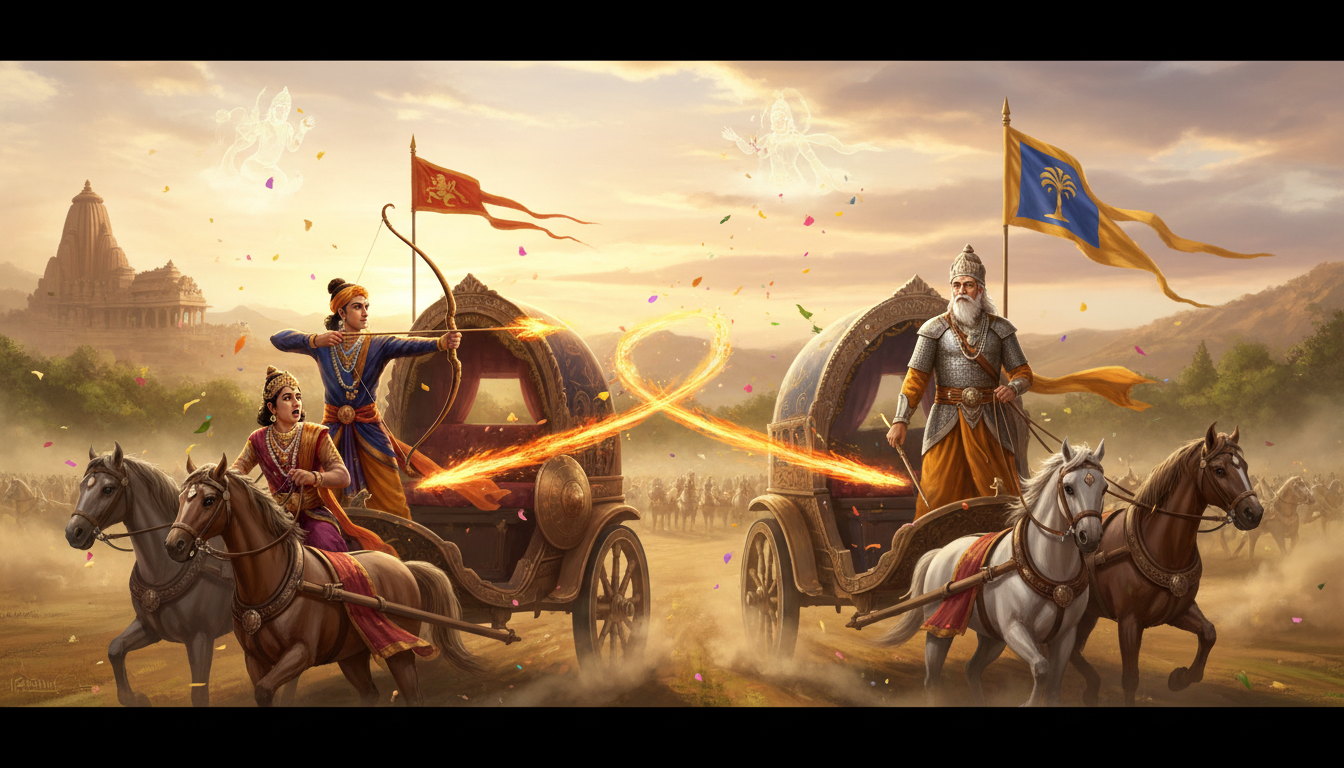
Celestial weapons, and Indra dropping flowers
Take Me to the Golden Palmyra
Vaishampayana said: Having defeated the son of Vikartana, Arjuna spoke to the son of Virata.
"Take me toward that division where you can see the device of a golden palmyra. Our grandfather waits under it, the son of Santanu, who looks like one of the celestials, and he wants an encounter with me."
Uttara looked where he was told to look.
He was seventeen years old. That morning he had been boasting in the women's apartments about what he would do to the Kurus if only he had a driver worth the name, and by noon he had discovered that the driver was Arjuna and that he himself was the one holding the reins. He had already been carried through the Kuru array once. There were arrows in him. And now he was being asked to drive into the part of the field where the whole host was thickest, toward a banner he had been taught to be frightened of before he could hold a bow.
The host in front of them was crowded with cars and horses and elephants and did not appear to end anywhere. Somewhere in the middle of it the golden palmyra stood up over the standards, and under it, with a white umbrella held above his head, was Bhishma.
Uttara did not move the horses.
I Am No Longer Able to Guide Thy Steeds
"Hero," the boy said, "I am no longer able to guide your excellent horses. My spirits droop. My mind is bewildered past anything. All the directions seem to be whirling in front of my eyes because of the energy of the celestial weapons that you and the Kurus have been using.
"I have been deprived of my senses by the stench. It is fat and blood and flesh, all of it together, and I cannot get away from it, and looking at what is on the ground my mind feels as if it has been split in two. I never in my life saw such a muster of horses in a battle.
"With the flapping of the leather fences, and the blare of the conchs, and the roaring the warriors make, and the elephants shrieking, and the twang of the Gandiva going off like thunder over my head, I have been so stupefied that I have lost both my hearing and my memory.
"And when I watch you drawing that bow into a circle in the middle of the fighting, so that the Gandiva looks like a wheel of fire, my sight fails and my heart is torn apart. When I look at your form in this battle, like the wielder of the Pinaka when he is inflamed with wrath, and at the terrible arrows you send out, I am filled with fear.
"I cannot see when you take up your arrows. I cannot see when you fix them on the string. I cannot see when you let them go. It is all being done in front of my eyes and I do not see any of it.
"My spirits are gone and the earth itself is swimming. I have no strength left in my hands to hold the whip and the reins."
Blessed Be Thou, Thou Art a Prince
There was a great deal Arjuna could have said. He had spent the earlier part of that morning chasing this same boy across a field on foot after Uttara jumped down off the car and ran, and hauling him back by the hair while he begged to be let go home.
He did not say any of it.
"Do not be afraid," Arjuna said. "Steady yourself. You have performed wonderful feats today on this field, bull among men, you yourself. Blessed be you. You are a prince, and you were born in the illustrious line of the Matsyas. It does not become you to lose heart while your enemies are being chastised.
"So stand on my car, prince, gather up the whole of your fortitude, and hold the reins of my horses, slayer of foes, while I go into the battle again."
He did not tell the boy that the fear was unreasonable, because it was not. He did not tell him it would pass. He told him what he was and where he came from and what he had already done, and then he gave him a job to do with his hands, which is the only thing that has ever worked on a frightened man in the middle of a field.
Uttara took up the whip and the reins.
What I Learned and From Whom
Then Arjuna told him what was about to happen, and he told it at length, the way a man talks to steady the person standing next to him.
"Take me to the front of Bhishma's division without any delay. I will cut off his very bowstring in this battle. Today you shall see celestial weapons of blazing beauty shot by me, looking like flashes of lightning playing among the clouds. Today the Kauravas will see the gold-decked back of my Gandiva, and they will stand there arguing with each other and saying, by which hand of his does he shoot, the right or the left?
"With my straight arrows I will clear away the Kuru forest, whose trees have hands and feet and heads and backs and arms for branches. Alone, bow in hand, beating the Kuru host, a hundred paths will open before me like the paths a fire opens in a wood. You shall see the Kuru army today going round and round in a wheel, unable to get off the field.
"Stand firm on my car, whether the ground is smooth or broken. I can pierce with my winged arrows even the mountain of Sumeru where it touches the heavens. I killed hundreds and thousands of the Paulomas and the Kalakhanjas in battle, long ago, at Indra's own command. I have my firmness of grasp from Indra. I have my lightness of hand from Brahman. I learned the fierce modes of attack and defence in the middle of crowds of enemies from Prajapati. On the far side of the great ocean I defeated sixty thousand car-warriors, every one of them a fierce archer, who lived in Hiranyapura.
"I obtained the Raudra from Rudra, and the Varuna from Varuna, and the Agneya from Agni, and the Vayava from the god of Wind, and from Sakra the thunderbolt and the rest. So let your fears be dispelled, son of Virata."
The boy drove. Assured by Savyasachin, he took the car into that fierce array of cars protected by Bhishma; and the son of Ganga, of fierce deeds, came cheerfully forward to meet a man who had announced in advance exactly what he intended to do to him.
The Standard Cut Off at the Root
The first thing Arjuna did was shoot a gold-decked arrow into Bhishma's standard and cut it clean off at the root, so that the golden palmyra came down and lay on the ground where everyone could see it.
Four of Dhritarashtra's sons rushed him for that: Dussasana and Vikarna and Dussaha and Vivingsati, all of them skilled with weapons, all of them full of energy, all of them wearing handsome garlands and ornaments, and they surrounded him.
Dussasana got in first. He put a crescent-shaped arrow into Uttara and another into Arjuna's chest. Arjuna turned on him and cut his gold-plaited bow in half with a sharp-edged arrow feathered with vulture wings, and then put five arrows into his breast, and Dussasana left the fight.
Vikarna came next with straight sharp arrows of his own. Within a moment Arjuna hit him in the forehead and he came down off his car.
Then Dussaha, with Vivingsati supporting him, covered Arjuna in a cloud of arrows, trying to get their brother out. Arjuna, without any particular hurry, pierced them both in the same instant with a pair of keen-edged shafts and then killed the horses of both cars. Men behind them drove up and took the two of them away with their bodies mangled.
And then the son of Kunti, with the diadem on his head and his aim being what it was, began to attack every side at once.
The River He Made
Then all the great car-warriors of the Kurus came at him together, from every direction, and he covered them all in clouds of arrows the way mist covers mountains.
The roaring of elephants and the blowing of conchs went up together in one noise. Arrows shot by Partha came down by thousands, going through elephants and horses and through steel coats of mail as well. He shot with such speed that men said afterwards he looked like the sun at an autumn midday. Car-warriors began jumping down off their cars, and horsemen off their horses, and foot-soldiers ran in every direction. There was a loud clattering as the shafts split armour made of steel and silver and copper.
And the ground filled up. Heads decked with turbans and earrings and gold necklaces fell in such numbers that it seemed a shower of stones was coming out of the sky. Trunks lay scattered, and arms with the bows still gripped in their hands and rings still on their fingers.
The Kuru warriors, in the presence of Duryodhana himself, became dispirited and stopped fighting.
What Arjuna made on that field the old account calls a river, and describes with a care that is worth repeating: a river of blood with waving billows, like the river Time creates at the end of the Yuga. The dishevelled hair of the dead and the dying was its floating moss and straw. Bows and arrows were its boats. Coats of mail and turbans floated thick on it. Elephants were its alligators and cars its rafts, and marrow and fat and blood made its current, and keen-edged weapons were its crocodiles. Strings of pearls were its ripples and the scattered ornaments were its bubbles. Swarms of arrows were its eddies and horses its tortoises. Great car-warriors standing in it were its islands. It resounded with the bleating of conchs and the sound of drums, and no one could cross it.
Indeed, so swift was his hand that the spectators could perceive no interval at all between his taking up an arrow, and fixing it on the bowstring, and letting it off by a stretch of the Gandiva.
The White Umbrella Comes Down
While that havoc was being made among the Kurus, Bhishma came.
He took up an excellent bow adorned with gold, and arrows of keen points made to go into the vitals, and he rushed at Arjuna. The white umbrella was still being held over his head, so that he looked, going forward, like a hill at sunrise. He blew his conch to cheer the sons of Dhritarashtra, wheeled along his right, and came across Arjuna's course and stopped it.
And Arjuna, seeing him come, received him gladly, the way a hill receives a cloud full of rain.
Bhishma shot first: eight arrows into Partha's flagstaff, and they went home into the blazing ape and into the creatures that sit in the banner-top, so that the whole standard began to scream.
Arjuna answered by throwing a sharp-edged javelin that cut the white umbrella off above the grandsire's head, and it fell to the ground. Then, light-handed, he shot away Bhishma's flagstaff, and then the horses, and then the pair of drivers who guarded Bhishma's flanks, one after another, in order, like a man taking a house apart from the outside.
Bhishma knew perfectly well what the Pandava could do, and he did not care to bear that. He covered Dhananjaya with a powerful celestial weapon. And the son of Pandu hurled a celestial weapon back at him and took Bhishma's the way a hill takes a mass of cloud, and stood.
The Weapons of the Eight
The whole Kaurava army stopped fighting to watch.
What took place between those two was not an exchange of arrows any more. Shafts struck shafts in the air and shone there like fireflies in the rainy season. Arjuna shot with his right hand and with his left, so that the bent Gandiva looked like one continuous circle of fire, and he covered Bhishma in hundreds of keen-edged arrows the way a cloud covers the breast of a mountain with rain. Bhishma broke that shower with his own arrows the way a bank resists a swelling sea, and covered the son of Pandu in return. The warriors who came near the two cars were cut into a thousand pieces and fell fast around Falguna's wheels. Arrows with golden wings came down out of Arjuna's car through the sky like a flight of locusts, and Bhishma turned that away too with hundreds of whetted shafts.
And the Kauravas began to shout. "Excellent. Excellent. Bhishma has done an exceedingly difficult thing, that he has fought with Arjuna. Dhananjaya is mighty, and young, and dexterous, and quick of hand. Who else is there, except Bhishma the son of Santanu, or Krishna the son of Devaki, or the mighty son of Bharadwaja who is the foremost of preceptors, who can bear the impetus of Partha in a battle?"
The two of them went through the whole armoury of the gods, repelling weapons with weapons, and they did it as if it were a game. They used the celestial weapons obtained from Prajapati and from Indra, from Agni and from the fierce Rudra, from Kuvera and from Varuna, from Yama and from Vayu.
And every creature watching was astonished, and they called out from both armies together, "Bravo, Partha of the long arms. Bravo, Bhishma. This application of celestial weapons that we are seeing between Bhishma and Partha is a rare thing among human beings."
Chitrasena Points Him Out to Indra
The gods had come to watch. All the celestials with Indra among them stood in the firmament above that field and looked down at a duel being fought by two men in the cattle-country of a small kingdom over a herd of stolen cows.
And when the conflict of celestial weapons ceased and the two of them went back to plain arrows, and Jishnu came in close and cut off the gold-decked bow of Bhishma with an arrow sharp as a razor, and Bhishma took up another bow and strung it within the twinkling of an eye and poured a cloud of arrows down on him, the gandharva Chitrasena was so pleased with what he was seeing that he began pointing it out to the lord of the celestials, as one connoisseur to another.
"Look at these arrows shot by Partha," he said, "coursing through the sky in one continuous line. The dexterity of Jishnu in bringing out this celestial weapon is wonderful. Human beings are incapable of shooting such a weapon. It does not exist among men. And how wonderful is this concourse of mighty weapons that have existed from the old days.
"No interval can be perceived between his taking up the arrows, and fixing them on the bowstring, and letting them off by stretching the Gandiva. The soldiers are incapable even of looking at the son of Pandu, who is like the midday sun blazing in the sky. And nobody ventures to look at Bhishma the son of Ganga either. Both are famous for what they have done. Both are of fierce prowess. Both are equal in feats of heroism, and both are difficult to vanquish in battle."
Thus addressed by the gandharva about that combat, the lord of the celestials paid proper respect to both of them, and let fall on the two men a shower of celestial flowers.
Ten Shafts in the Chest
It ended while the flowers were still coming down.
Bhishma, watching for it, went at Arjuna on the left side at the moment when the man who drew with either hand was on the point of piercing him.
And Vibhatsu laughed aloud. That is what the account says: he laughed. Then he cut off the bow of Bhishma, that hero of solar effulgence, with one keen-edged arrow feathered with vulture wings, and while the grandsire was contending with all the prowess he had, Arjuna pierced him in the breast with ten shafts.
Sorely afflicted with pain, the son of Ganga, mighty-armed and irresistible in battle, stood for a long time leaning on the pole of his car. He did not fall. He did not call out. He stood there holding on to the wood in front of him with ten arrows in his chest while the fighting went on around him.
Then his driver saw that he had lost consciousness where he stood, and remembered the instruction that is given to charioteers about what to do when the warrior in the car goes into a swoon, and turned the horses and took him out of the line to a place of safety.
That is how the grandsire of the Bharatas left the field at Matsya: alive, carried out of the line by a servant doing his duty, beaten by a man he had watched learn to shoot. Neither of them ever said afterwards that it had gone any other way. Bhishma had come to the field that morning saying openly that an encounter with Partha was what he wanted, and he got it, and he lost it, and he was carried off, and he made no complaint about any part of that.
And on the other car, still holding the reins, was a boy who had not been able to see when the arrows left the bow. He drove Arjuna back out through the wreckage of an army that had been forty times their number at daybreak, with sixty thousand recovered cattle already moving down the road toward his father's city, and he had been told twice that afternoon that he was a prince of the illustrious line of the Matsyas, and by the end of it he was starting to believe it.
Dharma Lesson
The greatest opponents pay each other the courtesy of a full effort, and neither of them afterwards lies about who won. Bhishma came to the field asking for this encounter, lost it, and was carried off without a word of complaint, which is a harder discipline than winning.