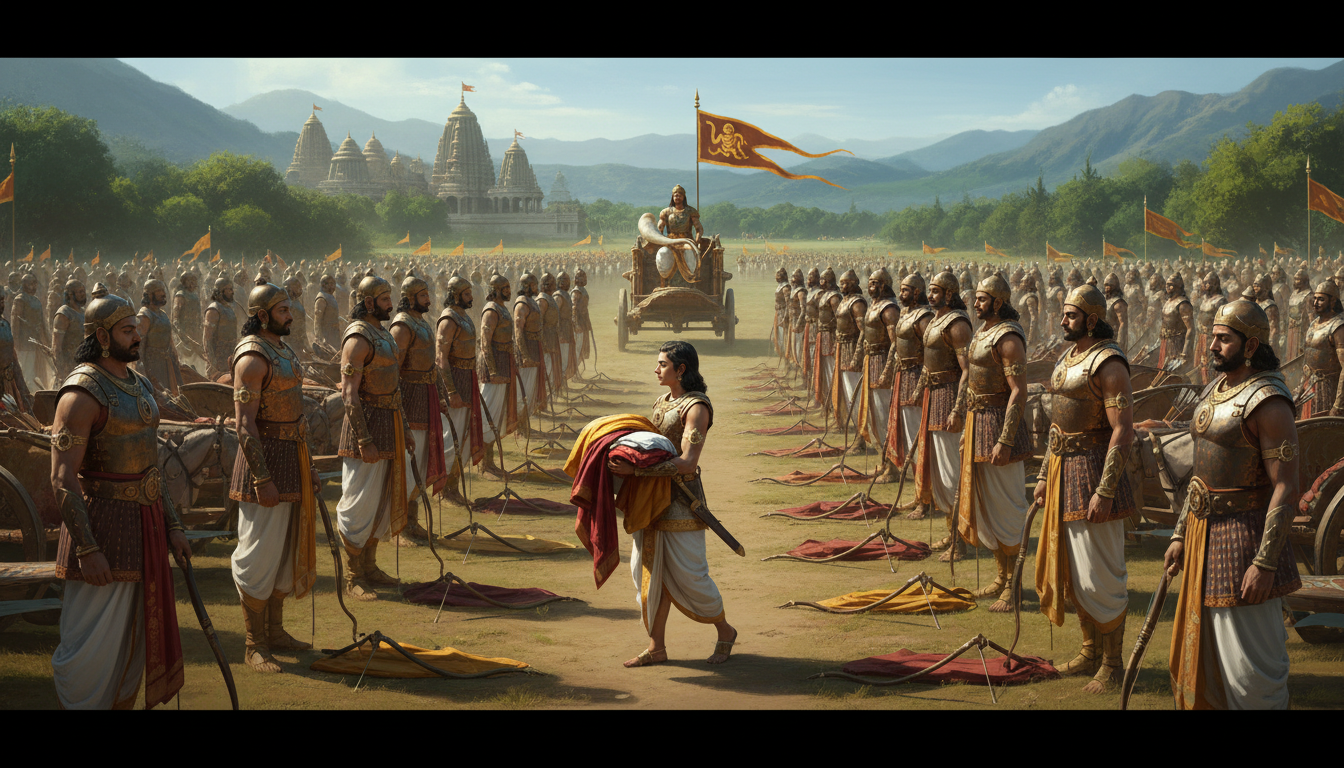
The Sleep Weapon and the Robes for the Dolls
Six great warriors disarmed, and a promise kept to some girls
The Grandsire Leaves the Van
When the conflict of celestial weapons was over, the two of them settled down to arrows.
Arjuna came in close and cut off Bhishma's gold-decked bow with a shaft sharp as a razor, and within the twinkling of an eye Bhishma had taken up another and strung it and was pouring a cloud of arrows down on him. They stood and shot at each other until no man on the field could see any distinction between them. Both obscured the ten directions. The Pandava covered Bhishma, and Bhishma covered the Pandava, and the warriors who protected the grandsire's car fell one after another beside the wheels of the son of Kunti. The feathery arrows of Shvetavahana, shot from the Gandiva, fell in every direction as though their object were a wholesale slaughter of the foe, and issuing from his car those blazing shafts furnished with golden wings looked like rows of swans crossing the sky.
High above, the Gandharva Chitrasena watched with the celestials and could not keep quiet about it.
"Behold these arrows shot by Partha coursing through the sky in one continuous line," he said to the lord of the celestials. "No interval can be perceived between his taking up the arrows, and fixing them on the bowstring, and letting them off by stretching the Gandiva. The soldiers are incapable of even looking at him; he is like the midday sun blazing in the sky. Nor does anyone venture to look at Bhishma, the son of Ganga. Both are famous for their achievements, both are of fierce prowess, both are equal in feats of heroism, and both are difficult to be vanquished."
And Indra, hearing that, paid proper respect to both of them with a shower of celestial flowers.
Then Bhishma came at Arjuna's left side, just as the man who could draw with either hand was on the point of piercing him, and Vibhatsu laughed aloud and cut off his bow again, and put ten shafts into his breast while the old man was contending with all his prowess. Sorely afflicted with pain, Ganga's son stood a long time leaning on the pole of his car. And his driver, calling to mind the instructions about protecting a warrior who is in a swoon, took him away out of the front of the battle.
A Shaft in the Forehead
With Bhishma gone from the van, the son of Dhritarashtra hoisted his flag high and came at Arjuna himself, bow in hand, setting up a loud roar.
He drew a spear-headed shaft back to his ear and let it go, and it took Arjuna in the forehead.
Pierced with that keen shaft of golden point, that hero of famous deeds looked resplendent, O king, like a beautiful hill with a single peak. The warm life-blood came out of the wound profusely and ran down over his body, and the blood on him shone like a wreath of golden flowers.
Arjuna did not put a hand to it. He swelled with rage and answered, taking up arrows that were endued with the energy of snakes of virulent poison, and he pierced the king in return. And Duryodhana of formidable energy attacked Partha, and Partha attacked Duryodhana, and those two foremost of men, both born in the race of Ajamida, struck each other alike in that combat, and for a little while there was nothing else on that part of the field.
It was late in a very long afternoon. Arjuna had already cut Bhishma's standard off clean at the roots, and when Dushasana and Vikarna and Dussaha and Vivingsati encompassed him for it he had broken Dushasana's gold-plaited bow and put five arrows in his chest and sent him out of the fight; he had struck Vikarna in the forehead and knocked him off his car; he had killed the steeds of the other two and left them to be carried off by the men behind. Behind Duryodhana the whole Kuru command had been standing since morning, six great car-warriors who had spent an hour of it quarrelling in public about a dice game, and every one of them now had to decide what to do about a wound on a forehead.
Eight Hundred Paces
Vikarna came next, seated on an infuriate elephant huge as a mountain and supported by four cars.
Arjuna saw the beast coming at speed and drew an iron arrow of great impetus back to his ear and struck it on the head, between the temples. Like the thunderbolt hurled by Indra splitting a mountain, that arrow furnished with vulturine wings went in up to the very feathers, into the body of an elephant as big as a hill.
The lord of the elephant species began to tremble. Then, deprived of strength, it came down on the ground in intense anguish, like the peak of a mountain riven by thunder.
Vikarna jumped clear as it fell, in great terror, and ran back a full eight hundred paces on his own feet before he found a car he could climb onto, which was Vivingsati's.
And having killed with a single thunder-like arrow an elephant huge as a hill and looking like a mass of clouds, the son of Pritha put another arrow of the same kind into Duryodhana's breast.
The elephant was down and the king was wounded and Vikarna had broken and gone, taking the supporters of the king's car with him. The other warriors, smitten by the arrows shot from the Gandiva, fled from the field in panic.
Where Is Thy Persistence in Battle
Duryodhana turned his car precipitately and fled in the direction where Partha was not.
He was vomiting blood as he went. Arjuna, still eager for battle and capable of enduring any enemy, did not pursue him. He raised his voice instead, and he was heard by both armies.
"Sacrificing thy great fame and thy glory, why dost thou fly away, turning thy back? Why are not those trumpets sounded now, as they were sounded when thou didst set out from thy kingdom?
"Lo, I am an obedient servant of Yudhishthira, myself the third son of Pritha, and I stand here for battle. Turn back. Show me thy face, O son of Dhritarashtra, and bear in thy mind the behaviour of kings.
"The name Duryodhana that was bestowed on thee before is hereby rendered meaningless. When thou runnest away, leaving the battle, where is thy persistence in battle? Neither do I behold thy bodyguards before thee nor behind thee. O foremost of men, fly away, and save that life of thine which is so dear to thee."
It was not said to make him fight. It was said in the hearing of the men who had ridden out of Hastinapura behind those trumpets, and it was designed to leave the king only one door open, and the king went through it.
Pricked By a Hook
Thus summoned to battle, Dhritarashtra's son turned back, stung by those censures like an infuriate elephant pricked by a hook. He was a brave car-warrior of great swiftness, and unable to bear what had been said of him he brought his car around like a snake that has been trampled under foot.
Karna, that hero among men, decked with a golden necklace, saw the king coming back with his wounds and stopped him on the way and soothed him, and then went on himself, passing along the north of Duryodhana's car, to meet Partha in battle.
And the mighty-armed Bhishma, the son of Shantanu, turned back his own steeds, decked with gold, enormous in size and of tawny hue, and rushed forward bow in hand to protect Duryodhana from Partha's hands. Drona came, and Kripa, and Vivingsati, and Dushasana, and the others, turning quickly with their bows drawn and their arrows already fixed on the strings, all of them for the protection of the king.
Arjuna saw those divisions advancing toward him like the swelling surges of the ocean, and he rushed at them the way a crane rushes at a descending cloud.
They surrounded him completely, with celestial weapons in their hands, and rained a perfect shower of shafts on him from every side, as clouds pour a heavy downpour on the breast of a mountain. He warded off, weapon by weapon, all the weapons of those bulls among the Kurus. And then, hemmed in by the six of them and by the whole army behind them, the wielder of the Gandiva reached for something he had been given on a mountain by his father.
Sammohana
The weapon was called Sammohana, the stupefier, and he had obtained it from Indra, and there was no answer to it.
He evolved it there in the middle of the encirclement. He covered the cardinal points and all the other directions with sharp and keen-edged arrows furnished with beautiful feathers, and with the twang of the Gandiva running under them he stupefied the senses of every man in front of him.
Then he took up in both hands that large conch of loud blare, and blew it with force, and filled the cardinal points and the other points, the whole earth and the sky, with that one noise.
And those foremost of the Kuru heroes were all deprived of their senses by it.
They did not fall. They stood exactly where they were, upright in their cars, and their bows, from which not one of them had ever been separated, dropped out of their hands and lay in the dust beside the wheels.
Drona stood there in his white robes with nothing in his hands. Kripa stood beside him. Karna stood with his golden necklace on and his face turned toward a man he had promised that morning to grind like an elephant afflicted with burning brands. Duryodhana stood in blue with the blood drying on his chest. Ashwatthama, who had refused an hour ago to lift a bow against Arjuna at all, stood disarmed like everybody else.
The army behind them stood as well, rank upon rank of it, sixty thousand cattle lowing somewhere beyond in the dust, and nothing moving on that whole field except one chariot and two men in it.
Every one of the six had spoken that morning. Karna had promised to hold this man as a bank holds the sea. Kripa had counted out, item by item, the things he had done alone, and had concluded that six of them together would be needed. Ashwatthama had said that he would not fight Dhananjaya at all and that the Gandiva does not throw Krita or Dwapara. Bhishma had told them that the worst calamity that can befall an army is disunion among its leaders. Not one of those speeches was worth anything now. The weapon had not asked which of them believed in the cause.
The Cloth for the Dolls
Then Partha remembered a promise, and it was not one he had made to a king.
When the chariot had gone out of the city that morning, the girls of the inner apartments had come around it, and Uttaraa and her maidens had called up to the dancing master who was holding the reins, saying, "Bring back for our dolls, Vrihannala, when you come, various kinds of good and fine cloths, after you have vanquished the Kurus, of whom Bhishma and Drona are the foremost." And he had answered them in a voice deep as the roar of the clouds, smiling, that if Uttara could vanquish those mighty warriors in battle he would certainly bring back excellent and beautiful cloths.
Now he turned to the son of Matsya.
"O best of men, go among the Kurus while they remain insensible, and bring away the white garments of Drona and of Kripa, and the yellow and handsome ones of Karna, and the blue ones of the king and of Drona's son."
Uttara looked at the standing army.
"One thing," said Arjuna. "Methinks Bhishma is not stupefied, for he knows how to counteract this weapon of mine. So pass on, keeping his steeds to your left. Those that are sensible should be avoided in that manner."
The illustrious son of Matsya gave up the reins and got down from the car and walked in among the greatest archers alive, none of whom moved, and took the garments off them one by one, keeping wide of the old man with the tawny horses. Then he came back to his place with an armful of cloth for the dolls of the palace girls, and picked up the reins again, and urged on the four handsome steeds with flanks adorned with golden armour. And those white horses took Arjuna out of the middle of that battlefield and beyond the array of the infantry standing there with their standards in their hands.
The One Who Was Not Asleep
Bhishma was not asleep, and he watched them go, and he shot.
Arjuna answered him by killing his steeds, and put ten shafts into him, and then slew his car driver, and left him standing there on the field, and came out of that multitude of cars like the sun emerging from behind clouds.
Then Dhritarashtra's son recovered his senses, and looked around at his own disarmed army, and saw the son of Pritha standing out on the open ground alone, like the lord of the celestials.
"How has this one escaped from you?" he said in a hurry to Bhishma. "Afflict him in such a way that he may not escape."
And Shantanu's son smiled at him.
"Where had this sense of yours been, and where had your prowess been too, when you were standing in a state of unconsciousness, having renounced your arrows and your handsome bow?
"Vibhatsu is not addicted to the commission of atrocious deeds, nor is his soul inclined to sin. He does not renounce his principles even for the sake of the three worlds. It is for this only that all of us have not been slain in this battle.
"O foremost of Kuru heroes, go back to the city of the Kurus, and let Partha also go away, having conquered the kine. Do not foolishly throw away your own good. That which leads to one's welfare ought to be accomplished."
The king listened to the grandsire's words, which tended to his own welfare, and drew a deep sigh, and became silent, and was no longer eager for battle. And the other warriors, reflecting that the advice was beneficial, and seeing that the Pandavas were gaining in strength, resolved to return, in order to protect Duryodhana.
They had come to take cattle. They went home in their undergarments.
Salutes, and a Crown Broken
As the foremost of the Kuru heroes departed for their city, Dhananjaya followed them for a while with a cheerful heart, because he wanted to address them and to worship them.
He worshipped the aged grandsire, the son of Shantanu. He worshipped the preceptor Drona. He saluted Drona's son, and Kripa, and the other venerable ones among the Kurus, with beautiful arrows sent past them in the proper manner. Then, with one more arrow, he broke into fragments Duryodhana's crown, which was decked with precious gems.
Having saluted all the venerable and brave warriors in that way, he filled the three worlds with the twang of the Gandiva, and suddenly blew his conch called Devadatta, and the hearts of all his foes were pierced by it.
"Turn back your steeds," he said to Matsya's son. "Your kine have been recovered. The foe is going away. Do you also return to your city with a cheerful heart."
And the celestials, having witnessed that encounter, were highly delighted, and went away to their respective abodes, reflecting upon Partha's feats.
Then out of the deep forest came a large number of Kuru soldiers who had been separated in the rout, walking slowly, with their hair dishevelled, fatigued with hunger and thirst, arrived in a foreign land, insensible with terror and confused in mind. They stood before him with joined palms.
"We are your slaves," they said.
"Welcome, and blessed be you," said Arjuna. "Go your way. You have no cause of fear. I will not take the lives of them that are afflicted. You have my assurance of protection."
And they greeted him with benedictions in praise of his fame, and wished him long life, and went away after their army.
On the road back, Arjuna gave the prince his instructions.
"It is known to you alone, O child, that the sons of Pritha are living with your father. Do not praise them on entering the city, for then the king of the Matsyas may hide himself in fear. Entering the city, proclaim in the presence of your father that the deed is your own. Say, by me has the army of the Kurus been vanquished, and by me have the kine been recovered from the foe."
"The feat you have achieved is beyond my power," said Uttara. "I do not possess the ability to achieve it. I shall not, however, O Savyasachin, discover you to my father, as long as you do not tell me to do it."
"Then look ahead," said Arjuna. "The kine are being escorted in front of us by the cowherds. We shall enter the metropolis in the afternoon, when the steeds have been given drink and a bath. Let the cowherds, despatched by you, go quickly into the city with the good news and proclaim your victory."
And Uttara ordered the messengers, and they went. "Go and proclaim the king's victory. The foe has been routed, and the kine have been recovered."
So they came back to the cemetery and to the same shami tree, and Arjuna stood under it with his body mangled by the arrows of the enemy. And that terrible monkey, blazing like fire, went up off the flagstaff into the sky with the other creatures that had sat there, and the illusion contrived by Vishwakarma melted away, and Uttara's own banner with the device of a lion was set up on the car again. The arrows and the quivers of those foremost of Kuru princes were put back into the tree, and the Gandiva with them.
Then Partha bound his hair into a braid, as it had been before, and took the reins out of Uttara's hands, and drove into the city of Virata as Vrihannala, the car-driver of the prince, with the robes of six great warriors folded on the floor of the chariot for the dolls of some girls.
Dharma Lesson
Power is measured by what it declines to do once nothing can stop it. Arjuna has six of the greatest archers alive standing helpless in front of him and takes nothing from them but cloth for a child's toys. Bhishma names the reason plainly: they are all alive only because Vibhatsu does not do atrocious things, and will not abandon his principles even for the sake of the three worlds.