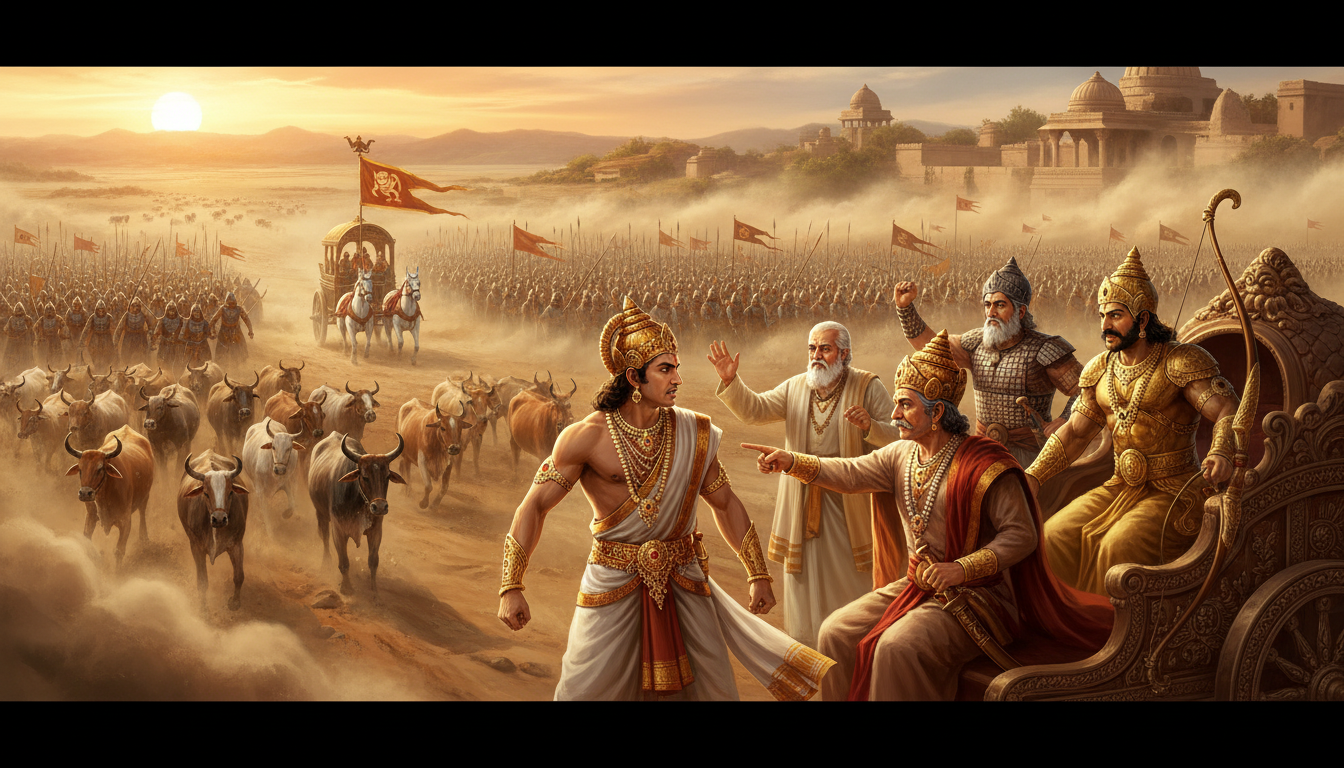
The Quarrel Before the Cattle
Ashwatthama tells Duryodhana what his kingdom is made of
The Rattle of One Car
The Kuru army had taken sixty thousand of Virata's cattle and was standing in the open country north of the Matsya capital, waiting for the herds to be driven clear, when they heard a bowstring.
It was one bowstring. It came from the direction of the burning ground, and the sound of it went across the plain like the collision of two great bulls, and the wind rose after it, and meteors fell. Birds came off the trees and could not hold their line in the air.
Drona had been a soldier for a very long time and he did not pretend that he had not understood it.
"From the rattle of that car," he said, "and from the manner in which the clouds have enveloped the sky, and from the trembling of the earth itself, this warrior can be none other than Savyasachin. Look at us. Our weapons do not shine. Our steeds are dispirited. Our fires, though fed with fuel, do not blaze up. All this is ominous."
"Omens," said Karna, from further along the line.
"All our animals are setting up a frightful howl, gazing toward the sun. The crows are perching on our banners. Those vultures and kites on our right portend a great danger. That jackal running through our ranks wails dismally, and see, it has escaped unstruck. The bristles of every man here are on end. Things endued with light are pale, and beasts and birds look fierce. These omens forebode great havoc among ourselves." He turned to Duryodhana. "O king, your ranks are confounded by these blazing meteors, and your animals seem to be weeping. You will have to repent when you behold this army afflicted by Partha's arrows. Send the kine ahead. We should stand here, ready to strike, arrayed in order of battle."
Across the field a single chariot came on toward sixty thousand men, and on its staff was a golden banner with an ape on it, and the ape had a lion's tail.
The Thirteenth Year Is Still Running
Duryodhana turned on the three of them, Bhishma and Drona and Kripa, and he was already arguing before he began.
"Both Karna and I said this to the preceptors before," he said, "and I say it again, because I am not satisfied with having said it once. This was the pledge of the sons of Pandu: that if defeated at dice they would reside to our knowledge in countries and woods for twelve years, and one more year unknown to us. That thirteenth year, instead of being over, is still running. Vibhatsu, who is still bound to live undiscovered, has appeared before us. And if Vibhatsu has come before the term of exile is at an end, then the Pandavas must pass another twelve years in the woods."
Nobody answered him.
"Whether it is due to forgetfulness on their part, induced by the desire of dominion, or whether it is a mistake of ours, it behoves Bhishma to calculate the shortness or the excess of the promised period. When an object of desire may or may not be attained, a doubt necessarily attaches to one of the alternatives, and what is decided in one way often ends differently. Even moralists are puzzled in judging of their own acts.
"As for ourselves, we came here to fight the Matsyas and to seize their kine stationed toward the north. If meanwhile it is Arjuna who has come, what fault attaches to us? We came on behalf of the Trigartas, who were overcome with fear and who represented to us how many were the oppressions committed by the Matsyas. It was agreed between us that they should seize the wealth of kine on the afternoon of the seventh lunar day, and that we should seize these at sunrise of the eighth, while the king of the Matsyas was away pursuing the first herd. It may be that the Trigartas are now carrying off the cattle, or that they have been defeated and are coming to us. It may be that the king of the Matsyas has driven them off and is advancing on us at the head of his whole army. It may be some one leader among them, endued with mighty energy."
He looked along the line of chariots.
"But be it the king of the Matsyas or be it Vibhatsu, we must all fight him. Even this has been our pledge. Why are all these foremost of car-warriors, Bhishma and Drona and Kripa and Vikarna and Drona's son, now sitting on their cars, panic-stricken? At present there is nothing better than fighting. Therefore make up your minds. If, for the cattle we have seized, we must have an encounter with the wielder of the thunderbolt himself, or even with Yama, who is there among us that will be liable to reach Hastinapura? Pierced by the shafts of the foe, how will the foot-soldiers escape with their lives, flying through the deep forest with their backs to the field, when escape even for the cavalry is doubtful?"
Disregard the Preceptor
Karna answered him, and he did not answer the question that had been asked.
"Disregard the preceptor," he said, "and make all arrangements yourself. He knows well the intentions of the Pandavas, and he strikes terror in our hearts. I see that his affection for Arjuna is very great. Seeing him only coming, he chants his praises. Make such arrangements that our troops may not break. Everything is in confusion because Drona has heard the neigh of Arjuna's steeds."
Drona said nothing at all.
"These troops have come to a distant land in this hot season and in the midst of this mighty forest. Make such arrangements that they may not fall into confusion and be subjugated by the foe. The Pandavas are always the special favourites of the preceptor; they have stationed Drona among us, and he betrays himself by his speech. Who would ever extol a person on hearing only the neigh of his steeds? Horses always neigh, whether walking or standing. The winds blow at all times. Indra also always showers rain. The roar of the clouds may frequently be heard. What has Partha to do with any of these, and why is he to be praised for them? All this, on the preceptor's part, is due either to a desire of doing good to Arjuna, or to his wrath and hatred toward us."
Then he said the thing that Ashwatthama would remember for the rest of the afternoon.
"Preceptors are wise and sinless and very kind to all creatures. They should never be consulted at times of peril. It is in luxurious palaces, and in assemblies, and in pleasure gardens, that learned men capable of making speeches seem to be in their place. Performing many wonderful things in an assembly, it is there that learned men find their place, or else where sacrificial utensils and their proper placing and washing are needed. In studying the characters of men, in the science of horses and elephants and cars, in treating the diseases of asses and camels and goats and sheep, in planning buildings and gateways, in pointing out the defects of food and drink, there the learned are truly in their own sphere."
Along the line the charioteers stopped pretending not to listen.
"Disregarding learned men who extol the heroism of the foe, make such arrangements that the foe may be destroyed. Place the kine securely. Array the troops in order of battle. Put guards in the proper places, so that we may fight."
As the Banks Resist the Sea
"I behold all these blessed ones," Karna went on, "looking as if alarmed and panic-struck and unresolved and unwilling to fight. If he that is come is the king of the Matsyas, or if he is Vibhatsu, even I alone will resist him, as the banks resist the swelling sea.
"Shot from my bow, these straight and flying arrows, like gliding snakes, are all sure of aim. Discharged by my light hands, these keen-edged arrows furnished with golden wings shall cover Partha all over, like locusts shrouding a tree. Strongly pressed by these winged arrows, the bowstring will make my leathern fences produce a sound that will be heard to resemble a pair of kettle-drums.
"He has been engaged in ascetic austerities for the last eight and five years. Vibhatsu will strike me but mildly in this conflict. The son of Kunti has become a Brahmana endued with good qualities, and has thus become a fit person to receive quietly the shafts shot by me in thousands. This mighty bowman is celebrated over the three worlds, and I too am by no means inferior to Arjuna. Let the firmament today seem to swarm with fireflies, from my golden arrows shot on all sides.
"Slaying Arjuna in battle, I will discharge today that debt, difficult of repayment, which I promised of old to Dhritarashtra's son. What man is there, even among the gods and the Asuras, who will endure to stand in the teeth of the arrows shot from my bow? Hard though he be as Indra's thunderbolt, I will surely grind Partha, as one afflicts an elephant by means of burning brands, and seize the unresisting Partha as Garuda seizes a snake.
"Struck with my javelin, the ape stationed on his banner-top shall fall down today on the ground, uttering terrible cries. The creatures stationed in that flagstaff, afflicted by me, will fly away in all directions. I shall today pluck up by the roots the long-existing dart in Duryodhana's heart, by throwing Arjuna down from his car. The Kauravas shall today behold Partha with his car broken, his horses killed, his valour gone, himself sighing like a snake."
He finished with a courtesy that was not one.
"Let the Kauravas, following their own will, go away taking this wealth of kine. Or, if they wish, let them stay on their cars and witness my combat."
A Battle Is the Last of the Expedients
"O Radheya," said Kripa, "your crooked heart always inclines to war. You do not know the true nature of things, nor do you take into account their after-consequences.
"There are various kinds of expedients inferrable from the scriptures. Of these, a battle has been regarded, by those acquainted with the past, as the most sinful. It is only when time and place are favourable that military operations can lead to success. In the present instance the time is unfavourable, and no good results will be derived. A display of prowess in proper time and place becomes beneficial; it is by the favourableness or otherwise of time and place that the opportuneness of an act is determined. Learned men can never act according to the ideas of a car-maker."
"Then let us stand here and be run down," said Karna.
"Considering all this," said Kripa, "an encounter with Partha is not advisable for us. But let me say what he is, since you have offered to hold him alone.
"Alone he saved the Kurus from the Gandharvas. Alone he satiated Agni. Alone he led the life of a Brahmacharin for five years on Himavat. Taking up Subhadra on his car, alone he challenged Krishna to single combat. Alone he fought with Rudra, who stood before him in the form of a forester. It was in this very forest that Partha rescued Krishna, the princess of Panchala, while she was being carried away. It is he alone who for five years studied the science of weapons under Indra. Alone, vanquishing all foes, he has spread the fame of the Kurus. Alone that chastiser of foes vanquished in battle Chitrasena, the king of the Gandharvas, and in a moment his invincible troops also. Alone he overthrew the fierce Nivatakavachas and the Kalakhanchas, who were both incapable of being slain even by the gods.
"What, O Karna, has been achieved by you single-handed, like any of the sons of Pandu, each of whom has alone subjugated many lords of the earth? Even Indra himself is unfit to encounter Partha in battle. He, therefore, who desires to fight with Arjuna should first take a sedative.
"As to yourself, you desire to take out the fangs of an angry snake of virulent poison by stretching forth your right hand and extending your forefinger. Or, wandering alone in the forest, you desire to ride an infuriate elephant, and to go to a boar with no hook in your hand. Or, rubbed over with clarified butter and dressed in silken robes, you desire to pass through the midst of a blazing fire fed with fat and tallow. Who is there that would bind his own hands and feet, and tie a huge stone to his neck, and cross the ocean swimming with his bare arms? What manliness is there in such an act?"
Six Chariots and No More Boasting
"He is a fool," Kripa said, "who, without skill in weapons and without strength, would desire to fight with Partha, who is so mighty and so skilled. And consider what we have actually done today. Dishonestly deceived by us, and liberated from thirteen years of exile, will the illustrious hero not annihilate us? Having ignorantly come to a place where Partha lay concealed like fire hidden in a well, we have exposed ourselves to a great danger."
"You said we should not fight," said Duryodhana.
"I said an encounter is not advisable. But irresistible though he be in battle, we should fight against him, since we are here and the cattle are behind us. Only let it be done as men do it who intend to live. Let our troops, clad in mail, stand here arrayed in ranks and ready to strike. Let Drona and Duryodhana and Bhishma and yourself and Drona's son and myself, all of us, fight with the son of Pritha."
He turned back to Karna and made the point once more, in case it had been missed.
"Do not, O Karna, act so rashly as to fight alone. If we six car-warriors be united, then we can be a match for that son of Pritha, who is resolved to fight and who is as fierce as the wielder of the thunderbolt. Aided by our troops arrayed in ranks, ourselves great bowmen standing carefully, we will fight with Arjuna as the Danavas encounter Vasava in battle."
It was, in its way, a complete answer. It conceded the battle, refused the boast, and told the assembled command that six of the greatest archers alive would be needed together to handle one dancing master in a borrowed chariot.
Fire Burns Silently
Then Drona's son spoke, and he began with Karna, and he was not finished when he got to the end of him.
"The kine, O Karna, have not yet been won," said Ashwatthama. "Nor have they crossed the boundary of their owner's dominions. Nor have they reached Hastinapura. Why, then, do you boast of yourself?
"Having won numerous battles, and acquired enormous wealth, and vanquished hostile hosts, men of true heroism speak not a word of their prowess. Fire burns mutely. Mutely does the sun shine. Mutely does the Earth bear creatures, both mobile and immobile."
He let that stand a moment in front of a man who had been talking for a quarter of an hour.
"The Self-existent has sanctioned such offices for the four orders that, having recourse to them, each may acquire wealth without being censurable. A Brahmana, having studied the Vedas, should perform sacrifices himself and officiate at the sacrifices of others. A Kshatriya, depending upon the bow, should perform sacrifices himself, but should never officiate at the sacrifices of others. A Vaisya, having earned wealth, should cause the rites enjoined in the Vedas to be performed for himself. A Sudra should always wait upon and serve the other three orders. As regards those that live by the profession of vendors of meat, they may earn wealth by expedients fraught with deceit and fraud.
"Always acting according to the dictates of the scriptures, the exalted sons of Pandu acquired the sovereignty of the whole earth. And they always act respectfully toward their superiors, even when their superiors prove hostile to them."
Up to that point every man had taken it for a lecture aimed at Karna. Then Ashwatthama turned his head and looked at the king.
The Gandiva Does Not Throw Krita or Dwapara
"What Kshatriya is there," said Ashwatthama, "who ever expressed delight at having obtained a kingdom by means of dice, like this wicked and shameless son of Dhritarashtra? Having acquired wealth in this way by deceit and fraud, like a vendor of meat, who that is wise would boast of it?
"In what single combat did you vanquish Dhananjaya, or Nakula, or Sahadeva, though you have robbed them of their wealth? In what battle did you defeat Yudhishthira, or Bhima, that foremost of strong men? In what battle was Indraprastha conquered by you?
"What you have done, O you of wicked deeds, is to drag that princess into the court while she was ill and had but one raiment on. You have cut the mighty root, delicate as the sandal, of the Pandava tree. Actuated by the desire of wealth, when you made the Pandavas act as slaves, do you remember what Vidura said to you?
"We see that men, and even insects and ants, show forgiveness according to their power of endurance. The son of Pandu, however, is incapable of forgiving the sufferings of Draupadi. Surely Dhananjaya comes here for the destruction of the sons of Dhritarashtra. It is true that, affecting great wisdom, you are for making speeches. But will not Vibhatsu, that slayer of foes, exterminate us all? Whether it be gods or Gandharvas or Asuras or Rakshasas, will Dhananjaya the son of Kunti desist from fighting out of panic? Upon whomsoever he falls, inflamed with wrath, him he will overthrow like a tree under the weight of Garuda. Superior to you in prowess, in bowmanship equal to the lord of the celestials, in battle equal to Vasudeva himself, who is there that would not praise Partha? Those acquainted with the scriptures declare that a disciple is in no way inferior to a son, and it is for this that the son of Pandu is a favourite of Drona."
Then he pointed, in front of the whole army, at the man standing next to the king.
"Employ now the means which you adopted in the match at dice. The same means by which you subjugated Indraprastha. The same means by which you dragged Krishna into the assembly. This wise uncle of yours, fully conversant with the duties of the Kshatriya order, this deceitful gambler Shakuni, the prince of Gandhara, let him fight now.
"The Gandiva, however, does not cast dice such as the Krita or the Dwapara. It shoots upon its foes blazing and keen-edged shafts by myriads. The fierce arrows shot from the Gandiva, endued with great energy and furnished with vulturine wings, can pierce even mountains. The destroyer of all, named Yama, and Vayu, and the horse-faced Agni, leave some remnant behind. Dhananjaya, inflamed with wrath, never does so.
"As you played at dice in the assembly aided by your uncle, so fight in this battle protected by Suvala's son. Let the preceptor fight, if he chooses. I, however, shall not fight with Dhananjaya. We are to fight with the king of the Matsyas, if indeed he comes in the track of the kine."
The Worst Calamity of an Army
So the Kuru command stood on that field with one chariot approaching, having quarrelled in public about a dice game, and it was Bhishma who had to put it back together.
"Drona's son observes well," he said, "and Kripa too observes rightly. As for Karna, it is only out of regard for the duties of the Kshatriya order that he desires to fight. No man of wisdom can blame the preceptor. I, however, am of opinion that fight we must, considering both the time and the place.
"Why should not that man be bewildered who has five adversaries effulgent as five suns, heroic combatants just emerged from adversity? Even those conversant with morality are bewildered in respect of their own interests. What Karna said to you was only for the raising of our drooping courage."
Then he turned to the young man who had refused to fight.
"As regards yourself, O preceptor's son, forgive everything. The business at hand is very grave. When the son of Kunti has come, this is not the time for quarrel. Everything should now be forgiven by you and by the preceptor Kripa. Like light in the sun, the mastery of all weapons resides in you. As beauty is never separated from Chandramas, so are the Vedas and the Brahma weapon both established in you. It is often seen that the four Vedas dwell in one man and the attributes of the Kshatriya in another. We have never heard of these two dwelling together in any person other than the preceptor of the Bharata race and his son. In the Vedantas, in the Puranas, and in the old histories, who save Jamadagni would be Drona's superior? O preceptor's son, forgive. This is not the time for disunion. Let all of us, uniting, fight with Indra's son, who has come. Of all the calamities that may befall an army, and that have been enumerated by men of wisdom, the worst is disunion among the leaders."
"O bull among men," said Ashwatthama, "these just observations of yours need not be uttered in our presence. The preceptor, however, filled with wrath, had spoken of Arjuna's virtues. The virtues of even an enemy should be admitted, while the faults of even one's own preceptor may be pointed out. Therefore one should, to the best of his power, declare the merits of a son or a disciple."
"Let the preceptor grant his forgiveness," said Duryodhana, "and let peace be restored. If the preceptor be at one with us, whatever should be done would seem to have been already done."
Then Duryodhana, assisted by Karna and Kripa and the high-souled Bhishma, pacified Drona.
"Appeased I have already been," said Drona, "at the words first spoken by Bhishma, the son of Shantanu. Let such arrangements be made that Partha may not be able to approach Duryodhana in battle, and that king Duryodhana may not be captured by the foe in consequence either of his rashness or his want of judgment. Arjuna has not, to be sure, revealed himself before the expiry of the term of exile. Nor will he pardon this act of ours today, having only recovered the kine. Like myself, Duryodhana also had said so before. Bearing that in mind, it behoves the son of Ganga to say what is true."
And so, with the ape banner coming up the field, the whole command turned to an old man and asked him for a calendar.
Dharma Lesson
An army whose captains do not respect the cause they serve is beaten before the first arrow. Ashwatthama will not lift a bow for a kingdom that was won at dice, and says so where every soldier can hear it. Bhishma names the real danger correctly: of all the calamities that can befall a host, the worst is disunion among its leaders.