Where a Good King Must Be Living
The Kuru court tries to find five men by their weather
The Spies Come Back Empty
Vaishampayana said: The spies came into the hall at Hastinapura together, O Janamejaya, and they came together because not one of them wished to say it alone.
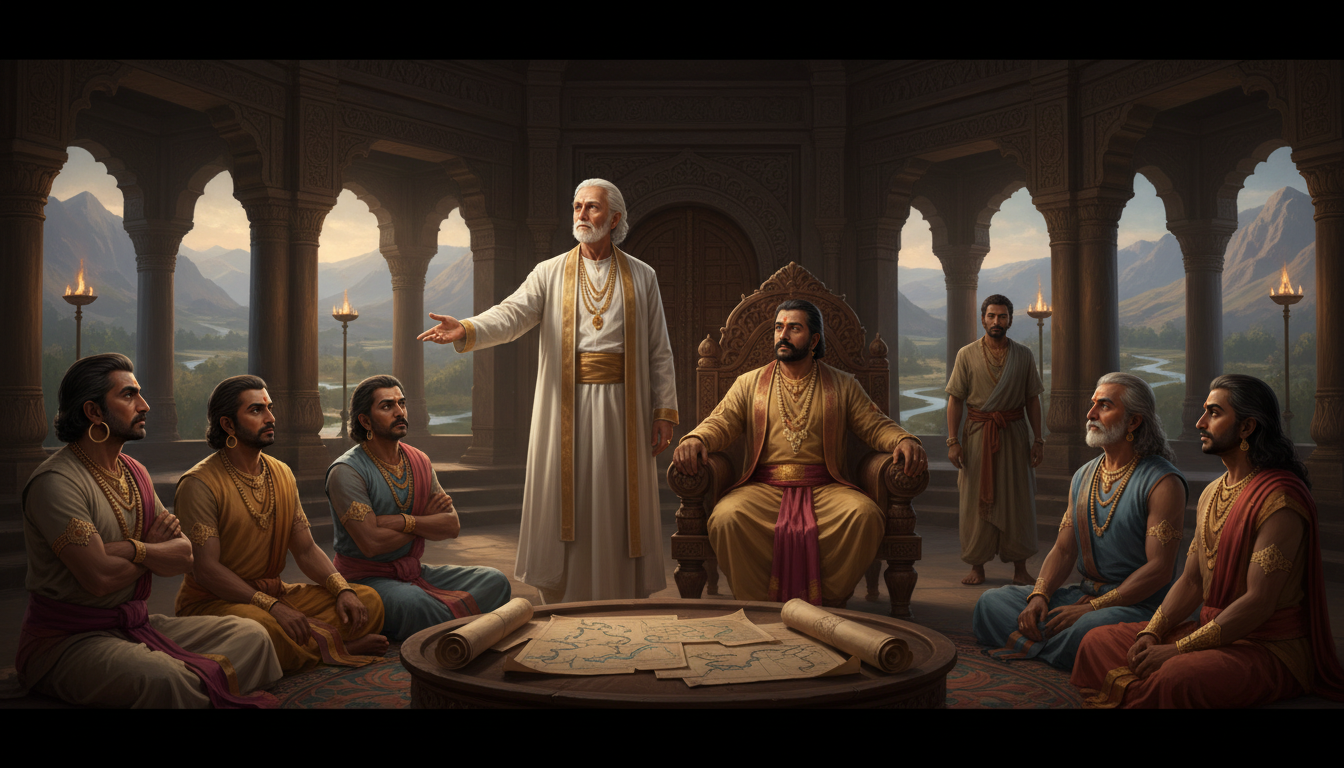
Duryodhana was seated in his court with Drona on one hand and Karna on the other, and Kripa beside them, and Bhishma the son of Shantanu above them all; his own brothers filled the benches, and along the wall stood the Trigarta lords, who had come to complain of Matsya and had not yet been given an answer. Into that assembly the searchers made their report.
"Great has been the care always bestowed by us in the search after the sons of Pandu," they said. "We have searched through the solitary wilderness that abounds with deer, overgrown with trees and with creepers of every kind. We have searched the arbours of matted woods. We have searched on mountain tops and in fastnesses that cannot be climbed, in kingdoms and provinces teeming with people, in encampments and in cities. We looked for their footprints in those places and in others. No trace of the sons of Pandu has been found."
"You followed the charioteers," said Duryodhana.
"For some time we followed in the wake of their charioteers, O king, and we made our inquiries duly, and we truly ascertained what we desired to know. The charioteers reached Dwaraka without the sons of Pritha among them. Neither the sons of Pandu nor the princess of Panchala are in that city of the Yadavas. We have not been able to discover either their track or their present abode. Salutations to thee: they are gone for good."
The hall took that in. It was not the answer any man in it had wanted, and yet there was a sound in the benches that was almost relief.
"Hear also these agreeable words of ours," the chief of them went on, "promising great good to thee. King Matsya's commander, Kichaka of wicked soul, by whom the Trigartas were repeatedly vanquished and slain with mighty force, now lies low on the ground with all his brothers, slain by invisible Gandharvas during the hours of darkness. Having heard this delightful news of the discomfiture of our enemies, we are exceedingly gratified. Do thou now ordain what should next be done."
Along the wall, the Trigarta lords looked at one another. Nobody in that hall yet understood what the death of Kichaka meant, or where the Gandharvas had come from.
What Remains Is By Much the Smaller
Duryodhana did not answer at once. He sat and reflected inwardly for some time, and the court waited on his silence, and when he did speak it was not to the spies but to the whole assembly.
"It is difficult to ascertain the course of events definitely," he said. "Discern all of you, therefore, whither the sons of Pandu have gone. Of this thirteenth year, which they are to pass undiscovered by us all, the greater part has already expired. What remains is by much the smaller."
He let that sit in the hall a moment, because every man there could do the sum.
"If indeed the sons of Pandu can pass undiscovered what remains of this year, devoted to the vow of truth as they are, they will then have fulfilled their pledge. They will then return like mighty elephants with the juice trickling down their temples, or like snakes of virulent poison. Filled with wrath, they will without doubt be inflicters of terrible chastisement on the Kurus."
"Then find them," said someone from the benches.
"That is what I am saying. It behoves you, therefore, to make such efforts without loss of time as may induce the sons of Pandu, acquainted as they are with the proprieties of time, and staying as they now are in painful disguise, to re-enter the woods suppressing their rage." He said the last words slowly, because that was the whole design: not to kill them, but to catch them one day short, so that the twelve years would begin again from the beginning and the thing would never have to be settled at all. "Adopt such means as may remove all causes of quarrel and anxiety from the kingdom, making it tranquil and foeless and incapable of sustaining a diminution of territory."
So the question was put to the court, and the court answered it in the order in which men rose.
Karna Wants Better Spies
Karna rose first, as he generally did.
"Let other spies, abler and more cunning, and capable of accomplishing their object, quickly go hence, O Bharata," he said. "These men searched forests. Forests are where a hunted man is looked for, and the sons of Pandu know that as well as we do. Let the next ones be well disguised, and let them wander through swelling kingdoms and populous provinces, prying into assemblies of the learned and into the delightful retreats of the provinces."
He began to count the places off, and the list was not the list of a man who had ever been hunted himself but of one who had thought carefully about where he would go.
"In the inner apartments of palaces. In shrines and holy spots. In mines. In diverse other regions of that kind, the sons of Pandu should be searched after with well-directed eagerness. Let those who are living in disguise be searched after by well-skilled spies in large numbers, devoted to their work, themselves well disguised, and all well acquainted with the objects of their search. Let the search be made on the banks of rivers, in holy regions, in villages and towns, in the retreats of ascetics, in delightful mountains and in mountain caves."
It was a good plan. It assumed that five men in hiding would go where hiding was easy, and it left out entirely the possibility that they had gone where hiding was hardest, into the middle of a king's household, in front of everybody, every day.
Dushasana Prefers Them Dead
When Karna had finished, Duryodhana's second brother rose, and Dushasana was always at his most cheerful when he had a comfortable thing to say.
"O monarch, O lord of men," he said, "let those spies only in whom we have confidence go once more after the search, and let them receive their rewards in advance. This, and what else has been said by Karna, has our fullest approval. Let all the spies engage themselves in the search according to the directions already given, from province to province, according to approved rules."
Then he came to what he actually thought.
"It is my belief, however, that the track the Pandavas have followed, or their present abode, or their occupation, will not be discovered. Perhaps they are closely concealed. Perhaps they have gone to the other side of the ocean. Or perhaps, proud as they are of their strength and courage, they have been devoured by wild beasts. Or perhaps, overtaken by some unusual danger, they have perished for eternity."
He turned to his brother with the ease of a man handing over a gift.
"Therefore, O prince of the Kuru race, dispel all anxieties from thy heart. Achieve what thou wilt, always acting according to thy energy."
It was the most agreeable speech made in that hall all day, and it was the only one that asked nothing of anybody. Duryodhana did not look comforted by it.
Drona Says They Do Not Perish
Then Drona spoke, and the assembly quieted, because the preceptor did not often trouble to contradict the king's brother.
"Persons like the sons of Pandu never perish," he said, "nor undergo discomfiture. Brave and skilled in every science, intelligent, with their senses under control, virtuous and grateful and obedient to the virtuous Yudhishthira. They follow always in the wake of their eldest brother, who is conversant with the conclusions of policy and virtue and profit, who is attached to them as a father, and who strictly adheres to virtue and is firm in truth. Men so devoted to their royal brother, and a brother who, gifted with great intelligence, never injures anybody and who in his turn himself obeys his younger brothers, do not perish in this way."
He let his eyes go along the benches.
"Why then should not the son of Pritha, possessing a knowledge of policy, be able to restore the prosperity of his brothers who are so obedient and devoted and high-souled? It is for this that they are carefully waiting for the arrival of their opportunity. Men such as these never perish. This is what I see by my intellect."
"Then what is to be done, preceptor?" said Duryodhana.
"Do quickly and without loss of time what should now be done, after proper reflection. And let the abode which the sons of Pandu are to occupy be now settled by us. Heroic and sinless and possessed of ascetic merit, they are difficult to be discovered within the period of their concealment. Devoted to truth and versed in the principles of policy, endued with purity and holiness, the son of Pritha is the embodiment of immeasurable energy and is capable of consuming his foes by a glance alone of his eyes." He paused. "Knowing all this, do what is proper. Let us search after them once more, but let us send Brahmanas and Charanas, ascetics crowned with success, and others of that kind who may have a knowledge of those heroes."
Karna's face did not change, but every man in the hall understood what had just been said about his spies.
The Grandsire Declines the Method
Then the grandsire of the Bharatas rose, Bhishma the son of Shantanu, conversant with the Vedas, acquainted with the proprieties of time and place, and knowing every duty of morality. He first applauded the preceptor.
"The words that the regenerate Drona has uttered, acquainted as he is with the truth of every affair, are approved by me. I have no hesitation in saying so. Endued with every auspicious mark, observant of virtuous vows, possessed of Vedic lore, obedient to the counsels of the aged, adhering to the vow of truth, acquainted with the proprieties of time, observant of the pledge they have given, pure in their behaviour, ever adhering to the duties of the Kshatriya order, always obedient to Keshava, high-souled and possessed of great strength, those heroic ones can never wither under misfortune. Aided by their own energy, the sons of Pandu, who are now leading a life of concealment in obedience to virtue, will surely never perish. It is even this that my mind surmises."
Then he set the whole day's business aside.
"Therefore, O Bharata, I am for employing the aid of honest counsel in our behaviour towards the sons of Pandu. It would not be the policy of any wise man to cause them to be discovered now by means of spies."
Duryodhana said nothing. Bhishma went on, and now he was speaking only to him.
"What we should do unto the sons of Pandu, I shall say, reflecting with the aid of the intellect. Know that I shall say nothing from ill will to thee. People like me should never give such counsels to him that is dishonest, for only counsels like those I would give should be offered unto them that are honest; counsels that are evil should under no circumstances be offered at all. He, O child, that is devoted to truth and obedient to the aged, he indeed that is wise, while speaking in the midst of an assembly, should under all circumstances speak the truth, if the acquisition of virtue be an object with him."
"Say it, then," said Duryodhana.
"I shall say that I think differently from all these people here, in respect of the abode of Yudhishthira the just in this the thirteenth year of his exile."
The Country a Just Man Makes
"The ruler, O child, of the city or the province where king Yudhishthira resides cannot have any misfortune," said Bhishma. "Do not send men out to find him. Send them out to find the place I am about to describe, and when they have found it, they will have found him."
And the old man described a country, and it took him some time, and nobody interrupted him.
"Charitable and liberal and humble and modest must the people be of the country where king Yudhishthira resides. Agreeable in speech, with their passions under control, observant of truth, cheerful, healthy, pure in conduct and skilful in work must the people be of the country where king Yudhishthira resides. The people of that place cannot be envious, or malicious, or vain, or proud, but must all adhere to their respective duties. In the place where Yudhishthira is, Vedic hymns will be chanted all around, sacrifices will be performed, the last full libations will always be poured, and gifts to Brahmanas will always be in profusion."
"There the clouds, without doubt, pour abundant rain, and furnished with good harvest the country will ever be without fear. There the paddy will not be without grain. The fruits will not be bereft of juice. The floral garlands will not be without fragrance, and the conversation of men will always be full of agreeable words. There the breezes will be delicious, the meetings of men will always be friendly, and cause of fear there will be none."
"There the kine will be plentiful, without any of them being lean-fleshed or weak, and the milk and the curds and the butter will all be savoury and nutritious. There every kind of corn will be full of nutrition and every edible full of flavour. There the objects of all the senses, taste and touch and smell and hearing, will be endued with excellent attributes. There the sights and the scenes will be gladdening, and the regenerate ones of that place will be virtuous and steady in observing their respective duties."
"In the country where the sons of Pandu may have taken up their abode during this thirteenth year, the people will be contented and cheerful, pure in conduct and without misery of any kind. Devoted to gods and to guests and to the worship of these with their whole soul, they will be fond of giving away, and, filled with great energy, they will all be observant of eternal virtue. There the people, eschewing all that is evil, will be desirous of achieving only what is good. Always observant of sacrifices and of pure vows, and hating untruth in speech, the people of the place where king Yudhishthira may reside will always be desirous of obtaining what is good and auspicious and beneficial, and their hearts will always incline towards virtue."
He had been asked for a hiding place and he had given them the weather, the harvest, the cattle, the manners of strangers in a street. It was the strangest report ever delivered in that court, and it was also the only accurate one.
I Dare Not Say Anything More
"O child," Bhishma said, and his voice had gone quieter, "that son of Pritha in whom are intelligence and charity, the highest tranquillity and undoubted forgiveness, modesty and prosperity, and fame and great energy and a love for all creatures, is incapable of being found out, now that he has concealed himself, even by Brahmanas, let alone by ordinary persons."
He looked at Duryodhana steadily.
"The wise Yudhishthira is living in close disguise in regions whose characteristics I have described. Regarding his excellent mode of life, I dare not say anything more."
The hall was very still. There were men on those benches who had heard a description that afternoon and had begun, quietly, to think of a particular country lying to the south and west, where the rains had been generous and the herds were famous and where the king's own general had just died in the night. Bhishma had not named it. He had come as close to naming it as a man may come and still keep both his honesty and his side.
"Reflecting well upon all this," he finished, "do without loss of time what thou mayst think to be beneficial, O prince of the Kuru race, if indeed thou hast any faith in me."
Duryodhana said nothing at all. It was not the silence of a man who had been convinced. It was the silence of a man who had been told something true by someone he could not dismiss and did not intend to obey.
Kripa Tells Him to Count
Then Sharadwat's son, Kripa, spoke, and he began by agreeing.
"What the aged Bhishma has said concerning the Pandavas is reasonable, suited to the occasion, consistent with virtue and profit, agreeable to the ear, fraught with sound reason, and worthy of him. Listen also to what I would say on this subject."
And then he turned the whole council through a quarter turn, from the question of where the Pandavas were to the question of what would happen when they stopped being anywhere in particular.
"O child, he that is solicitous of his welfare should not disregard even an ordinary foe. What shall I say, then, of the Pandavas, who are thorough masters of all weapons in battle? When the time comes for the reappearance of those high-souled ones, who are now passing their days in close disguise, thou shouldst have already ascertained thy strength, both in thy own kingdom and in the kingdoms of other kings. Without doubt, the return of the Pandavas is at hand. When their promised term of exile is over, the illustrious and mighty sons of Pritha, endued with immeasurable prowess, will come hither bursting with energy."
"Then what would you have me do?" said Duryodhana.
"Address thyself to increasing thy forces and improving thy treasury, and have recourse to sound policy, in order to conclude an advantageous treaty with them. Reckon thy own strength in respect of all thy allies, weak and strong. Ascertain the efficiency and the weakness and the indifference of thy forces, and who among them are well affected and who are disaffected. Then we should either fight the foe or make treaty with him. Having recourse to the arts of conciliation, disunion, chastisement, bribery, presents and fair behaviour, attack thy foes, subdue the weak by might, and win over thy allies and thy troops by soft speeches. When thou hast strengthened thy army and filled thy treasury, entire success will be thine. When thou hast done all this, thou wilt be able to fight with powerful enemies that may present themselves, let alone the sons of Pandu, deficient as they are in troops and animals of their own. By adopting all these expedients according to the customs of thy order, thou wilt, O foremost of men, attain enduring happiness in due time."
So the council ended. Not one measure had been agreed on, and two of the three elders had said in plain words that the search was over and the war was coming.
And it was into that silence, O Janamejaya, that Susharma the king of the Trigartas stepped forward from the wall, looking sideways at Karna as he came, and said that the mighty Kichaka was dead, and that Virata, shorn of pride and his refuge gone, would have lost all courage, and that the Matsya country abounded in corn and in excellent kine of every species, and that the accident which had happened was, he imagined, a favourable one for them all.
Dharma Lesson
A just man cannot be hidden for long, because the place he lives in begins to look like him. Righteousness is not a private condition; it shows up in the rainfall, the fatness of the cattle and the manners of strangers in the street. Bhishma could describe Yudhishthira's hiding place without ever having seen it, because virtue leaves the same signature everywhere it settles.