The Terms of a Servant
Of the six who came to Matsya in the thirteenth year, Draupadi came last and alone, walking into Virata's city in a single soiled garment with her hair hanging loose and unbraided, so that the women of the street took her for a beggar or a madwoman and drew their children away from her. She had been the empress of Indraprastha, consecrated beside Yudhishthira at the rajasuya while the kings of the earth stood as witnesses. She was now a woman looking for work.
Queen Sudeshna saw her from the palace terrace and sent for her, because beauty of that order is not easily hidden under dust. 'Who are you?' the queen asked. 'No servant walks with that carriage. Tell me truly whether you are a goddess or a gandharva woman, for I will not have my house disturbed.'
'I am Sairandhri,' Draupadi said, using the word for a woman skilled in the arts of the chamber who serves without being owned. 'I dress hair, I grind sandal paste, I weave garlands. I served Draupadi of the Pandavas once, and Krishna's queen Satyabhama before her, and I ask no wage but food and a roof.'
Sudeshna hesitated. 'The king will look at you,' she said. 'The men of this palace will look at you. You will bring me trouble.'
Then Draupadi set her terms, and she set them like a sovereign granting a treaty rather than a servant begging a place. She would not eat what was left on another's plate. She would not wash any person's feet. She would speak to no man alone. 'And know this,' she said. 'I have five husbands, gandharvas of great power, and they follow me unseen wherever I go. They ask nothing of you. But whoever touches me against my will, they will kill that night.'
Sudeshna, half frightened and half charmed, agreed to every condition, and Sairandhri entered the women's quarters of Matsya.
Another Woman's Hair
The work was not hard. Sairandhri rose before the queen, ground the sandal and the saffron, warmed the oils, laid out the combs of ivory and the pins of worked gold, and then stood behind Sudeshna for an hour each morning parting, oiling and plaiting the queen's long hair while the queen talked of the day's small politics.
Draupadi's hands had done this work before, though never for a stranger. Now they moved with the trained gentleness of a lifetime's rank, and Sudeshna, who had never been served so well, praised her and gave her sweets and confided in her, and never once asked why a hairdresser's fingers knew exactly how a crown should be settled so that it does not pull.
There was a discipline in it that nobody in the palace could see. Every morning Sairandhri gathered, smoothed and bound the hair of the queen of Matsya. Every morning she left her own hanging loose down her back, unoiled and unplaited, because in the dice hall at Hastinapura she had sworn before the assembled Kurus that it would stay unbound until she could wash it in the blood of the man who had dragged her by it. The women of the household thought it the untidiness of a poor servant. It was the only piece of Indraprastha she had carried into Matsya, and she wore it in the open where no one could read it.
She learned the palace the way a servant learns it, from below: which guards could be bought, which doors were watched, which of the king's men drank and what they said when they did. She spoke little. When Sudeshna asked idly about the Pandavas, whose fall was the gossip of every court in the world that year, Sairandhri answered that she had heard they were dead, and went on braiding.
Five Strangers in One House
The cruelty of the thirteenth year was not the work. It was the company.
Every day at the gaming board in the king's hall sat a soft-spoken brahmana called Kanka, who had come to amuse Virata with dice and had made himself the king's favorite. In the kitchens, enormous and cheerful, with a wrestler's shoulders and a ladle in his fist, worked a cook named Vallabha, who fed the court and threw tigers in the arena when the king wanted a show. In the stables a man called Damagranthi gentled the horses. Among the cattle a herdsman named Tantripala counted the king's wealth on the hoof. And in the women's apartments, teaching the princess Uttara and her companions to dance, moved a figure in bangles and braided hair, with a bowstring's callus on the left hand, whom the palace called Brihannala and pitied.
Sairandhri passed all five of them, most days, in the corridors of Virata's house.
She could not greet them. A queen's servant does not speak to the cook. A hairdresser does not linger at the dice board where the king is playing. If Kanka's eyes found hers across a crowded hall they moved on at once, and hers moved on, because the whole design of the year rested on nobody in Matsya noticing that six strangers had arrived in the same season.
Once, watching Vallabha carry a slaughtered beast across the yard with the ease of a man carrying kindling, she had to turn away and busy her hands with a garland. Once, hearing Brihannala's anklets go past the door, she stayed perfectly still until the sound was gone.
They were nearer to her that year than they had been at any time since the exile began, in the same house, under the same roof, breathing the smoke of the same kitchens. She had never in her life been more alone.
One Season Out of Four
The rains came, and with them Kichaka.
He was the queen's brother and the commander of Matsya's armies, the man whose sword kept Virata on his throne and who therefore did as he pleased in Virata's house. He saw Sairandhri crossing a courtyard and wanted her, and being what he was he did not trouble to hide it. He sent for her. He sent his own sister to persuade her. He put his hands on her in the king's hall, in front of the court, and Virata looked at the floor and said nothing, because a king who owes his safety to a man does not correct him.
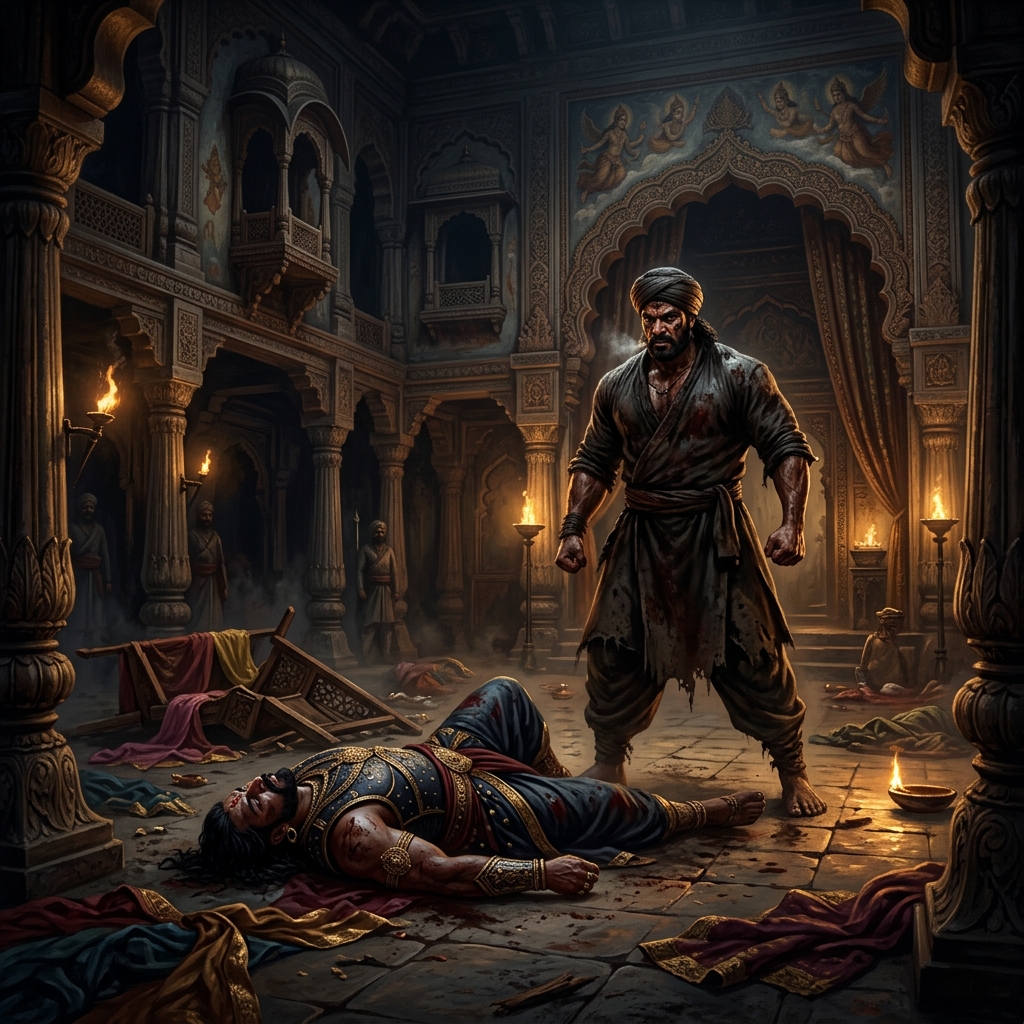
Sairandhri stood in that hall with her hair loose and reminded them all of her gandharvas. Kichaka laughed at gandharvas. What became of him for that, in a dark dancing hall at midnight, at the hands of something he had taken for a woman waiting to receive him, is a story of its own and is told in its own place; the palace found what was left at dawn and could not say which bone had been which.
What matters here is that this was one season out of four. The rains ended. Sudeshna, terrified of the servant she had taken in, tried to send her away, and Sairandhri asked for thirteen days more and was given them. Then the cold came, and the year went on, and the hairdresser rose before the queen and ground the sandal and warmed the oils exactly as she had done in the spring, as though nothing whatever had happened to her in between.
That was the ordeal. Not one night of violence, which she had survived before, but the eleven months around it, in which she had to keep grinding sandal.
She Walks Out a Queen
Count what each of them spent in that year, and the accounting is not equal.
Yudhishthira lost a throne and kept a courtier's respect; he sat at a king's elbow and was consulted. Bhima cooked, and was praised for it. The twins had horses and cattle to care for, which they loved. Arjuna wore bangles and taught girls to dance, and even that loss of his whole outward manhood was a curse he had chosen where to spend, and it expired when the year did.
Draupadi alone spent the year being handled. A consecrated empress, daughter of Drupada, daughter-in-law of the Kurus, stood every morning behind another woman and dressed her hair, was propositioned by a soldier, struck in an open court, threatened with fire, and could appeal to no one, because the five men who had sworn at her wedding to protect her were in the building and could not move a finger without destroying everything the twelve preceding years had bought. She had fallen further than any of them, and she had held.
When the year turned, the cattle were raided and Brihannala took a boy prince out to fight an army, and after that there was no more hiding. Virata walked into his own hall to find the dice-playing brahmana seated on his throne, and heard the five names spoken, and then heard the sixth. The king's face changed. He offered his daughter to Arjuna and his kingdom to Yudhishthira, and he begged the pardon of the woman who had been braiding his wife's hair since spring.
Sairandhri was not there to receive it. She had put down the combs. Draupadi came out of the women's quarters of Matsya with her hair still hanging loose, still unbound, still waiting on a promise made in another hall, and nobody in that palace ever called her a servant again.
Dharma Lesson
Draupadi's year in Virata's palace is the least spectacular of her ordeals and the heaviest. Dharma in the dice hall meant one blazing question put to a room of kings; dharma in Matsya meant grinding sandal paste every morning for a year without breaking, while the five men sworn to protect her walked past unable to help. The epic honors endurance that has no audience as highly as courage that has one. Her unbound hair is the sign that patience is not the same thing as forgetting.