The Ten Names of Arjuna
A frightened prince demands proof at the burning ground
The Prince Gets Down From the Car
The boy had been magnificent about it in the palace. He had said, in front of the women, that if he only had a charioteer worth the name he would go out and take the cattle back from Bhishma and Drona and Karna himself, and the women had told him he was splendid, and the sairindhri had said that the queen's dancing master could drive.
Now he was standing on the floor of his own chariot with the Kuru array in front of him, and he had stopped talking.
"My hair has stood on end and I am fainting with fear at the very sight of these smiters," he said. "My father has gone out to meet the Trigartas, taking his whole army with him, and left me in an empty city. There are no troops to assist me. Alone, and a mere boy who has not undergone much exercise in arms, I am unable to encounter these innumerable warriors, all skilled in weapons. Do thou therefore, O Brihannala, cease to advance."
"Why dost thou look so pale through fear, and enhance the joy of thy foes?" said the person holding his reins. "As yet thou hast done nothing on the field of battle. It was thou that ordered me, saying, take me towards the Kauravas. I will therefore take thee thither, where those innumerable flags are. Having, at the time of setting out, talked so highly of thy manliness before both men and women, why wouldst thou desist from the fight? If thou shouldst return home without recapturing the kine, brave men, and even women, will laugh at thee when they meet together."
"Let the Kurus rob the Matsyas of all their wealth," Uttara said. "Let men and women laugh at me. Let my kine perish. Let the city be a desert. Let me stand exposed before my father. Still there is no need of battle."
And having said it, that much affrighted prince, with the ear-rings still in his ears, jumped down from the car, threw away his bow and his arrows, and ran.
Within a Hundred Steps
"This is not the practice of the brave, this flight of a Kshatriya from the field of battle," the charioteer called after him. "Even death in battle is better than flight from fear."
Then Dhananjaya came down off that excellent car and went after him, and what the two armies saw was a dancing master in pure red garments running across the open ground with a long braid flying out behind, chasing a prince. Soldiers who did not know what they were looking at burst out laughing.
The Kurus did not laugh. They stood in their ranks and argued about it.
"Who is this person, disguised like fire concealed in ashes? He is partly a man and partly a woman. Although bearing a neuter form, he yet resembles Arjuna. His are the same head and neck, and his the same arms like a couple of maces, and this one's gait also is like his. He can be none else than Dhananjaya. Who else in this world than Dhananjaya would come alone against us? Virata left a single son in the empty city. It is Uttara who must have come out, having without doubt made Arjuna his charioteer. He is flying away in panic at the sight of our army, and Dhananjaya runs after him to bring him back."
He caught him by the hair within a hundred steps.
And the son of Virata, held by the hair in the middle of the plain, began to bargain like a merchant.
"Listen, O good Brihannala, O thou of handsome waist. Turn thou quickly the course of the car. He that lives meets with prosperity. I will give thee a hundred coins of pure gold, and eight lapis lazuli of great brightness set with gold, and one chariot furnished with a golden flagstaff and drawn by excellent steeds, and also ten elephants of infuriate prowess. Do thou, O Brihannala, set me free."
The tiger among men laughed at him, and dragged him back to the chariot by the hair, and set him on his feet against the wheel.
"If thou dost not venture to fight with the enemy, come thou and hold the reins of the steeds while I fight. Protected by the might of my arms, penetrate thou that formidable array of cars. Fear not. Thou art a Kshatriya and the foremost of royal princes. I shall fight with the Kurus and recover the kine."
What Drona Read in the Sky
While the prince was being lifted, fainting and reluctant, back onto his own chariot, the car turned towards a shami tree that stood near the burning ground, and on the other side of the field the greatest teacher of arms alive was watching it turn.
"Violent and hot are the winds that blow, showering gravel in profusion," Drona said. "The sky is overcast with a gloom of ashy hue. The clouds present the strange sight of being dry and waterless. Our weapons of various kinds are coming out of their cases. The jackals are yelling hideously. The horses are shedding tears, and our banners are trembling though moved by none. Such being the inauspicious indications seen, a great danger is at hand. Stay ye with vigilance. Protect your own selves and array the troops. Stand ye expecting a terrible slaughter, and guard ye well the kine."
Then he said the thing plainly, to Bhishma, in front of them all.
"O offspring of Ganga, apparelled as a woman, this is Kiritin, called after a tree, having on his banner the sign of the devastator of the gardens of Lanka's lord. This chastiser of foes is the valiant son of Pritha, surnamed Savyasachin. He does not desist from conflict even with the gods and the demons combined. Put to great hardship in the forest, he comes in wrath. Taught by Indra himself, he is like Indra in battle. Therefore, ye Kauravas, I do not see any hero who can withstand him."
"You always censure us by speaking of the virtues of Falguna," said Karna. "Arjuna, however, is not equal to even a full sixteenth part of myself or Duryodhana."
"If this be Partha, O Radheya," said Duryodhana, and he was pleased about it, "then my purpose has already been fulfilled. For then, if traced out, the Pandavas shall have to wander for twelve years again. Or, if this one be any other person in a eunuch's garb, I will soon prostrate him on the earth with keen-edged arrows."
Bhishma and Drona and Kripa and Drona's son all applauded his manliness. Not one of them corrected the arithmetic, which was wrong, and which Bhishma at least knew to be wrong.
Climb the Tree
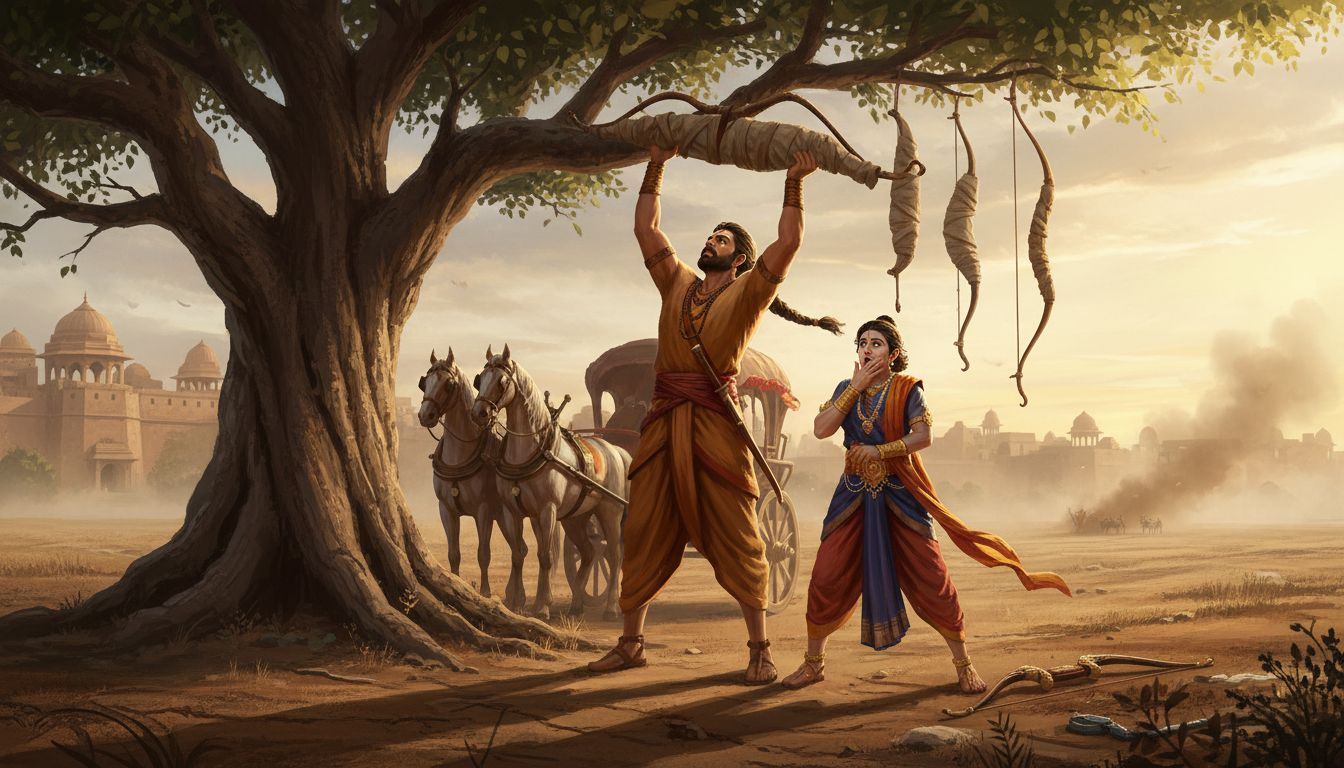
They reached the shami. It was an old tree with thick foliage, standing where such trees stand, at the edge of a cemetery where nobody goes without a reason, and there was a long bundle wrapped and lashed high in its branches.
Arjuna looked at the delicate, inexperienced boy beside him and gave him something to do.
"Enjoined by me, O Uttara, quickly take down some bows that are there. For these bows of thine are unable to bear my strength, or my heavy weight when I grind down horses and elephants, or the stretch of my arms when I seek to vanquish the foe. Therefore, O Bhuminjaya, climb thou up this tree of thick foliage. For in this tree are tied the bows and the arrows and the banners and the excellent coats of mail of the heroic sons of Pandu: of Yudhishthira, and Bhima, and Vibhatsu, and the twins.
"There also is that bow of great energy, the Gandiva of Arjuna, which singly is equal to many thousands of other bows, and which is capable of extending the limits of a kingdom. Large like a palmyra tree, able to bear the greatest stress, the largest of all weapons, capable of obstructing the foe, handsome and smooth and broad, without a knot, adorned with gold, it is stiff and beautiful in the make and it bears the heaviest weight. And the other bows that are there also, of Yudhishthira and Bhima and Vibhatsu and the twins, are equally mighty and tough."
He said it all in the light, high voice he had been using for a year, sitting in the driver's place in a woman's red garments with his braid over his shoulder, and the prince heard the names of the five vanished brothers of Kuru come out of that mouth and did not think about it at all, because he had noticed something else about the tree.
There Are Only Bows in This Tree
"It has been heard by us that a corpse is tied in this tree," Uttara said. "How can I, therefore, being a prince by birth, touch it with my hands? Born in the Kshatriya order, the son of a great king, and always observant of mantras and vows, it is not becoming of me to touch it. Why shouldst thou, O Brihannala, make me a polluted and unclean bearer of corpses, by compelling me to come into contact with a corpse?"
It was not superstition, and it was not a mistake. It was the exact rumour the Pandavas had planted a year ago, when they came down out of the woods and had to hide five arsenals in a country where a man carrying Gandiva would be known within the hour. Nakula had gone up this tree and lashed the bows and the swords and the quivers to the parts of it that would not break and where the rain would not reach. Then they had hung a corpse up beside them, so that anyone who caught the stench would say, here surely is a dead body, and keep well away; and when the shepherds and the cowherds asked about it, they answered that it was their mother, aged one hundred and eighty years, hung up in a tree according to the custom observed by their forefathers. The story had held for twelve months. It was holding now, against the man who had invented it.
"Thou shalt, O king of kings, remain clean and unpolluted," said Brihannala. "Do not fear. There are only bows in this tree, and not corpses. Heir to the king of the Matsyas, and born in a noble family, why should I, O prince, make thee do such a reproachable deed?"
So the son of Virata, with his ear-rings on, got down from the car and climbed the tree, reluctantly, and the charioteer stayed where he was and called up to him to be quick about it.
The boy cut the wrappings first, and then the ropes with which the weapons were tied, and the bundle came open in the branches.
Five bows came into the light together. Their splendour, radiant as the sun, began to shine with great effulgence like that of the planets about the time of their rising, and the shapes of them were like sighing snakes, and Uttara sat in the fork of that tree with his hands on them and the bristles of his body stood on end.
Whose Is This Bow?
He brought them down and laid them out, and then he could not stop asking.
"To what warrior of fame does this excellent bow belong, on which are a hundred golden bosses and which has such radiant ends? Whose is this excellent bow of good sides and easy hold, on the staff of which shine golden elephants of such brightness? Whose is this bow, adorned with three score Indragopakas of pure gold, placed on the back of the staff at proper intervals? Whose is this bow furnished with three golden suns of great effulgence, blazing forth with such brilliancy? Whose is this beautiful bow, variegated with gold and gems, on which are golden insects set with beautiful stones?
"Whose are these arrows, furnished with wings all around, numbering a thousand, having golden heads, and cased in golden quivers? Who owns these large shafts, so thick, furnished with vulturine wings, whetted on stone, yellowish in hue, sharp-pointed, well-tempered, and made entirely of iron? Whose is this sable quiver, bearing five images of tigers, which holds shafts intermixed with boar-eared arrows, altogether numbering ten? Whose are these seven hundred arrows, long and thick, capable of drinking the enemy's blood, and looking like the crescent-shaped moon?
"Whose is this excellent sword, irresistible and terrible to adversaries, with the mark of a toad on it, and pointed like a toad's head? Cased in a variegated sheath of tiger-skin, whose is this large sword of excellent blade, variegated with gold and furnished with tinkling bells? Whose is this handsome scimitar of polished blade and golden hilt? Manufactured in the country of the Nishadas, irresistible, incapable of being broken, whose is this sword of polished blade in a scabbard of cow-skin? Whose is this beautiful and long sword, sable in hue as the sky, mounted with gold, well-tempered, and cased in a sheath of goat-skin?
"Asked by me, O Brihannala, do thou answer me truly. Great is my wonder at the sight of all these excellent objects."
Shiva Held It First for a Thousand Years
"That about which thou hast first enquired is Arjuna's bow, of world-wide fame, called Gandiva, capable of devastating hostile hosts. Alone equal to a hundred thousand weapons, and always capable of extending the confines of kingdoms, it is with this that Partha vanquishes in battle both men and celestials. Worshipped ever by the gods, the Danavas and the Gandharvas, this large and smooth bow is without a knot or a stain anywhere.
"Shiva held it first for a thousand years. Afterwards Prajapati held it for five hundred and three years. After that Sakra, for five and eighty years. And then Soma held it for five hundred years. And after that Varuna held it for a hundred years. And finally Partha, surnamed Swetavahana, has held it for five and sixty years. Partha obtained this beautiful bow from Varuna."
The prince was counting on his fingers, and the sums were not the sums of any man's life.
"This other bow of handsome sides and golden handle is Bhima's, with which that son of Pritha conquered the whole of the eastern regions. This other excellent bow of beautiful shape, adorned with images of Indragopakas, belongs, O Virata's son, to king Yudhishthira. This other weapon, with golden suns of blazing splendour shedding a dazzling effulgence around, belongs to Nakula. And this bow, adorned with golden images of insects and set also with gems and stones, belongs to that son of Madri who is called Sahadeva."
Five bows on the grass under a shami tree, and a name attached to every one of them, and every name a man who had disappeared from the world thirteen years ago, and the person reciting them did it the way a housekeeper recites the contents of a store-room.
The Arrows and the Swords
"These winged arrows, thousand in number, sharp as razors and destructive as the poison of snakes, belong to Arjuna. When he shoots them in battle against foes, these swift arrows blaze forth more brilliantly, and become inexhaustible.
"And these long and thick shafts, resembling the lunar crescent in shape, keen-edged, and capable of thinning the enemy's ranks, belong to Bhima. And this quiver bearing five images of tigers, full of yellowish shafts whetted on stone and furnished with golden wings, belongs to Nakula. This is the quiver of the intelligent son of Madri, with which he conquered in battle the whole of the western regions. And these arrows, all effulgent as the sun, painted all over with various colours, and capable of destroying enemies by thousands, are Sahadeva's. And these short and well-tempered and thick shafts, furnished with long feathers and golden heads, and consisting of three knots, belong to king Yudhishthira.
"And this sword, with blade long and carved with the image of a toad, and head shaped as a toad's mouth, strong and irresistible, belongs to Arjuna. Cased in a sheath of tiger-skin, of long blade, handsome and irresistible, and terrible to adversaries, this sword belongs to Bhimasena. Of excellent blade, cased in a well-painted sheath, and furnished with a golden hilt, this handsome sword belongs to the wise Kaurava, Yudhishthira the just. And this sword of strong blade, irresistible and intended for various excellent modes of fight, cased in a sheath of goat-skin, belongs to Nakula. And this huge scimitar, cased in a sheath of cow-skin, strong and irresistible, belongs to Sahadeva."
The prince listened to a dancing master go through a dead family's armoury item by item, in order of seniority, without once hesitating over which brother owned which knife.
I Would Believe It If
"Indeed, these weapons adorned with gold, belonging to the light-handed and high-souled Partha, look exceedingly beautiful," Uttara said slowly. "But where are that Arjuna, the son of Pritha, and Yudhishthira of the Kuru race, and Nakula, and Sahadeva, and Bhimasena, the sons of Pandu? Having lost their kingdom at dice, the high-souled Pandavas, capable of destroying all foes, are no longer heard of. Where also is Draupadi, the princess of Panchala, famed as the gem among women, who followed the sons of Pandu to the forest after their defeat at dice?"
"I am Arjuna, called also Partha," said the charioteer. "Thy father's courtier is Yudhishthira. Thy father's cook Vallava is Bhimasena. The groom of horses is Nakula, and Sahadeva is in the cow-pen. And know thou that the sairindhri is Draupadi, for whose sake the Kichakas have been slain."
The boy stood among the bows with the Kuru army half a day's arrow-flight behind him and did not fall at anyone's feet.
He had been raised on those five names. Everybody had. The whole world had been telling the story of the sons of Pandu for thirteen years, and half of the world was quite sure they were dead, and here in a cemetery a person in a woman's clothing had just claimed all five of them and a princess of Panchala as well. The prince did what a Kshatriya should do with a claim, which is ask it for its proof.
"I would believe all this," Uttara said, "if thou canst enumerate the ten names of Partha, previously heard by me."
Every Name a Deed
"I will, O son of Virata, tell thee my ten names. Listen thou, and compare them with what thou hadst heard before. They are Arjuna, Falguna, Jishnu, Kiritin, Swetavahana, Vibhatsu, Vijaya, Krishna, Savyasachin and Dhananjaya."
"Tell me truly why art thou called Vijaya, and why Swetavahana. Why art thou named Krishna, and why Arjuna, and Falguna, and Jishnu, and Kiritin, and Vibhatsu, and for what art thou Dhananjaya and Savyasachin? I have heard before about the origin of the several names of that hero, and I can put faith in thy words if thou canst tell me all about them."
So he told him, and every name turned out to be a piece of a life.
"They called me Dhananjaya because I lived in the midst of wealth, having subjugated all the countries and taken away their treasures. They called me Vijaya because when I go out to battle with invincible kings, I never return from the field without vanquishing them. I am called Swetavahana because when battling with the foe, white horses decked in golden armour are always yoked to my car. They call me Falguna because I was born on the breast of the Himavat on a day when the constellation Uttara Falguna was on the ascendant. I am named Kiritin from a diadem, resplendent like the sun, placed of old upon my head by Indra during my encounter with the powerful Danavas. I am known as Vibhatsu among gods and men for my never having committed a detestable deed on the battlefield. And since both of my hands are capable of drawing the Gandiva, I am known as Savyasachin. They call me Arjuna because my complexion is very rare within the four boundaries of the earth, and because also my acts are always stainless. I am known among human beings and celestials by the name of Jishnu, because I am unapproachable and incapable of being kept down, a tamer of adversaries, and the son of the slayer of Paka. And Krishna, my tenth appellation, was given to me by my father out of affection towards his black-skinned boy of great purity."
The prince came nearer, and saluted him.
"My name is Bhuminjaya, and I am also called Uttara. It is by good luck, O Partha, that I behold thee. Thou art welcome, O Dhananjaya. O thou with red eyes, and arms that are mighty and each like the trunk of an elephant, it behoves thee to pardon what I said to thee from ignorance. As wonderful and difficult have been the feats achieved by thee before, my fears have been dispelled, and indeed the love I bear thee is great."
Then he took up the reins himself, and asked the only question that was left.
"O hero, mounting on this large car with myself as driver, which division of the hostile army wouldst thou penetrate? Commanded by thee, I would drive thee thither."
Dharma Lesson
A name earned is a record of deeds, and a man who can account for all of his is telling the truth about himself. Uttara does not accept the claim because it is impressive; he asks for the ten names and then for the reason behind every one, and only when each is answered does he salute. Proof of identity in this world is not a face or a weapon but a life that can be recited from end to end without a gap.