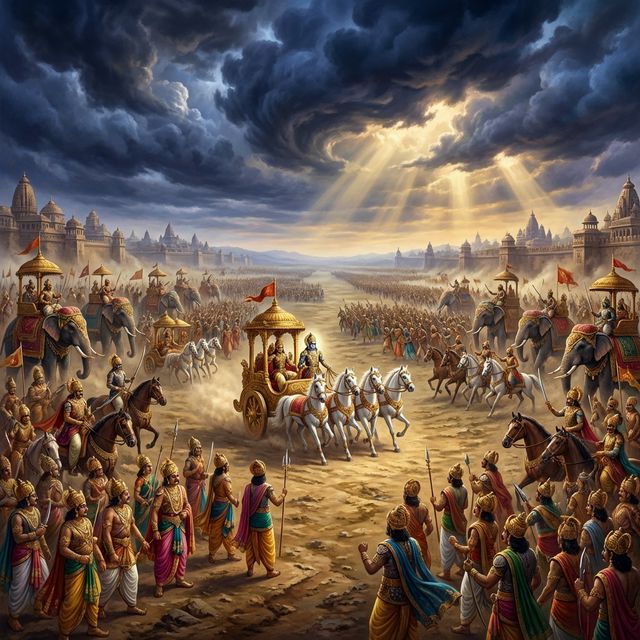
The Last Push on the Tenth Day
Tenth day: Bhishma asks Yudhishthira to kill him, and the champions of both armies pair off across the field while Dushasana alone stands between him and Arjuna
Strive to Slay Me
When Sanjaya came to the tenth day, the blind king asked the question he had been circling since the war began.
"How, Sanjaya, did Santanu's son Bhishma of mighty energy fight on the tenth day of battle, with the Pandavas and the Srinjayas? How also did the Kurus resist the Pandavas in battle? Describe to me the great battle fought by Bhishma, that ornament of battle."
Day after day, Sanjaya said, mighty car-warriors had been despatched to the other world by the diadem-decked Arjuna, and day after day Bhishma, agreeably to his vow, had caused a great carnage among the Partha host.
And then, having scorched the Pandava army for ten days, Bhishma of virtuous soul gave up all desire of protecting his life. Wishing his own slaughter at the head of his troops, he thought: No more shall I slay large numbers of the foremost of warriors.
He said it out loud, too, and he said it to the enemy. Seeing Yudhishthira near him on the field, he addressed him.
"O Yudhishthira, O thou of great wisdom, O thou that art acquainted with every branch of learning, listen to these righteous and heaven-leading words, O sire, that I say. O Bharata, I no longer desire to protect, O sire, this body of mine. I have passed much time in slaying large numbers of men in battle. If thou wishest to do what is agreeable to me, strive to slay me, placing Partha with the Panchalas and the Srinjayas at thy van."
Yudhishthira ascertained that this was his intention. Dhrishtadyumna, son of Prishata and generalissimo of the Pandava forces, heard the same words and urged the array on. And the king who had walked across this field before the first day to touch the old man's feet and ask his leave now gave the order.
"Advance! Fight! Vanquish Bhishma in battle. Ye all will be protected by that conqueror of foes, Jishnu of unbaffled aim. And this great bowman, this generalissimo of our forces, the son of Prishata, as also Bhima, will assuredly protect you. Ye Srinjayas, entertain no fear today of Bhishma in battle. Without doubt, we will vanquish Bhishma today, placing Shikhandi in our van."
The Pandavas advanced resolved to conquer or to go to heaven, with Shikhandi and Arjuna to the fore. From the other side, urged by Duryodhana, diverse kings went towards Bhishma where he stood, with Drona and Drona's son and a large force, and the mighty Dushasana at the head of all his uterine brothers.
One army was trying to reach him. The other was trying to stand in front of him. Nothing else happened on the tenth day that was not some version of those two things.
The Pairing of the Field
Before the dust closed over everything, Sanjaya was able to see who had gone against whom, and he named them in order, because for a little while that morning the whole enormous mess of the war resolved itself into a set of single combats.
Satyaki, the grandson of Sini, took Ashwatthama. Dhrishtaketu, the king of the Chedis, took the descendant of Puru, whom men called Paurava. Yudhamanyu, one of the two princes set to guard the wheels of Arjuna's car, went against Duryodhana at the head of his followers. Virata with all his Matsyas encountered Jayadratha, the ruler of the Sindhus, supported by his own troops. The heir of Vardhakshatra encountered Chitrasena, who was a son of Dhritarashtra and armed with an excellent bow. Yudhishthira himself proceeded against the mighty bowman Shalya, the ruler of the Madras. Bhimasena, well protected, went straight at the elephant division of the Kaurava army. Dhrishtadyumna, prince of Panchala, excited with fury and accompanied by his brothers, proceeded against Drona, that foremost of all wielders of weapons, invincible and irresistible.
And prince Vrihadvala, the ruler of the Kosalas, who bore on his standard the device of the lion, proceeded against Subhadra's son, whose standard bore the device of the Karnikara flower.
Duryodhana's brothers, accompanied by many kings, went against Shikhandi and Arjuna together, from the desire of slaughtering both of them.
Then the combatants of both armies rushed at each other with awful prowess and the earth shook under their tread. The divisions of the two hosts became mingled with one another. With the blare of conchs and the leonine shouts of the soldiers the uproar became awful, and it was heard on all sides. The splendour of the bracelets and diadems of all those heroic kings, a splendour equal to that of the Sun or the Moon, was dimmed. The dust that rose looked like a cloud with the flash of bright weapons for its lightning, and the twang of bows and the whiz of arrows and the beat of drums and the rattle of cars made the roar of those clouds.
Car-warriors felled car-warriors. Elephants killed elephants. Foot-soldiers slew foot-soldiers. The battle fought there for Bhishma's sake was like the battle between two hawks over a piece of flesh.
The Boy and the King
Abhimanyu, displaying his prowess for the sake of Bhishma, fought with Duryodhana, who was supported by a large force.
He was sixteen years old and he was fighting the king of the Kurus, and Sanjaya, who was watching for a blind man's sake, did not condescend to either of them in the telling.
Duryodhana, excited with wrath, struck Abhimanyu in the chest with nine straight arrows and then with three more. Arjuna's son, inflamed, hurled at Duryodhana's car a terrible dart that resembled the rod of Death himself. It came at the king with great speed, and Duryodhana, who was a mighty car-warrior whatever else he was, cut it in twain in the air with one broad-headed arrow of great sharpness.
Abhimanyu watched his dart drop on the earth in two pieces. Then, wrathful, he pierced Duryodhana with three shafts in the arms and the chest, and afterwards struck the Kuru king with ten fierce shafts in the centre of the chest.
The battle between those two, Sanjaya said, was fierce and interesting to behold and gratifying to the senses, and it was applauded by all the kings on the field. He also said plainly what each of them was fighting for, and the two purposes did not match. Subhadra's son was fighting to compass Bhishma's death. The bull of Kuru's race was fighting for Arjuna's defeat.
Not far from them, that bull among Brahmanas, the son of Drona, excited with wrath, struck Satyaki in the chest with a fierce arrow. The grandson of Sini, a hero of immeasurable soul, struck the preceptor's son in every vital limb with nine shafts winged with the feathers of the Kanka bird. Ashwatthama answered with nine, and then quickly with thirty more into the arms and chest. And that great bowman of the Satwata race, deeply pierced by Drona's son, pierced him back with arrows, and neither of them moved the other, and neither of them stopped.
Two Shields of a Hundred Moons
The longest duel of the morning was fought by two men whose names are barely known outside it.
Paurava was a descendant of Puru, the ancient king from whom the whole Kuru line takes its name, and he fought on Duryodhana's side. Dhrishtaketu was king of the Chedis, the son of that Shishupala whom Krishna had killed at Yudhishthira's sacrifice, and he had brought his father's kingdom over to the Pandavas. Both were mighty car-warriors and both were of gigantic stature.
Paurava covered Dhrishtaketu with his shafts and mangled that great bowman exceedingly. Dhrishtaketu, endued with great strength, quickly pierced him with thirty arrows. Then Paurava cut off Dhrishtaketu's bow and shouted aloud and pierced him with whetted shafts, and Dhrishtaketu took up another bow and put three and seventy sharp arrows into him.
After that they went through each other's equipment methodically. Each succeeded in cutting off the other's bow. Each slew the other's steeds. Deprived of their cars, they came down onto the earth and met with swords.
Each of them took up a beautiful shield made of bull's hide, decked with a hundred moons and graced with a hundred stars. Each took up a polished sword of brilliant lustre. And so equipped they rushed at each other like two lions in a deep forest, both seeking the companionship of the same lioness in her season.
They wheeled in beautiful circles. They advanced and retreated and displayed the other movements of that art, each seeking an opening in the other, and for a while the war went on around two men doing something older and more formal than the war.
Then Paurava, excited with wrath, called out to Dhrishtaketu.
"Wait. Wait."
And struck him on the frontal bone with that large scimitar of his.
The king of the Chedis, in the same moment, struck Paurava on the shoulder-joint with his own large scimitar of sharp edge.
Those two repressors of foes, having encountered each other and having struck each other, both fell down on the field.
Jayatsena, the king of the Magadhas, took Paurava up on his car and carried him out of the battle. And Sahadeva, the son of Madri, valiant and possessed of great prowess, bore Dhrishtaketu away.
Neither man was dead. Neither man was in the war any longer that day.
The Lion and the Karnikara Flower
Elsewhere Chitrasena and Susharma had found each other. Chitrasena pierced the lord of the Trigartas with many arrows made wholly of iron, and then with sixty, and then with nine. Susharma, excited with wrath, pierced Dhritarashtra's son with hundreds. Chitrasena answered with thirty straight shafts, and Susharma pierced him again, and that was the shape of it for a long time, two men who had nothing to settle except the war itself.
But the fight men remembered from that quarter of the field was the second one Abhimanyu fought.
Having left Duryodhana, and enhancing his fame and honour in that battle for the destruction of Bhishma, Subhadra's son took on prince Vrihadvala of Kosala. He fought him, Sanjaya said, putting forth his prowess for the aid of his father Partha, and then meant to go on towards Bhishma's front. The Kosala prince did not let him go on.
Vrihadvala pierced Arjuna's son with five shafts made of iron, and then with twenty straight ones. Abhimanyu pierced the ruler of the Kosalas with eight shafts of iron and did not succeed in making him tremble, and so pierced him again with many more. Then Phalguni's son cut off Vrihadvala's bow and struck him with thirty arrows winged with the feathers of the Kanka bird. Vrihadvala took up another bow and angrily pierced the son of Phalguni with many arrows.
Both were excited with rage. Both were conversant with every mode of fight. And Sanjaya, reaching for something to measure it against, went all the way back to the wars of the gods: the battle between those two, he said, was like the encounter of Vali and Vasava in days of old, on the occasion of the battle between the gods and the Asuras.
The lion on one standard and the Karnikara flower on the other stood over it while it went on. There was no result. Neither prince could break the other, and the boy who had wanted to get through to Bhishma's front did not get through, and both of them were still alive at the end of the tenth day, which is worth saying because Abhimanyu would kill Vrihadvala on the thirteenth.
Bhima in the Elephants
Bhimasena had asked for the elephant division, and he got it.
Fighting against those beasts, Sanjaya said, he looked highly resplendent, like Sakra armed with the thunder after splitting large mountains. That is the image the text chooses and it is exact, because what Bhima did that morning was less like fighting than like weather.
Elephants huge as hills, slaughtered by Bhimasena, fell down in numbers on the field and filled the earth with their shrieks. They resembled massive heaps of antimony. Lying prostrate with their frontal globes split open, of mountain-like proportions, they seemed like mountains strewn over the earth's surface.
An elephant corps was the most expensive thing a king could put on a battlefield and the most frightening thing an infantryman could see coming, and one man on foot among them was reducing them to landscape.
While that was going on, the mighty bowman Yudhishthira, protected by a large force, afflicted Shalya, the ruler of the Madras, encountering him in that dreadful battle. Shalya, displaying his prowess for the sake of Bhishma, afflicted the son of Dharma in return. This was the uncle of Nakula and Sahadeva, the man who had been tricked into the Kaurava army on the road to the war and who would drive Karna's chariot before the end, and Yudhishthira could not move him.
And the king of the Sindhus, having pierced Virata with nine straight arrows of keen point, struck him once more with thirty. Virata, the old lord of the Matsyas who had sheltered the Pandavas through their thirteenth year, was commanding a large division, and he struck Jayadratha in the centre of the chest with thirty shafts of keen point.
Sanjaya paused over those two long enough to describe them. The ruler of the Matsyas and the ruler of the Sindhus, both armed with beautiful bows and beautiful scimitars, both decked with handsome coats of mail and weapons and standards, and both of beautiful forms, looked resplendent in that battle.
He had been watching men die since sunrise and he still noticed that two of them were magnificent to look at.
The Mace and the Dart
Dhrishtadyumna had been born out of a fire for the purpose of killing Drona, and Drona knew it, and on the tenth day the prince of the Panchalas came at him with his brothers behind him.
Drona encountered him and fought fiercely with his straight shafts. Then he cut off the large bow of Prishata's son and pierced him deeply with fifty arrows.
That is how the exchange opened, and it never really improved. Dhrishtadyumna took up another bow and sped many arrows at Drona, who was contending with him. Drona cut off all of those arrows, striking each one with his own, and then sped five fierce shafts at Drupada's son.
So Dhrishtadyumna stopped shooting.
Excited with rage, he hurled at Drona a mace resembling the rod of Death himself. It was decked with gold and it came impetuously, and Drona checked it with fifty arrows and the mace fell to the earth in fragments, cut apart in the air by shafts from a bow.
Beholding his mace baffled, the son of Prishata hurled an excellent dart made wholly of iron.
Drona cut that dart with nine shafts, and then afflicted that great bowman with the rest.
There is a whole life in that sequence. The man was made to kill this teacher and he could not get anything through to him: not arrows, not the mace, not the iron dart. Everything he threw came apart in the air short of the target and fell down between them. And it would stay that way for five more days, until Drona sat down on the floor of his car and took his hands off his weapons, and then Dhrishtadyumna would need no bow at all.
Thus took place, Sanjaya said, that fierce and awful battle between Drona and the son of Prishata, for the sake of Bhishma.
Everything was for the sake of Bhishma that day, including the duels that had nothing to do with him.
The Fire-Chamber
Arjuna got at the son of Ganga at last and afflicted him with many arrows of keen point, rushing at him as one infuriated elephant in a forest rushes upon another.
King Bhagadatta of Pragjyotisha, of great prowess, put his elephant across the path and checked Arjuna's course with showers of arrows. Arjuna pierced the beast with many polished arrows of iron, bright as silver and keenly pointed, and then, without finishing the quarrel, called out to the man ahead of him.
"Proceed, proceed towards Bhishma, and slay him!"
Shikhandi went. The ruler of the Pragjyotishas, seeing that this was no longer the fight that mattered, abandoned Arjuna and drove off against the car of Drupada. And Arjuna proceeded towards Bhishma, placing Shikhandi ahead of him, while all the brave combatants of the Kaurava army rushed at him with great vigour and loud shouts. Like the wind dispersing masses of summer cloud, Arjuna dispersed them.
Shikhandi came up to the grandsire of the Bharatas without any anxiety and pierced him with a great many arrows.
And Bhishma, that morning, was burning.
His car was his fire-chamber. His bow was the flame of that fire. Swords and darts and maces were the fuel of it, and the showers of arrows he shot were the blazing sparks with which he was consuming Kshatriyas. As a raging conflagration with a constant supply of fuel wanders among masses of dry grass when the wind is behind it, so Bhishma blazed up, scattering his celestial weapons.
He slew the Somakas who followed Arjuna. He felled car-warriors and steeds along with their riders, and he made large bodies of cars look like forests of palmyras shorn of their leafy heads. Hearing the twang of his bow and the slap of his palms, both like the roll of thunder, the troops trembled all over the field. His shafts were never bootless. They never fell after merely touching a body; they went through.
Fourteen thousand great car-warriors of noble parentage, unretreating and brave, with standards decked with gold, belonging to the Chedis, the Kasis and the Karushas, approached him that day and were despatched to the other world with their steeds and cars and elephants. There was not one great car-warrior among the Somakas who came near Bhishma and came away with his life.
Two men on that field went towards him anyway. Arjuna with his white steeds and Krishna for his charioteer, and Shikhandi, prince of Panchala, of immeasurable energy.
The Look He Gave Shikhandi
Shikhandi, approaching Bhishma, struck him in the centre of the chest with ten broad-headed arrows.
The son of Ganga only looked at him. He looked at the Panchala prince with wrath, as if consuming him with that look, and remembering his femininity, in the very sight of all, he struck him not.
Shikhandi did not understand it. That is the detail the text insists on and it is the cruellest thing in the day: the man who had been born for this one purpose, out of one life into another, did not know why the arrows were not coming back.
Arjuna understood it perfectly and used it.
"Rush quickly and slay the grandsire. What needst thou say, O hero? Slay the mighty car-warrior Bhishma. I do not see any other warrior in Yudhishthira's army who is competent to fight with Bhishma in battle, save thee, O tiger among men. I say this truly."
So Shikhandi covered the grandsire with diverse kinds of weapons, and Bhishma disregarded those shafts entirely and used his own to check the angry Arjuna alone, and went on despatching the rest of the Pandava army to the other world at the same time. Surrounded on all sides, that Bharata hero consumed brave warriors like a conflagration in a forest consuming numberless trees.
And then Dushasana did the one thing anybody ever praised him for.
The prowess of that son of Dhritarashtra was wonderful, Sanjaya said, inasmuch as he battled with Partha and protected the grandsire at the same time. With that feat all the people there were highly gratified. Alone he fought with all the Pandavas, Arjuna among them, and he fought with such vigour that the Pandavas were unable to resist him. Many car-warriors were deprived of their cars by Dushasana. Many mighty bowmen on horseback and many elephants, pierced with his keen shafts, fell down on the earth, and many elephants afflicted by him ran away in all directions. As a fire blazes forth with bright flames when it is fed, so did he blaze, consuming the Pandava host.
No car-warrior of that host ventured even to proceed against him except Arjuna.
And Shikhandi kept shooting at an old man who would not shoot back, and the arrows whose touch was like the bolts of heaven and whose points were as fatal as snake venom caused Bhishma little pain. He received them laughing, as a person afflicted with heat cheerfully receives torrents of rain.
The Weapon He Put Away
Duryodhana rode along his own line and told his men what they were standing behind.
"Rush ye against Phalguni from all sides. Bhishma, acquainted with the duties of a commander, will protect you. With his tall standard bearing the device of the golden palmyra, Bhishma stayeth, protecting the honour and the armour of all the Dhartarashtra warriors. The very gods, striving vigorously, cannot vanquish the illustrious and mighty Bhishma. What need be said, therefore, of the Parthas who are mortals? Therefore, ye warriors, fly not away from the field, getting Phalguni for a foe. I myself, striving vigorously, will today fight with the Pandavas, uniting with all of you, ye lords of earth."
They believed him. Excited with rage, combatants of the Videhas and the Kalingas and the diverse tribes of the Daserkas fell upon Arjuna, and after them the Nishadas, the Sauviras, the Valhikas, the Daradas, the Malavas, the Surasenas, the Sivis, the Vasatis, the Salwas, the Sakas, the Trigartas, the Amvashthas and the Kekayas, like flights of insects upon a fire.
Arjuna called to mind diverse celestial weapons and aimed them at the great car-warriors at the heads of those divisions, and consumed them all. While he was creating thousands upon thousands of arrows, Gandiva looked highly resplendent in the welkin. Those Kshatriyas, with their tall standards torn and overthrown, could not approach the ape-bannered one even together, and the earth was soon covered on all sides with retreating troops.
Then he turned on Dushasana. The arrows went through him, iron-headed, and entered the earth behind him like snakes going into ant-hills. Arjuna slew his steeds and felled his charioteer. With twenty shafts he deprived Vivingsati of his car and struck him with five more, and piercing Kripa and Vikarna and Shalya with arrows made wholly of iron he took the cars from all of them. Kripa and Shalya and Dushasana and Vikarna and Vivingsati fled.
It was still only the forenoon. Partha blazed in that battle like a smokeless conflagration, and made a river of bloody current flow between the two hosts, and the field was strewn with princes falling and fallen, decked in their ear-rings and bracelets, and dogs and crows and vultures and jackals set up loud howls at the sight of the food before them.
Then Bhishma invoked a celestial weapon and rushed at the son of Kunti in the sight of all the bowmen.
And Shikhandi, clad in mail, put himself in front of it.
Bhishma withdrew the weapon. Its effulgence went out like a lamp, and the old man stood there with his hands empty of it, and while he stood there Arjuna went on slaughtering the troops behind him.
Dharma Lesson
Bhishma had already given his life away before the tenth day began, and told the enemy king so, and then went on killing fourteen thousand men because he had not yet been relieved of the duty of fighting. Every duel in this stretch of the war was fought for his sake by men who did not know that the stake had already conceded. That is what an oath does when it outlives the reason for it: it keeps a good man useful to a cause he no longer believes in, and the only person who can end the arrangement is the one it is destroying.