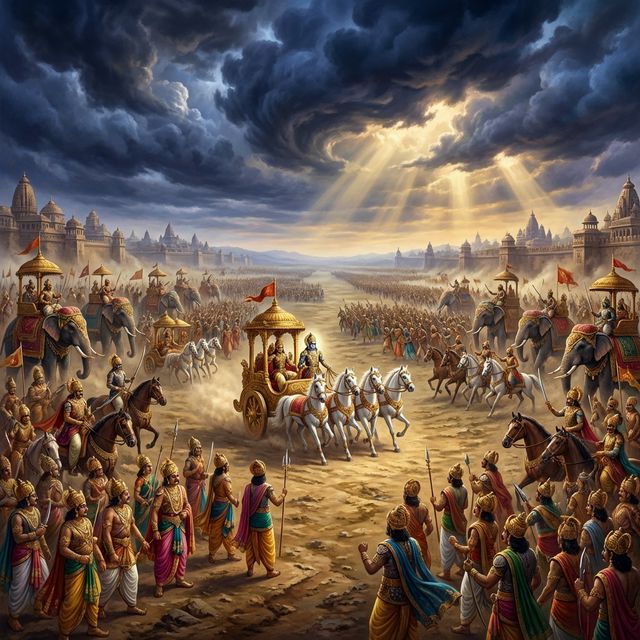
The Evening After Bhishma Fell
Both armies stop the war for a night, and Arjuna gives the grandsire the only pillow he will accept.
The Question in the Blind King's Hall
Sanjaya had come back to the hall at Hastinapur to say that the tenth day was over, and the old king would not let him get past the first sentence.
"Alas, what was the state of my warriors, Sanjaya," Dhritarashtra said, "when they were deprived of the mighty and god-like Bhishma, who had become a Brahmacharin for the sake of his reverend sire?"
He had been waiting for this news for ten days and he had prepared nothing to meet it with.
"Even then I regarded the Kurus and all the others as slain by the Pandavas, when Bhishma, despising the son of Drupada, struck him not. Wretch that I am, I hear today of my sire's slaughter. What can be a heavier sorrow than this? My heart assuredly, Sanjaya, is made of adamant, since it breaketh not into a hundred fragments on hearing of Bhishma's death."
The man he was calling his sire was his grandfather's son by Ganga, the prince who had given up a throne and a wife and a line of his own so that Shantanu could marry a fisherman's daughter, and who had then held the house of Kuru together through three generations of other men's failures. Dhritarashtra had never in his life had to imagine the world without him in it.
"Tell me, O thou of excellent vows, what was done by that lion among the Kurus, the victory-desiring Bhishma, when he was slain in battle. I cannot at all brook it that Devavrata should be slain in battle. He that was not slain by Jamadagni's son himself in days of old, by means of even his celestial weapons, alas, he hath now been slain by Drupada's son Shikhandi, the prince of Panchala."
Sanjaya, who had the divine sight and had watched all of it from the field, began where the king had asked him to begin, at the moment the arrow-struck body left the car.
The Boundary Tree Comes Down
Slain in the evening, Sanjaya said, the Kuru grandsire Bhishma saddened the Dhartarashtras and delighted the Panchalas.
He fell to the earth and he did not reach it. There were so many shafts standing in him, driven through the mail and out again along the whole length of the body, that when he came off the chariot the arrows took his weight and held him a hand's breadth above the ground. That is the bed the epic never stops naming afterwards. It was not prepared for him. It was made out of what had been done to him, and it was made in the last hour of the tenth day of the war.
When he came down, cries of Oh and Alas were heard among all creatures.
He had been the boundary tree of the Kurus. A boundary tree is the one landmark that both sides of a disputed field agree on, the thing nobody uproots, and when the ever victorious Bhishma fell, fear entered the hearts of the Kshatriyas of both the armies. Not the losing army. Both. Men who had spent the afternoon trying to kill him stood still and were afraid.
They looked at Santanu's son with his standard overthrown and his armour cut open, and Kurus and Pandavas alike were filled with the same cheerlessness. The welkin was enveloped with gloom. The sun himself became dim. The earth seemed to utter loud shrieks when the son of Santanu was slain.
And there was talking in the air over the field, which Sanjaya could hear because the Muni had given him ears for it.
"This one is the foremost of those conversant with the Vedas," said the creatures of the world, watching him lie there. "This one is the best of those that are conversant with the Vedas."
And the Rishis, with the Siddhas and the Charanas, said the other thing, the thing that went back sixty years before the war and had nothing to do with weapons at all.
"This one, formerly, ascertaining his sire Santanu to be afflicted by Kama, resolved to draw up his vital steed."
They did not praise him for the ten thousand he had killed that day. They praised him for the marriage he had refused.
Conches on One Side, Silence on the Other
When Santanu's son Bhishma, the grandsire of the Bharatas, was slain, thy sons, Sanjaya told the king, knew not what to do.
Their faces wore an expression of grief. The splendour of their countenances seemed to abandon them. All of them stood in shame, hanging down their heads, and that is a strange sentence to write about an army that was still standing in good order with its weapons in its hands. Nothing had happened to them. Their formations were unbroken. They simply could not think of a reason to move.
The Pandavas, on the other hand, having won the victory, stood at the head of their ranks. They all blew their large conchs decked with gold, and thousands of trumpets went up after them, and in the middle of that noise Sanjaya saw Bhimasena.
"We beheld, O monarch, the mighty Bhimasena, the son of Kunti, sporting in great glee, having quickly slain many hostile warriors endued with great strength."
He was dancing. Ten days of being told to hold his position while the grandsire cut the Pandava army to pieces at leisure had ended, and the second son of Pandu was slapping his arms in front of the whole field and shouting, and the Somakas and the Panchalas were shouting with him. It is worth setting that down next to what was happening a bowshot away, because both things were true at the same instant, and the poet refuses to choose between them.
A great swoon overtook all the Kurus.
And Karna and Duryodhana repeatedly drew long breaths.
That is all Sanjaya gives of those two, and it is enough. The king who had begun the war and the friend who had been kept out of it for ten days by the fallen man's refusal to fight beside him stood together and breathed like men who had run a long way, and neither of them said anything. Karna would have his command in a few days. Duryodhana would have his war without a grandsire in it. Neither of them had wanted this and both of them had made it.
Cries of sorrow were heard all round, and the greatest confusion prevailed among the Kuru army.
The Man Who Carried the News to Drona
Beholding Bhishma fallen, thy son Dushasana, with great speed, entered the division commanded by Drona.
Dushasana had been posted there by Duryodhana himself, clad in mail and at the head of his own troops, for the protection of Bhishma. That was his charge for the day, and it was the one duty in the whole army that he had just failed at, and he rode off the field to say so out loud to the greatest living master of arms.
The troops he had commanded he plunged into grief simply by leaving them and going. Men watch where a prince rides. Beholding him coming towards them, the Kauravas surrounded prince Dushasana, desirous of hearing what he had to say.
Then Dushasana of Kuru's race informed Drona of Bhishma's slaughter.
Drona, hearing those evil tidings, suddenly fell down from his car.
The son of Bharadwaja had taught nearly every man on that field how to hold a bow, including the man who had shot the arrows, and he had fought the whole ten days under Bhishma's command and had not once been able to keep him safe. He was not wounded. He went off the chariot the way a man goes off a chair.
Then the valiant son of Bharadwaja, quickly recovering his senses, forbade the Kuru army to continue the fight.
He did not consult Duryodhana. He was not the commander and would not be until the next morning, and he gave the order anyway, and the army obeyed it.
Beholding the Kurus desist from battle, the Pandavas also, through messengers on fleet horses, forbade their own. It went along the line the way such orders go, riders cutting across the front with their hands up, and within a short time the two hosts that had been trying to destroy each other since dawn had stopped, without a treaty, without terms, and without anybody on either side asking what it would cost.
Then the kings of both armies put off their armour, and all of them repaired to Bhishma.
These Do Not Become a Hero's Bed
Desisting from the fight, thousands of other warriors proceeded towards the high-souled Bhishma like the celestials going towards the Lord of all creatures.
They came unarmoured and on foot, from both camps, and they did not form up by side. Approaching Bhishma who was lying there, the Pandavas and the Kurus stood before him, having offered him their salutations.
Then Santanu's son, of righteous soul, addressed them.
"Welcome to you, ye highly blessed ones. Welcome to you, ye mighty car-warriors. Gratified am I with your sight, ye that are the equals of the very gods."
He said it to all of them together. Sanjaya does not record a single word of reproach spoken that evening to the men who had done it, and there is no sign that Bhishma thought of the two armies in front of him as anything other than his family, which is what they were.
Then he spoke again, and this time it was awkward, because his head was hanging down off the end of the arrows that held him and he could not lift it.
"My head is hanging down greatly. Let a pillow be given to me."
The kings standing there ran for pillows. They fetched many excellent ones, very soft, made of very delicate fabrics, the sort of thing a hundred royal tents on that plain could produce in a minute, and they brought them to the bed of arrows and offered them.
The grandsire desired them not.
That tiger among men then said unto those kings, with a laugh, "These, ye kings, do not become a hero's bed."
He was laughing at them and he was also refusing something, and none of them could tell which of the two mattered more. They stood holding armfuls of silk in the dusk while the man on the arrows looked past them along the line of faces until he found the one he wanted.
Beholding that foremost of men, that mightiest of car-warriors in all the worlds, the mighty-armed Dhananjaya the son of Pandu, he said:
"O Dhananjaya, O thou of mighty arms, my head hangeth down, O sire. Give me a pillow such as thou regardest to be fit."
He had asked the man who had killed him.
Three Shafts Under the Head
Arjuna strung his large bow.
He did it there, in front of both armies, at a place where every man present had just taken his armour off, and nobody stopped him, because Bhishma had asked and Arjuna had understood the question. Then he saluted the grandsire reverentially, and with his eyes filled with tears he said these words.
"O foremost one among the Kurus, O thou that art the first among all wielders of weapons, command me, O invincible one, for I am thy slave. What shall I do, O grandsire?"
Unto him Santanu's son said, "My head, O sire, hangeth down. O foremost one among the Kurus, O Phalguni, get me a pillow. Indeed, give me one without delay, O hero, that would become my bed. Thou, O Partha, art competent, thou art the foremost of all wielders of bows. Thou art conversant with the duties of Kshatriyas, and thou art endued with intelligence and goodness."
Then Phalguni said, "So be it."
He took up Gandiva and a number of straight shafts. He inspired them with mantras. He obtained the permission of that illustrious and mighty car-warrior of Bharata's race, which is to say he asked before he shot, and then, with three keen shafts endued with great force, he supported Bhishma's head.
Three arrows into the ground under the neck, at the angle that would take the weight. The same bow, the same hands, the same evening.
Then that chief of the Bharatas, conversant with the truths of religion, seeing that Arjuna, having divined his thought, had achieved that feat, became highly gratified. And after that pillow had been given to him, he applauded Dhananjaya.
Casting his eyes upon all the Bharatas there, he addressed Kunti's son.
"Thou hast given me, O son of Pandu, a pillow that becometh my bed. If thou hadst acted otherwise, I would have cursed thee, from wrath. Even thus, O mighty-armed one, should a Kshatriya, observant of his duties, sleep on the field of battle on his bed of arrows."
The threat is the most affectionate thing in the passage. Silk would have been an insult and Bhishma says so plainly, and he says it in the form of a curse he did not have to pronounce, because the boy he had carried on his knee had known without being told.
Until the Sun Turns North
Having addressed Vibhatsu thus, Bhishma turned to all those kings and princes that were present there, and told them what he intended to do with the rest of his life.
"Behold ye the pillow that the son of Pandu hath given me. I will sleep on this bed till the Sun turneth to the northern solstice. Those kings that will then come to me will behold me yield up my life."
He had the boon from his father Shantanu that death would wait on his own word, and he had spent it. He had chosen his hour, and the hour was not that night. The sun was in the southern declension, the wrong half of the year for a man to go out of the world, and he had decided in the middle of falling that he would simply hold on until the season changed. That meant lying on the arrows through the whole of Drona's command and the whole of Karna's and everything that came after.
"When the Sun, on his car of great speed, unto which are yoked seven steeds, will proceed towards the direction occupied by Vaisravana, verily, even then will I yield up my life, like a dear friend dismissing a dear friend."
Vaisravana is Kubera, who keeps the north. And the phrase Bhishma used for his own death is the phrase of a host at a doorway seeing a guest off with regret, and it is the only description of dying in the whole Bhishma Parva that sounds like courtesy.
Then he gave two instructions, one small and one enormous.
"Let a ditch be dug here around my quarters, ye kings. Thus pierced with hundreds of arrows will I pay my adorations to the Sun."
That was the small one. A trench around the bed, so that the field would not simply run over him, and a place from which he could go on making his offering to the sun with what remained of his body.
"As regards yourselves, abandoning enmity, cease ye from the fight, ye kings."
That was the other one. Lying on the arrows of one nephew's army, with the pillow of another nephew's arrows under his head, he told both sides to stop the war.
He was to say it again, at greater length and with a specific offer of half a kingdom, the next morning. Nobody moved that night either.
The Surgeons Are Sent Away With Presents
Then there came unto him some surgeons, well trained in their science and skilled in plucking out arrows, with all the becoming appliances of their profession.
They were Duryodhana's men, the best the Kuru camp had, and they arrived with the hooks and probes and forceps used for drawing shafts out of a living body, and they knelt down beside a man who had no unpierced space of two fingers' breadth left anywhere on him.
Beholding them, the son of Ganga said unto thy son, "Let these physicians, after proper respect being paid to them, be dismissed with presents of wealth. Brought to such a plight, what need have I now of physicians?"
Then he gave the reason, and it was not a medical one.
"I have won the most laudable and the highest state ordained in Kshatriya observances. Ye kings, lying as I do on a bed of arrows, it is not proper for me to submit now to the treatment of physicians. With these arrows on my body, ye rulers of men, should I be burnt."
He wanted the arrows left in. He intended to be burnt with them still standing in him, because a Kshatriya who has reached that end does not have it tidied up afterwards, and every man listening understood the claim he was making and could not answer it.
Hearing these words of his, thy son Duryodhana dismissed those physicians, having honoured them as they deserved. It is one of the few acts of his in the whole war that nobody criticises. The men were paid, thanked, and sent back to the tents with their instruments unused.
Then those kings of diverse realms, beholding that constancy in virtue displayed by Bhishma of immeasurable energy, were filled with wonder.
Having given a pillow to thy sire, those rulers of men, those mighty car-warriors, the Pandavas and the Kauravas united together, once more approached the high-souled Bhishma lying on that excellent bed of his. They saluted him reverentially. They walked round him three times, keeping him on their right, the circuit a man makes round a fire or a shrine. They stationed guards all around for his protection, drawn, it seems, from both camps.
Then those heroes, with their bodies drenched in blood, repaired for rest towards their own tents in the evening, their hearts plunged into grief, and thinking of what they had seen.
By Good Luck, Victory Hath Been Thine
In the Pandava camp that night the mood was not grief.
The mighty car-warriors were cheerfully seated together and filled with joy at the fall of Bhishma, and they had earned it. For ten days the grandsire had stood between them and any possible end to the war, and the arithmetic of the field had been the same every evening, and now it was not.
Then at the proper time, Sanjaya says, the mighty Madhava approached them. The proper time is doing quiet work in that sentence. Krishna had let the celebration have its hour first, and then came and sat down with them, and spoke to Dharma's son.
"By good luck victory hath been thine, O thou of Kuru's race. By good luck hath Bhishma been overthrown, who is unslayable by men, and is a mighty car-warrior of aim incapable of being baffled."
Then he said the second thing, and it was not a compliment of the ordinary kind.
"Or, perhaps, as destiny would have it, that warrior who was master of every weapon, having obtained thee for a foe that canst slay with thy eyes alone, hath been consumed by thy wrathful eye."
Yudhishthira had shot nobody that mattered. Shikhandi had stood in front and Arjuna had shot, and the eldest brother had spent the day urging his troops forward. What Krishna was telling him was that the man had been undone by being made the enemy of a king whose anger is itself a weapon, and that the credit for the tenth day belonged to the one who had never wanted the war and had accepted it anyway.
Thus addressed by Krishna, king Yudhishthira the just replied unto Janardana, and handed the whole of it straight back.
"Through Thy grace is Victory, through Thy wrath is Defeat. Thou art the dispeller of the fears of those that are devoted to thee. Thou art our refuge. It is not wonderful that they should have victory whom Thou always protectest in battle, and in whose welfare Thou art always engaged, O Kesava. Having got Thee for our refuge, I do not regard anything as wonderful."
Thus addressed by him, Janardana answered with a smile.
"O best of kings, these words can come from thee alone."
Out on the darkening field, between the two sets of guards, the grandsire lay on his arrows and began to wait for the sun to turn.
Dharma Lesson
Bhishma asks for a pillow and refuses the softest things a hundred kings can carry, because comfort offered at the wrong moment is a way of pretending that what happened did not happen. Arjuna, who put the arrows in him, is the only man there who answers the question correctly, and he answers it with the same bow. The evening is the one hour of the war in which both armies agree about something, and what they agree about is a man neither side can replace. That agreement lasts exactly as long as the light does.