The Day the Rod Vanished
What happened to the world when Chastisement disappeared
Who Is Chastisement?
"O grandsire, thou hast now finished thy discourse upon the duties of kings," Yudhishthira said.
That is a mild opening for what came next. He had been listening for weeks. He had been told how a king raises revenue, how he treats a beaten enemy, how he chooses the men who will tell him things he does not want to hear, and running underneath all of it, in every third answer, had been one word that the old man kept using as if its meaning were settled.
"From what thou hast said it seems that Chastisement occupies a high position and is the lord of everything, for everything depends upon Chastisement. It seems, O puissant one, that Chastisement, which is possessed of great energy and which is present everywhere, is the foremost of all beings, among gods and Rishis and high-souled Pitris and Yakshas and Rakshasas and Pisachas and Sadhyas, or living beings in this world including beasts and birds. Thou hast said that the entire universe, mobile and immobile, including gods, Asuras and men, may be seen to depend upon Chastisement."
Then he stopped summarising and asked, and the questions came in a run, the way they do when a man has been holding them.
"I now desire, O bull of Bharata's race, to know truly who Chastisement is. Of what kind is he? What is his form? What is his disposition? Of what is he made? Whence is his origin? What are his features? What is his splendour? How does he remain wakeful among living creatures so heedfully? Who is he that remains eternally wakeful, protecting this universe? Who, indeed, is that high personage called Chastisement? What is that upon which Chastisement depends? And what is his course?"
He had asked, in other words, for a person. Not for a policy on punishment. He wanted to know who the rod is.
The Shape of the Rod
"Listen, O descendant of Kuru, who Chastisement is, and why he is called also Vyavahara," Bhishma said.
"That upon whom all things depend is called Chastisement. Chastisement is that by which righteousness is kept up. And since it is by Chastisement that the misappropriation of other people's possessions is stopped, therefore Chastisement has come to be called by the name of Vyavahara."
Then he quoted the oldest sentence he knew on the subject, and named its author.
"In olden days Manu declared first of all this truth: He who protects all creatures, the loved and the odious equally, by impartially wielding the lord of Chastisement, is said to be the embodiment of righteousness. These words were uttered in days of old by Manu. They represent the high words of Brahman. And because they were spoken first, therefore they are known as the first words."
The loved and the odious equally. That is the entire doctrine, and everything the old man says afterwards is commentary on those five words.
Then he gave the king what he had actually asked for, which was a face.
"Chastisement is a great god. In form he looks like a blazing fire. His complexion is dark, like that of the petals of the blue lotus. He is equipped with four teeth, has four arms and eight legs and many eyes. His ears are pointed like shafts and his hair stands upright. He has matted locks and two tongues. His face has the hue of copper, and he is clad in a lion's skin."
Eight legs and two tongues and a copper face. This is not a magistrate. It is something that runs.
"That irresistible deity assumes such a fierce shape. Assuming again the form of the sword, the bow, the mace, the dart, the trident, the mallet, the arrow, the thick and short club, the battle-axe, the discus, the noose, the heavy bludgeon, the rapier, the lance, and in fact every kind of weapon that exists on earth, Chastisement moves in the world. Indeed, Chastisement moves on earth, piercing and cutting and afflicting and lopping off and dividing and striking and slaying and rushing against its victims."
And he added, almost in passing, a household detail that changes the picture: the wife of Chastisement is Morality, who is known also by the names of Brahmana's Daughter, Lakshmi, Vriti, Saraswati, and Mother of the universe.
The Chain That Ends in Rain
"If Chastisement had not existed," Bhishma said, "all creatures would have ground one another. Through fear of Chastisement, O Yudhishthira, living creatures do not slay one another."
He put no gloss on that and did not soften it. The reason your neighbour does not take your field is not that he loves you.
"The subjects, O king, always protected by Chastisement, enhance the might of their ruler. It is for this that Chastisement is regarded as the foremost refuge of all. Chastisement quickly sets the world on the path of righteousness."
Then he laid out the chain, link by link, and it is the sort of argument that sounds like theology until you notice that it ends in food.
"Dependent upon truth, righteousness exists in the Brahmanas. Endued with righteousness, the foremost of Brahmanas became attached to the Vedas. From the Vedas the sacrifices flow. Sacrifices gratify the deities. The deities, being gratified, commend the denizens of the earth to Indra. For benefiting the denizens of the earth, Indra gives them rain. The life of all creatures depends upon food. From food creatures derive their support and their growth. And Chastisement, in the form of the Kshatriya ruler, remains wakeful amongst them."
So the rod stands at one end of a line that runs through study, sacrifice, the gods, the monsoon, the harvest, and the body of every living thing. Take it out and the line does not merely lose a stage. It stops.
"For serving this object, Chastisement assumes the form of a Kshatriya among men. Protecting men, he remains awake, always heedful and never decaying. God himself has, with great care, sent Chastisement for the use of the Kshatriya. There is nothing more worthy of respect by kings than Chastisement, by which the ways of Righteousness are pointed out. Brahman himself, for the protection of the world and for establishing the duties of different individuals, sent down Chastisement."
And because he had said sent down, the next question was obvious, and Bhishma answered it before it was asked. "In this connection is cited the old story that follows."
The Ascetic King on Munjaprishtha
There was among the Angas a king of great splendour called Vasuhoma. That king was always engaged in acts of piety, and, accompanied by his spouse, he always practised the most rigid penances.
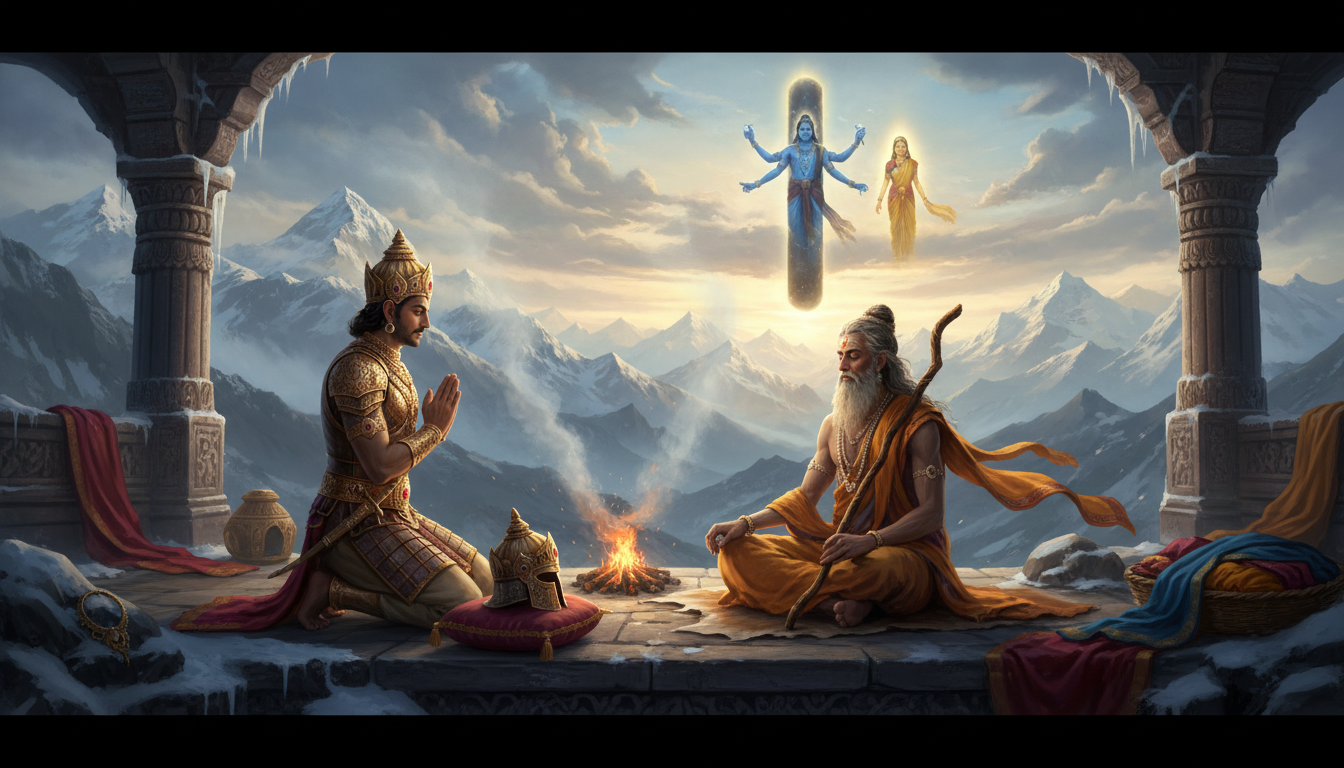
He left his kingdom and went up. He repaired to the spot called Munjaprishtha, which is held in high esteem by the Pitris and by the celestial Rishis, on a peak of Himavat near the golden mountains of Meru. The place has its name from a thing that happened there long before he came: Rama of the axe, sitting under a well-known banian on that spot, had tied his matted locks together with munja grass, and from that time the place was called Munjaprishtha by Rishis of rigid vows. It is a favourite haunt of Rudra.
King Vasuhoma, residing in that spot, acquired many pious attributes, and having gained the esteem of the Brahmanas, came to be regarded as a celestial Rishi in holiness. He was still a king. He had simply stopped being one anywhere that a king could be paid for it.
One day that crusher of foes, that friend of Sakra, the great-souled king Mandhatri, came to Vasuhoma on his mountain retreat.
Here it is worth pausing on who has walked up that mountain. Mandhatri was the emperor of the earth and a personal friend of the king of the gods. He had nothing left to conquer and nobody above him to consult. And arriving at the hermitage, beholding king Vasuhoma of austere penances, he stood before him in an attitude of humility, and waited.
Vasuhoma offered unto his guest water to wash his feet, and the Arghya consisting of the usual articles, and then, in the proper order, enquired of him about the well-being or otherwise of his kingdom consisting of seven limbs.
Only after all of that did the host ask the visitor what he had come for.
"What, O king, shall I do for thee?"
The Emperor Comes as a Pupil
Thus addressed, Mandhatri, that best of kings, was highly gratified, and answered Vasuhoma of great wisdom, who was seated at his ease.
He began by establishing his host's credentials out loud, which is the courteous way to ask a hard question.
"Thou hast, O king, studied all the doctrines of Vrihaspati. O best of men, the doctrines laid down by Usanas also are known to thee."
Both schools. The teacher of the gods and the teacher of the Asuras, the two great authorities on statecraft, and the man on the mountain had read both of them. Then Mandhatri asked what he had climbed for, in four questions.
"I desire to know what is the origin of Chastisement. What was awake before Chastisement? What also is said to be its end? How came Chastisement to depend upon the Kshatriya? Tell me all this, O thou of great wisdom."
And then the emperor of the world said the sentence that gives this whole episode its shape.
"I come to thee as a disciple, ready to give thee the tutorial fee."
He put himself in the posture of a boy at the start of a term, with the fee in his hand, in front of a man who had given up a kingdom smaller than his own. It is the same posture Yudhishthira had been holding in the sand at Kurukshetra for weeks, which is presumably why Bhishma chose this story out of all the stories he could have chosen.
"Listen, O king," Vasuhoma said, "as to how Chastisement, that upholder of the world, arose. The soul of righteousness, it is eternal, and it was created for maintaining the due government of all creatures."
Created. Not eternal in the sense of always having been in operation. There was a day it was made, and there was a reason, and the reason is a story about a sacrifice that went wrong.
The Sneeze That Made a Priest
"It hath been heard by us," Vasuhoma said, "that once upon a time the Grandsire of all the worlds, the divine Brahman, desiring to perform a sacrifice, failed to find a priest possessed of qualifications like himself."
That is the whole of the difficulty, and it is a difficulty peculiar to being first. A sacrifice requires a sacrificer and a priest, two men, one to give and one to conduct. The Grandsire had nobody in the universe of the right standing to hold the ladle for him, because there was nobody of his standing at all.
"For this reason he conceived in his brain, and held the foetus there for many long years. After a thousand years had passed away, the great god sneezed. In that act, the foetus fell from his head."
A thousand years of carrying, and the delivery is a sneeze. The book does not make a joke of it and neither should anyone else, but it is a strange and homely detail to find at the origin of the world's law, and it is put down in the plainest possible words.
"The divine being, O chastiser of foes, that thus took birth from Brahman was called by the name of Kshupa. Possessed of great powers, he became a lord of creatures. That Kshupa became the priest, O king, in the sacrifice of the high-souled Grandsire."
So the difficulty was solved. The Grandsire had made, out of his own head, the one being qualified to officiate for him, and the rite could begin.
And it is at the moment the rite begins that the disaster happens, and the cause of the disaster is the most unexpected thing in the whole account.
"Upon the commencement of that sacrifice of Brahman, O best of kings, Chastisement disappeared, in consequence of the visible form that the Grandsire was then obliged to assume."
To sacrifice, you must be somewhere. You must have hands and a seat and a direction you are facing. The Grandsire, in order to perform, had to take a visible form, and something went out of the world when he did, and the thing that went out was the rod.
The World With the Rod Gone
"Chastisement having disappeared, a great confusion set in among all creatures."
What follows is a short list, and it is worth reading in the order it is given, because the order is an argument. It does not begin with murder. It begins with the loss of a distinction.
"There was no longer any distinction between what should be done and what should not."
That is the first casualty, and it is not a crime. It is the disappearance of the category that makes a crime possible.
"All distinction between clean and unclean food ceased. Men ceased to distinguish between what drink was allowable and what drink was otherwise."
Still nobody has been hurt. What has gone is the small daily discrimination that a person makes without thinking about it, twenty times before noon.
"All creatures began to injure one another. There were no restraints in the matter of the union of the sexes."
Now it is bodies.
"All idea of property ceased. All creatures began to rob, and to snatch meat from one another. The strong began to slay the weak. Nobody cherished the slightest consideration for his neighbour."
And that is the end of the list, and it is the end of the world in a paragraph, and the whole of it followed from the withdrawal of one thing that nobody had been thinking about while it was there.
Notice what the sequence claims. It claims that the rod is not the last resort of a society that has failed at everything else. It claims that the rod is what holds up the ordinary sense of clean and unclean, mine and thine, permitted and forbidden, in the mind of a man who has never in his life been near a court. Take it away and the man does not become a criminal. He becomes a creature who cannot tell what a crime would be.
"The Grandsire then, having worshipped the divine and eternal Vishnu, addressed that great boon-giving god, saying: It behoveth thee, O Kesava, to show mercy on the present occasion. Let it be so ordained by thee that the confusion that has occurred may disappear."
Vishnu Makes a Body for It
Thus addressed, that foremost of deities, armed with an enormous Sula, reflected long.
He did not answer at once and he did not send a decree. Vasuhoma is careful about this, and the care matters, because what was needed was not a rule. Rules had not gone missing. What had gone missing was the thing that makes a rule bite, and no further rule can supply that.
So Vishnu created his own self into the form of Chastisement.
Out of himself. Not made from some material, not appointed from among existing beings, not delegated. The god took his own being and shaped it into the rod, which is why every list of the names of Chastisement that Bhishma had recited that morning ended where it did: Chastisement is the holy Vishnu, and he is the puissant Narayana, and because he always assumes a terrible form he is called Mahapurusha.
"From that form, having Righteousness for its legs," Vasuhoma said, "the goddess Saraswati created Danda-niti, the science of Chastisement, which very soon became celebrated over the world."
That is the second making, and it is as important as the first. The rod was a body; the goddess of speech drew a science out of it. Force came into the world first and the doctrine of how to use force came second, extracted from the thing itself by the one deity whose whole province is words. And the legs the form stands on are Righteousness, so that the science has nothing to rest on if the righteousness is taken away.
A king who has the rod without the Danda-niti has a weapon. A king who has the Danda-niti without the rod has a book. The world had just demonstrated what it looks like when it has neither.
Then the great god armed with the enormous Sula reflected for some time again, and did the third thing, which was to put names to responsibilities.
The Lords Appointed
He appointed a few among the gods as the lords or rulers of their respective classes, and Vasuhoma named them to Mandhatri one after another, in the manner of a man reading out a list of offices.
It was then that he made the divine Indra of a thousand eyes the ruler of the deities. Yama the son of Vivaswat was made the lord of the Pitris. Kuvera was made the lord of treasures and of all the Rakshasas. Meru was made the king of the mountains, and Ocean was made the lord of the rivers. The puissant Varuna was installed into the sovereignty of the waters and of the Asuras. Death was made the lord of life and of all living things, and Fire was appointed as the lord of all things possessed of energy. The puissant Isana, the high-souled and eternal Mahadeva of three eyes, was made the lord of the Rudras. Vasishtha was made the lord of the Brahmanas, and Jatavedas was made the chief of the Vasus. Surya was made the lord of all luminous bodies, and Chandramas was made the king of the stars and the constellations. Ansumat was made the lord of all herbs, and the puissant Kumara of twelve arms was made the chief of all the spirits and ghostly beings.
And Time, possessing the seeds of both destruction and growth, was made the sovereign of all creatures, and of the four portions of Death, which are weapons, diseases, Yama, and acts, and lastly of grief and of joy.
Read the list as a whole and its logic comes out. Nothing in it is left ownerless. The mountains have a king, the rivers have a lord, the plants have somebody answerable for them, the ghosts have a commander, and even grief and joy are on somebody's roll. The remedy for a world in which all idea of property ceased was not to abolish belonging. It was to establish, from the mountains down to the herbs, exactly whose each thing was and who would answer for it.
And then the rod itself had to be given to somebody.
The Hands the Rod Passed Through
"The rod of chastisement was given to Brahman's son of subsequent birth, Kshupa, that lord of all creatures and foremost of virtuous persons," Vasuhoma said.
The priest of the interrupted sacrifice got it first. Then, upon the completion of that sacrifice according to due rites, Mahadeva, after doing proper reverence, made over Chastisement, that protector of Righteousness, unto Vishnu.
And from there it went down, hand to hand, and Vasuhoma traced it the way a man traces a title deed.
Vishnu gave it to Angiras. Angiras, that foremost of ascetics, made it over to Indra and to Marichi. Marichi gave it to Bhrigu. Bhrigu gave that rod, intended for the protection of righteousness, unto all the Rishis. The Rishis gave it unto the Regents of the world. The Regents made it over again to Kshupa. Kshupa then made it over to Manu the son of Surya. And Manu gave it unto his sons, for the sake of true righteousness and wealth.
Eleven pairs of hands between the body Vishnu made of himself and the man sitting on a throne today, and not one of those transfers was a conquest. Every one of them was a handing over. What a king holds, he holds because it was given to him by somebody who had been given it, and the last man in that line is holding property that has been in trust since before there were kings.
Then Vasuhoma set out the terms of the trust, and they are short.
"Chastisement should be inflicted with discrimination, guided by righteousness and not by caprice. It is intended for restraining the wicked. Fines and forfeitures are intended for striking alarm, and not for filling the king's treasury. The maiming of one's body, or the infliction of death, should not proceed from trivial causes. The infliction of physical pain by diverse means, hurling from the tops of mountains, and banishment also, should not proceed from similar causes."
Not for filling the king's treasury. An emperor had climbed a mountain to hear the origin of the rod, and what he was sent home with was a rule about accounting.
"Chastisement, in the hands of successive holders, remains awake, protecting all creatures," Vasuhoma said. "A virtuous king should rule properly, guided by Chastisement."
"That person who listens to this teaching of Vasuhoma," Bhishma said to the son of Dharma from his bed of arrows, "and having listened to it conducts himself according to its tenure, is sure to obtain the fruition of all his wishes. I have now, O bull among men, told thee everything as to who Chastisement is, that restrainer of the universe which is governed by righteousness."
Dharma Lesson
Punishment is not the opposite of order but its body. When the rod withdrew, men did not first turn to murder; they lost the difference between clean and unclean, mine and thine, and only then began to devour one another. And the rod reached the throne through eleven pairs of hands as a trust, which is why it is meant for striking alarm and never for filling the treasury.