What the Brothers Wanted Most
An evening argument about virtue, wealth and desire
The Road Back from the Field
Vaishampayana said that when Bhishma had said what he had to say, he became silent, and that Yudhishthira and the others returned home.
That is the whole of the transition, and it is worth standing still in for a moment, because of what it covers. For days the sons of Pandu had been riding out from Hastinapura to the field at Kurukshetra, dismounting at a distance and walking the last part on foot, and sitting down in the sand around a man who was lying on a bed made of the arrows that had gone through him. He had been answering questions about kingcraft. He had told them how a king should choose ministers, how he should treat those he has beaten, what he owes to a beggar and what to a spy, and the brothers had listened the way men listen who know the source will not be there next season.
On this evening the old man stopped, and they got up, and they went back.
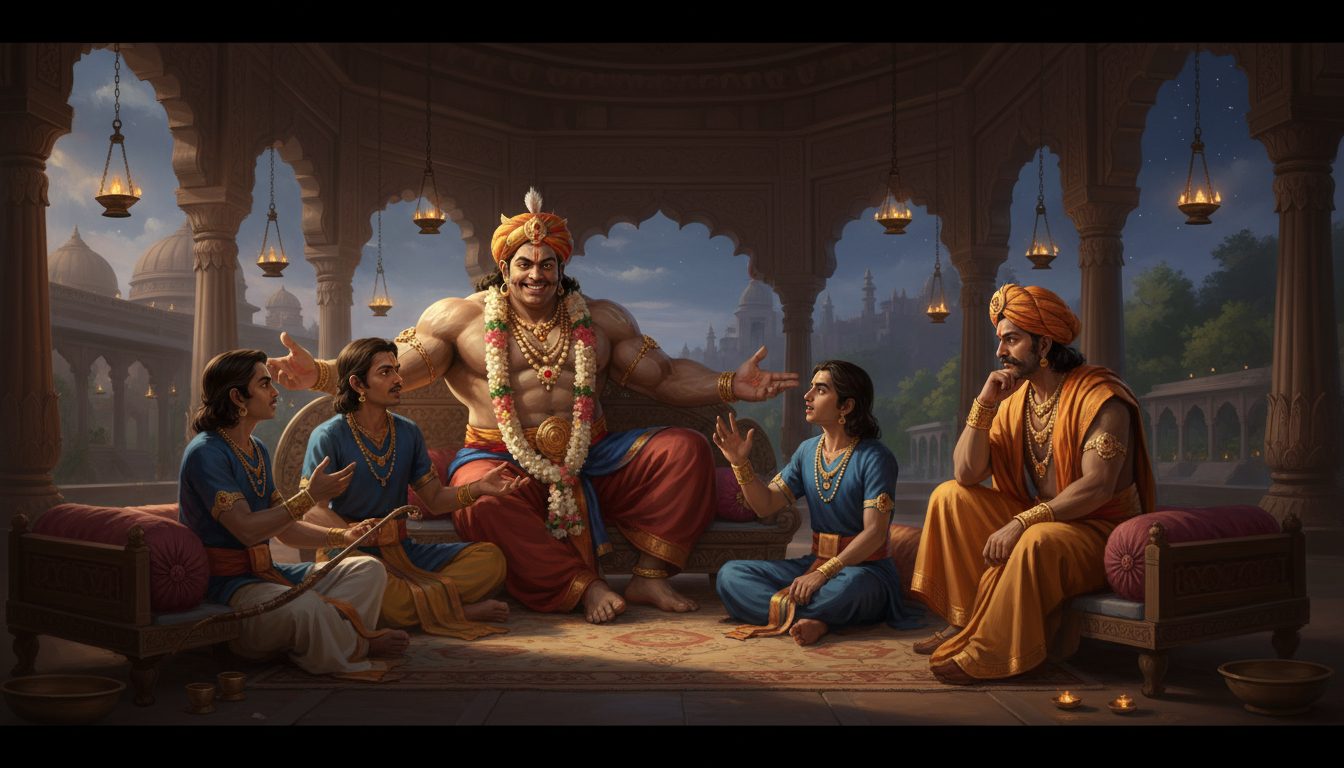
The road from the field to the city runs through country that had been fought over and had not yet been cleaned. They rode it in the last of the light. Nobody had asked Yudhishthira a question in a long while; every question in that season went the other way, from the living to the dying. And when they were home and the lamps were lit and the five of them were sitting together with Vidura making the fifth of the company, the king turned to his own brothers and asked them something, which was not usual.
He did not ask it as a king asks. He asked it the way a man asks who has been listening to another man for a fortnight and wants to hear what the people in his own house actually think.
The Question Put to Five Men
"The course of the world rests upon Virtue, Wealth and Desire," Yudhishthira said. "Amongst these three, which is the foremost, which the second, and which the last, in point of importance?"
That was the first half. The brothers were ready for it; it is a schoolroom question, and every one of them had an answer waiting behind his teeth. Then he asked the second half, which is the one he actually cared about.
"For subduing the triple aggregate," he said, "which is lust, wrath and covetousness, upon which of the first three should the mind be fixed?"
So it was not a question about the ranking of goods. It was a question about what a man should hold on to when the three enemies inside him come for him, and it was being asked by a man who had just spent eighteen days watching what wrath and covetousness do when nobody holds on to anything.
"It behoveth you all," he added, "to answer this question cheerfully, in words that are true."
Cheerfully. He asked them for that too, and it is a small strange courtesy in a house where the fires had not been out of anybody's nose for a month. He wanted an argument in his hall in the evening, brothers talking across a lamp, and not five men agreeing with the king.
He got what he asked for. They answered him in four separate voices and no two of them said the same thing, and one of them, before he was finished, told the eldest son of Dharma to his face that he was a small sort of man.
This is the one council in that whole long season where Bhishma is not present, where nobody quotes him, and where the five brothers and Vidura are obliged to speak for themselves.
Vidura Answers for Virtue
Vidura spoke first, and there is an irony in the order that the text does not point out and does not need to. Of the five men in that room he was the one conversant with the science of Profit. He knew the course of the world, he knew what things cost, he had run the treasury of a kingdom he did not own, and he had great brilliancy of intellect. If anyone was going to argue for Wealth it should have been the minister.
He argued for Virtue, and he did it by making a list, in the manner of a man who does not trust adjectives.
"Study of the various scriptures," he said. "Asceticism. Gift. Faith. The performance of sacrifices. Forgiveness. Sincerity of disposition. Compassion. Truth. Self-restraint. These constitute the possessions of Virtue."
He let the list sit there. Ten items, most of them things a man does rather than things a man feels.
"Adopt Virtue," he said. "Let not thy heart ever turn away from it. Both Virtue and Profit have their roots in these things I have named, and I think that all of them may be included in the one term."
Then he gave his grounds, and they were historical rather than moral. "It is by Virtue that the Rishis have crossed the world with all its difficulties. It is upon Virtue that all the worlds depend for their existence. It is by Virtue that the gods attained their position of superiority. It is upon Virtue that Profit rests."
His ranking followed from that. "Virtue, O king, is foremost in point of merit. Profit is said to be middling. Desire, it is said by the wise, is the lowest of the three. For this reason one should live with a restrained soul, giving his attention to Virtue most."
And he ended with a rule of conduct rather than a doctrine, which was his way. "One should behave towards all creatures as he should towards himself."
No one interrupted him. Vidura had earned a certain silence in that house, over years, by having been right in it when it was expensive to be right.
Arjuna Answers for the Field of Action
Then Pritha's son Arjuna spoke, urged on by the drift of the question. He was well skilled in the science of Profit and conversant also with the truths of Virtue, and he began where a soldier begins, with the ground.
"This world, O king, is the field of action. Action, therefore, is applauded here. Agriculture, trade, the keeping of cattle, and the diverse kinds of arts, constitute what is called Profit, and Profit is the end of all such acts. Without Wealth, neither Virtue nor the objects of Desire can be won. This is the declaration of the Sruti."
Then he said the sentence that cuts. "Even persons of uncleansed souls, if possessed of diverse kinds of Wealth, are able to perform the highest acts of virtue and to gratify desires that are apparently difficult of gratification."
That is not a pious sentiment and Arjuna did not offer it as one. It is an observation about who is able to build the tank and feed the brahmanas at the gate, and it does not depend at all on whether the man doing it is good.
"Virtue and Desire are the limbs of Wealth, as the Sruti declares. Like all creatures worshipping Brahman, even persons of superior birth worship a man possessed of Wealth."
Then he did something to the argument that made it hard to answer. He went down the list of everyone in the world who is supposed to be beyond wanting money, and put them all in the column of men who want it.
"Even they that are attired in deer-skins and bear matted locks on their heads. They that are self-restrained, that smear their bodies with mire, that have their senses under complete control. Even they that have bald heads and are devoted Brahmacharins and live separated from one another, cherish a desire for Wealth. Others attired in yellow robes, bearing long beards, graced with modesty, possessed of learning, contented, freed from all attachments, become desirous of Wealth. Others follow the practices of their ancestors, and others desire heaven, and they do the same. Believers and unbelievers, and those that are rigid practisers of the highest Yoga, all certify to the excellence of Wealth."
He finished with a definition that a king could act on. "He is said to be truly possessed of Wealth who cherishes his dependants with objects of enjoyment, and afflicts his foes with punishments. Even this, O foremost of intelligent men, is truly my opinion."
Then he did the courteous thing, and handed the floor on. "Listen, however, now to these two who are about to speak."
The Twins Answer Together
The two sons of Madri spoke next, and they spoke as one, which is how the twin sons of the Aswins do most things in this book. Nakula began a sentence and Sahadeva finished it and nobody in the room could afterwards say with confidence which of them had said which half.
They started by agreeing with Arjuna, hard.
"Sitting or lying, walking and standing, one should strive after the acquisition of Wealth, even by the most vigorous of means. If Wealth, which is difficult of acquisition and highly agreeable, be earned, then the person who has earned it is seen, without doubt, to obtain all the objects of Desire."
And then they put the fence around it, which was their contribution, and it is the most practical thing said in the room that night.
"That Wealth which is connected with Virtue, and that Virtue which is connected with Wealth, is certainly like nectar. For this reason our opinions are as follows. A person without wealth cannot gratify any desire. Similarly, there can be no Wealth in one that is destitute of Virtue. He, therefore, who is outside the pale of both Virtue and Wealth, is an object of fear unto the world."
An object of fear. Not a wicked man, not a fool, not a sinner. A hazard. The twins had been quartermasters in a war, and their picture of the man with neither money nor scruple is the picture of something you post guards against.
"For this reason one should seek the acquisition of Wealth with a devoted mind, without disregarding the requirements of Virtue. They who believe in the wisdom of this saying succeed in acquiring whatever they desire."
Then they gave the order of operations, three steps, in sequence, like a drill.
"One should first practise Virtue. Next, acquire Wealth without sacrificing Virtue. And then seek the gratification of Desire, for this should be the last act of one who has been successful in acquiring Wealth."
Having said that, the twin sons of the Aswins remained silent. They had put Desire last, but they had not thrown it out, and they had given the whole thing a shape that a young man could actually live by.
Across the lamp, the second son of Kunti was waiting.
Bhima Speaks for Wanting
Bhimasena was sitting garlanded. His body was smeared with sandal-paste and he wore excellent ornaments, and he had come to his brother's council out of whatever he had been doing that evening without changing anything about himself, which is one way of making an argument before you open your mouth.
"One without Desire never wishes for Wealth," he said. "One without Desire never wishes for Virtue. One who is destitute of Desire can never feel any wish at all. For this reason, Desire is the foremost of all the three."
He then went through the same catalogue Arjuna had used and turned it inside out.
"It is under the influence of Desire that the very Rishis devote themselves to penances, subsisting upon fruits, or living upon roots, or upon air only. Others possessed of Vedic lore are engaged upon the Vedas and their branches, or upon rites of faith and sacrificial acts, or upon making gifts and accepting them. Traders, agriculturists, keepers of cattle, artists and artisans, and those employed in rites of propitiation, all act from Desire. Some there are that dive unto the depths of the ocean, induced by Desire."
That last one is the image he chose to stop on. A man going down into black water with his lungs full because he wants a pearl.
"Desire takes various forms. Everything is pervaded by the principle of Desire. A man outside the pale of Desire never is, was, or will be seen in this world. This, O king, is the truth. Both Virtue and Wealth are based upon Desire."
Then he made his case in the kitchen, because he was a man who thought in food.
"As butter represents the essence of curds, even so is Desire the essence of Profit and Virtue. Oil is better than oil-seeds. Ghee is better than sour milk. Flowers and fruits are better than wood. Similarly, Desire is better than Virtue and Profit. As honeyed juice is extracted from flowers, so is Desire said to be extracted from these two."
Nobody had a rebuttal ready for the churn and the press. You cannot say that curds are more essential than butter without arguing with every woman in the house.
"Desire is the parent of Virtue and Profit," Bhima said. "Desire is the soul of these two. Without Desire the Brahmanas would never give either sweets or wealth unto Brahmanas. Without Desire the diverse kinds of action that are seen in the world would never have been seen at all."
The Small Man and the Best of His Species
Then Bhima said the thing that would have got a smaller man thrown out of the hall.
"Approaching beautiful damsels attired in excellent robes, adorned with every ornament, and exhilarated with sweet wines, do thou sport with them. Desire, O king, should be the foremost of the three with us."
He said it to Yudhishthira. To the eldest son of Dharma, in mourning, in a house that had buried most of its family inside the year. It is the only speech in the parva in which somebody tells the king to go and enjoy himself, and Bhima delivered it garlanded and smelling of sandalwood, which is either an insult or a prescription depending on how much you like Bhima.
Then, having got everyone's attention that way, he turned the whole speech around.
"Reflecting upon the question to its very roots, I have come to this conclusion. Do not hesitate to accept it, O son of Dharma. These words of mine are not of hollow import. Fraught with righteousness as they are, they will be acceptable to all good men."
And then, from the man who had just spent his whole turn arguing that Desire outranks the other two, came this.
"Virtue, Profit and Desire should all be equally attended to. That man who devotes himself to only one of them is certainly not a superior person. He is said to be middling who devotes himself to only two of them. He, on the other hand, is the best of his species who attends to all the three."
So the argument for Desire was never an argument for Desire alone. It was a trap laid for four men who had each just finished ranking things, and it caught all of them, Vidura at the top of the list with his ten possessions of Virtue and Arjuna with his catalogue of ascetics who want money. Bhima had let each of them plant a flag and had then informed the room that planting a flag was the error.
Having said these words, in brief and also in detail, unto those heroes, Bhima remained silent. Surrounded by friends, smeared with sandal-paste, adorned with excellent garlands and ornaments. The text mentions the garlands twice. It wants you to see him sitting there.
The King Calls It All False Philosophy
King Yudhishthira the just, that foremost of virtuous men, possessed of great learning, reflected properly for a while upon the words spoken by all of them.
And then he thought all those speeches to be false philosophy.
He did not say it rudely. He began with a compliment, and it was a real one. "Without doubt, all of you have settled conclusions in respect of the scriptures, and all of you are conversant with authorities. These words fraught with certainty that you have spoken have been heard by me."
Then: "Listen now, with concentrated attention, to what I say unto you."
What he said had not been on the table at any point in the evening. He did not pick Virtue, which his own name should have obliged him to pick. He did not split the difference with Bhima. He answered a question nobody had asked by describing a man.
"He who is not employed in merit or in sin. He who does not attend to Profit, or Virtue, or Desire. Who is above all faults. Who regards gold and a brick-bat with equal eyes. Such a man becomes liberated from pleasure and pain and from the necessity of accomplishing his purposes."
Gold and a brick-bat. Given who was in the room, and what had just been fought over, and what the whole war had been about in the end, that is a chosen example and not a random one.
"All creatures are subject to birth and death," he said. "All are liable to waste and change. Awakened repeatedly by the diverse benefits and evils of life, all of them applaud Emancipation."
And then, and this is the sentence that keeps the speech from being a sermon: "We do not know, however, what Emancipation is."
He went on without pretending otherwise. "The self-born and divine Brahman has said that there is no Emancipation for him who is bound with ties of attachment and affection. They, however, that are possessed of learning, seek Extinction. For this reason one should never regard anything as either agreeable or disagreeable. This view seems to be the best."
Seems. He was proposing a fifth thing to men who had each brought him a certainty, and he would not dress it up as one.
No One Acts As He Pleases
Then he took the last step, and it is the step that makes the whole evening land somewhere none of the four speakers had been standing.
"No one in this world can act as he pleases," Yudhishthira said. "I act precisely as I am made to act. The great Ordainer makes all creatures proceed as He wills. The Ordainer is Supreme. Know this, all of you."
Every one of the four answers had assumed a man choosing. Vidura's man chooses Virtue and holds to it. Arjuna's man goes out into the field of action and gets. The twins' man performs three operations in the correct order. Bhima's man wants, and because he wants, he moves. The king had listened to four descriptions of a chooser and had then told his brothers that he could not find the chooser anywhere.
"No one can, by his acts, obtain what is unobtainable. That which is to be, takes place. Know this. And since he who has withdrawn himself from the triple aggregate may succeed in winning Emancipation, it seems therefore that Emancipation is productive of the highest good."
He stopped there.
Vaishampayana said that having listened to these foremost words, fraught with reason and acceptable to the heart, Bhima and the others were filled with delight, and joining their hands, bowed unto that prince of Kuru's race. Bhima with them, garlands and all. They had heard a speech well adorned with sweet letters and syllables, acceptable to the heart, divested of dissonant sounds and words, and those foremost of men began to applaud Yudhishthira highly.
And the high-souled son of Dharma, possessed of great energy, praised them in return. That is in the text and it is easy to read past. He did not win the argument and leave it there. He praised his convinced auditors, four men who had each come at his question honestly and been overturned, and who had bowed rather than sulk about it.
Then, once more, the king addressed the son of the foremost of rivers, and asked him about duties.
Which is to say that the next morning they got on the road to the field again, and sat down in the sand around the old man on the arrows, and went on with the lesson while there was still somebody there to give it.
Dharma Lesson
Each of the three aims of life is honest and each is incomplete, and the man who insists on ranking them has not yet noticed that he did not choose his own place in the order. Yudhishthira's answer is not a fourth ranking but a refusal to rank: the eye that sees gold and a brick with the same weight is already free of the quarrel. He offers it, notably, without claiming to know what freedom is.