The Battle No One Else Can Fight
Krishna names the enemies still living in Yudhishthira's flesh
The Man Who Had Won
Vyasa finished speaking about the gold on the mountain, and nobody in the hall at Hastinapura said anything, and the king went on sitting exactly as he had been sitting.
He had won. That was the difficulty. There was no enemy left in the field, no claim outstanding, no assembly in which anyone would rise to dispute his right. He had been given back everything that had been taken from him and it had arrived in his hands looking like something else. Vaishampayana says that the son of Pritha was afflicted in mind, bereft of his relatives and his kinsmen slain in battle, and that he appeared crest-fallen like the sun darkened in eclipse, or like a fire smothered by its own smoke.
It was Krishna who spoke next, because he was the only man there who could say the next thing without softening it.
"All crookedness of heart leads to destruction," he said, "and all rectitude leads to Brahman. If this and this only is the aim and object of all true wisdom, then what can mental distraction do to one who understands it?"
Yudhishthira did not answer.
"Thy Karma has not yet been annihilated," Krishna said, "nor have thy enemies been subjugated. For thou dost not yet know the enemies that are still lurking within thine own flesh."
That was the sentence the king heard. It was put to him as a plain report of fact, the way a scout reports that a force has been sighted on a road, and it named a war he had not been told he was fighting.
"I shall relate to thee truly, as I have heard it," Krishna said, "the story of the war of Indra with Vritra, as it took place. It is not the war that is sung. It is the other one. Listen, and count how many times the enemy is driven out and how many times he is destroyed, for they are not the same number."
The Demon in the Earth
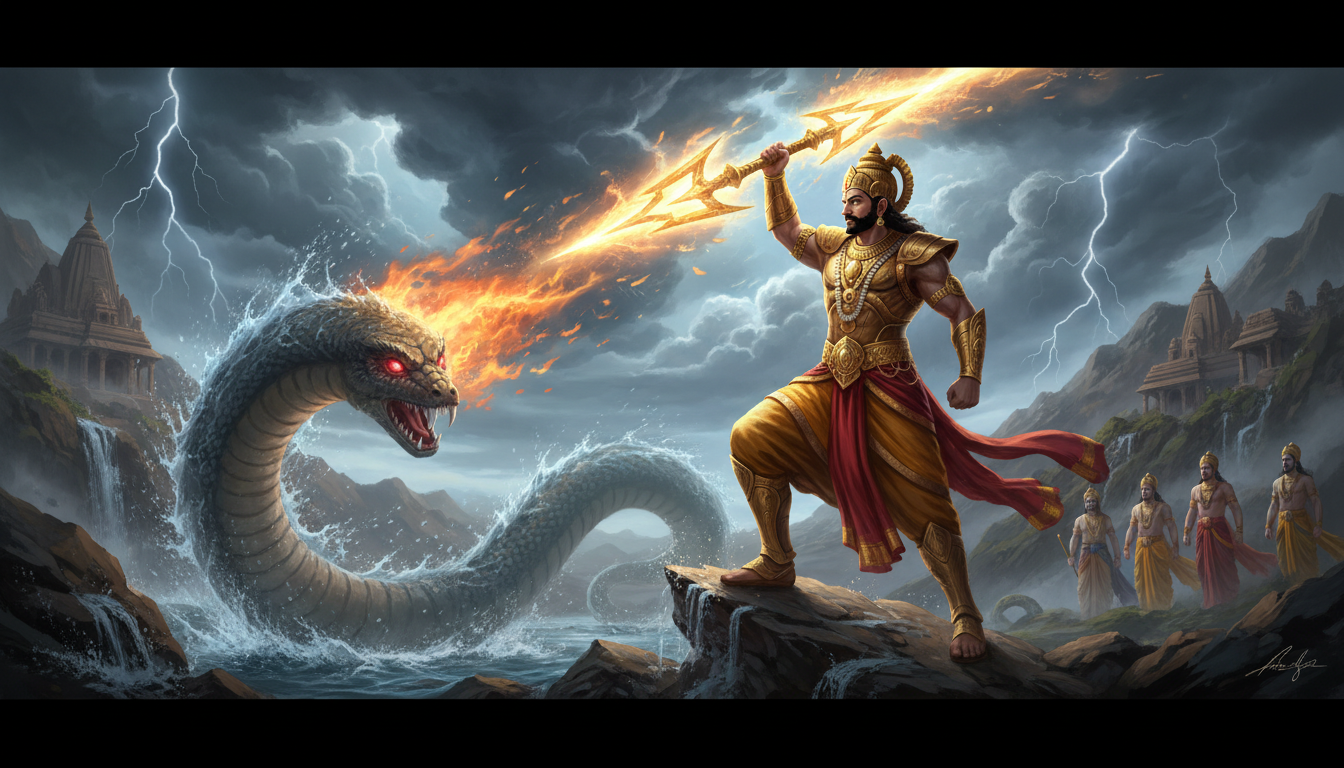
In ancient times, Krishna said, the Earth herself was encompassed by Vritra.
He did not stand upon her and he did not besiege her. He took her in, the way damp takes a wall, and he abstracted the earthly matter that is the seat of all odour, and drew that property out of her into himself.
What men noticed first was the smell. There arose bad odours on all sides, in the villages and on the roads and in the houses of the pious, and no one could say where they came from or what had gone wrong, only that the world had begun to smell like something spoiled. That was the whole of the visible damage. A quality had been stolen out of creation and the theft announced itself as a stench.
The Performer of a hundred sacrifices was much enraged by this act, and he hurled his thunderbolt at Vritra.
It struck. That is worth saying plainly, because in this story every blow lands. Deeply wounded by the thunderbolt of mighty Indra, Vritra did not die and did not flee upward and did not turn and fight. He entered into the waters.
"Mark what he does," Krishna said. "He is not defeated when he is struck. He is moved. Each blow of that thunderbolt is perfectly successful and each blow drives him one step further in."
The waters being seized by Vritra, their liquid property left them. Rivers ran and lakes stood full and the property that makes water water had gone out of them into the thing that had taken shelter there.
At this Indra became highly enraged, and again smote him with his thunderbolt.
Water, Light, Wind, and the Ether
Smitten by the thunderbolt of the most powerful Indra, Vritra betook himself to the Jyoti, the luminous matter, and abstracted its inherent property. The luminous matter being overwhelmed by Vritra, colour and form were thereby lost. Fires burned without looking like fire. The eye opened on a world that had nothing in it for the eye.
The wrathful Indra again hurled his thunderbolt at him.
Wounded again by Indra of immeasurable power, Vritra entered all on a sudden into the Vayu, the gaseous matter, and thereafter made away with its inherent property. The wind moved and could not be felt. Touch was gone out of the world.
Indra became again filled with wrath and flung his thunderbolt at him.
And wounded therein by the mighty one, he overwhelmed the Akasa, the ether, and took away its inherent property, and sound was destroyed. There was no longer anything for the ear to do.
"Consider what the king of the gods has accomplished," said Krishna. "He has driven his enemy out of earth, out of water, out of light, out of wind, and out of ether. There is no element left in which the thing can be pursued. Every campaign has been a victory and there are fewer places to stand after each of them than there were before.
"That is the shape of the war a man wages against what he wants. He drives it out of his hands and it goes into his speech. He drives it out of his speech and it goes into his silences. He drives it out of his silences and it goes where the thunderbolt cannot be aimed without wounding the one who throws it."
The god of a hundred sacrifices, highly incensed, smote him with the thunderbolt once more.
The Bolt That Could Not Be Seen
And thus smitten by the mighty Indra, Vritra suddenly entered into Sakra's own body, and took away its essential attributes.
There was nowhere further to go and there was no further blow to be struck, and the lord of the three worlds stood in his own heaven with his weapon in his hand and his enemy inside his ribs. Overtaken by Vritra, Krishna said, he was filled with great illusion. Everything he looked at he saw wrongly. He could not tell what was his own thought and what had been put into him.
And there was no shame in it, and no one laughed, and the one thing that happened in heaven at that hour was that an old ascetic came and sat with him.
"We have heard," Krishna said, "that Vasishtha comforted Indra when he was thus afflicted."
That is all the account gives, and it is a great deal. The lord of the celestials, undone by an enemy he could not point at, needed one man to sit near him and speak steadily until the illusion thinned enough for him to think. What Vasishtha said is not recorded. That he came is recorded.
And then the god of a hundred sacrifices slew Vritra in his own body, by means of his invisible thunderbolt.
"Not the thunderbolt that is seen," Krishna said. "The other one. The bolt that has no flash and makes no crash of air, that can be brought down inside a body without splitting it. There is no other weapon that reaches where the enemy had gone.
"Know, O prince, that this religious mystery was recited by Sakra to the great sages, and that they in turn told it to me. It was not told as the tale of a victory. It was told as an account of where the last enemy is always found."
Two Kinds of Sickness
"There are two kinds of ailments," Krishna said, "physical and mental. They are produced by the mutual action of the body and the mind upon each other, and they never arise without the interaction of the two. The ailment that is produced in the body is called the physical ailment, and that which has its seat in the mind is known as the mental ailment.
"The cold and the warm, which are phlegm and bile, and the windy humour along with them, are the essential transformations generated in the physical body. When these humours are evenly distributed and present in due proportions, they are said to be symptomatic of good health. The warm humour is allayed by the cold, and the cold by the warm. A physician who sees a fever does not ask the fever to be reasonable. He puts the opposite quality into the body and waits.
"So too with the other kind. Sattwa, Rajas and Tamas are the attributes of the soul, and it is said by the learned that their presence in due proportions indicates health of the mind. But if any of the three preponderates, some remedy is enjoined to restore the equilibrium.
"Happiness is overcome by sorrow, and sorrow by pleasure. Some people, while afflicted by sorrow, desire to recall past happiness. Others, while in the enjoyment of happiness, desire to recall past sorrow."
He let that stand a moment, because the king was doing neither.
"But thou, O son of Kunti, dost neither desire to recall thy sorrows nor thy happiness. What else, then, dost thou desire to recall, barring this delusion of sorrow? Or perchance, O son of Pritha, it is thy innate nature, by which thou art at present overpowered."
That is a hard thing to be told by a friend in a hall full of ministers: that the grief is not being fed by any particular memory, and that a man who will not name the thing he is mourning may be mourning nothing, and may simply be built that way.
The Things You Are Not Remembering
Then Krishna listed for him, one after another, the memories he was not brooding on, which is a strange kind of comfort and was meant to be.
"Thou dost not desire to recall to thy mind the painful sight of Krishna standing in the hall of assembly with only one piece of cloth to cover her body, while she was in her season, and in the presence of all the Pandavas.
"And it is not meet that thou shouldst brood over thy departure from the city, and thy exile with the hide of the antelope for thy robe, and thy wanderings in the great forest. Nor shouldst thou recall to thy mind the affliction from Jatasura, or the fight with Chitrasena, or thy troubles from the Saindhavas.
"Nor is it proper, O son of Pritha and conqueror of thy foes, that thou shouldst recall the incident of Kichaka kicking Draupadi, during the period of thy exile passed in absolute concealment. Nor the incidents of the fight which took place between thyself and Drona and Bhishma."
They were laid out like a muster roll, and there were thirteen years of them, and every one of them had been survived. The point was not that the injuries were small. The point was that not one of them was what the king had his face turned toward. He was sitting in a hall he had won, refusing to look at anything in particular, and calling the refusal grief.
"The time has now arrived," Krishna said, "when thou must fight the battle which each must fight single-handed with his mind. Therefore, O chief of Bharata's race, thou must now prepare to carry the struggle against thy mind, and by dint of abstraction and the merit of thine own Karma thou must reach the other side of that which is mysterious and unintelligible."
A War Without Missiles
"In this war," said Krishna, "there will be no need of any missiles, nor of friends, nor of attendants. The battle which is to be fought alone and single-handed has now arrived for thee."
The king had commanded seven divisions. He had a brother who could break a chariot with his hands and another who had brought down the grandsire of the house, and an ally beside him who had driven the horses of the greatest bowman living. Every one of them was in the hall. Not one of them could be sent into this.
"And if vanquished in this struggle," Krishna said, "thou shalt find thyself in the most wretched plight. And knowing this, O son of Kunti, and acting accordingly, shalt thou attain success. Knowing this wisdom, and the destiny of all creatures, and following the conduct of thy ancestors, do thou duly administer thy kingdom."
It is worth noticing what he did not prescribe. He did not tell the king to go into the woods. He told him to govern.
"Salvation is not attained by foregoing external things," he said. "It is attained by giving up those things which pander to the flesh. As for the virtue and the happiness attainable by the person who has renounced only external objects while remaining engrossed by his passions and the weakness of his flesh, let that be the portion of our enemies.
"The man who, having renounced the world, has taken to the life of a recluse in the forest, living on wild roots and edibles, and who has still a craving for the good things of the world and is addicted to them, may be said to bear death in his mouth. Watch and observe, O Bharata, the character of thy external and of thy internal enemies. He who is able to perceive the nature of the eternal reality is able to overreach the influence of the great fear."
The Word of Two Letters
"The word with two letters is Mrityu," Krishna said. "Death. The word with three letters is Saswata, the eternal.
"The consciousness that this or that thing is mine, the state of being addicted to worldly objects, is Mrityu. The absence of that feeling is Saswatam. And these two, Brahman and Mrityu, O king, have their seats in the souls of all creatures, and remaining unseen they wage war with each other without doubt and without ceasing."
This was aimed, and the king knew where.
He had walked over a field on which his own people lay in windrows and he had counted them as a thing done to him, and every one of those deaths had been counted twice, once as a loss to the house and once as a debt against himself. The word for that arithmetic is mine. Mine were the brothers, mine the sons, mine the kingdom bought at that price, and mine the guilt, and mine, mine, mine, until the whole eighteen days had been folded up and put inside one man to be carried.
"And if, O Bharata, it be true that no creature is ever destroyed," Krishna said, "then one does not make oneself guilty of the death of a creature by piercing its body.
"What does the world matter to a man who, having acquired the sovereignty of the whole earth with all its mobile and immobile creation, does not become attached to it or engrossed in its enjoyment? Men do not look with approbation upon the conduct of those who are engrossed in worldly desires. And there is no act without a desire at its root, and all desires are, as it were, the limbs and offshoots of the mind. Therefore, wise men knowing this subjugate their desires.
"What the soul desires is not conducive to piety and virtue. The suppression of the desires is at the root of all true virtue."
The Song Desire Sings
"By way of illustration of this truth," Krishna said, "the sages versed in ancient lore recite these Gathas which are called by the name of Kamagita. Listen to the recital of them in detail, O Yudhishthira, for it is Desire himself who speaks in them, and he is not modest."
And this is what Desire says.
"No creature is able to destroy me without resorting to the proper methods. If a man, knowing my power, strives to destroy me by muttering prayers, I prevail over him by deluding him with the belief that I am the subjective ego within him. If he wishes to destroy me by means of sacrifices with many presents, I deceive him by appearing in his mind as the most virtuous creature among all the mobile creation. If he wishes to annihilate me by mastering the Vedas and the Vedangas, I overreach him by seeming to his mind to be the soul of virtue among the immobile creation.
"If the man whose strength lies in truth desires to overcome me by patience, I appear to him as his own mind, and thus he does not perceive my existence. If the man of austere religious practices desires to destroy me by means of asceticism, I appear in the guise of asceticism in his mind, and thus he is prevented from knowing me. And as for the man of learning who, with the object of attaining salvation, desires to destroy me, I frolic and laugh in the face of such a man intent on salvation.
"I am the everlasting one, without a compeer, whom no creature can kill or destroy."
There is no counter-song. The Gathas end there, with Desire still standing, and the only answer the teaching offers is the one Krishna gave next.
"For this reason thou too, O prince, divert thy desires to Virtue, so that by this means thou mayst attain what is well for thee. Do thou therefore make preparations for the due performance of the horse sacrifice with presents, and various other sacrifices of great splendour. Let not grief overpower thee again on beholding thy friends lying slain on the battlefield. Thou canst not see the men slain in this battle alive again. Therefore shouldst thou perform magnificent sacrifices with gifts, so that thou mayst attain fame in this world and reach the perfect way hereafter."
The enemy in the flesh had been given a name, a voice, and a full account of his costumes, and had not been promised to the king as slain. Only the campaign had been declared, and the horses were to be sent out in the spring.
Dharma Lesson
The enemy driven out of the world does not die, it moves inward, and every blow that succeeds only drives it one step further in. The last campaign of a victorious king is fought alone, without allies or weapons, against a desire that has learned to imitate his virtues.