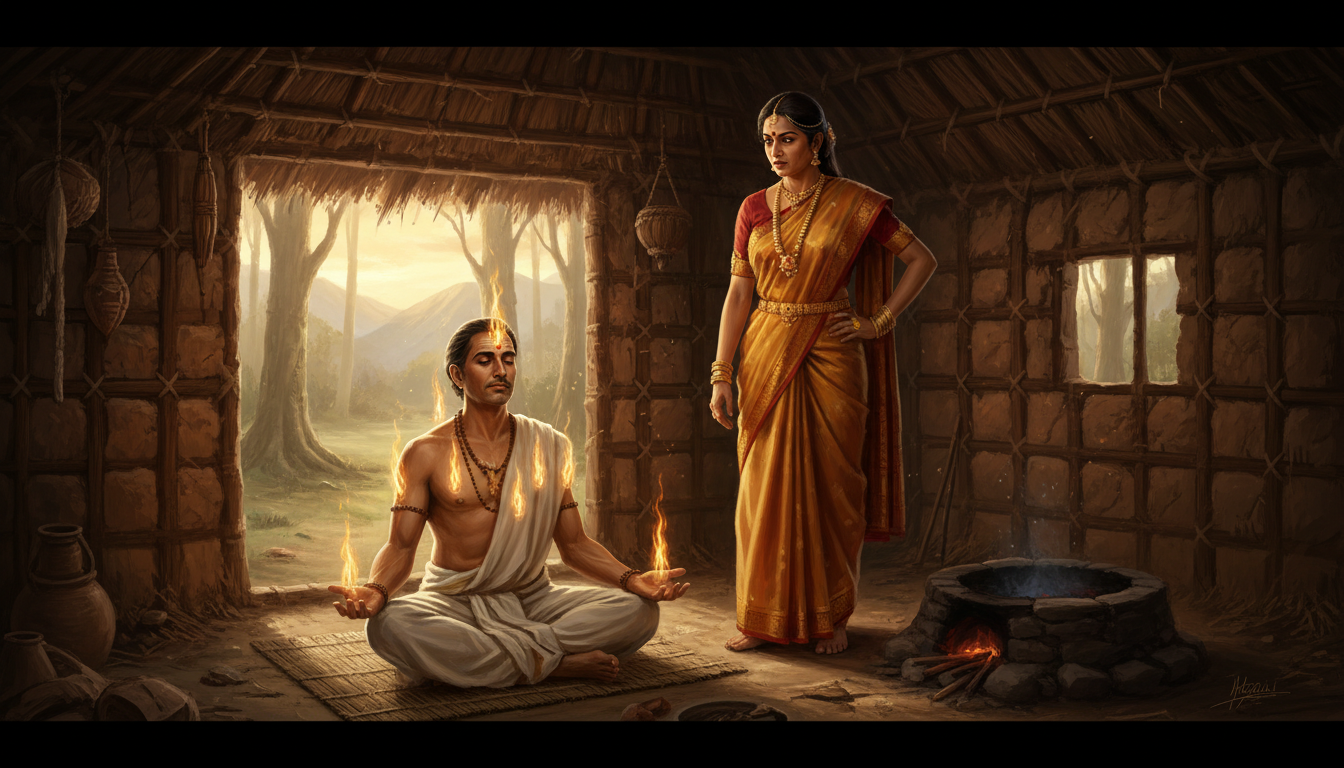
The Fires Inside the Body
A wife asks what her husband's stillness is worth
What Region Shall I Go To
Arjuna had asked to be told the Gita again and had been refused, and what he was given instead was other people's conversation. This was one of them.
"In this connection is cited the ancient narrative, O son of Pritha," said Krishna, "of the discourse that took place between a married couple."
There was a Brahmana, he said, a complete master of every kind of knowledge and wisdom, who had taken to sitting in seclusion. He had cast off all religious acts. He kept no fire. He poured no butter. So far as anybody could tell from the outside, he was not doing anything at all.
His wife stood in front of him and asked a question with a hard edge on it, because it was a question about her own future and he had made himself its obstacle.
"Into what region shall I go, depending on thee as my husband? Thee that art seated, having cast off all acts, that art harsh in thy conduct towards me, and that art so undiscerning. It has been heard by us that a wife attains to those regions which are acquired by her husband. What, indeed, is the goal that I shall attain, having obtained thee for my husband?"
He did not take offence, which is the first thing recorded of him.
"O blessed dame, I am not offended with these words of thine, O sinless one," the Brahmana said, and he smiled while he said it.
"Those persons that are destitute of knowledge only store delusion by acts. Freedom from acts, again, is incapable of being attained in this world for even a moment. From birth to the attainment of a different form, action good or bad, accomplished by acts or by the mind or by speech, exists in all beings.
"Those paths of action which are characterised by visible objects, such as the Soma juice and the ghee for the libations, have been destroyed by Rakshasas. Turning away from them, I have perceived the seat of the soul that is in the body."
The Fire With Seven Tongues
"There dwells Brahma, transcending all pairs of opposites," he said. "There is Soma with Agni, and there the urger of the understanding, who is Vayu, always moves, upholding all creatures. It is for that seat that the Grandsire and others, concentrated in Yoga, worship the Indestructible.
"It is not capable of being smelt by the sense of smell, nor tasted by the tongue, nor touched by the organs of touch. It cannot be conquered by the eye. It transcends the sense of hearing. It is by the mind that it is attained. It is that from which the well-ordered universe proceeds, and it is that upon which the universe rests.
"The life-breaths called Prana and Apana and Samana and Vyana and Udana flow from it, and it is that into which they again enter. Between Apana and Prana, Udana dwells, pervading all. Hence Prana and Apana do not desert a sleeping person.
"And in the midst of all those life-breaths that swallow up one another and move within the body, there blazes forth the fire called Vaiswanara, made up of seven flames."
Then he counted the fire out for her, because a woman who has asked about the fruit of sacrifices is entitled to be shown the whole apparatus.
"The nose, the tongue, the eye, the skin, the ear which numbers the fifth, the mind, and the understanding: these are the seven tongues of that Vaiswanara's flame.
"That which is smelt, that which is seen, that which is drunk, that which is touched, that which is heard, that which is thought of, and that which is understood: these are the seven sorts of fuel.
"That which smells, that which eats, that which sees, that which touches, that which hears, that which thinks, and that which understands: these are the seven great officiating priests.
"Behold, O blessed one, learned sacrificers casting seven libations in seven ways into seven fires. Earth, Wind, Ether, Water, and Light numbering as the fifth, Mind, and Understanding, these seven are called the wombs of all things."
There was no altar in the room. There was a man sitting still, and by his account the rite had not stopped since he was born.
The Ten Priests
"In this connection is cited the following ancient story," the Brahmana said. "Do thou understand of what kind the institution is of the ten Hotris.
"The ear, the skin, the two eyes, the tongue, the nose, the two feet, the two hands, the organ of generation, the lower duct, and speech: these are the ten sacrificing priests.
"Sound and touch, colour and taste, scent, speech, action, motion, and the discharge of the vital seed, of urine and of excreta: these are the ten libations."
He did not lower his voice at the unlovely part of the list, and she did not look away from it, and that is the argument. Nothing a body does is too low to be an offering, because there is no second body in which to offer the higher things separately.
"The points of the compass, the Quarters, Wind, Sun, Moon, Earth, Fire, Vishnu, Indra, Prajapati, and Mitra: these, O beautiful one, are the ten sacrificial fires. The objects of the senses are the fuel cast into them. The mind is the ladle, and the wealth of the sacrificer is his good and his bad acts. What remains, when all of it has been poured, is the pure and highest knowledge.
"The knower, encased in subtle form, lives within the gross body that is produced by the vital seed. The bearer of the body is the Garhapatya fire. Mind is the Ahavaniya fire, and into it is poured the oblation. From that was produced the Word."
His wife had been listening with more attention than he perhaps expected, and she stopped him there, on a point of order.
Word and Mind Go to Be Judged
"Why did Word first arise, and why did Mind arise afterwards," the Brahmana's wife said, "seeing that Word starts into existence only after having been thought upon by Mind? And why, again, in dreamless slumber, though separated from Mind, does not Prana apprehend objects? What is it that restrains it then?"
"The Apana breath, becoming the lord of the Prana, makes it identical with itself," the Brahmana said. "That restrained motion of the Prana breath has been called the motion of the mind. Hence the mind is dependent upon Prana, and not Prana upon the mind. Therefore in dreamless slumber, upon the disappearance of mind, Prana does not disappear.
"But since thou askest me a question about Word and Mind, I shall relate to thee a discourse between them.
"Both Word and Mind repaired to the Soul of matter and asked him, saying, Do thou say which among us is superior. And the holy one made this answer: The mind, undoubtedly. And unto him Word said: I yield to thee the fruition of all thy desires."
He went on before she could ask what a defeated goddess does afterwards.
"Know that I have two minds, immovable and movable. That which is immovable is verily with me. The movable is in thy dominion. That mind is called movable which, in the form of Mantra, or letter, or voice, is referable to thy dominion.
"The goddess Word used always to dwell between Prana and Apana. But, sinking into Apana, though urged upwards, in consequence of becoming dissociated from Prana, she ran to Prajapati and said, Be gratified with me, O holy one. Then Prana appeared, once more fostering Word. Hence Word, encountering deep exhalation, never utters anything.
"Word flows as endued with utterance or unendued with it, and of those two, Word without utterance is the superior. Like a cow endued with excellent milk, she yields diverse kinds of meaning. This one always yields the Eternal, speaking of Brahman."
Seven Who Cannot See One Another
"In this connection is cited the ancient story of what the institution is of the seven sacrificing priests," said the Brahmana. "The nose, the eye, the tongue, the skin, the ear numbering the fifth, the mind, and the understanding. These are seven, standing distinctly from one another. Dwelling in subtle space, they do not perceive one another."
"How is it that, dwelling in subtle space, these do not perceive one another?" she said. "What are their respective natures, O holy one? Do thou tell me this, my lord."
"Not knowing the qualities of any object is ignorance of that object, while knowledge of the qualities is knowledge of the object that possesses them. These seven never succeed in apprehending the qualities of one another. Smells are apprehended by the nose alone, and sounds by the ear alone, and doubt by the mind alone, and determination, which is certainty in respect of knowledge, by the understanding alone. Not one of them has ever met another.
"In this connection is cited this ancient narrative of a discourse between the senses and the mind."
The Mind spoke first.
"The nose does not smell without me. The eye does not seize colour, the skin does not feel touch, the ear does not apprehend sound, when deprived of me. I am the eternal and foremost one among all the elements. Destitute of myself, the senses never shine, like habitations empty of inmates, or fires whose flames have been quenched."
The Senses answered together, and they were not respectful.
"Even this would be true, as thou thinkest, if indeed thou couldst enjoy pleasures without either ourselves or our objects, and if, when we are extinct, there were still gratification and support of life and a continuation of thy enjoyments.
"If thou deemest thy power over our objects to be always complete, do thou then seize colour by the nose, and taste by the eye. Do thou take smell by the ear, and sounds by the skin.
"They that are powerful do not own the dominion of any rules. Rules exist for those only that are weak. Do thou seize enjoyments unenjoyed before. It behoves thee not to enjoy what has been tasted before by others.
"True it is that we have connections with our respective attributes. True it is that we have no knowledge of one another's attributes. But without us thou canst have no perception. Without us no happiness can come to thee."
The Five Winds Go Into Extinction
"There are five sacrificing priests also," the Brahmana said. "Prana and Apana and Udana and Samana and Vyana. The learned know this to be a great principle."
"That naturally there are seven sacrificing priests is what was my former conviction," said his wife. "Let it be declared to me how, verily, the number is five."
"The wind nursed by Prana afterwards takes birth in Apana. Nursed in Apana it becomes Vyana, and nursed by Vyana it is developed into Udana, and nursed in Udana it is generated as Samana.
"Those good beings, in days of yore, asked the first-born Grandsire, saying, Do thou say who amongst us is the foremost. And Brahma said: He upon whose extinction all the life-breaths become extinct in the bodies of living creatures, and he upon whose moving they move, is verily the foremost among you."
So they held the trial, and each of the five submitted to it in turn, and the manner of the trial was that the claimant stopped.
"Upon my extinction all the life-breaths become extinct in the bodies of living creatures," said Prana. "Upon my moving they once more move. I am therefore the foremost. Behold, I go into extinction."
And Prana went into extinction, and everything stopped, and then he moved again and everything moved. But Samana and Udana said to him: Thou dost not dwell here pervading all this, as we do. Thou art not the foremost amongst us. Only Apana is under thy dominion.
Then Apana said the same words and went into extinction, and everything stopped, and Vyana and Udana told him that only Prana was under his dominion. Then Vyana, then Samana, then Udana, and each time everything stopped and started again, and each time the others told the claimant whose master he was not.
Each of them had proved his case exactly. Each, by going out, had brought the whole body to a standstill, and not one had thereby become chief.
So the Lord of creatures spoke to them where they stood.
"No one of you is superior to the others. Ye are all endued with particular attributes. All are foremost in their own spheres, and all possess special attributes. There is one that is unmoving and one that is moving. In consequence of special attributes there are five life-winds. My own self is one. That one accumulates into many forms. Becoming friendly unto one another, and gratifying one another, depart in peace. Blessings to ye. Do ye uphold one another."
One Syllable, Four Kinds of Hearing
"There is one Ruler," the Brahmana said. "There is no second beside him. He resides in the heart. Impelled by him I move as directed, like water along an inclined plane.
"There is one Preceptor, and no second beside him, and he resides in the heart. There is one kinsman, and instructed by him kinsmen come to possess kinsmen, and the seven Rishis shine in the firmament. There is one dispeller, and having lived with that instructor under the proper mode of living, Sakra attained to the sovereignty of all the worlds.
"And there is one enemy. There is no second beside him. He resides in the heart. Instructed by that same preceptor, all the snakes in the world are always endued with feelings of animosity."
Then he told the story that proves it.
"The deities and the Rishis, the snakes and the Asuras, seated around the Lord of all creatures, asked him, saying: Let that which is highly beneficial for us be declared. And unto them that enquired about what is highly beneficial, the holy one uttered only the word Om, which is Brahman in one syllable.
"Hearing this, they ran away in various directions. Amongst them that thus ran, from a desire of self-instruction, the disposition first arose in the snakes of biting. Of the Asuras, the disposition of ostentatious pride arose, born of their nature. The deities betook themselves to gifts, and the great Rishis to self-restraint."
One syllable had been spoken. Four kinds of creature had heard four different instructions in it, and each had heard exactly what it already was.
"It is that one who hears himself when speaking, and apprehends it duly," the Brahmana said. "There is no second preceptor. By acting sinfully in the world, it is he that becomes a person of sinful deeds, and by acting auspiciously it is he who becomes a person of auspicious deeds, and it is he who becomes a Brahmacharin by always devoting himself to the subjugation of his senses. Brahman is his fuel, Brahman is his fire, Brahman is his origin, Brahman is his water, Brahman is his preceptor, and he is rapt in Brahman."
The Goat at the Stake
"In this connection is recited an ancient story of a discourse between an Adhwaryu and a Yati," the Brahmana said. "Do thou hear it, O glorious lady."
A Yati stood by while an animal was sprinkled with water at a sacrifice, and said to the Adhwaryu seated there, in censure: "This is destruction of life."
"This goat will not be destroyed," the Adhwaryu said. "The animal sacrificed meets with great good, if the Vedic declaration be true. That part of him which is of earth will go to earth. That part which is born of water will enter into water. His eye will enter the sun, his ear the points of the horizon, his life-winds the sky. I who adhere to the scriptures incur no fault by assisting at this killing."
"If thou beholdest such good to the goat in this dissociation with his life-winds," the Yati said, "then this sacrifice is for the goat. What need hast thou of it?
"Let the brother, the father, the mother and the friend of this goat give thee their approval in this. Take him to them and consult them. This goat is especially dependent. After hearing their consent, the matter will become fit for consideration.
"Abstention from cruelty is the foremost of all deities. Even this is the teaching of the elders."
The Adhwaryu had an answer, and it was a good one.
"Thou enjoyest the properties of smell which belong to the earth. Thou drinkest the tastes which appertain to water. Thou seest colours which belong to lighted bodies. Thou hearest the sounds which have their origin in space. All these entities, thou art of opinion, have life. Thou dost not then abstain from taking life. Really, thou art engaged in slaughter. There can be no movement without slaughter. Or, what dost thou think, O regenerate one?"
"The Indestructible and the Destructible constitute the double manifestation of the soul," the Yati said. "Of these the Indestructible is existent. As regards one that is freed from these existent objects, that transcends all pairs of opposites, that cherishes no expectation, that is alike to all creatures, that is liberated from the idea of mine, that has subjugated his self and is released from all his surroundings, for him no fear exists from any source."
"One should reside with those that are good," said the Adhwaryu. "Hearing thy opinion, my understanding shines with light. I come to thee believing thee to be a god."
With that conclusion the Yati remained silent, and the Adhwaryu proceeded with the great sacrifice, freed from delusion. Neither of them had been beaten, and the goat is not said to have been spared.
The Forest He Says He Lives In
"Having crossed that impassable fastness which has purposes for its gadflies and mosquitoes," the Brahmana said, "grief and joy for its cold and heat, heedlessness for its blinding darkness, cupidity and diseases for its reptiles, wealth for its one danger on the road, and lust and wrath for its robbers, I have entered the extensive forest of Brahman."
His wife had by now stopped arguing about regions and had begun to want the thing itself.
"Where is that forest, O thou of great wisdom? What are its trees? What its rivers? What its mountains and hills? How far is it?"
"There exists nothing that is separate from it. There is nothing more delightful than it. There is nothing more afflicting than it. There is nothing smaller than that, and nothing vaster. Regenerate persons entering into it at once transcend both joy and sorrow. They never stand in fear of any creature, nor does any creature stand in fear of them.
"In that forest are seven large trees, seven fruits, and seven guests. There are seven hermitages, seven forms of Yoga concentration, and seven forms of initiation. There is one fire here, possessed of a good mind. The five senses are the fuel. The qualities are the fruits, and the guests eat those fruits.
"And when they, having been worshipped, become annihilated, then another forest shines forth. In that forest Intelligence is the tree. Emancipation is the fruit. Tranquillity is the shade of which it is possessed. It has knowledge for its resting house, contentment for its water, and the Kshetrajna for its sun. Its end cannot be ascertained upwards, downwards, or horizontally.
"Seven females always dwell there, with faces downwards, possessed of effulgence and endued with the cause of generations. They take up all the different tastes from all creatures, even as inconstancy sucks up truth. In that itself dwell, and from that emerge, the seven Rishis who are crowned with ascetic success, with Vasishtha at their head. Glory, effulgence, greatness, enlightenment, victory, perfection and energy, these seven always follow the same, like rays following the sun.
"Hills and mountains also exist there, and rivers bearing waters that are born of Brahma, and a confluence of streams in the secluded spot for sacrifice. Thence those that are contented with their own souls proceed to the Grandsire."
Two Sticks and a Fire
"I do not, O timid one, move in this world in that manner which thou, according to thy own understanding, censurest," the Brahmana said, and this was the answer to the question she had asked him at the beginning, held back until she was able to hear it.
"I am a Brahmana possessed of Vedic knowledge. I am emancipated. I am a forest recluse. I am an observer of the duties of a householder. I am not what thou seest me in good and bad acts. By me is pervaded everything that exists in this universe.
"With numerous unconfused symbols, only one knowledge is worshipped. Those who, whatever the modes of life to which they adhere, have acquired an understanding having tranquillity for its essence, attain to that one entity, even as numerous rivers all meeting the Ocean.
"Hence, O blessed lady, thou needst have no apprehension in respect of the world hereafter. With thy heart intent upon the real entity, it is my soul into which thou wilt come."
"This is incapable of being understood by a person of little intelligence," said the Brahmana's wife. "My intelligence is very little, and contracted, and confused. Do thou tell me the means by which this knowledge may be acquired. I wish to learn from thee the source from which it flows."
"Know that intelligence devoted to Brahman is the lower Arani," he said. "The preceptor is the upper Arani. Penances and conversance with the scriptures are what cause the attrition. From this is produced the fire of knowledge."
"And as regards this symbol of Brahman which is designated Kshetrajna, where does there occur a description of it, by which it is capable of being seized?"
"He is without symbols and without qualities. Nothing exists that may be regarded as his cause. A good means may be found, which is the perception of hearing and the rest, as flowers are perceived by bees. That means consists of an understanding cleansed by action. One should comprehend as many parts, unmanifest and manifest, by hundreds and by thousands, as one is capable of comprehending here. Then will come, from practice, that above which nothing exists."
And the mind of that Brahmana's wife, upon the destruction of the Kshetrajna, became that which is beyond Kshetrajna, in consequence of the knowledge of Kshetra.
Krishna stopped there, and Arjuna, who had been listening to a married quarrel for a long time, asked the question of a man who wants an address.
"Where, indeed, is that Brahmana's wife, O Krishna, and where is that foremost of Brahmanas, by both of whom such success was attained?"
"Know that my mind is the Brahmana," said the holy one, "and that my understanding is the Brahmana's wife. He who has been spoken of as Kshetrajna is I myself, O Dhananjaya."
Dharma Lesson
A rite performed with fire and butter ends when the fire goes out, but the sacrifice a living body offers into its own senses never ceases. And the questioner who presses hardest is often the questioner's own understanding, so that the argument a man thinks he is winning against another is the argument he is having with himself.