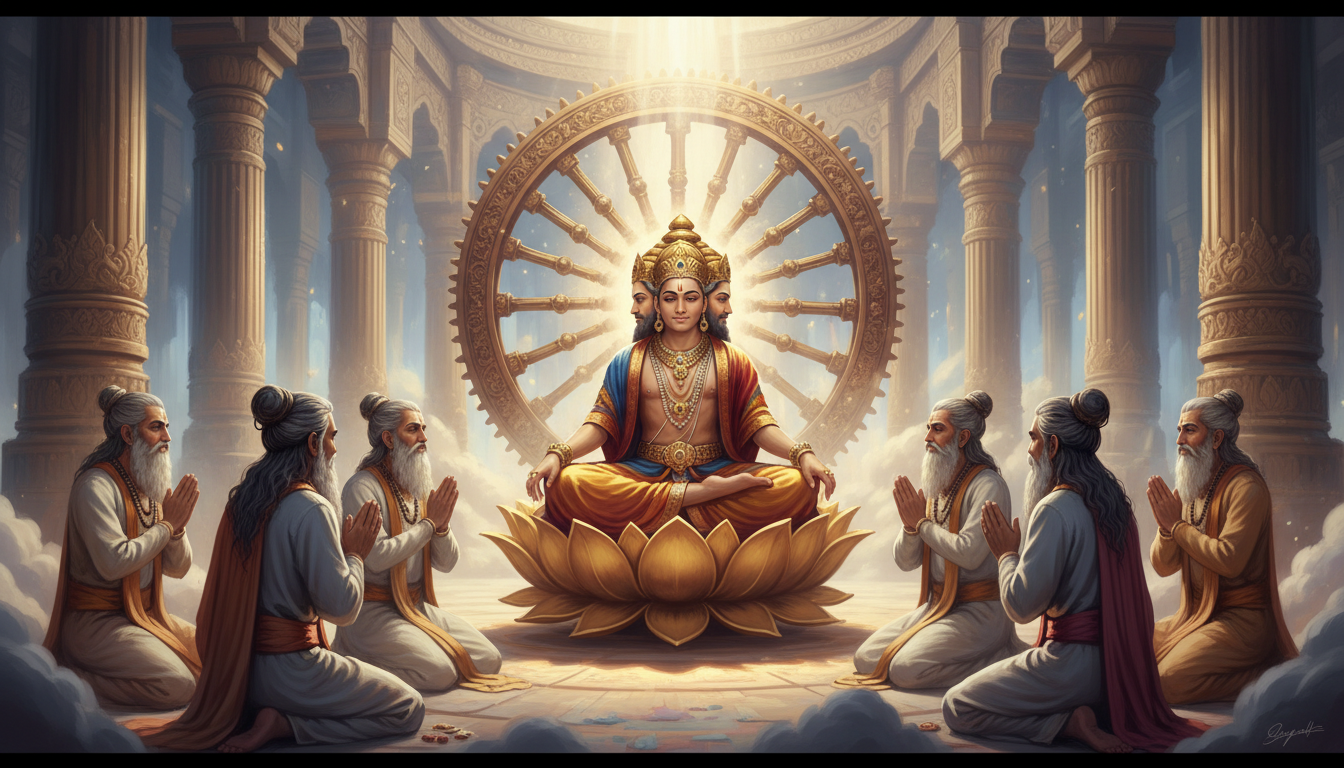
The Eight Who Questioned Brahma
The ladder from the Unmanifest down to a body
Where Am I, and Whence Art Thou
"It behoveth thee to expound Brahma to me," Arjuna said, "which is the highest object of knowledge. Through thy favour my mind is delighted with these subtle disquisitions."
"In this connection is recited the old history of the discourse between a preceptor and his disciple on the subject of Brahman," said Krishna.
Once on a time, he said, an intelligent disciple questioned a certain Brahmana of rigid vows who was his preceptor, as the preceptor sat at his ease. The disciple was one of those who live so constantly by the side of the instructor as to have almost become his shadow. He was self-restrained. He had the life of a Yati and a Brahmacharin. And when he had leave to ask, he did not ask one question, he emptied himself out.
"Where am I? Whence art thou? Explain that which is the highest truth. From what source have sprung all creatures, mobile and immobile? By what do creatures live? What is the limit of their life? What is truth? What is penance, O learned Brahmana? What are called attributes by the good? What paths are to be called auspicious? What is happiness? What is sin?
"It behoves thee to answer these questions of mine correctly, truly, and accurately. Who else is there in this world than thee that is capable of answering them? My curiosity is great. Thou art celebrated in all the worlds as one well skilled in the duties relating to Emancipation. There is none else than thou that is competent to remove all kinds of doubts. Afraid of worldly life, we have become desirous of achieving Emancipation."
It is worth marking the first two questions, because everything that follows answers them and not the rest. Where am I. Whence art thou. A man wanted to know his own position and the position of the person teaching him, and there is no way to answer that without giving the whole map.
"O regenerate one," the preceptor said, "I shall explain to thee everything about which thou mayst have any doubts."
Eight Who Had Travelled Every Path
"All this was declared in days of old by Brahma himself, the Grandsire of all the worlds," the preceptor said. "Applauded and practised by the foremost of Rishis, and depending on a knowledge of the Vedas, it involves a consideration of what constitutes the real entity.
"We regard knowledge to be the highest object, and renunciation as the best penance. That learned man who beholds the residence of all things in one place and their severance as well, and who sees unity in diversity, succeeds in freeing himself from misery.
"Understand properly that great tree which has the unmanifest for its seed sprout, and the understanding for its trunk, and high consciousness of self for its branches, and the senses for the cells whence its twigs issue, and the five great elements for its flower-buds, and the gross elements for its smaller boughs. It always puts forth flowers. Upon it all existent objects depend. Its seed is Brahman, and it is eternal. Cutting all topics with the sharp sword of knowledge, one attains to immortality and casts off birth and death."
And then he told his disciple where the teaching had come from, and the answer was not flattering to anybody.
"In days of old, the Rishis Vrihaspati and Bharadwaja, and Gautama and Bhargava, and Vasishtha and Kasyapa, and Viswamitra and Atri assembled together for the purpose of asking one another."
Those are eight of the greatest names in the world. The priest of the celestials. The father of Drona. The husband of Ahalya. The line of Bhrigu. The preceptor of the solar house. Kasyapa, from whom the tribes descend. The Kshatriya who made himself a Brahmana. And Atri, who fathered the moon.
"They thus assembled together after having travelled over all paths, and after they had got tired with the acts each of them had done."
They had done everything, and grown tired of it, and gathered to ask one another, and discovered that the eight of them together could not answer it. So, placing the sage son of Angiras at their head, they proceeded to the region of the Grandsire. There they beheld Brahma, perfectly cleansed of all sin. Bowing their heads unto that high-souled one who was seated at his ease, the great Rishis, endued with humility, asked him.
"How should a good man act? How would one be released from sin? What paths are auspicious for us? What is truth, and what is sin? By what action are the two paths, the northern and the southern, obtained? What is destruction? What is Emancipation? What is birth, and what is the death of all existent objects?"
It Is From Truth
"It is from Truth that all creatures, mobile and immobile, have been born," Brahma said. "They live by penance. Understand this, ye of excellent vows. In consequence of their own actions they live, transcending their own origin.
"For Truth, when united with qualities, becomes always possessed of five indications. Brahman is Truth. Penance is truth. Prajapati is truth. It is from Truth that all creatures have sprung. Truth is the universe of being. It is for this that Brahmanas who are always devoted to Yoga, who have transcended wrath and sorrow, and who always regard Religion as the causeway along which every one must pass, take refuge in Truth.
"The wise say that Religion is one, though having four quarters. I shall speak to ye now of that path which is auspicious and productive of good, which has constantly been trod over by men possessed of wisdom in order to achieve an identity with Brahman. Do ye understand, in all its details, what the highest seat is.
"The first step has been said to be the mode of life that appertains to Brahmacharins. The second step is domesticity. After this is the residence in the woods. And after that, it should be known, is the highest step, which is that relating to Adhyatma. Light, ether, sun, wind, Indra and Prajapati: one sees these as long as one does not attain to Adhyatma.
"I shall now declare, accurately and with reasons, the elements which reside in parts in all objects. The great soul, the unmanifest, egoism, the ten and one organs, the five great elements, and the specific characteristics of the five elements: these constitute the eternal creation. The number of the elements has been said to be four and twenty, and one more.
"That person of wisdom who understands the production and destruction of all these elements, that man among all creatures never meets with delusion."
They had asked how a good man should act. They were being handed an inventory.
Darkness
"That which is unmanifest, which is indistinct, all-pervading, everlasting, immutable, should be known to become the city of nine portals, possessed of three qualities, and consisting of five ingredients.
"The three ducts that are in it support it constantly. These are the three Nadis. They run continually, and they have the three qualities for their essence: Darkness, Passion, and Goodness. These are coupled with one another. They exist depending on one another. They take refuge in one another and follow one another. There where Darkness is restrained, Passion is seen to flow. There where Passion is restrained, Goodness is seen to flow.
"Darkness should be known to have the night for its essence. It has unrighteousness for its indication, and it is always present in all sinful acts."
Then the Grandsire read out the list, and it is long, and it is worth hearing in full because a man who wants to know what he is made of should be able to recognise himself somewhere in it.
"Complete delusion, ignorance, illiberality, indecision in respect of action, sleep, haughtiness, fear, cupidity, grief, censure of good acts, loss of memory, unripeness of judgment, absence of faith, violation of all rules of conduct, want of discrimination, blindness, vileness of behaviour, boastful assertions of performance when there has been no performance, presumption of knowledge in ignorance, unfriendliness, evilness of disposition, stupid reasoning, crookedness, incapacity for association, sinful action, senselessness, stolidity, lassitude, absence of self-control, degradation. All these qualities are known as belonging to Darkness.
"Frequent ill-speaking of other people, censuring the deities and the Brahmanas, vanity, wrath, unforgiveness, hostility towards all creatures, are also characteristics of Darkness, as are unmeritorious undertakings, unmeritorious gifts, and vain eating.
"I shall now declare the wombs where these men have to take their birth. Ordained to go to hell, they sink in the order of being. They become immobile entities, or animals, or beasts of burden, or carnivorous creatures, or snakes, or worms, insects and birds, or creatures of the oviparous order, or lunatics, or deaf or dumb human beings, or men afflicted by dreadful maladies and regarded as unclean. Their course of migrations is always downwards.
"I shall, after this, declare what the means are of their improvement and ascent. Those men who take birth in orders other than humanity, by growing up in view of the religious ceremonies of Brahmanas devoted to the duties of their own order and desirous of doing good to all creatures, succeed, through the aid of such purificatory rites, in ascending upwards. Struggling to improve themselves, they at last attain to the same regions with those pious Brahmanas.
"That, indeed, is the characteristic of Darkness: the beholding of reality in what is not real."
Passion, and the Quality of Goodness
"Ye highly blessed ones, do you understand what those qualities are that appertain to Passion.
"Injuring others, beauty, toil, pleasure and pain, cold and heat, lordship, war, peace, arguments, dissatisfaction, endurance, might, valour, pride, wrath, exertion, quarrel, jealousy, desire, malice, battle, the sense of mine, protection of others, slaughter, bonds and affliction, buying and selling, lopping off, cutting, piercing, and cutting off the coat of mail that another has worn, fierceness, cruelty, vilifying, pointing out the faults of others, anxiety, animosity, false speech, false or vain gifts, hesitancy and doubt, boastfulness of speech, dispraise and praise, prowess, defiance, attendance as on the sick and the weak, obedience to the commands of preceptors and parents, service, cleverness of conduct, policy, heedlessness, contumely, possessions, and the diverse decorations that prevail in the world among men, women, animals, inanimate things and houses."
The list of Passion does not sound like a list of vices, and that is the point of it. Attendance on the sick is in it. Obedience to a preceptor is in it. Peace is in it, next to war. And so is the whole apparatus of religion.
"Vows and regulations, actions with expectation of good result, diverse acts of public charity, the rites of Swaha and Swadha and Vashat, officiating at the sacrifices of others, imparting of instruction, performance of sacrifices, study, making of gifts, acceptance of gifts, rites of expiation, auspicious acts, the wish to have this and that. All these have been said to belong to Passion.
"Those men on Earth who are devoted to the aggregate of three, which is Religion, Wealth and Pleasure, and who, acting from the impulse of desire, exult on attaining to affluence in respect of every desire, are said to be enveloped by Passion. These men have downward courses. Repeatedly reborn in this world, they give themselves up to pleasure.
"I shall, after this, discourse to you on that excellent quality which is the third in the order of our enumeration. It is beneficial to all creatures in the world, and unblamable, and constitutes the conduct of those that are good.
"Joy, satisfaction, nobility, enlightenment and happiness, absence of stinginess, absence of fear, contentment, disposition for faith, forgiveness, courage, abstention from injuring any creature, equability, truth, straightforwardness, absence of wrath, absence of malice, purity, cleverness, prowess. Freedom from the idea of mine, freedom from egoism, freedom from expectations, looking on all with an equal eye, and freedom from desire: these constitute the eternal religion of the good.
"And he who is devoted to the duty of Yoga, regarding knowledge to be vain, conduct to be vain, service to be vain, and mode of life to be vain, attains to what is highest in the world hereafter."
The Sun, the Heat, and the Eclipse
"The qualities are incapable of being declared as completely separate from one another," Brahma said. "Passion and Goodness and Darkness are seen existing in a state of union. They are attached to one another. They depend on one another. They have one another for their refuge. They likewise follow one another. As long as Goodness exists, so long does Passion exist. There is no doubt in this.
"There where Darkness exists in an increased measure, in the lower creatures, Passion exists in a smaller measure and Goodness in a measure that is still less. There where Passion is copious, in creatures of middle course, Darkness is smaller and Goodness still less. There where Goodness is copious, in creatures of upward courses, Darkness exists in a small measure and Passion in a measure still less.
"They who abide in Goodness proceed upwards. They who abide in Passion remain in the middle. They who abide in Darkness, being characterised by qualities that are low, sink downwards."
Then he gave them the picture that makes it hold, and it is a single morning seen three ways.
"Beholding the sun rising, men of evil deeds become inspired with fear. Travellers on their way become afflicted with heat and suffer distress.
"The Sun is Goodness developed. The men of evil deeds represent Darkness. The heat which the travellers on their way feel is said to be a quality of Passion. And the shading of the sun on Parvana days should be known to represent Darkness.
"Even thus the three qualities exist in all luminous bodies. They act by turns in diverse places in diverse ways.
"The Day should be understood as threefold. The Night has been ordained to be threefold. So also are the fortnight, the months, the years, the seasons, and the conjunctions. The gifts that are made are threefold. Threefold is the sacrifice that flows. Threefold are the worlds, threefold the deities, threefold is knowledge, and threefold the path. The past, the present, and the future. Religion, Wealth and Pleasure. Prana, Apana and Udana.
"Whatever object exists in this world, everything in it is fraught with the three qualities. Verily, the three qualities always act in an unmanifest form."
The Ladder Down
"From the unmanifest first sprang Mahat, the Great Soul, endued with great intelligence, the source of all the qualities. That is said to be the first creation.
"The Great Soul is signified by these synonymous words: the Great Soul, Intelligence, Vishnu, Jishnu, Sambhu of great valour, the Understanding, the means of perception, as also fame, courage, and memory. It has hands and feet on every side, and ears on every side, and it stands pervading everything in the universe. Of great power, that Being is stationed in the heart of all.
"That Mahat who was first produced is called Egoism. When it sprang up as I, it came to be called the second creation. That Egoism is said to be the source of all creatures, for these have sprung from its modifications. It is that which feels: I am all this.
"From Egoism were verily born the five great elements. They are earth, air, ether, water, and light numbering the fifth. In these five great elements, in the matter of sound, touch, colour, taste and smell, all creatures become deluded.
"Those which have been called the eleven organs, and which have sprung from Egoism, I shall now mention particularly. They are the ear, the skin, the two eyes, the tongue, the nose numbering the fifth, the two feet, the lower duct, the organ of generation, the two hands, and speech forming the tenth. These constitute the group of organs, with mind numbering as the eleventh. One should first subdue this group. Then will Brahman shine forth in him."
And then, for every one of them, he named the same thing three times over: as it stands in the soul, as it stands in the world, and as the deity that presides between the two.
"Space is the first entity. As connected with the soul it is called the ear, as connected with objects it is sound, and the presiding deity is the quarters. The Wind is the second. In the soul it is the skin, in the world it is objects of touch. The third is Light: in the soul the eye, in the world colour, and the sun is its deity. The fourth is Water: in the soul the tongue, in the world taste, and the presiding deity is Soma. The fifth is Earth: in the soul the nose, in the world scent, and the presiding deity there is the wind.
"The two hands, as connected with objects, are actions, and the presiding deity there is Indra. Speech is what is spoken, and the presiding deity there is Agni. The mind is the mental operation, and the presiding deity is Chandramas. Egoism is consciousness of self, and the presiding deity there is Rudra. And the understanding, which impels the six senses, is that which is to be understood, and the presiding deity there is Brahma.
"The mode of birth is fourfold. Some are born of eggs. Some are born of germs which spring upwards, penetrating through the earth. Some are born of filth. And some are born of fleshy balls in wombs."
What Is First of Each Kind
"I shall now tell you truly about all that which has a beginning, middle, and end, and which is endued with name and characteristics.
"It has been said that the Day was first. Then arose Night. The Months are said to have the lighted fortnights first. The constellations have Sravana for their first. The Seasons have that of dews for their first. Earth is the source of all smells, and Water of all tastes. The solar light is the source of all colours, and the Wind of all sensations of touch, and of sound the source is space.
"The sun is the first of all lighted bodies. Fire is the first of all the elements. Savitri is the first of all branches of learning. Prajapati is the first of all the deities. The syllable Om is the first of all the Vedas, and the life-wind Prana is the first of all winds. The Gayatri is the first of all metres. Of all sacrificial animals the first is the goat. Kine are the first of all quadrupeds. The twice-born are the first of all human beings. The hawk is the first of all birds. Of sacrifices the first is the pouring of clarified butter on the fire. Of all reptiles the first is the snake. The Krita is the first of all the Yugas. Gold is the first of all precious things, and barley of all plants, and water of all liquid substances to be drunk. Of all the mountains the great Meru is said to be the first-born. Of all the points of the horizon the eastern is the foremost. Ganga of three courses is the first-born of all rivers, and of all reservoirs of waters the ocean. Of all the modes of life, that of the householder is the first.
"Of all the Prajapatis I am the first. There is no doubt in this. Of inconceivable soul, the self-existent Vishnu is said to be my superior."
And having ranked himself, and named the one above him, the Grandsire finished by ranking everything else out of existence.
"The Unmanifest is the source of all the worlds, as indeed that is the end of everything. Days end with the sun's setting and Nights with the sun's rising. The end of pleasure is always sorrow, and the end of sorrow is always pleasure. All accumulations have exhaustion for their end, and all ascents have falls for their end. All associations have dissociations for their end, and life has death for its end. All action ends in destruction, and all that is born is certain to meet with death.
"Sacrifice, gift, penances, study, vows, observances: all these have destruction for their end.
"Of Knowledge, there is no end."
The Wheel With Home for Its Rim
"The wheel of life moves on," said Brahma, and this was the last thing he told them, and it was the answer to the disciple's first question, which was where am I.
"It has the understanding for its strength, the mind for the pole on which it rests, the group of senses for its bonds, the five great elements for its nave, and home for its circumference.
"It is overwhelmed by decrepitude and grief, and it has diseases and calamities for its progeny. It has toil and exercise for its noise. Day and Night are the rotations of that wheel. It is encircled by heat and cold. Pleasure and pain fire its joints, and hunger and thirst are the nails fixed into it. Sunshine and shade are the ruts it causes.
"It can be agitated in such a short space of time as is taken up by the opening and the closing of an eyelid. It is enveloped in the terrible waters of delusion. It is ever revolving and void of consciousness. It is measured by months and half-months, and it moves through all the worlds.
"Penances and vows are its mud. Passion's force is its mover. It is illuminated by the great egoism and is sustained by the qualities. Vexations are the fastenings that bind it around. It is large, and is extended by attachments, and rendered unsteady by cupidity and desire. It is produced by variegated Ignorance, and attended upon by fear and delusion, and is the cause of the delusion of all beings. It is made up of entities beginning with Mahat and ending with the gross elements. Its speed is like that of the mind, and it has the mind for its boundary.
"This wheel of life, that is associated with pairs of opposites and devoid of consciousness, the universe with the very immortals should cast away, abridge, and check.
"That man who always understands accurately the motion and the stoppage of this wheel is never seen to be deluded among all creatures. Freed from all impressions, divested of all pairs of opposites, released from all sins, he attains to the highest goal."
The eight went home. They had asked for a rule of conduct and been given a machine, drawn out to its last fastening, with the word home written on its outermost rim.
"The householder, the Brahmacharin, the forest recluse and the mendicant," the preceptor said to his own disciple, at the end of the account, "these four modes of life have all been said to have the householder's mode for their foundation. Whatever system of rules is prescribed in this world, their observance is beneficial."
Dharma Lesson
Even the greatest of the seers had to travel every path, grow tired of it, and then go and ask. What they were given was not a comfort but a map: a count of how far a soul falls from the Unmanifest before it stands up in a body, and a wheel whose outermost rim is the word home.