Bhagavad Gita Chapter 14: The Three Gunas
Gunatraya Vibhaga Yoga - The Three Strands of Nature
The Womb of All Beings
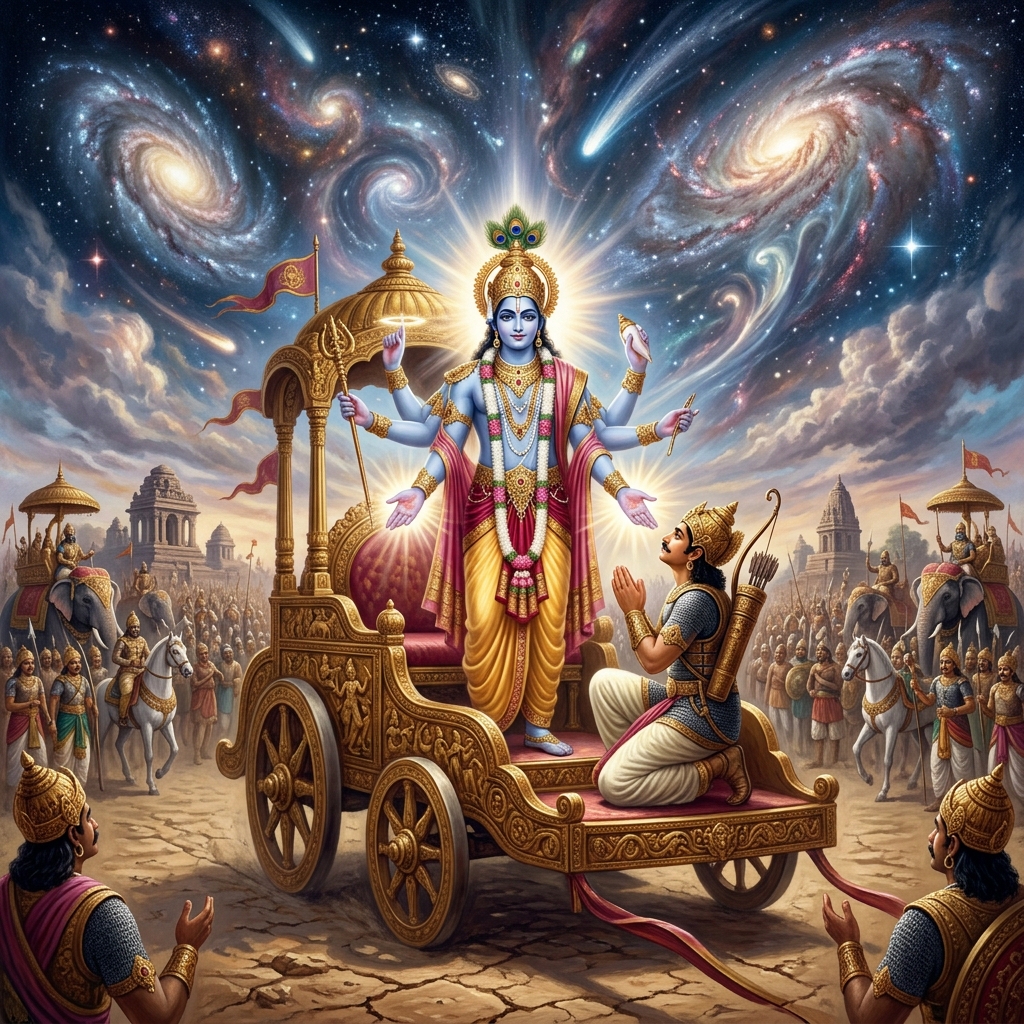
The sun had climbed higher over Kurukshetra, yet neither army stirred, held as if by the same pause that had settled over Arjuna's mind since the teaching began. Krishna's chariot stood in the space between the ranks, and Krishna, seeing that his friend was ready for a harder truth, spoke again.
"I will tell you now, Arjuna, of the supreme knowledge, the best of all knowledge, knowing which the sages who have gone from this world have reached the highest perfection. Taking refuge in this knowledge, and coming to share my own nature, they are not born again when the worlds are created, nor do they tremble when the worlds dissolve.
"The great Brahman is my womb, Arjuna. In it I place the seed, and from that union comes the birth of all beings, in every world. Whatever forms take shape in whatever wombs, know that the great Brahman is their womb, and I am the father who gives the seed.
"Sattva, rajas, and tamas, the three gunas born of prakriti, bind the imperishable dweller fast within the body, though that dweller is by nature free. These three strands are woven into everything nature makes, Arjuna, into every thought, every desire, every act of stillness or of motion, and a person who does not learn to see them at work will mistake their pull for his own will, again and again, for as long as he lives."
Arjuna frowned, turning the thought over. "Krishna, tell me plainly what each of these is, and how it binds, so that I might learn to recognize the hand that moves me before I mistake its motion for my own.
Sattva, the Luminous Strand
"Sattva, being pure, is luminous and free from sickness, Arjuna, and it binds the soul through attachment to happiness and through attachment to knowledge. When sattva grows strong in a person, wisdom's light shines out through every gate of the body, through the eyes, through the words, through the quiet of the mind. Such a person delights in learning, moves gently through the world, and often mistakes for freedom the very sweetness of that delight.
"This is the guna's trick, Arjuna: even virtue can become a leash, if a person clutches at his own goodness the way a miser clutches at coin. The wise man who loves his wisdom too well, who cannot let a single hour pass without tasting his own clarity, still labors under a bond, only a finer one than the others wear. Sattva lifts a person upward, but a chain of gold is still a chain, and a mind that cannot rest without its own brightness has not yet learned to rest at all.
"Do not despise sattva for this, Arjuna. Of the three, it is the gentlest master, and the easiest to slip free of once you have seen the leash for what it is. But see it you must, or the brightest of the three strands will hold you as surely as the darkest.
Rajas and Tamas
"Know rajas to be of the nature of passion, born from craving and attachment, Arjuna. It binds the embodied soul through attachment to action. Where rajas rules, a person cannot rest; he reaches always for the next thing, the next victory, the next possession, and calls this reaching his purpose. Restlessness feels, to one gripped by rajas, like purpose itself, and so he mistakes his hunger for his calling and is bound by the very energy that seems to carry him forward.
"Tamas, know it to arise from ignorance, and to delude all embodied beings. It binds through heedlessness, through laziness, and through sleep, Arjuna. Where tamas prevails, a person grows dull to what is true, careless of consequence, content to let the days pass in a fog of small comforts and long forgetting, mistaking his own inertia for peace. It is the heaviest of the three strands, and the hardest for a soul to recognize in itself, for it dims the very faculty that would otherwise see it clearly.
"Each of these three, Arjuna, contends against the other two for mastery of a single life. Sometimes sattva overpowers rajas and tamas both, and a person knows a season of clarity. Sometimes rajas rises over sattva and tamas, and restlessness rules the years. And sometimes tamas overwhelms sattva and rajas, and a person sinks into a long forgetting. No single strand holds a life forever; they rise and give way and rise again, like waves that never let the sea grow entirely still.
The Fruits of the Gunas
"You may know, Arjuna, when each guna has grown strong within a person, for each leaves its own mark. When the light of knowledge shines through every gate of this body, then sattva may be known to have increased. When greed arises, when a restless urgency for action takes hold, when a person cannot sit still with an unfinished desire, know that rajas has grown. And when darkness comes, when sluggishness and delusion and simple carelessness settle over a mind, know that tamas has increased.
"If a person dies when sattva has increased, he goes to the pure, untainted worlds of those who know the highest truth. If he dies when rajas has increased, he is born again among those attached to action, striving still, never quite arriving. And if he dies when tamas has increased, he is born into the wombs of the deluded, into a darkness that breeds only further darkness.
"They say the fruit of sattva's working is pure and untainted, while the fruit of rajas is pain, and the fruit of tamas is ignorance itself, and nothing else. From sattva is born wisdom, from rajas is born greed, and from tamas are born heedlessness, delusion, and simple ignorance.
"Those established in sattva rise upward, Arjuna, toward the higher worlds. Those of rajas remain in the middle regions, neither rising nor sinking, carried always by their own restlessness. And those of tamas, abiding in the lowest workings of that dullest guna, sink downward, into a darkness of their own making.
Beyond the Three Strands
Arjuna spoke, leaning forward as though the question had waited a long while inside him. "Krishna, by what marks does one know a man who has crossed beyond these three gunas? How does he conduct himself, and by what path does he cross beyond them?"
Krishna smiled, for it was, of all the questions Arjuna had asked that day, the one closest to the heart of the teaching, the question a man asks only once he has truly seen how thoroughly he has been steered by forces he mistook for himself.
"He who does not hate the light of sattva, nor the passion of rajas, nor even the delusion of tamas when they arise, Arjuna, and does not long for them when they are absent, he has crossed beyond the gunas.
"He who sits like one indifferent, undisturbed by the gunas, knowing it is only the gunas that act, and stands firm, unwavering; he to whom pleasure and pain are the same, who is established in his own self, to whom a clod of earth, a stone, and gold are of equal worth; the same amid what is dear and what is unwelcome, steady amid blame and amid praise, the same in honor and in disgrace, the same to friend and to foe, one who has let go of the urge to begin every undertaking out of restless desire, such a man, Arjuna, is said to have crossed beyond the gunas.
"And he who serves me with unswerving devotion, with a love that does not waver through any season of sattva or rajas or tamas, crosses beyond these three strands entirely, and becomes fit to be Brahman. For I am the abode of Brahman, of the immortal, the imperishable, of the eternal law, and of unending bliss."
Arjuna sat with the words a long while, watching the light move across the waiting ranks, and understood, for the first time, that even the calm he now felt was only a guna passing through him, not the self that watched it pass.
Dharma Lesson
Notice which strand of nature is steering you before you call any mood or craving your own true self. Sattva's calm clarity, rajas's restless hunger, and tamas's heavy inertia will each, in turn, try to claim you, and freedom lies not in choosing the pleasantest guna but in watching all three arise and pass without being ruled by any of them. Steady devotion, offered evenly through good days and bad, is what finally carries a person beyond nature's pull altogether.