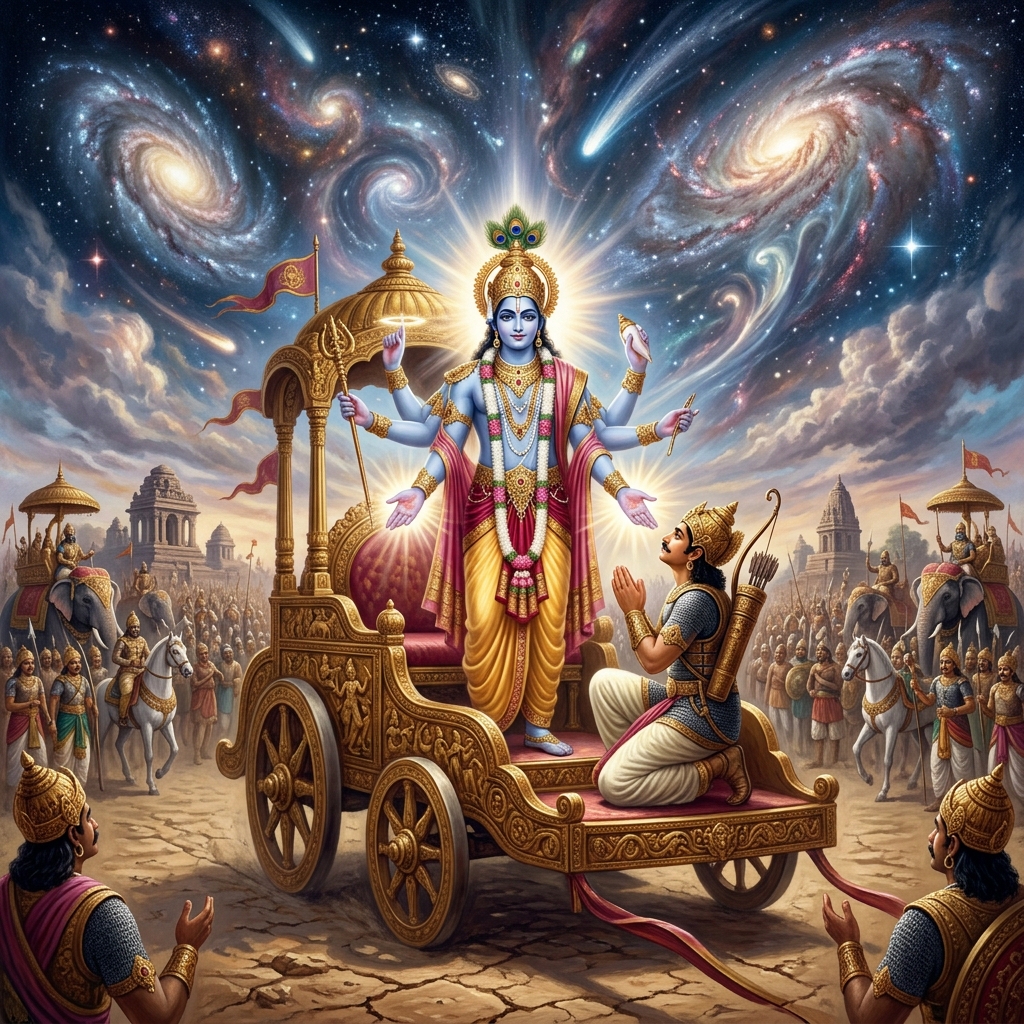
Bhagavad Gita Chapter 13: The Field and Its Knower
Kshetra Kshetrajna Vibhaga Yoga - Matter and Spirit
The Field and Its Knower
Arjuna sat in the stillness that had settled over the battlefield of Kurukshetra, the two armies waiting like a held breath on either side of the space where his chariot stood. The teaching had already moved through renunciation and equanimity, through devotion and the many paths that led to the Supreme, and now a new question rose in him, quieter than the ones before it.
"Krishna," said Arjuna, "I wish to understand prakriti, the nature that acts, and purusha, the spirit that witnesses. Tell me of the field and the knower of the field, and of knowledge, and of the object that is to be known."
Krishna answered him gently, his voice carrying the same unhurried certainty it had held through every teaching that morning. "This body, Arjuna, is called kshetra, the field. And the one who knows it, who perceives it and understands its workings, the wise call kshetrajna, the knower of the field. Know this too, that I am the knower of the field in every field there is, in every body that has ever lived or will live. To understand both the field and its knower together, this I hold to be true knowledge.
"Hear now what the field is, what changes pass over it, from where it rises, who its knower is, and what power that knower holds. Sages have sung of this in many ways, in the hymns of the Vedas, and in the reasoned, settled words of the aphorisms on the Absolute."
Arjuna leaned forward. Across the plain, banners stirred in a wind that seemed, for this hour, to have forgotten the armies beneath it. He had asked of duty and of grief, of the deathless self and the burning of desire, and each answer had opened onto a further question. Now the teaching turned inward again, past the armor and the flesh, toward the very ground on which a person stood whenever they said the word I.
"Speak on, Krishna," he said. "Tell me what this field contains, so that I may know it as you know it, and see at last the one who watches from within it, unmoved by all that passes through it.
The Elements of the Field
"The field, Arjuna, is built of many parts, and you must learn to name them if you wish to see past them. It is composed of the five great elements, earth, water, fire, air, and space, and of ahamkara, the sense of I, and of buddhi, the discerning intellect, and of the unmanifest root from which all of these unfold. It holds the ten senses, five that perceive and five that act, and the mind that stands between them, and the five objects toward which the senses reach, sound and touch and form and taste and smell.
"Desire and aversion belong to the field, Arjuna, and pleasure and pain belong to it, and the aggregate body that carries them, and consciousness itself, and the steadiness that holds a life together through its changes. All of this, in brief, is the field together with its transformations, the endless motion of a thing that is born, that grows, that ages, and that at last passes away.
"Whatever comes into being, whether it moves upon the earth or stands rooted and silent, is born from the meeting of the field and its knower, from nature and spirit joined together. This you must understand plainly, for it is the ground on which everything else I tell you will rest.
"He who sees the Supreme Lord standing equally in all beings, imperishable within the perishing body, sees truly, Arjuna. For when a man sees the Lord present alike everywhere, he no longer wounds his own self by his self, whatever comes to him, whatever slips from his hands. Walking with that vision, he walks toward the highest goal a person can reach.
The Marks of True Knowledge
"Now hear what I call knowledge, Arjuna, and what I call its opposite, though few who chase after learning ever think to ask the question in this shape.
"Humility is knowledge, and freedom from pretension. Non-violence is knowledge, and patience, and uprightness, and service offered to one's teacher without complaint. Purity of body and of mind is knowledge, and steadfastness, and mastery over oneself.
"Dispassion toward the objects the senses reach for is knowledge, and so is the absence of a swollen sense of I. Seeing clearly the suffering that waits in birth, in death, in old age, in sickness and in pain, this too is knowledge, for it does not look away from what is true.
"Non-attachment is knowledge, Arjuna, and the refusal to bind one's heart too tightly to son or wife or home or the comforts of a settled life. It is an even mind that meets what is wanted and what is unwanted with the same steady face, neither swept up by one nor cast down by the other.
"Unswerving devotion to me, offered with a single, undivided discipline, is knowledge. A taste for solitary places, and a weariness with the noisy crowd, is knowledge. Constancy in the knowledge of the self, and a clear sight of the goal toward which all true knowledge of truth is aimed, this also is knowledge.
"Whatever falls short of this, Arjuna, whatever is only cleverness or learning without this shape to it, I call ignorance, however much the world praises it.
Prakriti, Purusha, and the Gunas
"Now I will speak of what should be known, so that knowing it, you taste the deathless. It is the beginningless Supreme Brahman, said to be neither existent nor non-existent as the world reckons those words. Its hands and feet are everywhere, its eyes and heads and mouths are everywhere, its ears are everywhere in the world, for it stands, enveloping all things.
"Prakriti and purusha, Arjuna, nature and spirit, know both of these to be beginningless. And know too that the transformations and the qualities called gunas are born of prakriti alone. Nature is said to be the cause of the working of instrument and effect, and spirit is said to be the cause of the experience of pleasure and of pain.
"For the spirit, seated in nature, experiences the gunas born of nature, and its attachment to these gunas becomes the reason for its birth in good wombs or in evil ones. Yet the Supreme Spirit within this body is also called the witness, the permitter, the sustainer, the experiencer, the great lord, and the supreme self. He who knows purusha and prakriti together with the gunas, in whatever condition he now lives, is not born again.
"Some behold the self in the self by meditation, Arjuna, some by the discipline of knowledge, and others by the discipline of action. And there are those who do not know this themselves, and yet worship having only heard it from others, and even they, devoted to what they have heard, cross beyond death.
The Sun That Illumines the Field
"As the one sun illumines this whole world, Arjuna, so the knower of the field illumines the whole field. Those who see, with the eye of knowledge, the distinction between the field and the knower of the field, and the liberation of beings from the grip of nature, they go to the Supreme.
"Whatever is born, moving or unmoving, know it to be born from the union of the field and the knower of the field. He who sees the Supreme Lord abiding equally in all beings, not perishing as they perish, sees truly. For seeing the Lord present equally everywhere, he does not harm himself by himself, and so he walks the highest path.
"He who sees that all actions are, in every way, performed by nature alone, and that the self is not the doer, sees truly. And when he beholds the manifold existence of beings resting in the One, and their expansion from that One alone, he attains Brahman in that very hour.
"This imperishable Supreme Self, being without beginning and without qualities, does not act and is not tainted, even though it dwells within the body. As space, pervading everything, remains untouched because of its subtlety, so the self, present in every body, is untouched by anything the body does."
Arjuna sat very still. The armies had not moved, the sun had not shifted far across the sky, and yet something in him had been carried a great distance and set down in an unfamiliar quiet. He understood, or began to, that the war he dreaded was a motion of the field alone, and that what watched it from within needed no rescuing.
Dharma Lesson
True freedom begins with the simple discipline of noticing that this body, these thoughts, these passing moods are the field, not the one who watches them. When you can observe your own mind the way you would observe a stranger's, with humility, patience, and without clinging to outcomes, you have already glimpsed the knower within. Peace is not the absence of a difficult field, but the steady witness that stands unmoved inside it.