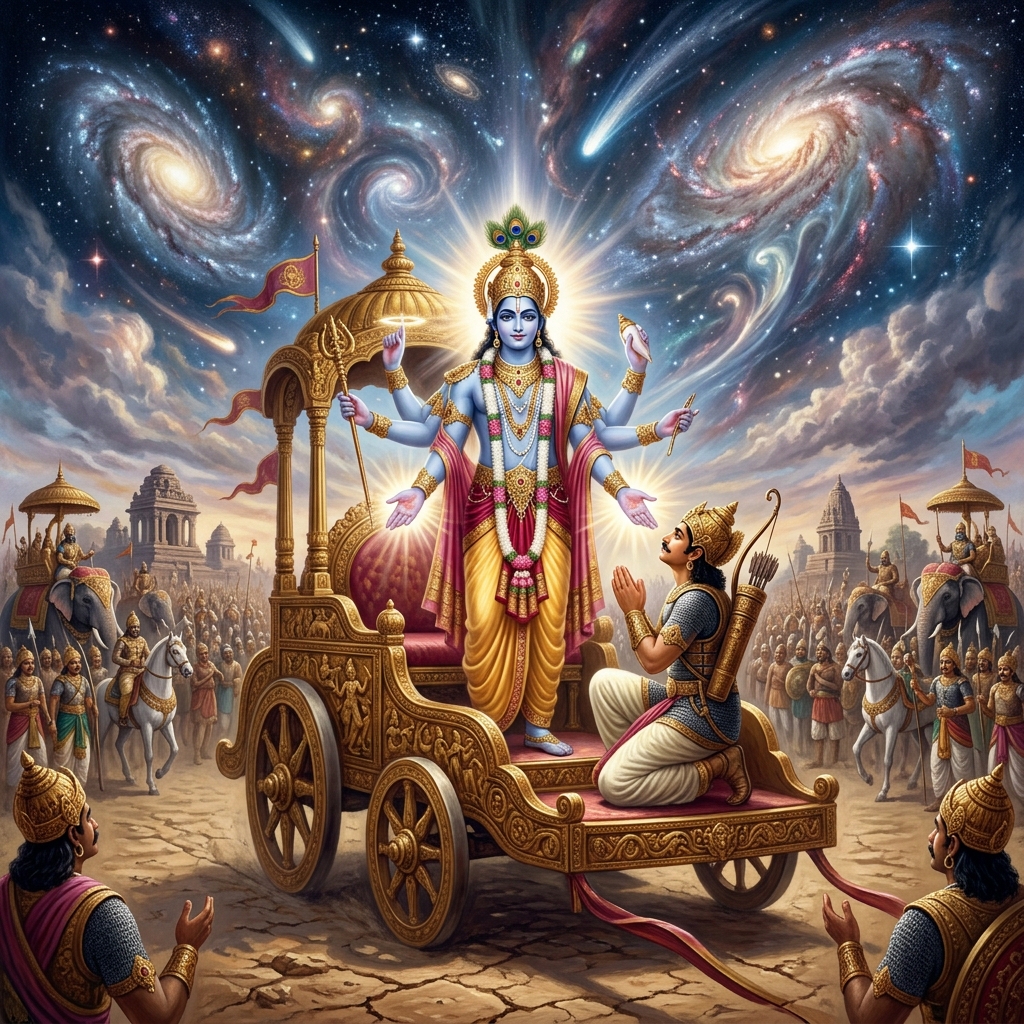
Bhagavad Gita Chapter 12: The Yoga of Devotion
Bhakti Yoga - The Path of Love
Arjuna's Question
The light on the plain had steadied. Arjuna's hands had stopped shaking, though he could still feel where the fear had been, the way a man feels the place a wave struck him after the water has drawn back.
He had seen the form that filled the sky and had begged for the face he knew. That begging had left a question in him, and he asked it plainly.
"Those devotees who are ever steadfast," he said, "who worship you in this way, and those others who worship the imperishable and the unmanifest - which of them are the better knowers of yoga?"
It was not an idle question, and Krishna did not treat it as one. Arjuna was asking about the two roads he had watched men walk all his life. There were the ascetics of the forest, who sat with their eyes half closed and turned away from every name and every form, seeking that which cannot be pictured, cannot be spoken, and has no edges. And there were the others, the ones who kept a lamp burning before an image, who wept at a story, who sang at festivals until their voices cracked, and who did not want a truth that had no face.
Arjuna knew which of the two he was. He had just been shown the formless blazing whole of things, and it had nearly unmade him. What had restored him was a familiar profile in the morning light, a hand on the reins, a voice that had teased him at a hundred campfires.
He wanted to know whether that was a smaller love, whether the man who needs a face is a beginner at the work, and whether the road he could actually walk went anywhere at all.
Both Roads Reach Me
"Those who fix their minds on me," said Krishna, "and worship me with constant devotion and supreme faith - they, in my view, are the most perfect in yoga.
"But those who worship the imperishable, the undefinable, the unmanifest, the all-pervading and unthinkable, the unchanging, the immovable and the constant, who hold their senses in check, who are even-minded in every circumstance, and who rejoice in the welfare of all beings - they too come to me. They reach me and no other.
"Yet greater is the trouble of those whose minds are set on the unmanifest, for the unmanifest is a hard goal for embodied beings to reach. A man with a body must climb toward the formless with the very instruments that were given him for form. It can be done. It is a steep and lonely road, and few finish it.
"But those who lay all their actions in me, holding me as the highest, and worship me meditating with an undivided mind - for them I become before long the one who lifts them out of the ocean of death and birth.
"Their thought is set on me, and I do not leave them to swim."
Arjuna listened, and something in his chest unknotted. It was not that one road had been declared false. Both went to the same place. But one of them could be walked by a man who still had a body, still had a temper, still had a brother he loved and an enemy he hated, and still needed a face to speak to when the night was long.
The Ladder
"Fix your mind on me alone," said Krishna. "Let your understanding rest in me. Then you shall live in me hereafter. Of this there is no doubt."
Then he paused, and what followed was not a demand but a stair with the steps set close together, so that no one could say the climb was beyond him.
"If you are not able to fix your thought steadily on me, then seek to reach me by the yoga of practice, abhyasa, by returning again and again, patiently, as a man leads a wandering animal back to the same field.
"If you are not equal even to practice, then make my work your highest aim. Doing your actions for my sake, you shall still come to perfection.
"And if you are unable to do even this, then take refuge in union with me, restrain yourself, and give up the fruit of every action you perform. Do the work and let the harvest go.
"For knowledge is better than blind practice, and meditation is better than knowledge, and better than meditation is the surrender of the fruit of action. From that surrender peace follows at once."
It was the strangest ladder Arjuna had ever been shown, because it went downward to meet him. Every rung was for the man who had failed the rung above. There was no place on it where a person could stand and say honestly that there was nothing left for him to do, and there was no height on it that could be reached by anything but love.
Who Is Dear to Me
"And now hear who is dear to me," said Krishna, "for you have asked what the goal looks like when it is wearing a man.
"He who has no hatred for any being, who is friendly and compassionate, who is free from the thought of I and mine, who is the same in pain and in pleasure, and who is patient under injury.
"He who is ever content, who is steady in yoga, who has mastered himself, whose resolve does not waver, whose mind and understanding are given to me - that devotee of mine is dear to me.
"He by whom the world is not disturbed, and who is not disturbed by the world, who is free from elation and impatience, from fear and anxiety - he is dear to me."
Arjuna turned the words over. He had known men of the first kind and men of the second. He had known warriors who stirred up trouble wherever they walked, and holy men who were forever being wounded by the noise and rudeness of ordinary life. It had never occurred to him that peace was a thing owed in both directions, that a man was not finished until the world had stopped bruising him and he had stopped bruising the world.
"He who wants nothing," Krishna went on, "who is pure, skilled in action, unconcerned for himself, untroubled, who has given up every anxious undertaking - he, my devotee, is dear to me.
"He who neither rejoices nor hates, who neither grieves nor craves, who has let go of the pleasant and the unpleasant alike and is full of devotion - he is dear to me."
Exceedingly Dear
"He who is the same to friend and to foe," said Krishna, "the same in honor and in dishonor, the same in cold and heat, in pleasure and in pain, and who is free from attachment.
"To whom blame and praise are equal, who is quiet, content with whatever comes, who claims no house as his own, whose mind is steady, and who is full of devotion - that man is dear to me.
"But those who follow this deathless dharma as I have declared it, who are full of faith, and who hold me as their highest goal - such devotees are exceedingly dear to me."
The words came to rest. On either side of the chariot the armies waited, and neither had moved.
Arjuna looked along the Kaurava line at the white parasol of Bhishma, and at Drona's banner, and at Karna standing apart, and he found that he could look at them without the sick heaving of the morning. Nothing about the day had changed. The men he loved would still die on this ground, and some of them by his hand. What had changed was the man holding the bow.
He had been offered the highest vision and had not been able to bear it. He had been offered the formless and had been told honestly that it was hard. And then he had been offered this: fix your mind on me, and if you cannot, practice; and if you cannot practice, work for my sake; and if you cannot even do that, then do the work anyway and let the fruit go.
Four doors, and the last one so low that any man on earth could get through it on his knees.
The wind moved along the plain. Somewhere down the line a horse shook its harness, and the sound carried in the stillness, and Arjuna waited for his teacher to speak again.
Dharma Lesson
Krishna's ladder descends to meet whoever is climbing: fix the mind on the highest, and failing that practice, and failing that work for its sake, and failing even that, act and surrender the fruit. No one is disqualified by weakness, only by refusing to begin. And the marks of arrival are not powers or visions but ordinary decencies made unshakable - freedom from hatred, evenness in praise and blame, and a life that neither disturbs the world nor is disturbed by it.