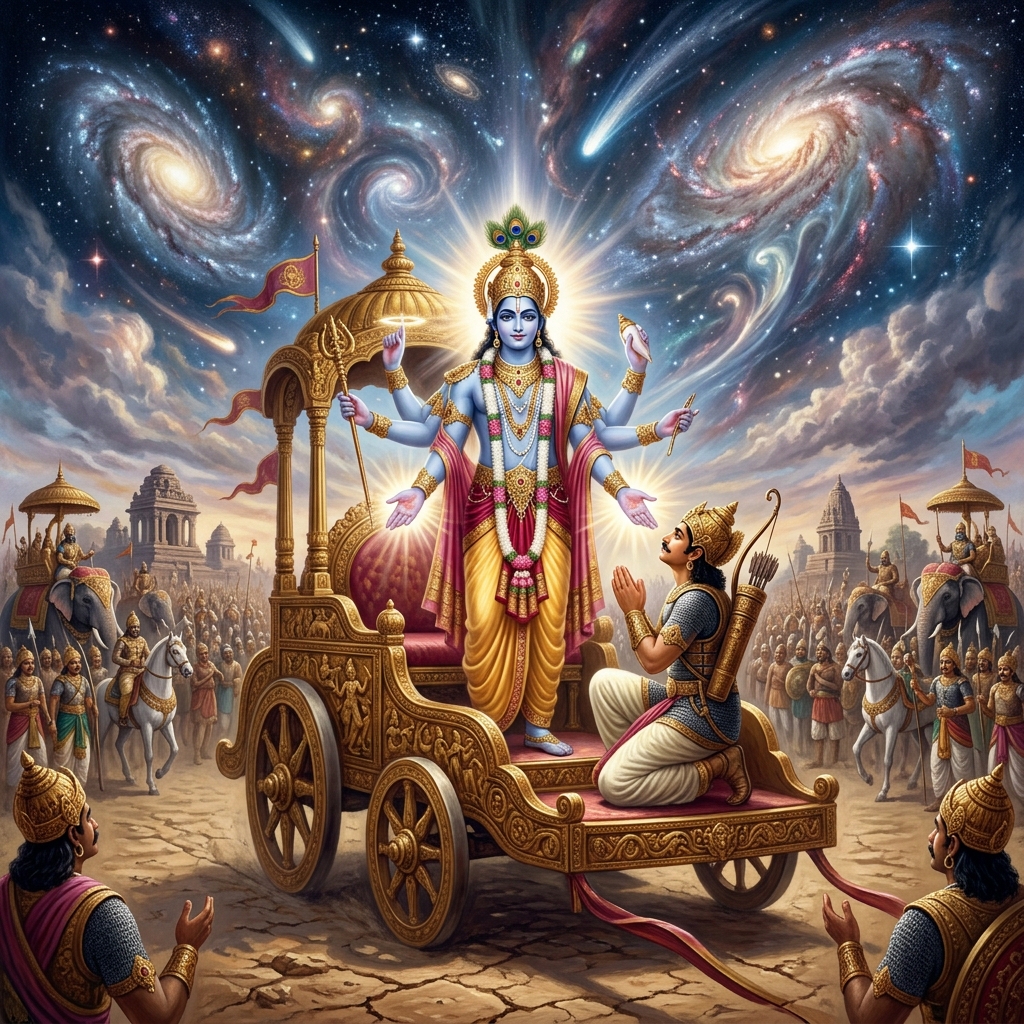
Bhagavad Gita Chapter 11: The Universal Form
Vishvarupa Darshana Yoga - The Vision of the Cosmic Form
Show Me Your Imperishable Self
Arjuna set his hands together and bowed his head over them.
"Out of compassion for me," he said, "you have spoken the highest secret, the word concerning the Self, and by it my delusion is gone. I have heard from you in full the coming to be and the passing away of beings, and I have heard of your imperishable greatness.
"It is as you have declared yourself to be, supreme Lord. And yet I long to see. I desire to look upon that lordly form of yours, O highest Person.
"If you judge that it can be borne by me, if you think it possible that I should behold it, then, Lord of yoga, show me your imperishable Self."
Krishna held the reins loosely in one hand, and when he answered there was no ceremony in it, as though a man were opening a door in his own house.
"Behold my forms, Partha, by the hundred and by the thousand, of many kinds, divine, of many colors and many shapes.
"Behold the Adityas, the Vasus, the Rudras, the twin Ashvins and the Maruts. Behold, descendant of Bharata, many wonders never seen before.
"Behold here today the whole universe, all that moves and all that does not, standing together as one in this body of mine, and whatever else you desire to see.
"But you cannot see me with these eyes of yours. Eyes made of the world cannot look at what the world is made of." He turned, and his glance rested on Arjuna as a hand rests on a shoulder. "I give you a divine eye. Behold now my sovereign power of yoga."
A Thousand Suns
Far away from the plain of Kurukshetra, in a hall in Hastinapura where no lamp had ever been needed, an old king sat forward on his throne.
Dhritarashtra had been born blind. All his life the world had come to him as report, and now the world's greatest hour was coming to him the same way, out of the mouth of a charioteer's son who sat on the step below him. Vyasa had given Sanjaya sight that crossed distance, so that whatever passed on that field passed also before his eyes, and the king who could not see was the only man in the palace who would miss nothing.
"Speak," said Dhritarashtra. "What do they do now, my sons and the sons of Pandu, gathered on the field of dharma, eager to fight?"
Sanjaya was slow to answer. When he did, his voice had changed, and the courtiers standing along the walls came closer without knowing that they moved.
"Having spoken so, great king, Hari, the great Lord of yoga, showed to the son of Pritha his supreme and sovereign form.
"It had many mouths and many eyes, and many marvellous aspects. It wore many divine ornaments and heavenly garlands, held uplifted many divine weapons, and was anointed with heavenly perfumes. It was all wonders, resplendent, boundless, and its faces were turned in every direction at once.
"If the light of a thousand suns were to blaze forth together in the sky, that might be like the splendor of that great Being.
"There, in the body of the God of gods, Arjuna beheld the whole universe, divided into countless parts and yet standing as one."
The old king's hands had closed hard upon the arms of his throne. "And Arjuna," he said. "What did Arjuna do?"
"He was overcome with wonder," said Sanjaya. "The hair stood up upon his body. He bowed his head, and he joined his palms, and he began to speak."
No Beginning, No Middle, No End
"I see the gods in your body, O God," said Arjuna, "and all the hosts of beings besides. I see Brahma the lord seated on his lotus throne, and all the sages, and the celestial serpents.
"I see you with countless arms and bellies, countless mouths and eyes, on every side, everywhere, without limit. I see no end in you, and no middle, and no beginning, Lord of all, whose form is the universe.
"Crowned, bearing the mace and the disc, a mass of light blazing on all sides, so I see you, immeasurable, hard to look at, glowing everywhere with the brilliance of fire and sun.
"You are the imperishable, the supreme thing to be known. You are the last resting place of all this world. You are the undying guardian of the eternal dharma. You are, I now believe, the everlasting Person.
"Beginningless, middleless, endless, of infinite power, of arms without number, the sun and moon your eyes, your mouth a blazing fire, you scorch this universe with your radiance.
"The space between heaven and earth is filled by you alone, and all the quarters of the sky. Seeing this terrible form, the three worlds tremble.
"Into you the hosts of the gods are entering. Some, afraid, praise you with folded hands. The great sages and the perfected ones cry Hail, and sing your glory in a rain of hymns. The Rudras and the Adityas, the ancestors and the gandharvas, the yakshas and the demons, all gaze upon you and are struck with wonder.
"Seeing your mighty form of many mouths and eyes, of many arms, thighs and feet, of many bodies and many terrible tusks, the worlds tremble, and I tremble too.
"For seeing you touching the sky, blazing with many colors, your mouths open and your enormous eyes aflame, my inmost self shakes and I find neither courage nor peace, O Vishnu."
I Am Time
The terrible thing came slowly, the way the shape of a mountain comes out of morning mist.
Arjuna saw the mouths. They were many, and they were open, and they were fitted with tusks like the fires that end an age. He could not tell the quarters of the sky apart, and he could find no shelter in them.
Then he saw who was going into the mouths.
"The sons of Dhritarashtra," he said, and his voice broke on it, "all of them, together with the hosts of kings, and Bhishma, and Drona, and Karna the son of the driver, and with them the chief warriors of our own side as well - they are rushing headlong into your fearful mouths with their terrible tusks. Some I see caught between your teeth, their heads ground to powder.
"As the many torrents of the rivers run toward the ocean and are lost in it, so do these heroes of the world of men pour into your flaming mouths.
"As moths rush with quickening speed into a blazing flame to their own destruction, so do these worlds rush headlong into your mouths to perish.
"You lick up all the worlds with your flaming mouths and swallow them, and your terrible splendors scorch the universe.
"Tell me who you are, so fierce of form. I bow to you, best of gods. Be gracious. I wish to know you, the primal one, for I do not understand what you are doing here."
And the answer came, and it was not the voice of the friend who had held his horses that morning.
"I am Time," said Krishna, "grown ripe, come forth to consume the worlds. Even without you, Arjuna, none of these warriors arrayed in the opposing ranks will remain alive.
"Therefore stand up. Win glory. Conquer your enemies and enjoy a prosperous kingdom. By me alone have they already been slain. Be you the instrument only, nimitta matram, and nothing more.
"Drona and Bhishma, Jayadratha and Karna, and the other brave fighters as well - they are killed by me. Do not be shaken. Fight. You shall conquer your rivals in the field."
I Called You Friend
In the hall at Hastinapura, Sanjaya stopped speaking, and the silence went on so long that the blind king said his name twice.
"He is trembling, great king," Sanjaya said at last. "Having heard that word of Keshava, the wearer of the crown pressed his palms together, and bowed, and spoke to Krishna in a choked voice, full of fear."
Arjuna's words came out of him half broken.
"Rightly, Krishna, does the world rejoice and delight in your glory. The demons flee in terror to every quarter, and all the hosts of the perfected ones bow down to you.
"And why should they not bow, O great one, greater even than Brahma, first maker, infinite, Lord of gods, home of the universe? You are the imperishable, you are being and non-being, and you are that which is beyond them both.
"You are the first of gods, the ancient Person, the supreme resting place of all this. You are the knower, the known, and the highest abode. By you the universe is spread out.
"You are Vayu and Yama, fire and the waters, the moon, the lord of creatures, the great-grandfather of all. Salutation to you a thousand times, and again and yet again, in front and behind and on every side. Of immeasurable might, you pervade all, and therefore you are all.
"And now I must beg." His head went lower. "Whatever I said rashly, thinking of you only as a friend, calling out O Krishna, O Yadava, O comrade, careless of your greatness because I did not know it, and in whatever way I showed you disrespect in jest, at play, at rest, sitting or eating, alone or before others - forgive me, immeasurable one.
"You are the father of this moving and unmoving world, and its teacher, and worthiest of worship. There is none equal to you. How then could there be one greater?
"Therefore I bow down. I lay my body on the ground before you. I beg your grace, adorable Lord. As a father forgives a son, as a friend forgives a friend, as a lover forgives the beloved, so, O God, forgive me."
The Familiar Face
"I am gladdened," said Arjuna, "having seen what was never seen before. And yet my mind shakes with terror. Be gracious, Lord of gods, and show me that other form of yours.
"I wish to see you as before, crowned, bearing the mace and the disc in your hand. Take again that shape of four arms, O thousand-armed one whose body is the world."
And Krishna answered, and the great voice had begun to gentle.
"By my grace and by my own power of yoga, Arjuna, this supreme form has been shown to you, made of light, universal, endless, primal, which none but you has ever seen.
"Not by the Vedas, not by sacrifice or study or gifts or rites or the severest austerities can I be seen in this form by any other man.
"Do not tremble, and do not let your mind be bewildered by this terrible form of mine. Free from fear, glad at heart, look upon that other shape again."
"Having spoken thus," said Sanjaya to the blind king, "Vasudeva showed his own form once more, and the great-souled one, taking again his gentle shape, comforted the frightened man."
The plain of Kurukshetra was a plain again. The white horses stood quiet in their traces. In the chariot beside Arjuna sat the dark-skinned cousin he had known since boyhood, holding the reins, watching him with a familiar and unbearable kindness.
"Seeing again this gentle human form of yours," Arjuna said, when he could speak, "I am composed once more and restored to my own nature."
"This form of mine which you have seen is very hard to see," said Krishna. "Even the gods are forever longing to look upon it. Not by the Vedas, nor by austerities, nor by gifts, nor by sacrifice can I be seen as you have seen me.
"But by devotion that is undivided, ananya bhakti, and by that alone, I can be known in this way, and truly seen, and entered into.
"He who does his work for me, who holds me as the highest, who is devoted to me, free from attachment, and without enmity toward any living being - he comes to me."
Dharma Lesson
Arjuna is not asked to become the author of the destruction he fears, only its instrument, nimitta matram, in a design already complete. Seeing the whole does not excuse a man from acting; it frees him from the vanity of believing that the outcome is his to own. Do the work set before you with clean hands, and leave the weight of the world to the one who is already carrying it.
Common Questions
What is the Vishvarupa in the Bhagavad Gita?
The Vishvarupa is Krishna's universal or cosmic form, revealed in chapter 11 after Arjuna asks to see it. Granted a divine eye, Arjuna beholds every world, god and creature contained in a single body blazing like a thousand suns, with countless faces, arms, eyes and mouths.
What did Krishna mean by "I am Time, the destroyer of worlds"?
In verse 11.32 Krishna declares himself kala - time, or death - already at work devouring the armies on both sides. The warriors are doomed with or without Arjuna, who is called to be nimitta matram, a mere instrument, rather than the author of the destruction he fears.
Why was Arjuna afraid of Krishna's cosmic form?
Arjuna watched the warriors of both armies, Bhishma and Drona and Duryodhana's sons among them, rushing into the blazing mouths of the form and being crushed. Terrified by a vision with no boundaries and no mercy, he begged Krishna to return to the familiar four-armed and then human shape.
Does chapter 11 mean the Kurukshetra war was predestined?
In most tellings, yes in outcome but not in responsibility. Krishna shows the deaths already accomplished inside his cosmic form, yet still commands Arjuna to rise and fight. Seeing the whole design frees a man from the vanity of owning results; it does not excuse him from acting.