The Earrings of Madayanti
A pupil grown old, and a bargain with a man-eating king
The Question Janamejaya Asked
"With what penances was the high-souled Utanka endued," said Janamejaya, "that he entertained the wish to denounce a curse on Vishnu himself, who is the source of all puissance? A man does not stand up to that unless something has made him."
Vaishampayana said: Utanka was endued with austere penances, O Janamejaya. He was devoted to his preceptor. He had great energy in him, and he abstained from worshipping anybody else at all. Among all the children of the Rishis there was one wish that came up again and again, and it was this: that their devotion to their preceptors might be as great as Utanka's.
His preceptor was Gautama, and Gautama's gratification with him and affection for him were very great, greater than for any of the numerous other disciples in that retreat. He was pleased with the self-restraint of Utanka, and with the purity of his behaviour, and with his acts of prowess, and with the services he rendered.
And that was the trouble. One after another, thousands of disciples received the preceptor's permission to go home when their pupilage was finished. Utanka did not. Gautama loved him too well to let him leave the retreat, and so the permission was never given, and Utanka never asked for it, because asking would have been a kind of leaving.
Gradually, in course of time, decrepitude overtook that great ascetic. He did not notice. A man who is entirely devoted to his preceptor is not looking at himself.
One White Hair in a Load of Firewood
One day he set out to fetch fuel for his preceptor, as he had done every few days for a hundred years, and he brought back a heavy load of it on his head.
He was toil-worn and hungry and the load was too much for him. He threw it down on the earth. And one of his matted locks, white as silver, had got entangled in the wood, and when the load went down that lock of hair went down with it and lay there on the ground in front of him.
Utanka looked at it.
Oppressed by that load, overcome by hunger, and now confronted by that sign of old age lying in the dirt among the sticks, he began to lament aloud, out of an excess of sorrow that had been a century in accumulating without his knowing it.
The preceptor's daughter came out. She was conversant with every duty, and had eyes like the petals of the lotus, and at the command of her father she went with her face downcast and tried to hold Utanka's tears in her hands.
Her hands seemed to burn where the drops fell. She could not hold them any longer and was obliged to throw them down on the earth. The Earth herself could not hold those tear-drops of Utanka either.
Gautama came out then, and his heart was gratified rather than alarmed, because he understood what he was looking at.
"Why is your mind so afflicted with grief today, son?" he said. "Tell me calmly and quietly, learned Rishi. I wish to hear it in detail."
A Hundred Years Without Knowing It
"With my mind entirely devoted to you," Utanka said, "and wholly bent upon doing what is agreeable to you, with my heart's devotion turned to you and my thoughts dwelling on nothing but you, I have lived here until decrepitude has come upon me without my knowing it at all.
"I have not known any happiness either. Though I have dwelt with you for a hundred years, you have not granted me permission to depart. Many disciples of yours who were my juniors have been permitted by you to go. Hundreds and thousands of foremost Brahmanas have left this place equipped with knowledge and set themselves up as teachers. I fetched the wood for them while they packed."
"Through my love and affection for you," said Gautama, "and in consequence of the dutiful services you rendered me, a long time has elapsed without my knowing it either, foremost of Brahmanas. If, however, you now entertain the desire of leaving this place, go without delay. You have my permission."
"What shall I present to my preceptor?" Utanka said. "Tell me this, best of regenerate persons. Having brought it, I shall go hence with your leave."
"The good say that the gratification of the preceptor is the final fee," Gautama answered. "Without doubt I have been highly gratified with your conduct. Know, perpetuator of Bhrigu's race, that I have been exceedingly gratified with you for this. If you become a young man today, of sixteen years, I shall bestow on you this my own daughter for your wife. No other woman except this one is capable of waiting upon your energy."
At those words Utanka became a youth again, and accepted that famous maiden for his wife, and the hundred years fell off him like the load of firewood. But he had asked a question and it had not been answered to his satisfaction, and he went next to his preceptor's wife.
Ahalya Names the Earrings
"What shall I give you as the final fee for my preceptor?" he asked her. "Command me. I desire to accomplish what is agreeable and beneficial to you, with wealth or even with my life. Whatever gem exists in this world, however wonderful and however costly, I shall bring it for you with the aid of my penances. I have no doubt of this."
"I am highly gratified with you, learned Brahmana," said Ahalya, "with your unintermitting devotion, sinless one. This is enough. Blessed be you. Go wherever you like."
He said it again. "Command me, mother. It is meet that I should do something that is agreeable to you."
And because he would not leave it alone, she named a thing.
"Blessed be you. Bring me those celestial ear-rings that are worn by the wife of Saudasa. Then what is due to your preceptor will be well discharged."
"So be it," said Utanka, and departed.
He went without any loss of time towards Saudasa, who through the curse of Vasishtha had become a cannibal, to ask him for his queen's ear-rings.
Gautama came looking for him later that day. "Utanka is not to be seen today," he said.
His wife told him where the young man had gone and why.
"You have not acted wisely," said Gautama. "That king, cursed by Vasishtha and transformed into an eater of men, will verily slay Utanka."
"I set him to this task without knowing it, holy one," Ahalya said. "He shall not, however, incur any danger. Your grace will cover him."
"Let it be so," said Gautama, which is the only kind of blessing a man can give at that distance.
And meanwhile Utanka met king Saudasa in a deserted forest.
The Sixth Hour of the Day
The king was of frightful appearance, wearing a long beard smeared with the blood of human beings. Utanka, beholding him, did not become agitated.
That monarch of great energy, who inspired terror in every breast and looked like a second Yama, rose up and addressed him.
"By good luck, best of Brahmanas, you have come to me at the sixth hour of the day, when I am in search of food."
"King, know that I have come here in the course of my wanderings for the sake of my preceptor," said Utanka. "The wise have said that while one is employed for the sake of one's preceptor, one should not be injured."
"Best of Brahmanas, food has been ordained for me at the sixth hour of the day," said the king. "I am hungry. I cannot therefore allow you to escape today."
"Let it be so, king," said Utanka. "Let this compact be made with me. After I have ceased to wander for my preceptor, I shall come back and place myself within your power.
"It has been heard by me that the object I seek for my preceptor is under your control. Therefore I solicit you for it. You give many foremost of gems daily to superior Brahmanas. You are a giver from whom gifts may be accepted, and I too am a worthy object of charity, standing here in front of you. Having accepted from you in gift that object which is under your control, I shall come back to you in consequence of my compact and place myself under your power. I assure you truly of this. There is no falsehood in it. I have never before spoken anything untrue, not even in jest. What shall I say then of other occasions?"
Saudasa looked at him for a while.
"If the object you seek for your preceptor is capable of being placed in your hands by me," he said, "and if I am regarded as one from whom a gift may be accepted, then say what that object is."
What the Earrings Can Do
"Foremost of men, O Saudasa, in my estimation you are a worthy person from whom gifts may be accepted," said Utanka. "I have therefore come to beg of you the jewelled ear-rings worn by your queen."
"Those ear-rings belong to my wife, learned Rishi," said Saudasa. "They should be asked from her. Solicit something else from me and I shall give it to you."
"If we are regarded as any authority, cease to urge this pretext," said Utanka. "Give me those jewelled ear-rings. Be truthful in speech, king."
The king did not take offence at being spoken to that way by a man he had been proposing to eat.
"Go at my word to my venerable queen, best of men, and ask her, saying, Give. She is of pure vows, and thus solicited by you at my command she will certainly give you those jewelled ear-rings of hers."
"Where shall I meet your queen, ruler of men? And why do you not go to her yourself?"
"You will find her today in the vicinity of a foremost fountain. I cannot see her today. The sixth hour of the day has come."
So Utanka left that spot, and found Madayanti, and told her his errand and whose command he came by. That lady of large eyes heard him out.
"It is even so, regenerate one. You should, however, assure me that you are not saying what is untrue. It behoves you to bring me some sign from my husband.
"These celestial ear-rings of mine are made of costly gems, and the deities and the Yakshas and the great Rishis are always watching for an opportunity to bear them away. If they are placed at any time on the earth, the Nagas steal them. If they are worn by one who is impure from eating, the Yakshas take them. If the wearer falls asleep without taking care of them, the deities take them. They are capable of being taken away by deities and Rakshasas and Nagas, whenever such opportunities present themselves, if they are worn by a heedless person.
"Day and night they always produce gold. At night they shine brightly, attracting the rays of the stars and the constellations. Whoever wears them is freed from hunger and thirst and from fear of every kind, and from the fear of poison and of fire and of every kind of danger. If they are worn by one of short stature they become short, and if by one of tall stature they grow. Even of such virtues are these ear-rings of mine. They are praised and honoured everywhere, and they are known over the three worlds.
"Bring me some sign."
The Sign, and the Advice
Utanka went back to king Saudasa, who was always well disposed towards his friends, and asked him for a sign. That foremost one of Ikshwaku's race gave him one, and it was not a token or a ring.
"Say this to her," said Saudasa. "This my present condition is intolerable. I do not behold any refuge. Knowing this to be my wish, give away the jewelled ear-rings."
Utanka carried that sentence back to the queen and repeated it. Hearing those words, she gave him the ear-rings without another question, because no one else in the world could have counterfeited them.
He came back to the king with them in his hand.
"I desire to hear, monarch, what the import is of those mysterious words which you gave me as a sign for your queen."
"Kshatriyas are seen to honour the Brahmanas from the very beginning of the creation," said Saudasa. "Yet many offences arise on the part of Kshatriyas towards them. As for myself, I am always bent in humility before them. I am overtaken by a calamity through a Brahmana. Possessed of Madayanti, I do not see any other refuge. I do not behold any other refuge for myself in the matter of approaching the gates of heaven, or in continuing here. It is impossible for a king who is hostile to Brahmanas to continue living in this world or to attain happiness in the next. That is why I have given you these jewelled ear-rings which you coveted. Now keep the compact you made with me today."
"I shall certainly act according to my promise," said Utanka. "I shall truly come back and place myself under your power. There is, however, a question I wish to ask you."
"Say what is in your mind. I shall reply to it. I shall dispel whatever doubt is in you. I have no hesitation in this."
"Those who are skilled in the rules of duty say that Brahmanas are of restrained speech, and that one who behaves wrongly towards friends is as vile as a thief. You, king, have become my friend today. Give me then such counsel as is approved by the wise. As regards myself, I have obtained the fruition of my wishes. You, again, are a cannibal. Is it proper for me to come back to you or not?"
Saudasa did not answer quickly.
"If it is proper for me to say what you ask," he said, "then I should tell you that you must never come back to me. By acting even thus you will attain to what is beneficial for you. If you come back, learned Brahmana, you will surely meet with death."
The Vilwa Tree and the Anthill
Utanka took his leave of the monarch, who had given him counsel against himself, and set out with great speed for the retreat of Gautama, desirous of doing what was agreeable to the wife of his preceptor.
He protected the ear-rings in the manner Madayanti had directed, binding them within the folds of his black deer-skin, and carried them that way along the road.
After he had gone some distance he became afflicted by hunger. He saw a Vilwa tree bent down with the weight of ripe fruits, and he climbed it. He hung his deer-skin on a branch and began to pluck the fruit, with his eyes directed towards the fruit and not towards the branch.
Some of the fruits fell on the deer-skin. With the strokes of them, the knot came untied. Suddenly the deer-skin fell, with the ear-rings in it, to the ground.
A snake was there and saw them lying loose on the earth, exactly the circumstance Madayanti had warned him of. That snake belonged to the race of Airavata. With great promptness he took the ear-rings up in his mouth and entered an anthill.
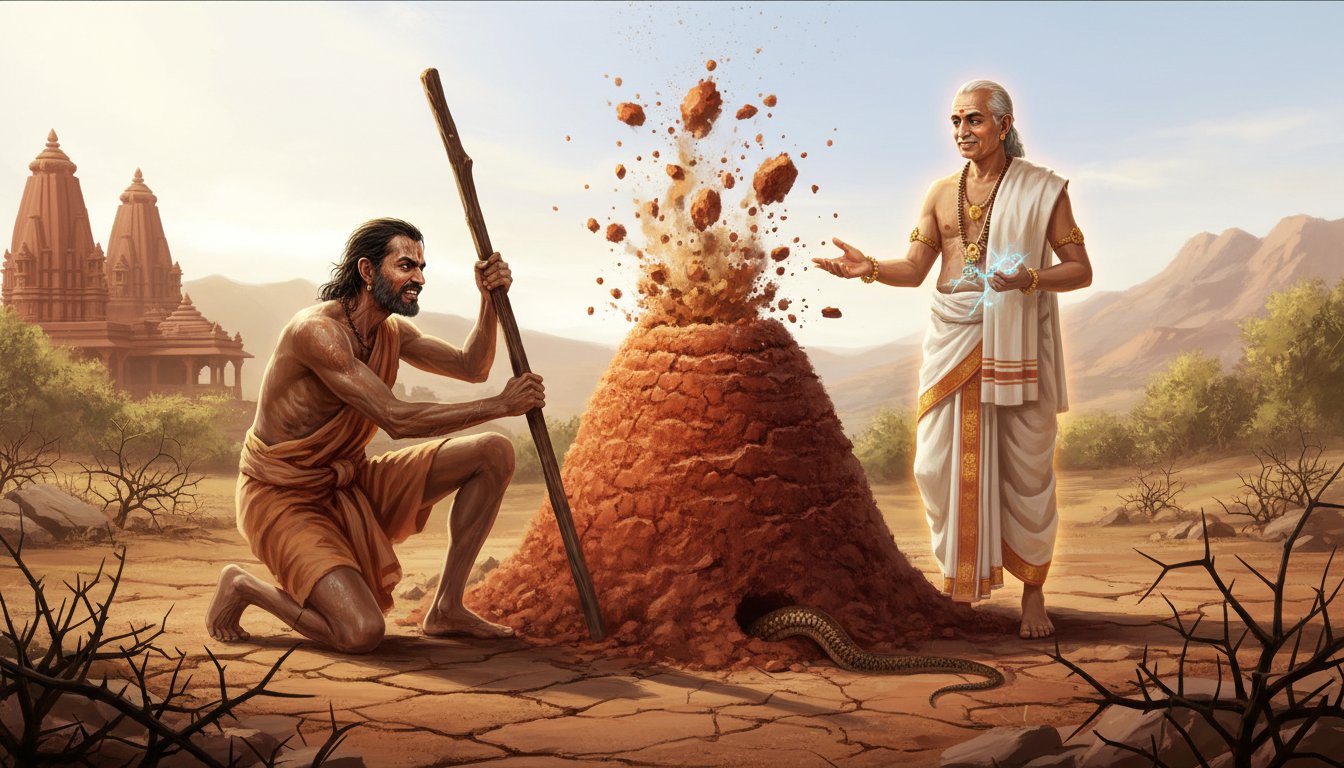
Utanka came down out of the tree filled with wrath and in great anxiety of mind. He took his walking staff and began to pierce that anthill with it. Burning with wrath and with the desire for revenge, he employed himself ceaselessly in that task for five and thirty days.
The goddess Earth, her body torn by that staff, became exceedingly anxious, for she could not bear the force of it.
Then the chief of the celestials, armed with the thunder, came there on his car drawn by green horses, and beheld that foremost of Brahmanas sitting and digging a hole to the nether regions with a stick.
Indra took the garb of a Brahmana afflicted with the sorrow of Utanka, and spoke to him gently.
"This purpose of yours is incapable of being achieved. The regions of the Nagas are thousands of yojanas removed from this place. I think your purpose is not capable of being achieved with your walking staff."
"If the ear-rings are not recovered by me from the regions of the Nagas," said Utanka, "I shall cast off my life-breaths before your eyes, foremost of regenerate persons."
When the thunder-armed Indra failed to divert him from his purpose, he stopped arguing and united that walking staff with the force of thunder. The Earth, opening under strokes that now had the thunder in them, yielded a way down.
The Black Horse in the World of Snakes
By that path Utanka entered the world of the Nagas, and saw that the region lay extended for thousands of yojanas on every side.
It was equipped with many walls made of pure gold and decked with jewels and gems. There were fine tanks of water with flights of stairs made of pure crystal going down into them, and many rivers of clear and transparent water, and many trees with diverse species of birds perching on them. The gate of that region was five yojanas high and a hundred yojanas in width.
Beholding all this, Utanka became very cheerless. He had come down through the earth with a stick and he despaired of ever finding the ear-rings in a country that size.
Then there appeared before him a black steed with a white tail. His face and eyes were of a coppery hue, and he seemed to blaze forth with energy.
"Blow into the Apana duct of my body," the horse said. "You will then get back your ear-rings, which have been taken away by a descendant of Airavata's race. Do not loathe to do my bidding, son. You did it often at the retreat of Gautama in former days."
"How did I know you in the retreat of my preceptor?" said Utanka. "I wish to hear how I did in those days what you bid me do now."
"Know, learned Brahmana, that I am the preceptor of your preceptor, for I am the blazing Jatavedas. By you I was often worshipped for the sake of your preceptor, child of Bhrigu's race, duly and with a pure heart and a pure body. For that reason I shall accomplish what is for your good. Do my bidding without delay."
So Utanka, who had knelt at that fire every morning for a hundred years and blown it into life for another man's sake, knelt down and did it once more.
The deity, gratified with him, blazed up to consume everything. From the pores of his body, in consequence of his very nature, a thick smoke issued that threatened terror to the world of the Nagas. With that mighty and wide-spreading smoke everything became enveloped in gloom, until nothing could any longer be seen in all that golden country.
Cries of woe were heard throughout the mansions of the Airavatas, uttered by the Nagas with Vasuki at their head. The palaces could no longer be seen. They resembled woods and hills overwhelmed by a thick forest.
With their eyes red from that smoke, afflicted by the energy of the deity of fire, the Nagas came out of their mansions to the son of Bhrigu's race to find out what the matter was.
The Fee Delivered
They heard from that ascetic of immeasurable energy what the matter was. Then all the Nagas, with fear depicted in their eyes, offered him their worship according to the due forms. They placed the old and the young ones in front of them and bowed to him with their heads, and joined their hands.
"Be gratified with us, holy one."
Having gratified that Brahmana, and offered him water to wash his feet and the ingredients of the Arghya to honour him, the Nagas gave him back those celestial and highly adored ear-rings, and the smoke went out of their country.
Honoured by them, Utanka of great prowess walked round the deity of fire and started for the retreat of his preceptor.
He came quickly to Gautama's asylum and presented the ear-rings to the wife of his preceptor, which was the only thing he had set out to do. And he told his preceptor everything about Vasuki and the other Nagas, and about the compact with the cannibal king, and about the black horse in the smoke.
It was even thus, O Janamejaya, said Vaishampayana, that the high-souled Utanka wandered through the three worlds and fetched those jewelled ear-rings for his preceptor's wife. Of such prowess was that ascetic, and so austere were the penances with which he was endued. I have told you what you asked me.
Dharma Lesson
A debt to a teacher is not discharged by obedience alone, and a hundred years of service can leave the fee still unpaid. The man who keeps his word even to a cannibal, and who once knelt to blow another man's fire into life, is the man heaven arms with thunder when a snake takes what he earned.