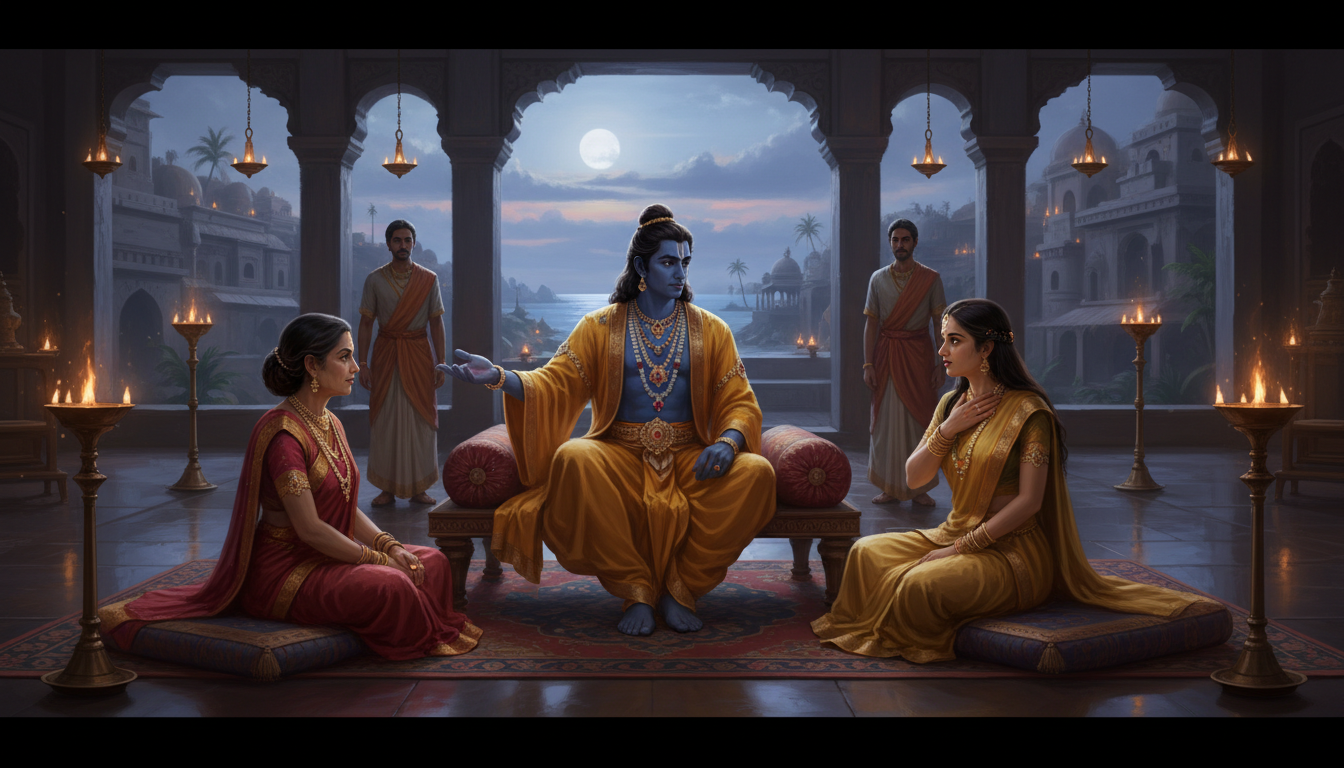
The News Krishna Held Back
A grandfather is spared until his daughter refuses it
Tell Me How It Happened
Vaishampayana said: When the rites for the dead were finished at Hastinapura and the ashes had gone into the river, Krishna came home to Dwaraka, and brought his sister Subhadra with him, for Kunti had given her leave to go.
His father Vasudeva was old. He had heard the war the way the old hear everything now, in pieces, from men who had heard it from other men, and every version was larger than the last and none of them held together. He sat Krishna down in the hall with Devaki beside him and asked for the whole of it.
"O son of the Vrishni race, I have heard men speak again and again of that wonderful battle between the Kurus and the sons of Pandu," he said. "But you saw it with your own eyes, mighty-armed one. So describe it to me in detail. Tell me how that battle took place between the high-souled Pandavas on the one side and Bhishma and Karna and Kripa and Drona and Shalya and the others on the other, and between all those numberless kshatriyas besides, well skilled in arms, differing from one another in bearing and in dress, who came to it out of every realm on earth."
So Krishna, whose eyes were like lotus petals, sat in front of his father and his mother and told it. The women of the household came and stood at the edges of the hall to listen, and Subhadra came with them and sat down where she could see her brother's face.
"The feats those kshatriyas performed were wonderful," Krishna began. "They were so many that a hundred years would not be enough to count them. So I shall name only the foremost of them, and you may take the rest on trust."
Ten Days Under the Son of Ganga
"Bhishma of Kuru's race became generalissimo first," Krishna said, "with eleven divisions of the Kaurava princes under his command, standing among them the way Vasava stands among the celestial forces. Against him the sons of Pandu had seven divisions, and their leader was Shikhandin, protected in every hour of every day by Arjuna, who never let him stand alone.
"Under those two the battle raged for ten days. It was of a kind to make the hair stand on the body. At the end of it Shikhandin, with the wielder of Gandiva behind him, covered the son of Ganga with innumerable arrows while he fought bravely on, and brought him down.
"He did not die then. He lay on a bed of arrows outside both camps and waited there like an ascetic under a vow, refusing to let go, until the sun left his southward path and entered on the northerly course. Only then did that hero give up his life-breaths."
Vasudeva said nothing. He had known Bhishma. Every kshatriya of his generation had known Bhishma, and had grown up understanding that the world had one fixed point in it, and that it stood in Hastinapura and carried a bow.
"Ten days," he said at last. "He held them ten days."
"He held them ten days," Krishna said, "and on the tenth he chose the manner of it himself. It was the only thing left that anyone could still give him."
Five Days Under the Preceptor
"After him," Krishna said, "Drona took the command, that foremost of all men conversant with weapons, the greatest of all who stood under Duryodhana, as Kavya once stood beside the lord of the Daityas. What was left of the Kaurava host then was nine akshauhinis, and Kripa and Karna and the others were set to protect him.
"Against him the Pandavas put forward Dhrishtadyumna, who knew many mighty weapons and had intelligence besides, and Bhima was set to guard him as Mitra guards Varuna. That prince had wanted to measure himself against Drona all his life. He carried the memory of what Drona had done to his father Drupada, king of the Panchalas, and he carried it into every hour of those five days.
"That was a furious battle. In the encounter between Drona and the son of Prishata the kings who had assembled out of all the realms of the earth were very nearly wiped out. When five days had run, Drona was exhausted, and he succumbed to Dhrishtadyumna."
Krishna did not say how. His father did not ask. That much of the story had already reached Dwaraka, the way such things do, complete with the lie about the elephant and the old man sitting down in his car with his weapons laid aside.
"Fifteen days gone," Vasudeva said, counting on his fingers like a man doing accounts. "And two commanders."
Two Days, and Half a Day
"After that Karna became generalissimo of Duryodhana's forces," Krishna said. "Five akshauhinis were what remained to support him. The sons of Pandu had three. Innumerable heroes had already been killed on both sides, and what was left of the Pandava army came to the field protected by Arjuna.
"The Suta's son was a fierce warrior. But he met Partha, and on the second day of his command he came to his end, like an insect that has flown into a blazing fire.
"After Karna fell, the Kauravas lost heart altogether. Three akshauhinis of them gathered round the ruler of the Madras. On our side, after all the car-warriors and elephants and horsemen we had lost, one akshauhini remained, and it was a cheerless army, and it took Yudhishthira himself for its leader. In the battle that followed the king accomplished the most difficult feats of his life, and before half that day was over he had killed the king of the Madras with his own hand.
"When Shalya had fallen, Sahadeva of immeasurable prowess killed Shakuni, the man who had brought the whole quarrel about in the first place. And when Shakuni was dead, the royal son of Dhritarashtra, whose army had by then been butchered out of existence and who could see it, went off the field alone with his mace in his hand."
What Was Left Standing
"Bhimasena went after him in a rage and found him," Krishna said, "inside the waters of the Dwaipayana lake. We surrounded that lake with what we had left of an army, and we were glad, and we shot words at him instead of arrows. Those wordy shafts went down through the water and pierced him, which no arrow of ours had ever managed. He came up out of the lake with the mace in his hand, wanting the fight, and in the great battle that followed Bhimasena put out all his strength and killed the son of Dhritarashtra in the sight of many kings.
"And then, at night, while what remained of our army slept in its own camp, Drona's son came in among them, because he could not bear that his father had been killed by Dhrishtadyumna, and he killed them where they lay.
"Their sons dead, their forces dead, only the five sons of Pandu are alive, with myself and Yuyudhana. On the other side, with Kripa and the Bhoja prince Kritavarman, Drona's son is all that is not slain of the Kaurava army. Dhritarashtra's son Yuyutsu escaped as well, because he crossed over to the Pandavas before it began. Vidura and Sanjaya have come into the presence of Yudhishthira the just. Even thus did that battle take place, my lord, over eighteen days, and many kings of the earth were slain in it and have ascended to heaven."
He stopped. The hall was quiet, and then it was not quiet. The Vrishnis who had come to hear it filled with grief and sorrow and pain, and some of them wept without any shame at all, and it was a long while before anybody in that room could speak.
The Name That Was Not Spoken
Vaishampayana said: When Krishna of great prowess had finished the narration of the great battle of the Bharatas before his father, it was plain to everyone in that hall that he had passed over one thing. He had gone through eighteen days, four commanders and the whole roll of the dead, and he had never once said the name of Abhimanyu.
He had done it on purpose. He had not wanted his father to hear what would be unpleasant to him. The intelligent one did not wish that Vasudeva should be afflicted with sorrow and grief by the dreadful news of the death of his daughter's son, and so he had built a version of the war with a hole in the middle of it and hoped the hole would not be noticed.
Subhadra noticed. She had been listening for that name from the first sentence, through Bhishma's ten days and Drona's five, through the fall of Karna and Shalya and Shakuni, through the lake and the night in the camp, waiting for her brother to come to it. He came to the end and did not come to it.
She stood up.
"Tell them how my son died, Krishna," she said.
Then she fell down on the earth in a swoon, and lay there among the women.
Vasudeva saw his daughter fall. He understood everything in that instant, the way an old man does, and as soon as he saw it he fell down too, his senses taken from him by grief, and the household ran to them both.
The Questions of an Old Man
When Vasudeva had his senses back he did not weep at once. He asked, and every question he asked was one that bereaved elders have been asking since there were wars.
"O lotus-eyed one," he said, "you are famed over the earth for being truthful in speech. Why then do you not tell me today of the death of my daughter's son? Tell me in detail of the killing of your own sister's son. He had eyes like yours. How was he killed in battle by enemies?
"Since my heart does not break into a hundred pieces from grief, it seems the heart does not die with a man when its hour has not come.
"At the time of his fall, what words did he say, calling on his mother? What did that darling of mine say about me, that boy with the restless eyes? I hope he was not killed while going back from the battle with his back turned to them. Tell me that first. I hope his face did not become cheerless while he was fighting. He had mighty energy in him, Krishna. Out of pure boyishness he used to stand in front of me and boast about his skill until the whole hall laughed at him. He used to say he would challenge Bhishma. He used to say he would challenge Karna, that foremost of all mighty warriors, and he meant it.
"I hope that boy does not lie on that field killed by fraud, by Drona and Karna and Kripa and the others together. Tell me this. Do not spare me now, you have already tried it."
And Krishna, who was more afflicted than his father was, answered him.
He Did Not Turn His Back
"His face did not become cheerless as he fought in the van of the battle," Krishna said. "Fierce as that fighting was, he did not turn his back upon it. Take that much from me as certain.
"He killed hundreds and thousands of the kings of the earth before anything touched him. Then he was brought to grief by Drona and by Karna, and at the last he succumbed to the son of Dussasana. If he had been met one against one, without a break, he could not have been killed in battle by the wielder of the thunderbolt himself. He was not met that way. When his father Arjuna was drawn off from the main body by the Samsaptakas, who challenged him to fight them apart from the rest, Abhimanyu was surrounded by the enraged Kaurava heroes with Drona at their head. He had gone in alone and there was no one behind him. He slaughtered a very large number of them, and then your daughter's son succumbed.
"He has gone to heaven. There is no doubt about that. Kill this grief of yours, father, for you are a man of great intelligence, and they who have cleansed understandings never languish when a calamity meets them. He by whom Drona and Karna and the rest were checked in battle, heroes the equal of Indra in might, why should he not ascend to heaven? He has attained that sanctified goal which belongs to those who die at the edge of weapons.
"Do not let yourself be swayed by wrath. There is no one left to be wrathful at."
Where Are All Our Sons
"And there is something else you should hear," Krishna said, "because it is your daughter's grief and not only your own.
"After that hero fell, my sister Subhadra, stricken, cried aloud like a female osprey when she saw Kunti. And when she met Draupadi she asked her, in grief: 'Reverend lady, where are all our sons? I desire to behold them.' Hearing her, all the Kaurava ladies embraced her and sat around her and wept.
"Then she saw Uttaraa, and she said to her: 'O blessed girl, where has your husband gone? When he comes back, tell me at once, do not lose a moment. Daughter of Virata, the moment he heard my voice he used to come out of his chamber without the loss of an instant. Why does your husband not come out today? Abhimanyu, your maternal uncles are all hale, mighty car-warriors, they used to bless you when they saw you come here ready to go out to the fighting. Tell me the incidents of the battle today, as you did before. Why do you not answer me today, me who am weeping so bitterly?'
"Kunti heard those lamentations, and she was deeply afflicted herself, and she answered slowly.
"'Subhadra, though he was protected by Vasudeva and by Satyaki and by his own father, your young son has still been killed. That killing is due to the influence of Time. Daughter of Yadu's race, your son was mortal. Do not grieve. Irresistible in battle, he has without doubt attained the highest goal. You were born in a high race of high-souled kshatriyas. Do not grieve, O girl of restless glances. Cast your eyes instead on Uttaraa, who is quick with child. Do not yield to sorrow. This auspicious girl will soon bring forth a son to that hero.'
"Then Kunti, conversant with every duty, cast off her own grief and made the arrangements for Abhimanyu's obsequial rites, with the consent of Yudhishthira and Bhima and the twins. She made many presents to the Brahmanas and gave them many kine. And when it was done, comforted a little, she went to the daughter of Virata and said: 'Faultless girl, you must not indulge in grief. For the sake of your husband, protect the child in your womb.' With her permission I have brought Subhadra here. That, my lord, is how your daughter's son met his death."
Six Million Brahmanas
Vaishampayana said: Having heard these words of his son, Vasudeva of Sura's line, whose soul was righteous, cast off his grief and made excellent obsequial offerings for a grandson he had never seen fall.
He performed the rites for the ascension of that high-souled boy who had been the darling of his father. He fed six millions of Brahmanas, endued with great energy, with food possessed of every recommendation, and gave them clothes as well, and Krishna satisfied their thirst for wealth until there was nothing more that any of them wished to name. The heaps of gold given away that day were wonderful, and so were the numbers of the kine and the beds and the cloths. The Brahmanas cried out over and over, 'Let his wealth increase.'
Then Vasudeva of Dasarha's race, and Balarama, and Satyaki, and Satyaka, each performed the obsequial rites of Abhimanyu separately, one after another, as though repetition might do what one performance had not done. It did not. Afflicted beyond measure, they failed to attain comfort.
It was no better in the city called after the elephant. Deprived of Abhimanyu, the sons of Pandu could not get peace of mind either, and the daughter of Virata, for many days together, refused all food. Her relatives were plunged into fear on top of grief, for they thought the child in her womb would be destroyed.
Then Vyasa, who saw the state of things with his spiritual vision, came there and spoke to Pritha and to Uttaraa. "Let this grief be abandoned. Famous lady, a son endued with mighty energy will be born to you, through the power of Vasudeva and at my word, and that son will rule the earth after the Pandavas have departed from it."
And looking at Arjuna, in the hearing of Yudhishthira the just, he said: "The grandson will become a high-souled prince. He will righteously rule the whole earth to the verge of the sea. Cast off this grief, mower of foes. Do not doubt it. As for Abhimanyu, he has gone to the regions of the deities, which he conquered by his own acts. He should not be grieved for by you or by any of the Kurus."
Then he urged the royal son of Dharma to perform the horse-sacrifice, and made himself invisible where he stood.
Dharma Lesson
Kindness that edits the truth only postpones the blow and adds a second wound to it, because the bereaved will always hear the shape of what has been left out. Better to be the one who says the name than to be the one caught not saying it.