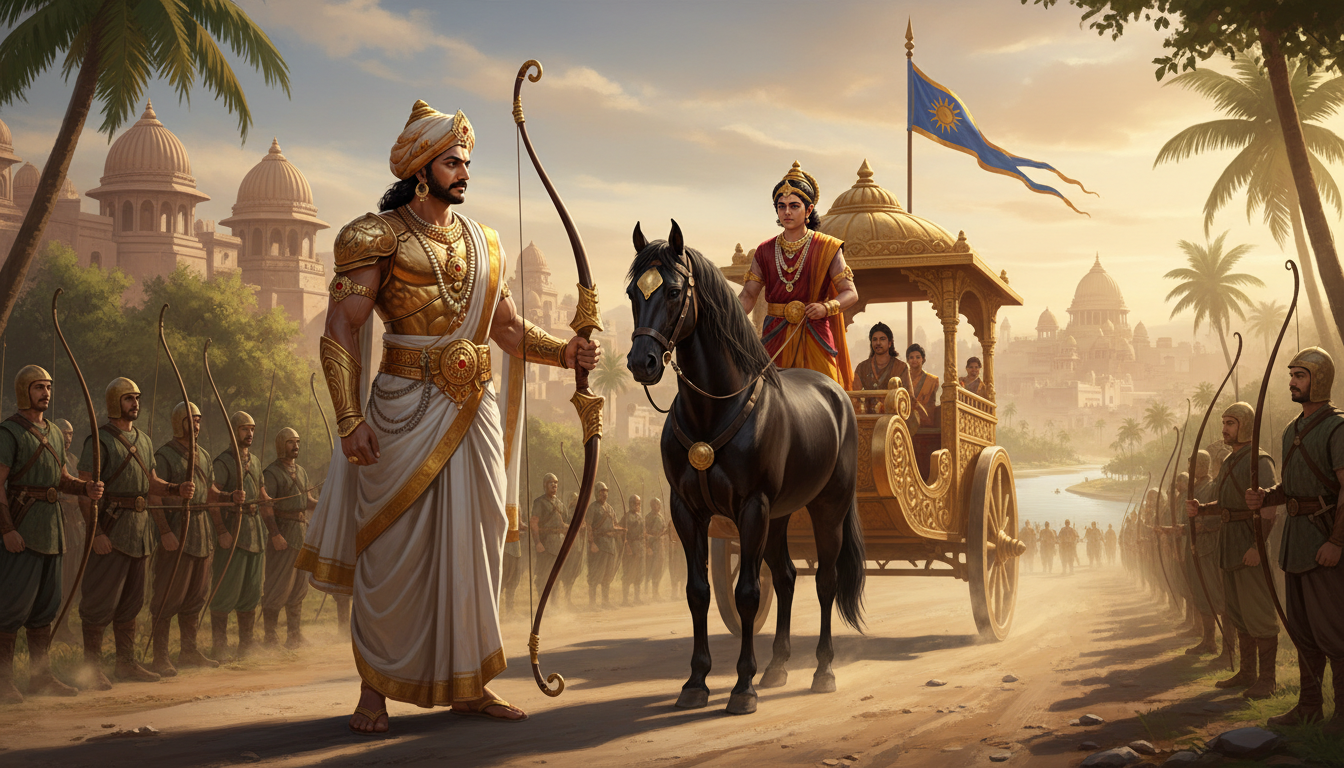
The Horse Goes South
Ekalavya's son, and the day Dwaraka grabbed the bridle
No Place to Rest for Even a Short While
"He would not sleep under his son's roof," said Vaishampayana. "Hear how the horse came home, O Janamejaya, and what it cost the man who walked behind it."
At Manipura the quarrel with the dead was over. Babhruvahana had killed his father in the dust of his own gate and had been given him back again, and Ulupi had explained why she had arranged it, and Arjuna had said that all she had done was agreeable to him. Now the horse was cropping grass at the edge of the road, and the whole of Manipura had come out to watch it eat.
Arjuna told his son when to come. "The Horse-sacrifice of Yudhishthira will take place on the day of full moon in the coming month of Chaitra. Come there, king, with your mother and your counsellors and your officers."
Babhruvahana's eyes were still wet. "I shall certainly repair to the great Horse-sacrifice at your command, and I will take upon myself the task of distributing food among the regenerate ones. But show me this grace. Enter your own city with your two wives. Live one night in your own mansion in happiness, and then follow the steed. Let no scruple be yours in this, father, you who are acquainted with every duty."
"You know what vow I am observing," Arjuna said. "Until the termination of it I cannot enter your city. This sacrificial horse wanders at will, and I have to follow it always. Blessings on you. I must go away. Place I have none wherein to rest for even a short while."
So the son worshipped the father, and the two wives gave their permission, and the man in the iguana-skin fence with Gandiva across his shoulder went back to the animal in the grass and waited for it to decide where they were going next.
It had already crossed the whole Earth to the sea on every side. Now it lifted its head, of the colour of a black deer, and turned its face toward the city that is named after the elephant. It had had enough of the world. It was going home.
The Boy Who Came Out of Rajagriha
Going home is not a straight line for a horse that has been told to wander at its will. It grazed westward for days along roads that had not seen a Kuru army since the war, and then it turned aside and walked into the dominions of Magadha, and by evening it was standing inside the walls of Rajagriha, in a market square, being stared at.
Magadha had reason to remember the Pandavas. Jarasandha had died in that city in a wrestling bout of thirteen days, and his son Sahadeva had brought the Magadhan chariots to Kurukshetra and had not brought them back. The man who ruled there now was Sahadeva's son, Meghasandhi, and he was very young, and he had been raised on the story of what the Kurus had done to his house.
He observed the duties of a Kshatriya as he understood them. A strange horse in his city with a Kuru mark on it was a challenge, so he challenged it. He came out through his own gate on a car, with bow and arrows and his hand cased in a leathern fence, and he rushed at Dhananjaya, who was standing on the ground on foot beside the animal, holding nothing but his bow.
What he said then he said out of childishness and without any skill.
"This steed of yours, Bharata, seems to move about protected by women only. I shall take away the horse. Strive to free him. My sires did not teach you in battle, but I shall do the duties of hospitality to you all the same. Strike me, for I shall strike you."
Arjuna smiled. It was not the smile the boy wanted.
"To resist the man who obstructs me is the vow cast on me by my eldest brother," he said. "Without doubt this is known to you. Strike me to the best of your power. I have no anger."
Arrows That Went Everywhere but the Body
The ruler of Magadha struck first, and he struck well. He showered his arrows down on the man on foot the way the thousand-eyed Indra showers a heavy downpour of rain, filling the air between them so that the crowd on the walls could not see the ground.
Arjuna did not move much. Shafts sped from his excellent bow met the shafts coming at him and baffled every one of them, carefully as they had been aimed. Having broken that cloud, the ape-bannered hero began to answer, and his answers were a list of things that were not Meghasandhi.
He sent blazing arrows that looked like snakes with fiery mouths, and he put them into the flag, and the flagstaff, and the body of the car, and the poles, and the yoke, and the horses. He did not put one into the prince. He did not put one into the prince's driver. Anybody watching who understood archery understood at once what was being done and why, because a man who can hit the yoke can hit the throat above it.
Meghasandhi did not understand. He thought his skin was being spared by his own prowess. So he kept shooting, and he was good enough that his arrows went home, and the wielder of Gandiva stood there taking them until he shone like a flowering Palasa in the season of spring, red all down his chest.
That was the boy's real achievement, and it should be said plainly: he stayed on the field in front of the greatest archer alive and made him bleed. It was because Arjuna had no desire to kill him that he was able to go on standing there. He never knew it. He remained before that foremost of heroes, striking, and the blood ran, and the crowd on the wall began to shout for their king.
Then Arjuna became angry.
Disarmed Piece by Piece
He drew Gandiva with great force, and what followed was not a duel any more but a dismantling, done in order.
The horses went first. Then a shaft took the head from the car-driver where he stood. With a razor-headed arrow Arjuna cut Meghasandhi's large and beautiful bow in two, and then the leathern fence off his hand, and then the flag with its staff, which came down across the wreck of the car.
Exceedingly afflicted, deprived of his steeds and his bow and his driver, the prince did the only thing left to a Kshatriya. He took up a mace and came at the son of Kunti on foot, running.
Arjuna cut the mace to pieces in the air with shafts equipped with vulturine feathers. It was a fine mace, adorned with bright gold, and its bonds and knots were set with gems, and all of them were severed at once, so that it fell on the earth in fragments like a she-snake helplessly hurled down by somebody.
His car gone, his bow gone, his mace gone, Meghasandhi stood in the square with nothing, waiting for it. That foremost of warriors did not wish to strike him. The ape-bannered hero walked over to his cheerless enemy and spoke to him the way an older man speaks to a boy who has done a hard thing well.
"Son, you have sufficiently displayed your adherence to Kshatriya duties. Go now. Great have been the feats you have accomplished in battle, king, although you are very young in years. The command I received from Yudhishthira was that kings who oppose me should not be slain. It is for this that you live yet, though you have offended me in battle."
Meghasandhi considered himself vanquished and considered himself spared, and thought it his duty to say so. He joined his hands and worshipped the man who had been shooting at his flagstaff all afternoon.
"Vanquished have I been by you. Blessed be you. I do not venture to continue the battle. Tell me what I am to do now for you. Regard your behest as already accomplished."
"Repair to the Horse-sacrifice of our king," Arjuna said, "which takes place at the coming full moon of Chaitra."
"So be it," said the son of Sahadeva. Then he worshipped the horse, as the rite required, and worshipped Phalguna, which the rite did not.
The Oyster City, and Shishupala's Son
The steed, equipped with beautiful manes, went out of Magadha along the sea-coast at its own pace, into the countries of the Bangas and the Pundras and the Kosalas. There the fighting was of another kind. Innumerable Mlechchha armies came against the horse one after another, and Dhananjaya with Gandiva vanquished them one after another, and none of their names were worth carrying home.
Worshipped by the ruler of Magadha, Pandu's son had white steeds yoked to his car again, and he turned and went south.
Turning in the course of its wanderings, the mighty animal came upon the beautiful city of the Chedis, the city called after the oyster. Arjuna knew whose country he was standing in before anyone came out to meet him. Shishupala had ruled here, the man who had risen in Yudhishthira's own sacrificial hall at Indraprastha and abused Krishna until the hundred pardons were used up, and had lost his head to the discus in front of every king in the world.
Sarabha, the son of Shishupala, endued with great strength, came out to the horse. He encountered Arjuna in battle first. That was owed to his father, and he paid it.
Then, having paid it, he stopped, and worshipped Arjuna with due honours, and had the sacrificial steed honoured as well. There is no record that either man mentioned the discus, or the hall, or the head. Two sentences of the chronicle hold the whole of it: he fought, and then he did the honours. A great many men in the south that year had a father to answer for, and the ones who came through it were the ones who could do both things in a single afternoon.
Worshipped by him, that best of steeds then went on, into the realms of the Kasis and the Angas and the Kosalas and the Kiratas and the Tanganas, receiving due honours in all of them, and the son of Kunti walked behind it and had nothing to do.
The Other Chitrangada
Then the horse turned its head inland and Dhananjaya turned his course after it, and the son of Kunti proceeded to the country of the Dasarnas.
The ruler of that people was named Chitrangada. It was the same name as his wife's, the princess of Manipura whose son had killed him at his own gate a few months before and had wept over him afterward, and there is nothing in the chronicle to say whether Arjuna noticed. He probably did. He had been on the road a long time with very little to think about except the animal in front of him.
This Chitrangada was endued with great strength and was a crusher of foes, and he did not send a herald. Between him and Vijaya there occurred a battle exceedingly terrible, and it is one of the few in the whole circuit that the chronicle calls terrible without qualification. The Dasarna king held the field a long time. Nothing about him was childish and nothing about him was easily broken.
Arjuna brought him under his sway. The formula is the one used all along that road, and it means what it says: brought under, not killed. The vow held. Yudhishthira had said try to avoid battles to the best of your power, and invite them all to my sacrifice, and go forth and establish friendly relations with them, and his brother had turned this into a technique, which was to fight until the other man could not go on and then hand him an invitation.
By now the pattern had a shape to it that the following Brahmanas could see. The horse ate. The local king came out. There was an afternoon of extremely serious violence in which nobody of consequence died. And then in the evening a man who had been trying to kill Arjuna at noon sat with him and was told the date of the full moon of Chaitra.
The Nishada King's Right Hand
From the Dasarnas the diadem-decked Arjuna, that foremost of men, proceeded to the dominions of the Nishada king, who was the son of Ekalavya.
Of all the meetings on that road this was the one with the oldest grievance in it, and the grievance was Arjuna's own doing. Ekalavya had been a boy of the Nishadas who wanted to learn the bow from Drona and was refused because of his birth. He made an image of Drona out of clay in the forest and practised in front of it until he could shoot faster than anyone the princes had ever seen, and when Drona found out, Drona asked him for his fee, and the fee he named was the thumb of the boy's right hand. Ekalavya cut it off and gave it to him and never drew as he had drawn before. It was done so that no archer in the world should stand above Arjuna, and it had been done for Arjuna, and everybody in the Nishada country knew it.
The son received Arjuna in battle. He had no reason to accept an invitation to anybody's sacrifice, and every reason to obstruct the horse, and he obstructed it.
The encounter that took place between the Kuru hero and the Nishadas was so furious as to make the hair stand on end. They came at him in numbers and they came at him from the trees and the broken ground, fighting the way people fight who have never owned chariots, and for a while the sacrifice of Yudhishthira the just genuinely stood in question in that forest.
Unvanquished in battle, the valiant son of Kunti defeated the Nishada king who had proved an obstacle to the sacrifice.
Having subjugated the son of Ekalavya, the son of Indra was then duly worshipped by the Nishadas. That is the whole of what is recorded. A father's thumb, a son's war, and a formal reception afterward with the sacrificial horse standing in the middle of it, cropping grass, having caused all of this by walking where it liked.
Down to the Southern Ocean
Then the horse went south again, as far south as land goes, and Arjuna went with it toward the southern ocean.
In those regions battle took place between the diadem-decked hero and the Dravidas, and the Andhras, and the fierce Mahishakas, and the hillmen of Kolwa, who fought in country where a chariot is an embarrassment. The chronicle is careful about how it describes this stretch. He subjugated those tribes, it says, without having to accomplish any fierce feats.
That is not a boast, and it is worth reading slowly. There were no celestial weapons on the southern coast. There was no invocation of Agni's shafts or Varuna's nooses. There was a tired man with an ordinary bow and a reputation that had arrived several weeks before he did, walking behind an animal, and kingdoms that measured what was coming and decided that the price of the horse was lower than the price of the war. Half of the southern arc was conquered by arithmetic.
So the horse grazed its way up out of the south, its footsteps guiding him, and Arjuna proceeded to the country of the Surashtras. At Gokarna he stopped where the pilgrims stop. From Gokarna he repaired to Prabhasa, on the shore where the western sea comes in, a place with the kind of holiness that predates every kingdom that has ever claimed it.
He was near the end of the southern road now, and he knew what stood at the end of it. Beyond Prabhasa, along that coast, was the beautiful city of Dwaravati, protected by the heroes of the Vrishni race. Krishna himself was not there. Krishna was at Hastinapur with Yudhishthira, waiting for the full moon of Chaitra, which was the entire reason a horse of the colour of a black deer was walking toward his home city with a Kuru mark on it and a Kuru bowman behind it.
The Day Dwaraka Grabbed the Bridle
When the beautiful sacrificial horse of the Kuru king reached Dwaravati, the Yadava youths used force against that foremost of steeds.
Nobody sent them. There was no king's order, no herald, no line drawn across the road. They were young men of the Vrishni and Andhaka houses who saw an animal walking into their city under another realm's protection, announcing by the fact of its walking that everything it had crossed now belonged to Hastinapur, and their hands went to the bridle before their heads engaged. It was the same reflex that had made Meghasandhi come out of his gate, except that these were Krishna's own people, and the man walking behind the horse was Krishna's friend and Krishna's brother-in-law, and Subhadra was a daughter of that city, and Abhimanyu had been raised in it.
King Ugrasena soon went out and forbade those youths from doing what they meditated. It took a very short time and, one guesses, very few words. Then the ruler of the Vrishnis and the Andhakas issued out of his palace properly, in state, with Vasudeva beside him, the maternal uncle of Arjuna, and the two elderly chiefs met the Kuru hero cheerfully and received him with due rites.
There was no fight at Dwaraka. It is the only stop on the whole southern arc where the horse was seized and no arrow was loosed, and the reason is that two old men came out of a door fast enough. The rite of universal sovereignty had walked into the one city that could have humiliated it, and been met instead with water and honey and the honours due to a guest.
The two elders honoured Arjuna duly. Obtaining their permission, the Kuru prince then proceeded to where the horse he followed led him.
It led him north. The steed went along the coast of the western ocean and at last reached the country of the five waters, swelling with population and prosperity, and from there it turned toward the country of the Gandharas, where it wandered at will as it had always done. Waiting there, with a bitter remembrance of the grudge his sire had borne the Pandavas, was the son of Shakuni. The horse had crossed the world and had almost no road left, and the road it had left ran straight through the last man in it who still wanted the war.
Dharma Lesson
A rite that claims the whole world will sooner or later be resisted by the people who love you best, and the men who came out to obstruct the horse were almost all sons paying a debt owed by a father. A man following such a horse must learn to be gentler with the sons of the men he killed than they intend to be with him.