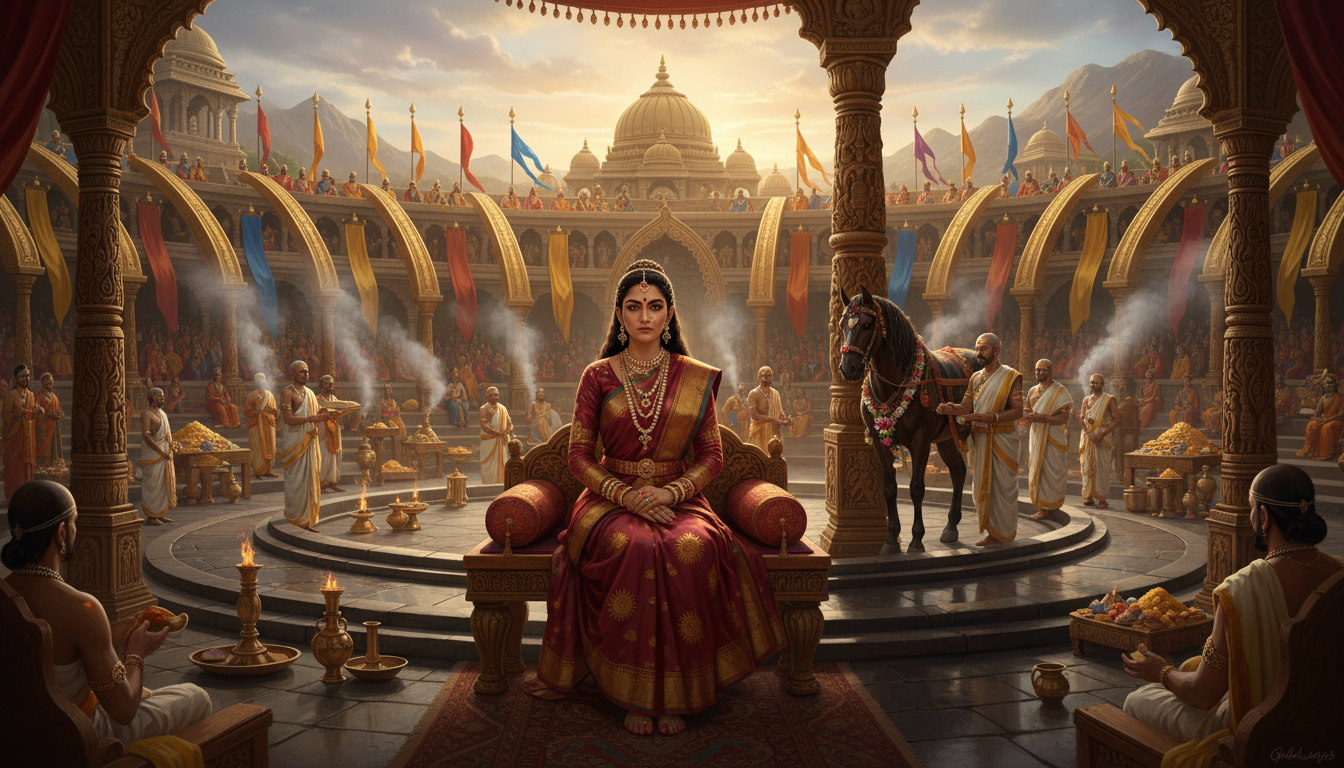
The Sacrifice of Profuse Gold
Yudhishthira gives away the earth and is given it back
The Twelfth Day of the Lighted Fortnight
Vaishampayana said: The horse had turned for home. Yudhishthira's intelligence-bearers came in ahead of it and told him so, and told him also that Arjuna was hale, and the king was filled with joy for the first time in a long while. They brought him the tally of what had happened in the country of the Gandharas and in the other realms besides, and he heard all of it and was glad.
Then he looked at the calendar rather than at the reports. The twelfth day of the lighted fortnight in the month of Magha had come, and the constellation was favourable, and the full moon of Magha was not far off. He summoned Bhima and Nakula and Sahadeva.
"Your younger brother is coming back with the horse, Bhimasena," he said. "I have it from the men who followed him. The time for the sacrifice has come. The horse is near. The day of the full moon of Magha is at hand and the month is about to expire, Vrikodara. Let learned Brahmanas conversant with the Vedas go out and look for a sacrificial spot, so that the horse-sacrifice may be accomplished without a flaw in it."
Bhima obeyed the royal behest, and he was very glad to obey it, because it meant that Arjuna of the curly hair was coming home. He went out that same day with a body of men well versed in the rules for laying out sacrificial grounds and putting up buildings, and he took with him a company of Brahmanas who knew every rite belonging to a sacrifice.
A City Built to Be Given Away
Bhima chose a beautiful spot and had it measured out for the sacrificial compound, and then he built a city on it.
Houses and mansions went up, hundreds of them, and high broad roads were laid out between them. The surface of the ground was levelled and made smooth and set with jewels and gems, and structures of gold were put up all over it. Columns were raised and ornamented with bright gold. Triumphal arches, high and wide, were set at the entrances, and every one of them was made of pure gold and nothing else.
He built apartments for the ladies, and quarters for the kings who would be coming out of many realms to grace the rite, and separate mansions for the Brahmanas who would arrive from every direction. He was building for the whole continent and he knew it.
Then, at the king's command, the mighty-armed son of Kunti sent messengers out to the great kings of the earth.
They came. Those foremost of kings came to the horse-sacrifice of the Kuru monarch simply to do what was agreeable to him, and they did not come empty-handed. They brought gems, and female slaves, and horses, and weapons. The noise that rose out of those pavilions from so many high-souled men touched the very heavens and resembled the sound of the roaring ocean.
Yudhishthira assigned to every monarch who arrived his own kinds of food and drink, and beds of celestial beauty. For the animals that had come with the guests he set aside stables filled with corn and sugarcane and milk. Munis came too, utterers of Brahman, and every foremost man of the regenerate class then alive came with his disciples, and the Kuru king received them all. He cast off all pride and walked each of his guests personally to the pavilion assigned to him, and did not sit down until the engineers came and told him that everything was ready.
Nothing There That Was Not Gold
When the sacrifice commenced, the eloquent dialecticians started propositions and disputed on them, each of them wanting to vanquish the rest, and the arguing went on at the edges of the rite from morning to night.
The invited kings walked through the compound and looked at what Bhimasena had made, and it resembled the preparations of the chief of the deities himself. They saw the triumphal arches of gold, and the beds and seats and the other articles of comfort, and crowds of men gathered at one sport or another. There were jars and vessels, cauldrons and jugs, lids and covers. The invited kings saw nothing there that was not made of gold.
Many sacrificial stakes were set up, made of wood according to the directions of the scriptures and adorned with gold, planted and dedicated with the proper mantras. Animals were collected there of every kind that belongs to the land and every kind that belongs to the water: kine and buffaloes, aquatic creatures, beasts of prey, many species of birds, the viviparous and the oviparous and those that are filth-born, plants and animals that live or grow on mountains. The kings looked at all of it and were filled with wonder.
Large heaps of costly sweetmeats were kept ready for the Brahmanas and the Vaisyas. When a hundred thousand Brahmanas had been fed, the drums and cymbals were beaten, and the number fed was so great that the drums and cymbals were beaten again, and again, day after day.
There were hills of food. There were tanks of curds and lakes of ghee. The entire population of Jamvudwipa, with all its realms and provinces, seemed to be collected in that one compound, thousands of nations and races, and men adorned with garlands and wearing bright golden ear-rings went among them with vessels in their hands, distributing food to the regenerate classes by hundreds and by thousands, food and drink so costly that kings might have eaten it.
What Arjuna Sent Word to Say
Krishna came, with the Vrishnis behind him and Balarama in the van, and Yuyudhana and Pradyumna and Gada and Nisatha and Samba and Kritavarman with him. Bhima offered them the most reverential worship, and they entered the palaces of gems that had been assigned to them.
When the greetings were done and the conversation had gone on a while, Krishna brought up Arjuna, who was not there yet and who had been worn thin by too many fights.
"A confidential agent of mine came to me at Dwaraka," he said. "He had seen Arjuna. That foremost of Pandu's sons has been very much emaciated with the fatigue of many battles. He is very near to us now. Set yourself to accomplish your horse-sacrifice."
"By good luck he comes back safely," said Yudhishthira. "Tell me, delighter of the Yadavas, what did he say in this matter, that mightiest of heroes among the sons of Pandu?"
"My man remembered Partha's words and reported them to me thus," Krishna said. "'Yudhishthira should be told these words of mine when the time comes. Many kings will come to the sacrifice. When they arrive, high honours should be paid to them, for that would be worthy of us. And the king should further be told, at my request, that he must do what is necessary to prevent a carnage like the one that took place at the presenting of the Arghya at the Rajasuya. Let Krishna also approve of this. Let not the people be slaughtered, O king, through the ill-feeling of kings.'
"And there was one more thing. 'The ruler of Manipura, my dear son Vabhruvahana, will come to the sacrifice. Honour him duly for my sake. He is always attached and deeply devoted to me.'"
Yudhishthira heard the message about the Arghya and did not need it explained. He had watched a man die at his last great sacrifice over the question of who should be honoured first. He approved every word of it.
The Fault in Arjuna's Body
"I have heard your agreeable words, Krishna," Yudhishthira said, "and they are such as deserve to be spoken by you, and they are sweet as nectar to me. But there is something else on my mind.
"Hrishikesa, I have heard how many battles Vijaya has fought with the kings of the earth. For what reason is Partha always dissociated from ease and comfort? He is exceedingly intelligent. This pains my heart. Whenever I am withdrawn from business I find myself thinking of Kunti's son, and the lot of that delighter of the Pandus is exceedingly miserable. His body has every auspicious mark on it. What sign is there in that excellent body, then, on account of which he always has to endure misery and discomfort? That son of Kunti has to bear an exceedingly large share of unhappiness, and I can see no censurable indication anywhere on him. Explain the cause to me, if I deserve to hear it."
Krishna reflected for a long time before he answered.
"I do not see any censurable feature in this prince," he said at last, "except that the cheek bones of this lion among men are a little too high. It is in consequence of that alone that this foremost of men always has to be on the road. I really do not see anything else on him by which he could be made so unhappy."
Yudhishthira said that it was even so.
Draupadi looked at Krishna angrily and askance, and said nothing, because she could not bear to hear a fault ascribed to Arjuna even by him and even in a cheek bone. Krishna saw the look and approved of it, and let it be. She was his friend as well, and he knew what he was seeing.
Bhimasena and the other Kurus and the sacrificial priests, who had been listening to the account of Arjuna's triumphs on the road behind the horse, were highly gratified by the whole conversation, and it went on until an envoy arrived.
The Horse Comes Back
The envoy came from Arjuna himself. He bowed his head in the presence of the Kuru king and told him that Phalguna was coming. Tears of joy covered the king's eyes, and large gifts were made to the messenger for the very agreeable tidings he had brought.
On the second day after that a loud din was heard, and that foremost of men came in. The dust raised by the hoofs of the horse walking beside him looked as beautiful as the dust raised by the celestial steed Uchchaisravas.
As Arjuna advanced he heard the citizens calling out to him from both sides of the road. "By good luck, Partha, you are out of danger. Praise to you and to king Yudhishthira. Who else than Arjuna could come back after making the horse wander over the whole earth and vanquishing all the kings in battle? We have not heard that such a feat was ever achieved by Sagara or by any of the high-souled kings of antiquity. Future kings will never be able to accomplish anything so difficult."
Listening to that, the righteous-souled Phalguna entered the sacrificial compound.
Yudhishthira came out to receive him with all his ministers and with Krishna, and they placed Dhritarashtra at the head of that party. So the first feet Arjuna saluted, when he came home from a year of following the horse across the world, were the feet of the blind king whose hundred sons his brothers had killed. Then he saluted Yudhishthira, and worshipped Bhima and the others, and embraced Kesava. They honoured him and he honoured them in return according to the due rites, and then that mighty-armed hero took rest, like a shipwrecked man tossed on the waves who has reached the shore and is allowed to lie down on it.
Three Households Under One Roof
Meanwhile king Vabhruvahana of great wisdom came to the Kuru capital, and he came accompanied by his mothers, Chitrangada and Ulupi.
The prince saluted all his seniors of Kuru's race and all the other kings who were present, and was honoured by them in return, and then he went into the excellent abode of his grandmother Kunti. He greeted her in soothing and sweet accents, as a young king does who has been raised to be careful, and then queen Chitrangada and Ulupi the daughter of the snake Kauravya approached Partha and Krishna together, with humility, and after that they met Subhadra and the other ladies of the Kuru race with the due formalities.
So the three of them stood in one room: the princess of Manipura whom Arjuna had married on condition that her son stayed with her father, the Naga woman who had taken him down into the water, and Subhadra of the Vrishnis whose own son was dead. Kunti gave the newcomers many gems and costly things. Draupadi and Subhadra and the other ladies of Kuru's race made presents to them as well. The two took up their residence there, with costly beds and seats, treated with affection and respect by Kunti herself, because Kunti wished to do what was agreeable to Partha and knew exactly what that was.
Vabhruvahana, duly honoured, then met Dhritarashtra according to the rites, and went to Yudhishthira and Bhima and the other Pandavas and saluted them all with humility. They embraced him with great affection and made large gifts of wealth to him, being highly gratified with him. Then the king of Manipura approached Krishna humbly, like a second Pradyumna approaching his father, and Krishna gave him a very costly car adorned with gold, with excellent steeds yoked to it. Yudhishthira and Bhima and Phalguna and the twins each honoured him separately and made him costly presents of their own.
Three Times What Is Enjoined
On the third day Vyasa, the son of Satyavati, came to Yudhishthira.
"From this day, son of Kunti, begin your sacrifice," he said. "The time for it has come. The moment for commencing the rite is at hand and the priests are urging you. Let it be performed in such a way that no limb of it becomes defective. Because of the very large quantity of gold that this rite requires, it has come to be called the sacrifice of profuse gold. And you, great king, are to make the Dakshina of this sacrifice three times what is enjoined. Let the merit of it increase threefold. The Brahmanas are competent for the purpose. Attaining then the merit of three horse-sacrifices, each with profuse presents, you shall be freed from the sin of having slain your kinsmen. The bath that one performs at the completion of a horse-sacrifice is highly cleansing, and that merit shall be yours."
So Yudhishthira underwent the Diksha, and the great rite began.
The priests were well trained and knew the Vedas and moved about in every direction doing each rite duly, and nothing swerved from the ordinances and nothing was done improperly. Having first performed the rite called Pravargya, they went through the rite of Abhishava, and then, extracting the juice of the Soma, they performed the Savana according to the injunctions. Among those who came to that sacrifice not one could be seen who was cheerless, or poor, or hungry, or plunged in grief, or vulgar in appearance. Bhimasena, at the king's command, caused food to be distributed ceaselessly among all who wished to eat.
When the time came for erecting the sacrificial stakes, six were set up made of Vilwa, six made of Khadira, and six of Saravarnin. Two were set up made of Devadaru, and one of Sleshmataka. At the command of the king, Bhima had some others set up for the sake of beauty only, and those were made of gold. Dressed in fine cloths supplied by the royal sage, the stakes stood there like Indra and the deities with the seven celestial Rishis standing around them in heaven. Golden bricks were made for the Chayana, which measured eighteen cubits and had four lairs, and resembled in beauty the one made long ago for Daksha, the lord of creatures. A golden bird in the shape of Garuda, with three angles, was made and set in place.
Three hundred animals were tied to the stakes, each assigned to its particular deity, including that foremost of steeds. All round the compound were the abodes of Brahmanas crowned with ascetic success. Narada was there, and Tumvuru of great splendour, and Viswavasu and Chitrasena, and at the intervals between the rites those Gandharvas, skilled in music and in dancing, gladdened the Brahmanas who were engaged in the work.
Draupadi Beside the Divided Horse
The other animals were cooked according to the rites, and then the priests sacrificed that steed which had wandered over the whole world.
After the horse had been cut into pieces conformably to the scriptural directions, they caused Draupadi to sit near the divided animal. She was possessed of the three requisites, mantras and things and devotion, and there was no one else in that compound of whom all three could be said. So the queen who had been dragged by the hair into an assembly of kings sat beside the sacrificial horse of the empire her husbands had won back, and the rite could not proceed without her.
The Brahmanas, with cool minds, took up the marrow of that steed and cooked it duly. Yudhishthira the just, with all his younger brothers, then smelled, as the scriptures direct, the smoke of that cooked marrow, which is capable of cleansing a man from every sin. The remaining limbs of the horse were poured into the fire by the sixteen sacrificial priests, who were possessed of great wisdom and did not hurry.
When the sacrifice of that monarch was thus completed, the illustrious Vyasa with his disciples eulogised the king greatly, and Yudhishthira gave away to the Brahmanas a thousand crores of golden nishkas.
And then he gave Vyasa the earth.
The Gift That Was Handed Back
Vyasa accepted the earth, and then addressed that foremost one of Bharata's race.
"Best of kings, the earth which you have given me I return to you. Give me instead the purchasing value of it, for Brahmanas are desirous of wealth and have no use for the earth."
Yudhishthira, standing with his brothers in the midst of the invited kings, answered the Brahmanas rather than Vyasa.
"The Dakshina ordained in the scriptures for the great horse-sacrifice is the earth. I have therefore given away to the sacrificial priests the earth conquered by Arjuna. Foremost of Brahmanas, I shall enter the woods. Divide the earth among yourselves. Divide it into four parts, as is done in the Chaturhotra sacrifice. I do not desire to appropriate what now belongs to the Brahmanas. This has always been the intention cherished by myself and by my brothers."
His brothers said, "Yes, it is even so." Draupadi said it with them.
Great was the sensation created by that announcement. Then an invisible voice was heard in the welkin, saying, "Excellent. Excellent." And the murmur of the crowds of Brahmanas rose after it.
The Island-born Krishna applauded him highly, and then spoke again in the presence of them all.
"The earth has been given by you to me. I, however, give her back to you. Give these Brahmanas gold. Let the earth be yours."
And Vasudeva, addressing Yudhishthira the just, said, "It behoves you to do as the illustrious Vyasa bids you."
So the king, glad of soul along with all his brothers, gave away millions of golden coins, trebling the Dakshina ordained for the horse-sacrifice, and no other king has been able to accomplish what the Kuru king accomplished that day after the manner of Marutta. Vyasa took that wealth, divided it into four parts, and gave it to the sacrificial priests as the price of the earth, and they distributed it among the Brahmanas according to the desire of each recipient. With Yudhishthira's permission the Brahmanas also divided among themselves the golden ornaments of the compound, the triumphal arches, the stakes, the jars and the vessels, and what was left after they had taken as much as they wanted was carried away by Kshatriyas and Vaisyas and Sudras and diverse tribes of Mlechchhas. The city Bhima had built was taken to pieces and carried off in every direction, which was what it had been built for.
Vyasa presented his own share, which was very large, to Kunti, and she received that gift of affection from her father-in-law gladly and spent it on acts of merit.
Yudhishthira bathed at the conclusion of the sacrifice, cleansed of all his sins, and stood in the midst of his brothers like the chief of the celestials among the denizens of heaven. He made presents of jewels and gems and elephants and horses and golden ornaments and cloths to the assembled kings. He summoned Vabhruvahana, gave him wealth in profusion, and gave him permission to return home. To gratify his sister Dussala he established her infant grandson in the paternal kingdom of that child, which was the last thing anyone had expected of the man who had just given away the world. Then he dismissed the assembled kings, each properly honoured, and worshipped Govinda and Balarama and the thousands of other Vrishni heroes and sent them back to Dwaraka.
People of many realms speak of that sacrifice to this day. Having showered wealth in torrents, cleansed of all his sins and his purpose fulfilled, the foremost one of Bharata's race entered his capital, still king.
Dharma Lesson
Atonement is not achieved by walking away from the throne but by proving that you would, in front of everyone, with the deed already done. The gift that is handed back to you is still a gift completely given, and the king who kept nothing is the only one fit to keep it all.