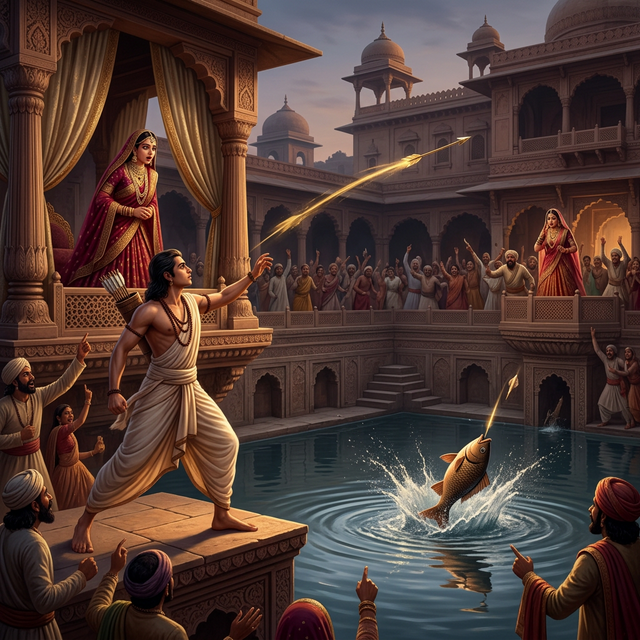
The Princess at the Practice Ground
Arjuna's tirtha yatra carried him east from the banks of the Ganga, through forests thick with sal trees and rivers he had never before crossed, until he came at last to Manipura, a kingdom perched where the land began to rise toward mountains still stranger than any he had known. He had heard travelers speak of it as a place of wealth and old customs, ruled by King Chitravahana of the Kshatriya lineage descended, they said, from Prabhanjana himself, but nothing he had heard prepared him for what he saw on his first morning within its gates.
A practice ground lay near the palace, ringed by low stone walls, and on it a young woman worked a chariot team through turns tight enough to make a seasoned charioteer wince, then dismounted and put an arrow through a spinning target three times running without pausing to breathe hard between shots. Arjuna, who had spent a lifetime among warriors and had judged more archers than he could count, stood at the wall and watched with an attention he rarely gave anyone.
"You stare like a man who has never seen a woman draw a bow," she said, not turning, though she had clearly marked him from the first moment.
"I have seen women fight," Arjuna answered. "I have rarely seen anyone, man or woman, hold a bow the way you do. What is your name?"
"Chitrangada," she said, turning now, unhurried, taking his measure as plainly as he had taken hers. "Daughter of Chitravahana, and heir to this kingdom, for I am my father's only child." Something in the way she said it, level and unapologetic, told Arjuna this was not a fact she carried as a burden. "And you are a stranger dressed like a kshatriya of the west, wandering into my father's practice ground uninvited."
"Arjuna," he said, "of the house of Pandu, on pilgrimage." He inclined his head, an equal's courtesy rather than a suitor's flourish. "I would ask your father for an audience, if you think he might grant one to a wandering prince who has just admired his daughter's archery rather too openly."
Chitrangada studied him a moment longer, then, for the first time, smiled.
The King's Condition
King Chitravahana received Arjuna in a hall hung with old battle standards, and listened without interruption while the Pandava asked, plainly and without flattery, for Chitrangada's hand. When Arjuna finished, the king was quiet for a time, weighing something that plainly troubled him more than the asking itself.
"I will not pretend surprise," Chitravahana said at last. "My daughter draws the eye of every prince who passes through Manipura, and she has refused every one of them until now, which tells me something in your favor already. But before I answer, you must hear the debt our house carries, or you will curse me later for concealing it."
He told the story then: how an ancestor of his line, Prabhanjana, had been childless and had won from Shiva the boon of a single heir in every generation, one child only, so that the succession would never be contested by rival claims among many siblings, and never diluted by division of the kingdom. "It is a boon that has kept Manipura whole and at peace for generations," the king said, "but it carries its price. Whatever child is born of Chitrangada, son or daughter, must remain in Manipura as heir to this throne. That child will not go with you to Hastinapura. That child will not carry the name of Kuru into the wider world. Manipura will have its heir, and only Manipura will have him."
Arjuna considered this in silence, and found, somewhat to his own surprise, that it asked nothing of him he was unwilling to give. He had five brothers and a growing web of kin to carry the Kuru name forward; he had no need to claim every child as his own possession. "I accept your condition, great king," he said. "I ask for your daughter's hand as her equal, not as a means of adding to my own house. Whatever child we are given, I give freely to Manipura, now, before the marriage, so there can be no grief over it later."
Chitravahana studied him for a long moment, then nodded, satisfied in a way that suggested he had expected a lesser answer and was glad to be wrong. "Then Manipura welcomes you, son of Pandu."
Three Years of Equals
The marriage rites were simple by the standards of the great Kuru weddings Arjuna had attended, but no less binding for their plainness, and he settled into life at Manipura for what both he and Chitrangada understood from the start would be a season rather than a lifetime.
It was not, in those years, a marriage of a warrior husband and a sheltered wife. Chitrangada continued her training each morning on the practice ground where he had first seen her, and more often than not Arjuna joined her there, not as a teacher correcting a novice but as one accomplished archer sharpening himself against another. "You hold your elbow a fraction too high on the draw," he told her once, and she answered without looking up from restringing her bow, "And you plant your left foot too far forward when you shoot from a moving chariot, which will cost you balance one day against a faster team than mine." Neither of them was wrong, and neither took offense; it was the kind of correction warriors give each other, not the kind a husband gives a bride.
Chitravahana, meanwhile, began drawing his daughter more fully into the business of governing, sitting her beside him during audiences, letting her hear disputes over land and grain and border rights and render her own judgments before his, testing her readiness the way any careful king tests an heir. Arjuna watched this with something that was not quite pride, since he had no claim to it, but a deep and genuine respect for a woman being shaped, deliberately and unhurriedly, into a ruler rather than merely a mother.
"You will govern this kingdom better than most kings I have known," he told her one evening, watching her frown over a boundary dispute between two river villages until she found a solution that satisfied both. "I say that as a fact, not as a courtesy to a wife."
"I know the difference," Chitrangada said, "which is exactly why I chose to believe you." It was, in its way, the truest vow either of them exchanged in three years of marriage.
A King Born, a Father Departing
In the third year, Chitrangada bore a son, and the whole of Manipura celebrated as though the kingdom itself had been granted a second heartbeat, for by Prabhanjana's old boon this child alone would carry the line forward. They named him Babruvahana, and from his first months he was watched over not merely as a beloved infant but as a king already, in miniature, waiting to grow into the throne prepared for him.
Arjuna held his son once, briefly, in the formal way a father holds a child he already knows he must give away, and he found the ache of it sharper than he had expected, though not sharp enough to make him regret the bargain he had struck three years before. "He will never know Hastinapura," he said quietly to Chitrangada, as much to settle it in his own heart as to remind her of the terms.
"He will know Manipura," she answered, "which is not a lesser thing, only a different one. I will raise him to draw a bow the way you drew one on my practice ground the day we met, and to rule the way my father taught me to rule. He will be worthy of both bloodlines even if he is claimed by only one of them."
Arjuna's pilgrimage, and the vow beneath it, had not paused for marriage or fatherhood; the remaining years of his exile still called him onward, toward other rivers and other fords he had yet to bathe in. He had known this day was coming since the moment he first agreed to Chitravahana's condition, and so, he suspected, had Chitrangada, who had never once asked him to stay past what the terms allowed.
He left at dawn, without ceremony, the way he had arrived. Chitrangada stood at the palace gate with their infant son against her shoulder and did not weep, though something in her bearing was heavier than before. "Go well, husband," she said. "I will raise a king Manipura can be proud of, and if the day ever comes when he must prove himself against the whole world, he will not disgrace either of the names he carries." Arjuna rode east into the pilgrimage's next unwritten chapter, and did not look back, because he trusted, completely, what he left behind.
The Son Who Proved Himself
Years turned Babruvahana from an infant in his mother's arms into a king in fact as well as name, trained exactly as Chitrangada had promised: an archer fit to be spoken of alongside the finest in Bharatavarsha, and a ruler whose judgments already carried his mother's clear-eyed fairness. Manipura prospered under him long before Chitravahana's throne formally passed to his grandson, and travelers who came through the kingdom spoke of its young king the way they had once spoken of the princess who trained on the practice ground at dawn.
Then, after the great war at Kurukshetra had been fought and won and the Pandavas had been crowned, Yudhishthira ordained an Ashvamedha sacrifice to seal his sovereignty, and the consecrated horse of that rite wandered, as such things do, into the borders of Manipura, with Arjuna following behind it as its appointed guardian.
Babruvahana did what any king raised as he had been raised would do: he came out to meet the horse and the warrior who guarded it, prepared to defend his kingdom's honor against any challenger, not yet knowing, in the fullness that recognition requires, that the warrior riding toward him was the father who had left before he could remember his face. The battle that followed was fierce and honestly fought on both sides, and it ended with Babruvahana's arrow finding its mark and Arjuna falling, lifeless, on the very soil his son had been raised to rule.
It was Ulupi, Arjuna's naga wife from years before and long since bound to Babruvahana's fortunes as a kind of unseen guardian, who came bearing the jewel of Nagaloka that could call the dead back from the threshold, and who knelt with Chitrangada over the body of the man both women had once loved, and restored him. When Arjuna woke to find his own son standing over him, stricken with a grief no victory could soften, he did not see a boy who had failed him. He saw exactly what Chitrangada had promised at the palace gate all those years before: a king Manipura could be proud of, worthy of both the names he carried, who had stood against his own father and not disgraced either bloodline in the standing.
Dharma Lesson
A vow can be a gift rather than a limitation: Arjuna's promise to leave his son entirely to Manipura let Chitrangada raise a king answerable to no one else's expectations. Dharma sometimes asks a parent to give a child away not out of neglect but out of trust, and the truest proof of good raising is a child capable of standing, unaided, against even the parent who gave them up.