An Empty Treasury
The war had won Yudhishthira a throne and left him almost nothing to rule it with. Eighteen days of Kurukshetra had drained Hastinapura's treasury as thoroughly as it had drained its armies, spent on weapons, on grain for the vast camps, on the endless debts a war of that size accumulates and never quite finishes repaying even after the killing stops. Now the priests told him that only the ashvamedha, the horse sacrifice, could cleanse the throne of the blood spilled to win it, and Yudhishthira, staring at ledgers that showed nothing left to spend, felt the last of his hope for atonement drain away with the gold.
He could not summon the priests such a rite required, could not feed the kings who would need to be invited to witness it, could not even properly outfit the horse itself for its year of wandering. To sit on a stained throne without the means to cleanse it seemed to him a worse fate than any defeat the war itself might have handed him, and he said as much to Vyasa when the sage came to see how the new king fared.
Vyasa listened without alarm. Kingdoms had faced barer treasuries than this and still found their way to a completed sacrifice, he said, and there was, in fact, a very old story that might offer Yudhishthira exactly what he needed. It concerned a king named Marutta, who many ages before had held a sacrifice so vast that its gold had never all been spent, and some of it, if the old accounts could be trusted, still lay where it had been left, buried in the folds of the Himalaya.
The King Whom Brihaspati Refused
Marutta, Vyasa said, had been a king of such ambition that he resolved to hold a sacrifice grand enough to rival the sacrifices of the gods themselves, and he turned first, as custom demanded, to Brihaspati, priest to Indra and the most learned of the gods' own officiants, to conduct it. Brihaspati refused him. Indra, watching a mortal king prepare a rite that threatened to draw glory away from heaven itself, had asked his priest to withhold his services, and Brihaspati, bound to his god before he was bound to any earthly patron, obeyed.
Marutta was left standing with wealth enough for a sacrifice and no one willing to perform it, humiliated before the assembled kings he had already summoned to witness his glory. It would have ended there, an ambition quietly buried along with the plans that never came to anything, had Marutta not remembered that Brihaspati was not the only claim heaven's priesthood could offer.
Yudhishthira asked what he meant, and Vyasa's answer carried the shape of an old and half forgotten scandal. Brihaspati had a brother, Samvarta, born of the same sage-father but nothing like him in temperament or fortune, a wanderer who had renounced every trapping of his brother's high station, going naked through the world, indifferent to comfort, and, by the accounts that survived him, more than a little mad by the standards of settled men. It was to this brother, exile from his own family's respectability, that the humiliated king Marutta finally turned. It was, Vyasa admitted, an unlikely rescue for a proud king to accept, asking a wild and ungoverned ascetic to succeed where heaven's own chief priest had refused, but pride that had already been humbled once had little left to lose in the asking.
Samvarta's Terms
Samvarta agreed to officiate, Vyasa continued, but on one condition, that Marutta first secure a promise from Indra himself not to obstruct the rite as Brihaspati had been made to obstruct it. Marutta, with nothing left to lose, sought out Indra directly, and the god, weighing his brother priest's mad and formidable sibling against the trouble of another refusal, agreed to permit the sacrifice rather than provoke a confrontation with a sage of Samvarta's power. In exchange he was promised a full share of the rite's honors, so that heaven's pride would be satisfied alongside Marutta's ambition.
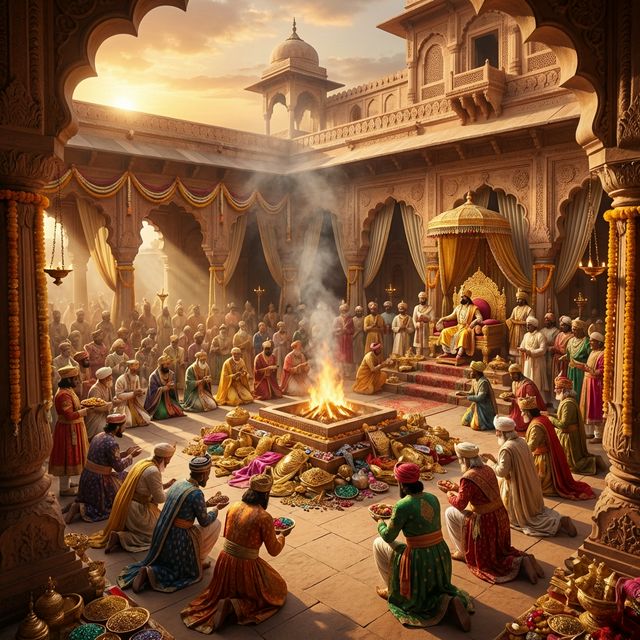
What followed, Vyasa said, was a sacrifice on a scale the world had rarely seen before or since. So much gold was gathered for its vessels and its offerings that mortal hands could not manage the ceremony alone, and it was said that the gods themselves came down and carried the golden dishes and implements from station to station, serving a mortal king's rite as though it were their own. Marutta's glory, once refused by Brihaspati, was in the end confirmed by the very heaven that had tried to deny it.
But a sacrifice of that size, Vyasa said, could not spend every measure of gold gathered for it, however lavish its excess. When the rite concluded and the assembled kings dispersed, a great remainder was left over, more than any single treasury could easily absorb, and rather than let it scatter into ordinary hands it had been carried north and left, by long tradition, hidden in the high folds of the Himalaya, guarded ever since by the hosts of Shiva who kept that country.
Asking the Mountain's Permission
Yudhishthira listened to the whole account with a hope he had not felt since the ledgers were first laid before him, and he asked Vyasa directly whether the old story could truly lead them to gold that still existed, after so many ages, waiting under the snow. Vyasa believed it could, and advised the king to gather his brothers and go north himself rather than send others, for the hoard was guarded by beings who would answer to a king's own devotion more readily than to a servant's.
The Pandavas marched into the Himalaya with Vyasa at their head, climbing past the tree line into country where the air itself seemed to thin every ambition down to its essentials. They did not go as conquerors seeking plunder. At the sage's direction they made camp near the place the old accounts pointed to and turned first to worship, propitiating the ganas and rudras of Shiva's own retinue who had kept that gold through every age since Marutta's sacrifice, offering the mountain's guardians the same humility Marutta himself had needed before Samvarta would help him.
The hosts of the mountain, whatever unseen form their consent took, offered no resistance. Where an ordinary raid on such wealth might have met every obstacle the guardians could raise, a king who came asking rather than seizing found the way open before him, and Yudhishthira understood, watching the peace settle over the camp, that the manner of his approach had mattered every bit as much as the old story that had brought him there.
The Gold Comes Down From the Mountain
The digging itself took days. The Pandavas and the men who had marched with them broke ground in the place the old accounts and the mountain's own quiet consent pointed to, and what they found exceeded even Vyasa's telling, vessels and unworked gold in quantities that no single caravan could have carried, the leftover excess of a sacrifice so vast that even the gods had needed to lend their hands to serve it.
Every beast that could bear a load was brought into service, camels and elephants and oxen beyond easy counting, until the whole company began its slow descent from the high passes toward Hastinapura looking less like an army returning from a mountain errand than a second migration, an unbroken line of wealth winding down out of the snow.
Yudhishthira rode at the head of it, and he found himself thinking less of the riches than of the king who had first gathered them. Marutta's ambition, once refused by a jealous heaven, had in the end produced not glory alone but a surplus so vast it had waited centuries in the mountain for exactly this moment, a ruined and grieving king's genuine need. It seemed to him a fitting shape for the world to take, that an old excess, hoarded past any single reign's use, should come at last to answer an emptiness the war had made. With Marutta's gold behind him, the ashvamedha that had seemed impossible only weeks before was, for the first time, simply a matter of preparation, and Yudhishthira allowed himself, cautiously, to believe that the throne might yet be cleansed of what the war had put upon it.
Dharma Lesson
A kingdom emptied by war is not disqualified from seeking atonement; the means to make amends are sometimes already lying in the world, left behind by an older excess, waiting only for a humbler king to ask permission before he takes them.