The Rain Agastya Did Not Need
Twelve years of drought against one sage's seeds
The Question the Mongoose Left Behind
The mongoose with the golden head had vanished out of the sacrificial enclosure, and the Brahmanas had gone home, and Janamejaya was still not satisfied.
"Kings are attached to sacrifices," he said to Vaishampayana. "The great Rishis are attached to penances. Learned Brahmanas are observant of tranquillity of mind, peacefulness of behaviour, and self-restraint. Hence it seems that nothing can be seen in this world which can compare with the fruits of sacrifices. Even this is my conviction, and that conviction seems to be undoubtedly correct.
"Indra of a thousand eyes obtained the sovereignty over the deities through the many sacrifices he performed with gifts in profusion, and attained to the fruition of all his wishes. When king Yudhishthira, with Bhima and Arjuna beside him, resembled the chief of the deities himself in prosperity and prowess, why then did that mongoose depreciate his great Horse-sacrifice?"
"Formerly, on one occasion," said Vaishampayana, "Sakra himself performed a particular sacrifice. The limbs of the sacrifice were spread out. The Ritwijas were busy with the diverse rites. The deities were summoned one by one by contented Brahmanas of great learning uttering the Mantras in sweet voices, and those foremost of Adhwaryus, not fatigued with what they did, recited the Yajurveda in soft accents.
"Then the time came for slaughtering the animals. And when the animals selected for sacrifice were seized, the great Rishis felt compassion for them."
They went to Indra where he stood in his own sacrifice and told him he did not understand it.
"This method of sacrifice is not auspicious. Desirous of acquiring great merit as thou art, this is verily an indication of thy unacquaintance with sacrifice. O Purandara, animals have not been ordained to be slaughtered in sacrifices. These preparations of thine are destructive of merit. The destruction of creatures can never be said to be an act of righteousness. Do thou perform the sacrifice with seeds of grain that have been kept for three years. Even this, O Sakra, would be fraught with great righteousness and productive of fruits of high efficacy."
"The deity of a hundred sacrifices, however, influenced by pride and overwhelmed by stupefaction, did not accept these words."
The King Who Answered Too Quickly
"A great dispute then arose in that sacrifice of Sakra between the ascetics," Vaishampayana said, "as to how sacrifices should be performed, that is, whether they should be performed with mobile creatures or with immobile objects. All of them were worn out with disputation.
"The Rishis then, those beholders of truth, having made an understanding with Sakra about referring the matter to arbitration, asked king Vasu: O highly blessed one, what is the Vedic declaration about sacrifices? Is it preferable to perform sacrifices with animals, or with seeds and juices?
"Hearing the question, king Vasu, without at all judging of the strength or the weakness of the arguments on the two sides, at once answered, saying, Sacrifices may be performed with whichever of the two kinds of objects is ready.
"Having answered the question thus, he had to enter the nether regions. Indeed, the ruler of the Chedis had to undergo that misery for having answered falsely."
He had not lied about anything he cared about. He had been asked a hard question and had produced a convenient answer without weighing it, and the ground opened.
"Therefore, when a doubt arises, no person, however wise, should singly decide the matter, unless he be the self-born Lord of creatures himself.
"Gifts made by a sinner with an impure understanding, even when they are very large, become lost. Such gifts go for nothing. That person of little intelligence who, from a desire of acquiring merit, performs sacrifices with wealth acquired by unrighteous means, never succeeds in earning merit. But men endued with wealth of penances, by giving away to the best of their power grains of corn picked up from the fields, or roots, or fruits, or pot-herbs, or water, or leaves, acquire great merit and proceed to Heaven. We hear of Visvamitra, and Asita, and king Janaka, and Kakshasena, and Arshtisena, and king Sindhudwipa. These and many other kings, endued with wealth of penances, having made gifts of articles acquired lawfully, have attained to high success."
Janamejaya heard that out and put the obvious question, which was about the word lawfully.
"If Heaven is the fruit of wealth acquired by lawful means, do thou discourse to me fully on it. Thou art well conversant with the subject. Thou hast said what high fruit accrued unto that Brahmana who lived according to the Unccha mode, through his gift of powdered barley, and without doubt all thou hast said is true. In what way, however, was the attainment held certain of the highest end in all sacrifices?"
Twelve Years and the Men Who Came
"In this connection is cited this old narrative," said Vaishampayana, "of what occurred in former days in the great sacrifice of Agastya.
"In olden days, O king, Agastya of great energy, devoted to the good of all creatures, entered into a Diksha extending for twelve years."
Twelve years is the length of the thing. It should be said plainly at the outset, because everything that follows turns on the arithmetic: a rite consecrated for twelve years, provisioned for twelve years, and fed daily to whoever came.
And they came. In that sacrifice of the high-souled Rishi, many Hotris were engaged that resembled blazing fires in the splendour of their bodies. Among them were men that subsisted upon roots or upon fruits. Among them were men who used two pieces of stone only for husking their corn, and men who were supported by nothing but the rays of the moon. Among them were also men who never took any food unless it was placed before them by others solicitous of feeding them, and men who never ate anything without having first served the deities, the Pitris and their guests, and men who never washed the food which they took. There were Yatis among them, and Bikshus.
All of them, the account says, were men who had obtained a sight of the deity of Righteousness in his embodied form. They had subjugated wrath and acquired a complete mastery over all their senses. Living in the observance of self-restraint, they were freed from pride and from the desire of injuring others, and they were never obstructed in the prosecution of their purposes by their senses.
Those great Rishis attended that sacrifice and accomplished its various rites. Numerous other ascetics at that time performed large sacrifices of their own elsewhere.
And of the food that was collected in that sacrifice, and that came up to the required measure, every grain was acquired by the illustrious Rishi by lawful means, according to the best of his power.
That is the sentence the whole story hangs from, and nobody at the time thought it remarkable. It is the same standard by which the Brahmana of the Unccha mode was measured, the man who lived on grains of corn picked up one by one from the fields after the reapers had gone, and who gave away a prastha of powdered barley to a guest and turned half a mongoose to gold with it. Lawful means is not a phrase about honesty only. It is a phrase about the width of the channel: roots, fruits, pot-herbs, water, leaves, gleanings, and nothing whatever taken by force, by flattery, by office, or by the exercise of a power that other men do not have.
The Rain Stops
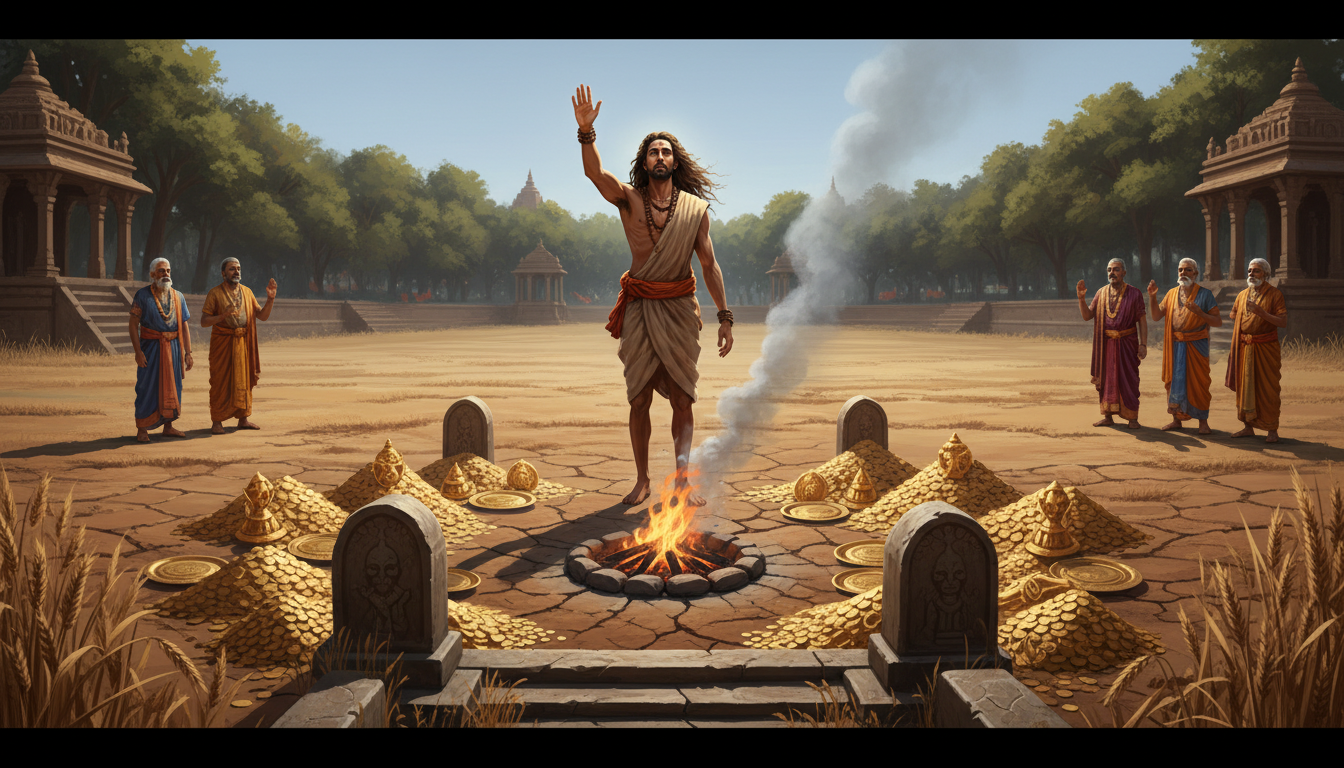
As Agastya was engaged in that sacrifice of his, the thousand-eyed Indra ceased to pour rain on the Earth.
No message came with it. There was no herald and no curse pronounced in an assembly and no envoy sent down with terms, and there is nothing in the account to say that Indra ever explained himself to anybody. The sky simply held what it had.
The Rishis noticed first, as men who live on what grows will. At the intervals of the sacrificial rites, when there was nothing to do but sit in the shade of the enclosure and wait for the next hour of the ritual, this talk occurred among them, and they were careful to speak of Agastya as men speak of someone they are worried for and do not wish to shame.
"This Agastya, engaged in sacrifice, is making gifts of food with a heart purged of pride and vanity. The deity of the clouds, however, has ceased to pour rain. How, indeed, will food grow?
"This sacrifice of the Rishi, ye Brahmanas, is great, and it extends for twelve years. The deity will not pour rain for these twelve years. Reflecting on this, it behoveth you to do some favour unto this Rishi of great intelligence, unto Agastya of severe penances."
They were not asking him to submit. They were proposing, among themselves, to help him out of a difficulty that was plainly going to break him, since a man who has undertaken to feed several hundred ascetics daily for twelve years out of grain lawfully got cannot do it out of a country where nothing is growing.
Agastya heard them. He did not argue with them and he did not raise his voice. He gratified those ascetics by bending his head to them, in the manner of a host acknowledging the kindness of guests, and then he answered.
The Mental Sacrifice and the Sacrifice by Touch
"If Vasava does not pour rain for those twelve years," Agastya said, "I shall then perform the mental sacrifice. Even this is the eternal ordinance.
"If Vasava does not pour rain for these twelve years, I shall then perform the Touch-sacrifice. Even this is the eternal sacrifice.
"If Vasava does not pour rain for these twelve years, I shall then, putting forth all my exertion, make arrangements for other sacrifices characterised by the observance of the most difficult and severe vows."
He had three answers ready before he was asked for one, and each of them was smaller than the last. If there is no grain there will be a rite performed in the mind. If the mind is not permitted, there will be a rite performed by the laying on of a hand. He was not proposing to abandon the sacrifice. He was proposing to keep shrinking it until it fitted inside whatever the world would still allow him.
"This present sacrifice of mine, with seeds, has been arranged for by me with labour extending for many years," he said. "I shall, with seeds, accomplish much good. No impediment will arise. This my sacrifice is incapable of being baffled. It matters little whether the deity pours rain or no downpours happen."
The Rishis in the enclosure sat and listened to a man tell them that the weather was not a party to his vow. He had provisioned the rite years before it began, and the provision was seed, and seed does not care whether the year is wet. Whatever else the lord of the clouds could withhold, he could not withhold what was already in the store.
And then, having exhausted the humble answers, Agastya said the other thing.
Then I Shall Be Indra
"Indeed, if Indra does not, of his own will, show any regard for me, I shall in that case transform myself into Indra and keep all creatures alive.
"Every creature, on whatever food he has been nourished, will continue to be nourished on it as before. I can even repeatedly create a different order of things."
It was said in the same tone as the arrangements about seeds. The office of the king of the gods was described as a vacancy that could be filled if its present holder declined the work, and the duty attached to it, which is that every creature goes on being fed, was described as a duty Agastya was prepared to assume.
Then he began to call, and the calling was itself the demonstration.
"Let gold, and whatever else of wealth there is, come to this place today. Let all the wealth that occurs in the three worlds come here today of its own accord. Let all the tribes of celestial Apsaras, and all the Gandharvas along with the Kinnaras, and Viswavasu, and the others there are of that order, approach this sacrifice of mine. Let all the wealth that exists among the Northern Kurus come of their own accord to these sacrifices. Let Heaven, and all those who have Heaven for their home, and Dharma himself, come hither."
After the ascetic had uttered these words, everything happened as he wished.
It happened in consequence of his penances, for Agastya was endued with a mind that resembled a blazing fire and was possessed of extraordinary energy. The wealth of the Northern Kurus came down into a sacrificial ground in a country where it had not rained. The singers of heaven came, and the dancers, and Dharma in his own person, and the thing that had been withheld was shown to be a thing the sacrifice had never actually required.
The Rishis who were there beheld the power of penances with rejoicing hearts, and were filled with wonder, and then they said something that no one at that ground expected.
The Rishis Ask Him Not To
"We have been highly gratified with the words thou hast uttered," the Rishis said. "We do not, however, wish that thy penances should suffer any diminution."
That was the whole of the objection, and it was not made out of timidity. The men saying it had spent their lives on penances and knew to the last grain what such a display costs the man who makes it, and they had watched a twelve-year store of merit spent in an afternoon to solve a difficulty about rainfall.
"Those sacrifices are approved by us which are performed by lawful means. Indeed, we desire duly those sacrifices which rest on lawful means.
"Earning our food by lawful means, and observant of our respective duties, we shall seek to go through the sacrificial initiations, and the pouring of libations on the sacred fire, and the other religious rites. We should adore the deities practising Brahmacharyya by lawful means. Completing the period of Brahmacharyya, we have come out of our abode observing lawful methods.
"That understanding which is freed from the desire of inflicting any kind of injury on others is approved by us. Thou shouldst always, O puissant one, command such abstention from injury in all sacrifices. We shall then be highly gratified, O foremost of regenerate ones. After the completion of thy sacrifice, when dismissed by thee, we shall then leave this place and go away."
They had been offered a miracle that would have kept them all fed for eleven more years, and they asked instead to go on eating what they could lawfully get, and to be dismissed in the ordinary way when the twelve years were done.
It is the same argument the Rishis had made to Indra in his own sacrifice, when they told him to use seeds three years old rather than the animals at the stake. It is the argument the mongoose made about a prastha of powdered barley. The size of the offering is not the measure of the offering. How it was got is the measure of it, and a rite funded by a display of power is no better placed than a rite funded by plunder.
Purandara Pours
As they were saying these words, Purandara, the chief of the deities, endued with great energy, beholding the power of Agastya's penances, poured rain.
Nothing was negotiated. No envoy went up and no terms came down, and Indra did not require the sage to unsay anything he had said about becoming Indra. He had seen the wealth of the Northern Kurus arrive of its own accord in a dry country and had drawn the correct conclusion, which was that the drought was no longer a weapon and had only ever been an argument, and that he had lost it.
And indeed, O Janamejaya, till the completion of the sacrifice of that Rishi of immeasurable prowess, the deity of rain poured rain that met the wishes of men in respect of both quantity and time. Not merely enough. The right amount, at the right hour, for eleven more years.
Then, placing Vrihaspati before him, the chief of the deities came there, O royal sage, and gratified the Rishi Agastya. He brought the priest of heaven with him and put him in front, which is what a king does when he intends the visit to be read as an honour rather than a submission, and Agastya let it be read that way.
On the completion of that sacrifice, Agastya, filled with joy, worshipped those great Rishis duly, and then dismissed them all, exactly as they had asked him at the beginning to do.
"Thou shouldst not, O king, think highly of sacrifice," Vaishampayana said to Janamejaya, closing the account where he had opened it. "Millions of Rishis have ascended to Heaven with the aid of only their penances. Abstention from injury as regards all creatures, contentment, conduct, sincerity, penances, self-restraint, truthfulness, and gifts are each equal in point of merit to sacrifice."
Dharma Lesson
The measure of a sacrifice is not the size of what is offered but the lawfulness of how it was got, so that a prastha of gleaned barley can outweigh a horse sacrifice. And a power great enough to replace God is a power the wise will ask you not to use, because a rite funded by a display of force stands no better than a rite funded by plunder.