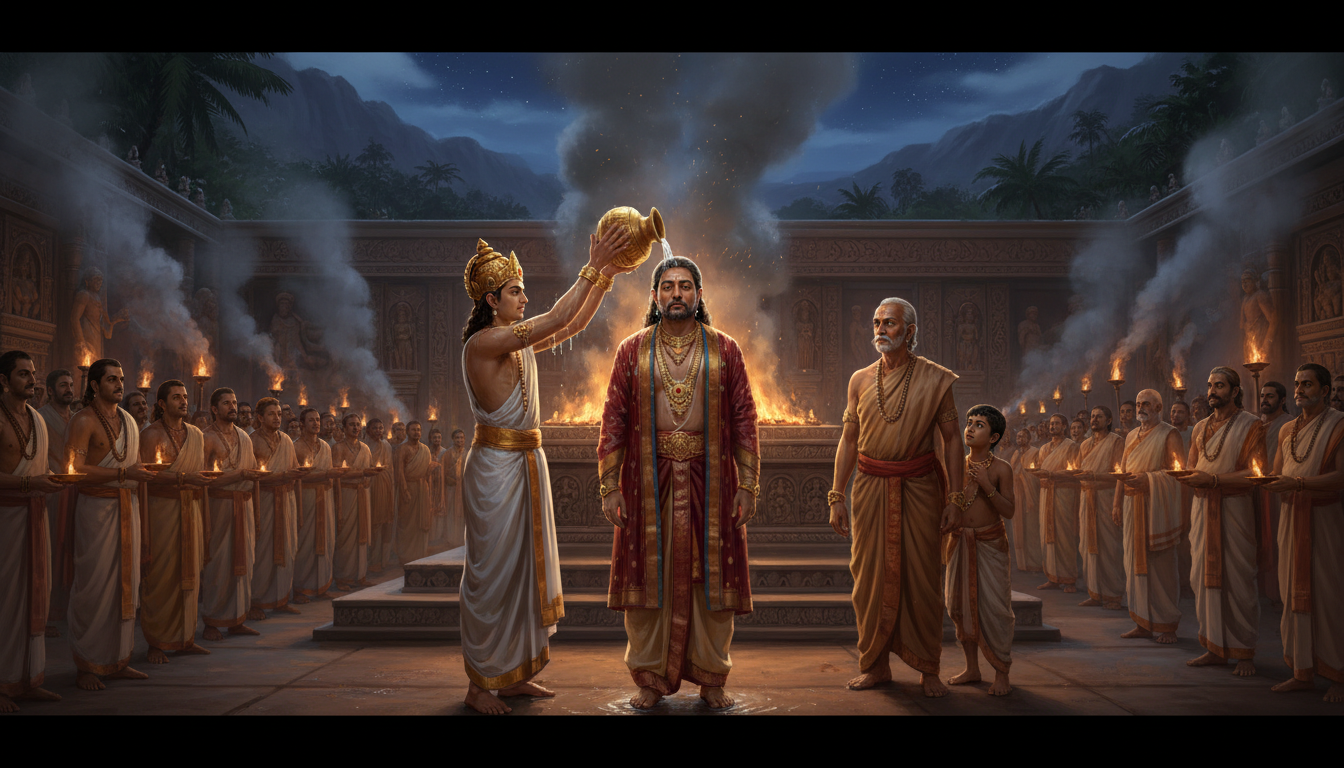
Vyasa Brings Back Parikshit
A Son Bathes His Dead Father at the Snake Sacrifice
The King Who Had Already Won
The snakes had stopped falling into the fire.
Janamejaya's great sacrifice had been running for days on the platform at Takshashila, the priests calling the serpents by name out of the four quarters and the serpents coming, helpless, curling in the air above the altar and dropping into the flame. Then a boy of the Yayavara line named Astika, son of Jaratkaru, had walked in and asked for a boon and used it to stop the rite while Takshaka hung in the sky above the fire with his coils already smoking. Janamejaya had kept his word and let him go. The sacrifice had been closed with everything alive in it that Astika had asked for.
What was left was the recitation. In the long clear days after the fires were banked, Vaishampayana, the disciple of Vyasa, sat before the king and told him the whole history of his house, and the king listened the way a man listens who is looking for something specific and has not found it yet.
On this day Vaishampayana had come to the end of the story of the forest: how Vyasa had stood in the waters of the Bhagirathi at night and summoned the dead of Kurukshetra out of the river, and how they had risen by thousands in the dress and the standards they had died in, free of animosity and pride; how the Pandavas had met Karna there and been reconciled with him; and how, in the twinkling of an eye, all of them had gone back into the water.
Janamejaya was highly pleased. He was also, Sauti said afterward to the Rishis of Naimisha, not finished.
How Can a Destroyed Body Come Back
"How is it possible," Janamejaya asked, "for persons whose bodies have been destroyed to reappear in those very forms?"
It was not a hostile question. It was the question of a man who wanted the thing to be true and had been trained not to accept what he wanted.
Vaishampayana, that first of speakers, answered him.
"This is certain: that acts are never destroyed without their consequences being enjoyed or endured. Bodies are born of acts, O king, and so also are features. The great primal elements are eternal, in consequence of the union with them of the Lord of all beings. They exist with what is eternal, and accordingly they have no destruction when the non-eternal are destroyed."
"Then what is it that suffers?"
"The soul, united with such acts as require exertion for their accomplishment, enjoys pleasure and pain. Yet though it is so united, it is a certain inference that the soul is never modified by them, as the reflection of a creature is not modified by the mirror it falls in. It is never destroyed. So long as one's acts are not exhausted, so long does one regard the body to be oneself. The man whose acts have been exhausted no longer regards the body to be self, and takes the self to be something otherwise."
He went further than the question, as teachers do.
"He who beholds a creature as disposed to take diverse forms is regarded as having an erroneous understanding. And he who indulges in too much grief at separation is, I think, a foolish person. He who sees evil in separation should abandon union. By standing aloof, no unions are formed, and sorrow is cast off, for sorrow in the world is born of separation."
Janamejaya heard the whole of it and did not dispute a word. He had been taught the same doctrine himself. He simply did not believe an account of the dead returning because someone had told it to him well.
The Blind King Saw His Sons
"Consider what happened to your great-uncle," Vaishampayana said. "King Dhritarashtra had never beheld his own sons. A hundred of them were born in his house and grew in it and went out of it to be killed, and he had never once seen a face. Obtaining eyesight through the grace of the Rishi, he beheld, for the first time, those children of his that were very like his own self. He had learned all the duties of kings, and the Vedas, and the Upanishads, and he had acquired certitude of understanding from the same source; and none of that had given him his sons. Vyasa gave him his sons. He saw them for one night, and he was divested of his grief, and he went back to his retreat in the woods and made no further complaint."
"And Vidura?"
"Vidura of great wisdom attained to high success through the power of his own penances. Dhritarashtra attained to great success in consequence of having met the ascetic Vyasa. Those are two roads, O king, and the second is shorter, and it was not the blind king's merit that opened it. It was the sage's grace."
Janamejaya sat with that for a while. He was young. He had inherited a kingdom from a father he could not remember, and had spent the best part of his reign building a fire large enough to answer for that father's death, and it had all gone the way such things go: the fire had been very great, the snakes had burned by the thousand, and the man he had done it for had not come any nearer.
There was one sage in the world who had brought the dead back out of a river within living memory. And that sage was sitting in the sacrificial enclosure, forty paces from the throne, and had been there the whole time.
Then Show Him to Me
Janamejaya rose from his seat and spoke, not to Vaishampayana but past him, to the old man in bark cloth sitting among the priests.
"If Vyasa is disposed to grant me a boon," he said, "let him kindly show me my sire."
The court heard what he had asked and made no sound at all.
"In that form which he had," the king went on, and he was precise about it, the way a man is precise about the one thing he has thought of every day. "Clad as he used to be clad. And as old as he was when he departed from this world. Not a light. Not a voice. Him. If I am shown that, I may then believe all that you have told me. Such a sight will be most agreeable to me. Indeed, I shall regard myself as crowned with success. I shall have gained a certainty of conclusion. O, let my wish be crowned with fruition through the grace of that foremost of Rishis."
It was, considered coldly, an outrageous demand. Vyasa had raised the dead of Kurukshetra for two grieving parents and a grieving mother, after being asked by his own son's widow and by Kunti, and he had done it once, and he had said plainly that the dead should not be grieved for. Janamejaya was asking a sage to repeat a miracle as evidence.
But he was also a son who had never seen his father alive, and everyone in that enclosure knew how Parikshit had died, and knew that the boy on the throne had built the largest sacrifice of the age around the wound.
Vyasa of great energy and intelligence showed his grace.
The Stag, the Silence, and the Dead Snake
This was the death he was asking to have undone.
Parikshit, the son of Abhimanyu, hunting alone, had wounded a fleet stag with an arrow and chased it until he lost it in an extensive wilderness. Oppressed by hunger and thirst and labour, he came upon a lean old Rishi named Samika sitting motionless in a cow-pen, and asked him again and again which way the deer had gone. The Rishi was under a vow of silence and returned no reply. He said nothing good and nothing bad. And the king, in anger, lifted a dead snake on the end of his bow and laid it across the old man's shoulder.
Samika suffered him to do it without protest. He did not curse him. He knew that the monarch was true to the duties of his order, and he let the insult sit on his shoulder and went on with his devotion. The king rode home to the city named after the elephant, and on the road his anger cooled and he became sorry.
But Samika had a son, Sringin, of tender years, deep in ascetic penances, severe in his vows, very wrathful and difficult to appease. A companion of his, a Rishi's son named Krisa, told him laughingly, "Be not proud, Sringin. Ascetic as you are, your father bears on his shoulders a dead snake." And Sringin's eyes reddened, and he asked who had done it, and was told, and then he touched water and cursed.
"That sinful wretch of a monarch who has placed a dead snake on the shoulders of my lean and old parent, that insulter of Brahmanas and tarnisher of the fame of the Kurus, shall be taken within seven nights hence to the regions of Yama by Takshaka, the king of serpents."
Samika was not pleased with his son. "Ascetics should not act thus," he said. "We live in the domains of that great king. We are protected by him righteously." And he sent a disciple, Gaurmukha, to warn the king to guard himself, which is a thing very few cursed men are given.
Parikshit used the warning. He caused a mansion to be erected upon one solitary column, well guarded day and night, with physicians and medicines and Brahmanas skilled in mantras placed all around it. He discharged his kingly duties from up there, surrounded by his ministers. No one could approach him. The air itself, it was said, could not get in.
On the seventh day Takshaka sent snakes in the guise of ascetics carrying fruits and kusa grass and water as presents, and the king accepted them courteously and dismissed the visitors, and then said to his councillors, eat these excellent fruits with me. The particular fruit that he chose for himself had a small ugly insect inside it, of a coppery colour, with black eyes. The sun was setting. He had a few minutes left of the seventh day.
And Parikshit held the insect up and said: today I have no more fear from poison, therefore let this insect become Takshaka and bite me, so that my sinful act may be expiated and the words of the ascetic be rendered true. He was smiling when he put it on his own neck.
That was the account. Janamejaya had heard it as a child, and had answered it with a fire that ate serpents for days.
Brought Down in the Same Form
King Janamejaya beheld his royal father, possessed of great beauty, brought down from heaven, in the same form that he had and of the same age as he was at the time of leaving this world.
He was not a light and he was not a voice. He wore what he had worn. He was the age he had been on the seventh night, which was not an old man's age. The king who had built the house on the single column, and had counted the days inside it, and had eaten a fruit brought to him by men he trusted, stood on the sacrificial ground at Takshashila in front of his own son, and all the counsellors and the ministers of the king beheld him. Not one of them could afterward be persuaded to say it had been an appearance only.
And two others were brought there with him, and this is the part of it that the reciters do not hurry over.
The high-souled Samika was similarly brought. And his son Sringin.
They stood where the whole court could see them: the old Rishi who had carried a dead snake on his shoulder without a word and had then sent a runner to warn the man who put it there, and the boy who had lost his temper over his father's dignity and had spent it, in one sentence, on the life of a king.
Janamejaya looked at the three of them together. He had spent years and a treasury and an ocean of serpents on the proposition that his father's death had been a murder that could be answered. Vyasa had now set the whole transaction on the ground in front of him at once, in the correct order, with nobody missing and nobody being punished.
What the Son Did Not Ask For
There is no speech recorded between them.
Sauti, telling it in the Naimisha forest long afterward, gives the meeting no dialogue at all, and it may be that there was none. Janamejaya did not ask his father whether it had hurt. He did not ask him what the last day in the house of one column had been like, or whether he had known when the fruit was cut open, or whether he had thought of his son. He did not ask him whether the snakes burning had reached him where he was and been any use to him.
And he did not turn on Sringin.
He had every worldly right to. The boy was standing in a Kuru sacrificial enclosure surrounded by a Kuru king's guards and had killed a Kuru king with his mouth. The rite that had just been concluded on that platform had been designed, from the first pouring, to make somebody pay for exactly this. Janamejaya was a young man with a temper; his own father's temper was on record and was the cause of everything.
He let it go. He looked at his father, and at the old ascetic who had refused to curse, and at the furious boy who had, and he understood what he had actually been shown, which was not a resurrection but a settled account.
His father had insulted a Brahmana and had been sorry before he reached the city. The Brahmana had forgiven him without being asked and had sent a runner to save him. The son of the Brahmana had not forgiven him and had killed him with a sentence. And Parikshit, at the end, had put the insect on his own neck with his own hand so that the words of the ascetic should be rendered true. Every one of them had done what his nature required. None of them was standing there asking for anything.
What Janamejaya said, when he spoke, he said to a priest, and it was about water.
The Final Bath
It was the day of the avabhritha, the final bath that closes a sacrifice and washes the rite off the man who performed it. Everything he had done for years ended with that water going over his head.
King Janamejaya, performing the final bath in his sacrifice, became highly glad. And he poured the sacred water on his father, even as he caused it to be poured on himself.
He did not do it apart or afterward. The same jars, the same consecrated water, at the same moment: over his own head, and over the head of the man standing beside him who had been dead since before he could remember. Whatever a son owes a father in the way of libation and offering, he had been performing at a distance all his life, into fire and into water, hoping it arrived. Now he simply reached over and poured it on him.
Somewhere in the completion of that gesture the sacrifice stopped being about Takshaka.
The snakes were ash. Takshaka was alive, spared by a boy's boon and by the king's own word, and would stay alive. Parikshit was standing in the courtyard in the clothes he had died in, at the age he had died at, and would not be staying. Samika and Sringin were standing there too, unharmed, unaccused. And Janamejaya, wet to the shoulders, was a man with nothing further to collect from anybody.
The Knots of the Heart
Having undergone the final bath, the king turned to the regenerate Astika, who had sprung from the race of the Yayavaras and was the son of Jaratkaru, the same boy whose boon had stopped the fire.
"O Astika," he said, "this sacrifice of mine is fraught with many wonderful incidents, since this my sire has been seen by me. He who has dispelled all my sorrows."
Astika answered him.
"The performer of that sacrifice in which the ancient Rishi, the Island-born Vyasa, that vast receptacle of penances, is present, is sure, foremost one of Kuru's race, to conquer both the worlds. O son of the Pandavas, you have heard a wonderful history. The snakes have been consumed into ashes and have followed the footsteps of your sire. Through your truthfulness, O monarch, Takshaka has with difficulty escaped a painful fate. The Rishis have all been worshipped. You have seen also the end that has been attained by your high-souled sire. Having heard this sin-cleansing history you have achieved abundant merit."
Then he said the thing that the whole of it had been for.
"The knots of your heart have been untied through the sight of this foremost of persons. They that are the supporters of the wings of Righteousness, they that are of good conduct and excellent disposition, they at the sight of whom sins become attenuated: we should all bow to them."
And the dead went back, as the dead at the Bhagirathi had gone back, without anyone trying to hold them.
Janamejaya worshipped the Rishi, honouring him repeatedly and in every way. Then, conversant with all duties, and with nothing left in him that needed answering, he sat down again and asked Vaishampayana of unfading glory to go on with the story: what became, in the end, of king Dhritarashtra's residence in the woods.
Dharma Lesson
Vengeance completed does not close a grief. What closes it is meeting the dead, and the men who wronged them, and wanting nothing further from either. The knots of the heart are untied by sight and not by fire.