A Month in the Woods, and a Boon Offered
"Tell me," said Janamejaya, "what that wonderful thing was which Vyasa accomplished after the promise he made to the old king. Dhritarashtra had gone to the woods with his wife and with Kunti, his daughter-in-law. Vidura had already left his body and entered into Yudhishthira. And all the sons of Pandu were staying at that retreat. How many days did they stay? On what food did they live there, they and their men and their women?"
"They stayed about a month," said Vaishampayana, "with their troops and the ladies of the household, living on the fruits and roots and such foods as the forest gives, and they were happy there. And towards the close of that month Vyasa came."
He did not come alone. While the princes sat around him talking, other rishis arrived at that spot: Narada, and Parvata, and Devala of the hard penances, and Viswavasu and Tumvuru and Chitrasena. Yudhishthira asked Dhritarashtra's leave before he did anything, because that was the rule of the household even here, and then worshipped them by the proper rites. They sat down on seats of kusa grass and on seats made of peacock feathers. The Kuru king sat surrounded by his brothers. Gandhari sat, and Kunti, and Draupadi, and Subhadra of the Sattwata line, and the other women of the royal house behind them.
The talk that went round the circle was of piety, and of the rishis of the old time, and of the gods and the asuras, and it was very fine talk, and it lasted a long while, and under all of it lay one subject that nobody had named.
At the end of it Vyasa turned to the blind man.
"You are burning," he said. "I know, O king of kings, what object is cherished in your heart. I know the sorrow that is always in Gandhari's heart, and the sorrow in Kunti's, and the one Draupadi carries, and the grief for a dead son that Krishna's sister Subhadra carries. I heard that you were all meeting here, and I came for that reason and no other, to put an end to your doubting. Let the gods and the gandharvas and all these great rishis see today what my penances have earned in all these years. Tell me what you wish. I have the power to grant it. Look at the fruit of my austerities and ask."
What the Blind King Asked For First
Dhritarashtra sat with the offer in front of him and did not take it up. He thought for a moment, and then he began to speak, and what came out was not a wish but an accounting.
"I am fortunate," he said. "I am lucky to have your favour. My life is crowned today, since this meeting has happened between me and all of you who are equal to Brahma himself. There is no doubt that the sight of you has cleansed me of every sin, and I have no fear now about my end in the next world.
"But I am full of love for my children, and I remember them always. And my mind is tortured by the memory of the wrongs my son did. He had a sinful understanding and he persecuted the innocent all his life. The whole earth has been laid waste by him, with her horses and her elephants and her men. Many high-souled kings, rulers of many realms, came to take my son's side and died for it. They left their fathers and their wives and their own breath behind them, and they are guests now in the house of the king of the dead.
"What end have they reached, holy one, those men who were killed for the sake of a friend? What end have my sons reached, and my grandsons who fell in the fray? My heart is pained always by the thought that it was I who brought about the slaughter of Bhishma, the son of Santanu, and of Drona, the foremost of Brahmanas, through a foolish and sinful son who injured his own friends. He wanted the sovereignty of the earth, and to get it he had the Kuru race annihilated while it was blazing with prosperity. I turn all this over day and night and I burn. I am not able to get peace of mind. Indeed, father, thinking of this, I have no peace at all."
He did not ask for anything. He simply laid the whole weight of it down in the middle of that circle of sages and let it lie there.
And hearing him say it aloud, the grief of every person sitting in that forest went green again, as though the sixteen years had been nothing: Gandhari's grief, and Kunti's, and Drupada's daughter's, and Subhadra's, and the grief of every daughter-in-law of the house of Kuru sitting behind them in the dark.
Gandhari Names Them
It was Gandhari who asked, because Gandhari had counted them.
She joined her hands, with the bandage still across her eyes as it had been across them for a lifetime, and spoke to her father-in-law.
"Sixteen years have passed over this king's head while he grieved for his sons," she said. "He has had no peace in any of them. He breathes heavily. He does not sleep at night. O great rishi, by the power of your penances you are able to create new worlds. What is it to you, then, to show this king his children who are in the other world?
"This Krishnaa, the daughter of Drupada, has lost every kinsman and every child she had, and she is the dearest of my daughters-in-law, and she grieves. The sister of Krishna, Subhadra of the sweet speech, burns for the loss of her son. This lady here, who is respected by everyone, is the wife of Bhurisravas, and she laments in a way that tears the heart, because of what happened to her husband. Her father-in-law was Somadatta, and his father was the intelligent Valhika of Kuru's line, and both of them, the son and the sire, were killed in that battle. What end have they reached?
"And a hundred sons of this king, heroes who never turned their backs in a fight, were killed there. The hundred wives of those hundred sons are grieving still, and they gather around me, and every one of them makes the king's grief and my own grief larger. Do this, holy one, and the lord of the earth and I and this daughter-in-law of yours, Kunti, will all be free of our sorrow."
She had asked for one hour of the impossible in the plainest voice she had, and she had not asked for herself first. She had put Draupadi first, and Subhadra second, and a widow whose name nobody else in that forest would have thought to mention, and only then the hundred.
Kunti Tells the Thing She Has Never Told
While Gandhari spoke, Kunti sat with her face wasted from years of hard vows and thought about a son with the light of the sun on him whom nobody in that circle had named.
Vyasa, who could hear what was said at a great distance and see what was hidden, turned to her.
"Tell me, blessed one. What is in your mind. Tell me what you wish to say."
She bent her head to her father-in-law and, ashamed, said it.
"An ascetic named Durvasa came to my father's house for alms. He was of the regenerate order and full of wrath. I pleased him by the cleanness of my behaviour and my mind, and by refusing to take notice of the many wrongs he did me; there was a great deal in his conduct that could have made me angry, and I did not become angry. So he was pleased, and he said, 'You must accept the boon I shall give you.' I was afraid of his curse and I said, 'So be it.' Then he said, 'O blessed girl, you will become the mother of Dharma. The gods whom you summon will obey you.' And he vanished, and I was left wondering, and the mantra stayed in my memory always.
"One day I was sitting in my own chamber and I saw the sun rising. I wanted to bring the maker of day in front of me. I remembered the rishi's words. I had no idea of the fault I was committing. I called him out of pure girlishness, and the god of a thousand rays came. He divided himself in two. With one half he stood in the sky and heated the worlds, and with the other half he stood on the earth in front of me. I was trembling, and he said, 'Ask a boon of me.' I bowed my head and asked him to leave me. He said, 'I cannot bear the thought of having come to you for nothing. I shall burn you, and I shall burn the Brahmana who gave you the mantra.' I wanted to save that Brahmana, who had done no evil. So I said, 'Then let me have a son like yourself, O god.' He filled me with his energy and left me stupefied, and said, 'You will have a son,' and went back into the sky.
"I lived on in the inner apartments, and to save my father's honour I put my infant son into the water. His name is Karna. Through the grace of that god I became a virgin again, as Durvasa had said I would. And fool that I am, though he knew me for his mother when he was grown, I made no effort to own him. That is what burns me, and you know it already. Sinful or not, I have told you the truth. Satisfy this craving I have to look at that son of mine."
Portions of the Gods
"Blessed be you," said Vyasa. "Everything you have said to me will happen. And in the matter of Karna's birth no fault attaches to you. You were restored to your maidenhood. The gods have the power of yoga; they can enter human bodies. There are gods who beget offspring by thought alone. By word, by sight, by touch, and by union: these are the five ways. You belong to the order of humanity. There is no fault in you. Know it, Kunti, and let the fever go out of your heart. For those that are mighty, everything is becoming. For those that are mighty, everything is pure. For those that are mighty, everything is meritorious. For those that are mighty, everything is their own."
Then he turned back to Gandhari and gave his answer to all of them at once.
"Blessed be you, Gandhari. This night you shall see your sons and your brothers and your friends and your kinsmen and your fathers, like men getting up out of sleep. Kunti shall see Karna. She of Yadu's race shall see her son Abhimanyu. Draupadi shall see her five sons and her father and her brothers. This was in my mind before any of you asked; I formed the purpose when the king urged me, and when you urged me, and Kunti.
"You should not grieve for those foremost of men. They died in the way the practice of Kshatriyas has established, and the work of the gods could not be left unaccomplished. That is what they came down to the earth for. They were all portions of deities.
"It is heard that the intelligent king of the gandharvas, who was also named Dhritarashtra, was born among men as your lord. Pandu sprang from the Maruts. Vidura and Yudhishthira are both portions of the god of Righteousness. Duryodhana was Kali, and Shakuni was Dwapara. Dussasana and his brothers were Rakshasas. Bhimasena is from the Maruts. Arjuna is the ancient rishi Nara, and Hrishikesa is Narayana, and the twins are the Aswins. Surya, foremost of the heat-giving ones, divided his body in two, and with one half went on heating the worlds and with the other half lived on earth as Karna. He who was born as Arjuna's son, the gladdener of all, the heir of the Pandavas, who was killed by six great car-warriors at once, was Soma, born of Subhadra. Dhrishtadyumna, who came out of the sacrificial fire with Draupadi, was an auspicious portion of the god of fire. Sikhandin was a Rakshasa. Drona was a portion of Vrihaspati, and Drona's son is born of a portion of Rudra. Ganga's son Bhishma was one of the Vasus, made a man.
"So the gods took birth as men, and having done what they came for, they have gone back to Heaven. That sorrow which is in all your hearts, about their going back, I shall put an end to today. Go down to the Bhagirathi. There you will see everyone who was killed on that field."
The Day That Would Not End
When they heard him say it, that whole assembly raised a shout like the roar of lions, and got up, and went.
Dhritarashtra went with all his ministers. The Pandavas went. The rishis went, and the gandharvas who had come with them, and behind them the citizens and the country people who had followed the court out of Hastinapura and had been camped in the woods for a month. They came down to the bank of the Ganga, that sea of people, and took up their places along it wherever it pleased them. The king found a good spot and settled there with the women and the old men of his household.
Then they had to wait.
They passed that day as though it were a year. Nobody could eat much. Nobody could sit still and nobody could go far. The river went by in front of them with the light on it, ordinary water, the same water that had gone past yesterday, and every one of them looked at it and thought about the night. The hundred wives of a hundred dead men sat together and did not speak. Draupadi, who had lost five sons in one night to a man who cut their throats while they slept, sat and waited to see them again for the length of one darkness. Kunti waited to look, for the first time as his mother in front of witnesses, at a man she had refused to name while he lived.
The sun came at last to the sacred mountain in the west. They went down into the stream and bathed in it, all of them, and finished the evening rites, and came up out of the water, and it was night.
Vyasa Stands in the Bhagirathi and Calls
They came to Vyasa when the rites were done. Dhritarashtra sat with his body purified and his mind fixed on the one thing, the Pandavas around him and the rishis with them. The women sat apart with Gandhari. The citizens and the country people ranged themselves along the bank in order of their years, the oldest nearest the water.
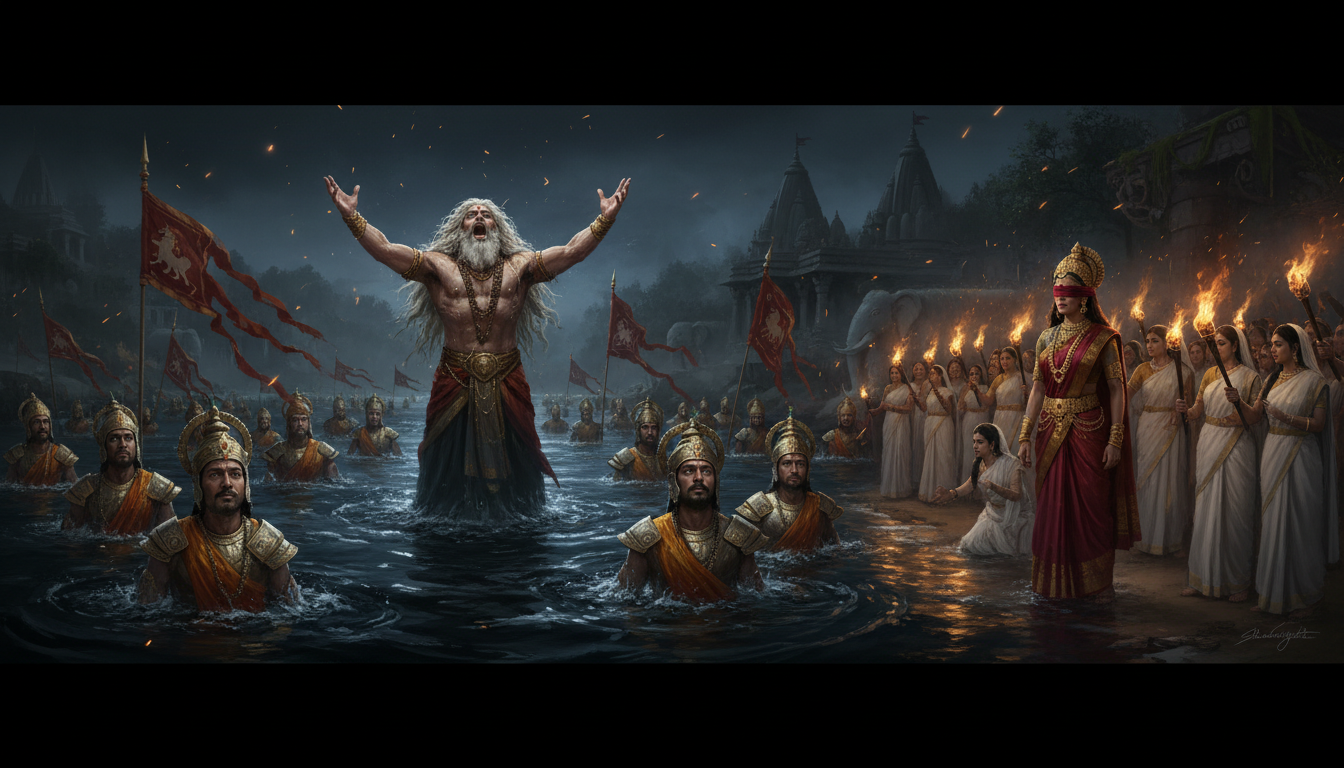
Then the great ascetic waded out into the Bhagirathi until he stood in the sacred water, and summoned the dead.
He called them all. Those who had fought on the Pandava side and those who had fought for the Kauravas, and the blessed kings of many realms who had come from far countries to die on that plain.
And out of the water came a sound.
It was a deafening uproar, and every man on that bank who had been at Kurukshetra knew it at once, because it was the same noise: the noise the two armies had made facing each other, wheels and conches and elephants and the shouting of men, rising up out of a river at night in front of their families.
They Come Up in Their Own Colours
Then the kings rose out of the Bhagirathi by thousands, with Bhishma and Drona at their head, and their troops behind them.
Virata came up, and Drupada, with their sons and their forces. The five sons of Draupadi came up, and the son of Subhadra, and the Rakshasa Ghatotkacha. Karna came, and Duryodhana, and Shakuni the great car-warrior, and all the rest of Dhritarashtra's strong sons with Dussasana in front of them. The son of Jarasandha came, and Bhagadatta, and Jalasandha, and Bhurisravas, and Sala, and Salya, and Vrishasena with his younger brother. Duryodhana's boy Lakshmana came, and the son of Dhrishtadyumna, and all the children of Sikhandin, and Dhrishtaketu with his brother. Achala came, and Vrishaka, and the man-eater Alayudha, and Valhika, and Somadatta, and king Chekitana. There were more of them than could be counted or named.
Every one of them came up out of the water with his body shining, dressed in the dress he had worn on the field, with the standard he had carried and the chariot he had ridden, so that the watchers on the bank could tell each one at a distance by his colours, exactly as they had once been told apart in the smoke.
But the men inside the armour were not the same. They were robed now in celestial cloth and wearing bright earrings, and they were free of animosity and free of pride, with the anger gone out of them and the jealousy gone out of them. Gandharvas sang in front of them. Bards walked at their sides chanting their deeds. Apsaras attended them in bands.
And there in the water Vyasa, the son of Satyavati, being pleased with Dhritarashtra, gave the blind man celestial sight. For the first and only time in his life the king saw his hundred sons with his own eyes. Gandhari, with knowledge and strength given to her, saw all her children too, and everyone else who had been killed in the war.
The people on the bank stood staring with the hair standing up on their bodies. It looked like a great carnival of glad men and women. It looked, said the man who told it, like a picture painted on cloth.
One Night Without Reproach
Then those men, with the wrath and the jealousy washed out of them and every sin cleansed off them, met the living, according to the high ordinances the rishis have laid down for such meetings. They were happy of heart. They looked like gods walking about in heaven.
A son met his father. A son met his mother. Wives met their husbands. Brother met brother, and friend met friend.
And the Pandavas went to Karna.
They met the mighty bowman with joy, and they met Subhadra's son, and the children of Draupadi; and the sons of Pandu came up to Karna, and were reconciled with him. That is the whole of what is said about it. No argument is recorded, and no apology. Five men who had hunted him across a battlefield, and one of whom had cut him down while his wheel was in the ground, walked up to their eldest brother in front of two armies and made peace, and he let them.
All the warriors did the same, everywhere along that bank. They threw off unfriendliness and settled on amity and peace. Kauravas were united with Kurus, and the kings of other countries with their kinsmen, and fathers with their children.
The whole night went by that way in great happiness. The Kshatriyas, for the pleasure of it, thought the place was heaven itself. There was no grief on that bank that night, and no fear, and no suspicion, and no discontent, and not one word of reproach spoken by anyone to anyone. The women, meeting their fathers and brothers and husbands and sons, put their grief down and were carried away with delight.
And when they had been together for one night, those heroes and those women embraced, and took leave of one another properly, and went back to the places they had come from.
The Women Who Walked Into the River
Vyasa dismissed them. In the time it takes to blink, that enormous crowd was gone from in front of the eyes of everyone watching, plunging back into the Bhagirathi with their chariots and their standards and going away to their own homes.
Some went to the regions of the gods, and some to the region of Brahma, and some to Varuna, and some to Kuvera. Some of the kings went to the region of Surya. Among the Rakshasas and Pisachas, some went off to the country of the Northern Kurus, and others moved away in the company of the gods with the pleasure still on them. Every one of them went, with his animals and his vehicles and all his followers.
And when they had gone, the sage was still standing in the water. He turned to the Kshatriya women on the bank, the widows, who had just had their husbands back for the length of one night and lost them again at dawn.
"Let those among these women who wish to reach the regions their husbands have reached," he said, "cast off all sloth, and quickly go down into the sacred Bhagirathi."
They believed him. They asked their father-in-law's permission, which he gave them, and they walked into the river.
They were freed of their human bodies in the water and went to their husbands, in celestial shapes, in celestial ornaments and garlands, riding in excellent cars, their anxieties finished. That was the end of the hundred wives of the hundred sons, and of many others besides.
Vyasa, standing in the stream, gave to everyone else assembled there the fruition of whatever each of them wished for, and then it was over.
Janamejaya, hearing his forefathers described in this way, coming back and going away again, was filled with joy, and asked Vaishampayana another question. And people in every country, when they heard of that meeting between the hallowed dead and living men, were delighted; for the man who hears this account properly told is said to obtain everything that is dear to him, both here and hereafter, and to be reunited with his own.
Dharma Lesson
Grief is not answered by getting the dead back but by seeing that they are no longer angry. What the living actually need is reconciliation, not resurrection, and one night without reproach does more than sixteen years of mourning.