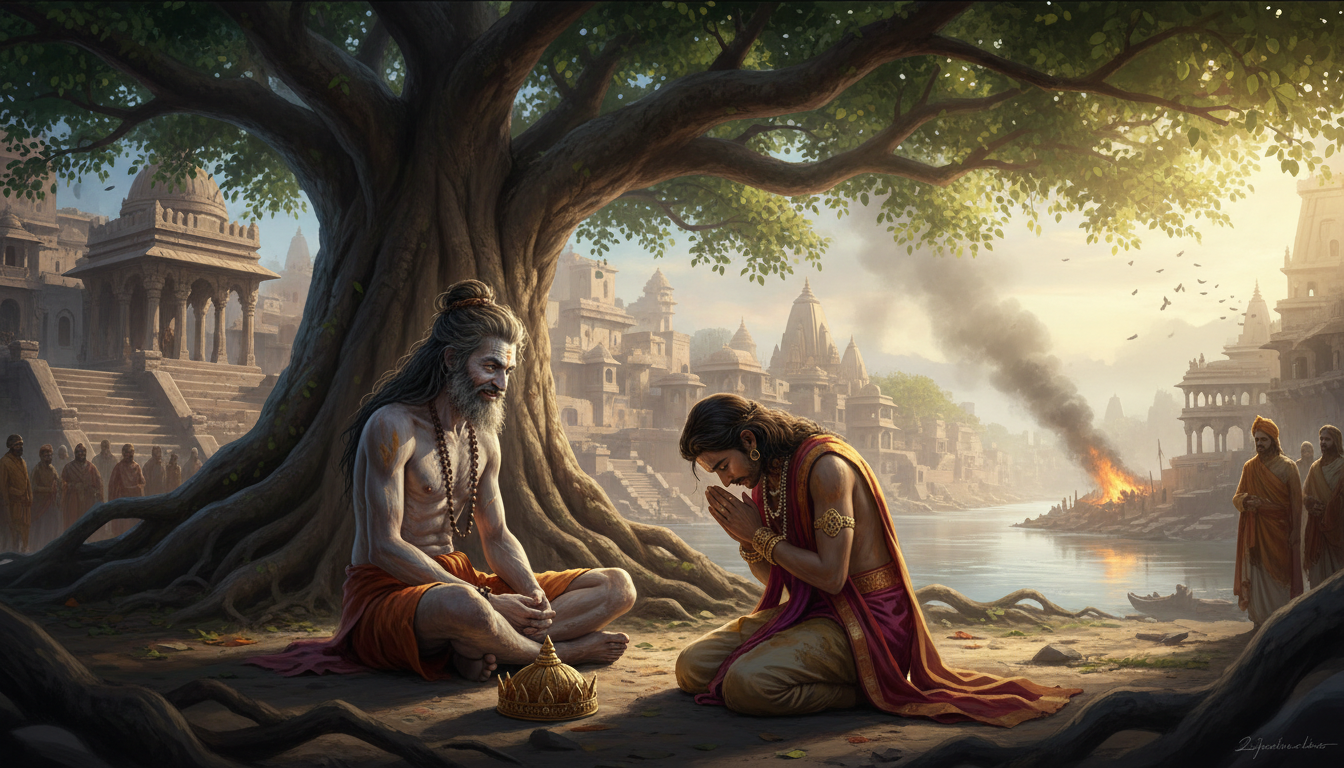
The Naked Priest of Varanasi
How a king outbid Indra for a brother nobody wanted
The King Asks Whose Gold It Was
"O righteous one, I am desirous of hearing the history of that royal sage Marutta. Relate it to me, O sinless one."
Krishna Dwaipayana had come into the hall at Hastinapura with an answer to a question nobody had put to the king directly. The horse sacrifice would need gold, and there was none. The treasury had gone into the war, and the war had eaten it, and the men who might have refilled it were ash on the plain at Kurukshetra. Vyasa had said there was gold in the north, on a mountain, heaped and abandoned where it lay after a sacrifice performed in a former age. And Yudhishthira, who had been sitting for days with his hands open in his lap like a man who has forgotten what they are for, did not ask how far the mountain was. He asked who the king had been.
"In the Krita age," said Vyasa, "Manu was lord of the earth and wielded the sceptre. His son was Prasandhi. Prasandhi's son was Kshupa, and Kshupa's son was that lord of men, king Ikshwaku. He had a hundred sons of pre-eminent piety, and he made monarchs of every one of them. The eldest, Vinsa, became the model of bowmen. Vinsa's son was the auspicious Vivinsa, and Vivinsa had fifteen sons, all powerful archers, reverential to the Brahmanas, truthful and gentle and ever speaking fair.
"The eldest of those fifteen was Khaninetra, and he oppressed all his brothers. He conquered the entire kingdom and rid it of every trouble, and then he could not keep it, for the people were not pleased with him. They dethroned him, and invested his son Suvarcha with the rights of sovereignty, and experienced joy in their hearts when it was done.
"Suvarcha had watched his father lose an empire, and he drew the lesson from it. He was devoted to the Brahmanas, he spoke the truth, he practised purity, he restrained his senses and his thoughts, and he was ever intent on the welfare of the people. And because he was constantly engaged in virtuous deeds, his treasures and his vehicles became greatly reduced. When his treasury was depleted, the feudatory princes swarmed round him and began to give him trouble."
Yudhishthira looked up at that.
"They could not slay him," Vyasa said. "His power was established in righteousness, and righteousness cannot be taken by siege. But he reached the extreme of misery along with his citizens, and at the end of it he blew upon his hand with his mouth, and out of that breath there appeared a supply of forces. With them he vanquished every king along his borders, and from that circumstance men have called him Karandhama ever since.
"His son, born at the beginning of the Treta age, equalled Indra himself and was invincible even by the immortals, and all the kings of that time were under his control. Then came Avikshit, righteous, given to sacrifices, holding his senses under restraint. In energy he resembled the sun, in forbearance the Earth herself, in intelligence Vrihaspati, and in calmness the mountain Himavat. He performed hundreds of horse-sacrifices, and the potent and learned Angiras himself served him as priest.
"And Avikshit's son surpassed his sire. His name was Marutta. He possessed the might of ten thousand elephants and was like a second self of Vishnu, and when the desire came upon him to celebrate a sacrifice he went north of Himavat to Mount Meru and had thousands of shining golden vessels forged there. Goldsmiths made basins and pans and seats without number. On a huge golden hill he performed the rites, and the sacrificial ground was near that place."
Two Sons of Angiras
"How did that king become so powerful?" Yudhishthira said. "How did he obtain so much gold? And where now, O reverend sire, is all his wealth, and how can we secure the same?"
"As the numerous offspring of the Prajapati Daksha, the Asuras and the Celestials, challenged each other," Vyasa said, "so in the same way did the two sons of Angiras. The elder was Vrihaspati, exceedingly energetic. The younger was the ascetic Samvarta, of equal vows. They were brothers of one house and one father, and they challenged each other, and Vrihaspati began to worry Samvarta again and again.
"There is no account of how long it went on. What is recorded is how it ended. Constantly troubled by his elder brother, Samvarta renounced his riches and went into the woods with nothing to cover his body save the open sky.
"At that time Vasava, having vanquished and destroyed the Asuras and obtained the sovereignty of the celestial regions, appointed as his priest that best of Brahmanas, Angiras's eldest son, Vrihaspati. Now Angiras had formerly been the family priest of king Karandhama. But the son took the higher house."
Vyasa let that sit a moment before he went on, because the whole of the story turned on it.
"Marutta, master of the Earth, was pure and possessed of perfections, and this earth clad in oceans felt herself drawn towards him. He always used to defy the lord of the celestials, and Vasava also defied Marutta, and in spite of all his striving Sakra could not prevail over him. Being incapable of controlling him, Indra rode out with the celestials about him, summoned Vrihaspati, and put the matter plainly.
"'O Vrihaspati, if thou wishest to do what is agreeable to me, do not perform priestly offices for Marutta, on behalf of the deities or of the ancestral Manes. I have obtained the sovereignty of the three worlds, while Marutta is merely the lord of the Earth. How, O Brahmana, having acted as priest unto the immortal king of the celestials, wilt thou unhesitatingly perform priestly function unto Marutta, who is subject to death? Good betide thee. Either espouse my side or that of the monarch Marutta. Forsake him, and gladly come over to me.'
"Vrihaspati reflected for a moment. Then he said: 'Thou art the Lord of creatures, and in thee are the worlds established. Thou hast destroyed Namuchi, Viswarupa and Vala. Thou alone encompassest the highest prosperity of the celestials, and thou sustainest the earth as well as the heaven. How, O foremost of the celestials, having officiated as thy priest, shall I serve a mortal prince? Do thou listen to what I say. Even if the god of fire cease to cause heat and warmth, or the earth change its nature, or the sun cease to give light, I shall never deviate from the truth that I have spoken.'
"On hearing this speech, Indra became cured of his envious feelings, and praising him, he repaired to his own mansion."
A Rebuff, and a Rishi on the Road
News of the compact travelled, as such news does, and it reached Marutta while his sacrificial materials were still being counted into their baskets. He had already conceived the whole rite in his mind. He went to Vrihaspati anyway.
"O worshipful ascetic," he said, "I have intended to perform the sacrifice which thou didst propose to me once on a previous occasion, and in accordance with thy instructions, and I now desire to appoint thee as officiating priest in it. The materials have been collected by me. Thou art our family priest. Take those sacrificial things and perform the sacrifice thyself."
"O lord of the earth," said Vrihaspati, "I do not desire to perform thy sacrifice. I have been appointed as priest by the Lord of the gods, and I have promised him to act as such."
"Thou art our hereditary family priest," Marutta said, "and for this reason I entertain great regard for thee, and I have acquired the right of being assisted at sacrifices by thee. Therefore it is meet that thou shouldst officiate at mine."
"Having acted as priest to the Immortals, how can I act as such to mortal men? Whether thou dost depart hence or stay, I tell thee, I have ceased to act as priest to any but the Immortals. O thou of mighty arms, I am unable to act as thy priest now. Appoint any one thou likest who will perform thy sacrifice."
There was no argument to make against that, and Marutta did not make one. He became confused with shame and went home, and his mind was oppressed with anxiety on the road, and on the road he met Narada.
The king stopped and saluted him with his hands clasped together.
"O royal sage, thou seemest to be not well-pleased in thy mind," Narada said. "Is all well with thee? Where hast thou been, O sinless one, and whence the cause of this thy mental disquietude? If there be no objection to thy telling it, disclose it to me, so that I may allay the disquietude of thy mind with all my efforts."
"Seeking for a priest to officiate at my sacrifice," Marutta said, "I went to that priest of the Immortals, Vrihaspati, the son of Angiras. He did not choose to accept my offer. Having met with this rebuff from him, I have no desire to live any longer, for by his abandoning me thus I have become contaminated with sin."
Narada did not console him. He gave him an address.
"The virtuous son of Angiras, Samvarta by name, is wandering over all the quarters of the earth in a naked state, to the wonder of all creatures. Go to him, O prince. If Vrihaspati does not desire to officiate at thy sacrifice, the powerful Samvarta, if pleased with thee, will perform it."
"I feel as if instilled with new life by these thy words. But tell me where I can find Samvarta, and how I can remain by his side, and how I am to act so that he may not abandon me. For I do not desire to live if I meet with a rebuff from him also."
The Corpse at the Gate of Varanasi
"Desirous of seeing Maheswara," Narada said, "he wanders about at his pleasure in the city of Varanasi, in the garb of a mad man. He is not to be found by asking. He is to be found by this means.
"Having reached the gate of that city, thou must place a dead body somewhere near it. And the man who shall turn away on seeing the corpse, know that man to be Samvarta. Knowing him, follow his footsteps wheresoever that powerful man chooses to go, and finding him at length in a lonely place, thou must seek his protection with thy hands clasped together in supplication.
"And if he enquires of thee as to the person who has given thee the information about his own self, tell him that Narada has informed thee. And if he should ask thee to follow me, tell him without any hesitation that I have entered into the fire."
Marutta signified his assent, worshipped the sage, took his permission, and went to Varanasi.
He did exactly what he had been told. He found a dead man and laid the body at the gate of the city, and he waited beside it in the crowd like a person with no business there, which was, at that moment, the truth about him.
By coincidence, that Brahmana entered the gate of the city at the very same time.
On beholding the corpse he suddenly turned away.
That was the whole of the sign, and it lasted less than a breath, and Marutta took it. The son of Avikshit went after him with his hands clasped together, following his footsteps through the streets with the object of receiving instruction from him. And when at length he had him in a lonely place, the naked man turned round and covered the king of the earth with mud and ashes and phlegm and spittle.
Marutta did not wipe his face. He kept his hands clasped, and he followed, and he went on trying to appease the man who was fouling him. That is what the text says he did, and it does not say it took courage, and it does not say how long it went on, only that it went on until Samvarta himself was tired.
At length, overcome with fatigue, the Brahmana came to the cool shade of a sacred fig tree with many branches, and there he desisted from his course, and sat himself down to rest.
The king stood in front of him, filthy, with his hands still clasped.
The Bargain Under the Fig Tree
"How hast thou come to know me, and who has referred thee to me? Tell this to me truly, if thou wishest me to do what is good to thee. If thou speak truly, thou shalt attain all the objects of thy desire. Shouldst thou tell a lie, thy head shall be riven in a hundred pieces."
"I have been told by Narada, wandering on his way, that thou art the son of our family priest," Marutta said, "and this information has inclined my mind towards thee with exquisite satisfaction."
"Thou hast told this to me truly. He knows me to be a performer of sacrifices. Now tell me where Narada is living at present."
"That prince of celestial saints, having given me this information about thee and commended me to thy care, has entered into the fire."
Samvarta was highly gratified. "I too am quite able to do all that," he said.
And then, raving like a lunatic and scolding the king with rude words, he tried a last time to be rid of him.
"I am afflicted with a cerebral disorder, and I always act according to the random caprices of my own mind. Why art thou bent upon having this sacrifice performed by a priest of such a singular disposition? My brother is able to officiate at sacrifices. He has gone over to Vasava and is engaged in performing his sacrifices. Have thy sacrifice performed by him. My elder brother has forcibly taken away from me all my household goods and my mystical gods and my sacrificing clients, and has now left to me only this physical body of mine. And as he is worthy of all respect from me, I cannot by any means officiate at thy sacrifice unless with his permission. Go to Vrihaspati first, and take his permission, and then come back to me, and then only shall I officiate."
"I did go to Vrihaspati first," Marutta said. "Desiring the patronage of Vasava, he did not wish to have me as his sacrificer. He said, 'Having secured the priesthood of the Immortals, I do not desire to act for mortals; and I have been forbidden by Sakra to officiate at Marutta's sacrifice, as he told me that Marutta, having become lord of the earth, was always filled with a desire to rival him.' And thy brother assented to the Slayer of Vala by saying: Be it so. Know, O best of ascetics, that I went to him with a gratified heart, and he did not agree to act as my priest. Repulsed by him for no fault of mine, I now desire to spend all I possess to have this sacrifice performed by thee, and to outstrip Vasava by the merit of thy good offices."
"I can certainly accomplish all that thou desirest," Samvarta said, "if only thou agree to do all that I shall ask thee to do. But I apprehend that Vrihaspati and Purandara, when they learn that I am engaged in performing thy sacrifice, will be filled with wrath and do all they can to injure thee. Therefore assure me of thy steadfastness, so as to ensure my coolness and constancy. For if I am filled with wrath against thee, I shall reduce thee and thy kindred to ashes."
"If ever I forsake thee, may I never attain the blessed regions as long as the mountains shall exist and the thousand-rayed sun continue to emit heat. If I forsake thee, may I never attain true wisdom, and remain for ever addicted to worldly pursuits."
"For myself," said Samvarta, "I have no desire to amass wealth or sacrificial presents. I shall only do what is disagreeable to both Indra and my brother. I shall certainly make thee attain equality with Sakra, and I tell thee truly that I shall do what is agreeable to thee."
The Gold on Munjaban
"There is a peak named Munjaban on the summits of the Himalaya mountains," Samvarta said, "where the adorable Lord of Uma is constantly engaged in austere devotional exercises. There the mighty god, accompanied by his consort and armed with his trident, surrounded by wild goblins of many sorts, pursuing his random wish or fancy, resides in the shade of giant forest trees, or in the caves, or on the rugged peaks.
"There the Rudras and the Sadhyas and the Viswedevas and the Vasus, Yama and Varuna and Kuvera with all his attendants, the spirits and the goblins, the two Aswins, the Gandharvas, the Apsaras, the Yakshas, the celestial sages, the Sun-gods and the gods presiding over the winds, all worship the lord of Uma. There the adorable god sports with the wild and playful followers of Kuvera, possessed of weird and ghostly appearances.
"Glowing with its own splendour, that mountain looks resplendent as the morning sun, and no creature with his natural eyes made of flesh can ever ascertain its shape or configuration. Neither heat nor cold prevails there, nor does the sun shine, nor do the winds blow. Neither senility nor hunger nor thirst nor death nor fear afflicts any one at that place.
"And on all sides of that mountain there exist mines of gold, resplendent as the rays of the sun. The attendants of Kuvera, desirous of doing him good, protect those mines from intruders with uplifted arms.
"Hie thee thither, and appease that adorable god."
Then he gave the king the names to say, and there was no end to them: Sarva and Bhava and Rudra, Sitikantha and Kapardi and Karala, Tryambaka and Sthanu and Girisa, Harikesa and Vamana and Munda, Pinaki, Mahayogi, Bhutapati, Pasupati, Umapati, Viswarupa, Virupaksha, Mahadeva, and a hundred more besides, until the naming itself was the penance.
"There, bowing unto that deity, must thou crave his protection. Thus making thy submission to that high-souled Mahadeva of great energy, shalt thou acquire that gold. The men who go there thus succeed in obtaining it."
Marutta went, and did as he had been advised, and made superhuman arrangements for the performance of his sacrifice, and artisans manufactured vessels of gold for it.
Word of what was coming down off the mountain reached heaven before the sacrifice began.
Vrihaspati, hearing of the prosperity of Marutta, eclipsing that of the gods, became greatly grieved at heart. The thought that his rival Samvarta should become prosperous made him sick. The glow of his complexion left him and his frame became emaciated, and the priest of the Immortals went about the celestial city looking like a man with a wasting disease, until the lord of the gods came to know of it.
Agni Carries the Message
"Dost thou sleep in peace, O Vrihaspati?" Indra said. "Are thy servants agreeable to thee? Dost thou seek the welfare of the gods, and do the gods protect thee?"
"I do sleep in peace in my bed, O Lord of the gods. My servants are to my liking. I always seek the welfare of the gods, and they cherish me well."
"Whence, then, is this pain, mental or physical, and why art thou pale and altered in appearance? Tell me who those people are who have caused thee pain, so that I may kill them all."
"I have heard that Marutta will perform a great sacrifice at which exquisite presents will be given by him, and that at his sacrifice Samvarta will act as the officiating priest. Therefore do I desire that he may not officiate at that sacrifice."
"Thou hast attained every object of thy desire," Indra said. "Thou art the priest of the gods, versed in all the sacred hymns, and thou hast overreached the influence of death and dotage. What can Samvarta do to thee now?"
"Prosperity of a rival is always painful to one's feelings," said Vrihaspati. "For this reason too thou dost, with thy attendant gods, persecute the Asuras with their kith and kin, and kill the most prosperous among them. Hence am I changed in appearance, at the thought that my rival is prospering. Therefore, O Indra, do thou by all means restrain Samvarta and king Marutta."
Indra turned to the fire. "Do thou, O Jataveda, go to king Marutta to present Vrihaspati to him, and say unto him that this Vrihaspati will officiate at his sacrifice and make him immortal."
Agni went on his errand devastating all the forests and trees, like the mighty wind roaring and revolving at random at the end of the winter season, and Marutta saw him coming down.
"Behold, I find the fire-god come in his own embodiment this day," the king said. "Therefore do thou, O Muni, offer him a seat and water, and a cow, and water for washing the feet."
"I accept thy offerings of water, seat, and water for washing the feet, O sinless one," said Agni. "Know me as the messenger of Indra, come to thee in accordance with his directions. The object for which he has sent me is to present Vrihaspati to thee. Let this priest of the Celestials perform thy sacrifice, and make thee, who art only a mortal, attain immortality. If Vrihaspati act as thy priest, thou shalt conquer all the regions inhabited by men, and the heavenly regions, and all the highest regions created by Prajapati, and even the entire kingdom of the gods."
"This twice-born Brahmana Samvarta will perform my sacrifice," Marutta said, and he took hold of Vrihaspati's hands as he said it. "And I pray to Vrihaspati, that having acted as priest to Mahendra, it does not look well for him now to act as priest to mortal men."
Samvarta had been listening from the altar ground.
"Thou must never come again thus to present Vrihaspati to Marutta," he said to the fire. "For know, O Pavaka, if thou dost, I, losing my temper, will burn thee with my fierce evil eyes."
And Agni, apprehending destruction by fire, trembling like the leaves of the Aswattha tree, returned to the gods.
What the Fire Reminded Indra Of
"Didst thou go to present Vrihaspati to Marutta according to my direction?" Indra said. "What did that sacrificing king say unto thee, and did he accept my message?"
"Thy message was not acceptable to Marutta," Agni said. "When urged by me, he clasped the hands of Vrihaspati and repeatedly said that Samvarta would act as his priest. He also observed that he did not desire the worldly regions, nor the heavenly, nor the highest regions of Prajapati; and that if he were so minded, he would accept thy terms."
"Go back to that king and tell him these words of mine. If he obey them not, I shall strike him with my thunderbolt."
"Let the king of the Gandharvas repair thither as thy messenger, O Vasava," said Agni, "for I am afraid to go thither myself. Samvarta, highly incensed, told me these words in a rage: I shall burn thee with my fierce evil eyes if thou on any account come again here."
"O Jataveda, it is thou who dost burn all other things, and there is none else who can reduce thee to ashes. All the world is afraid to come in contact with thee. These words of thine are worthy of no credence."
"Thou hast encompassed the dominion of heaven and earth and the firmament by the might of thy own arms," said Agni. "But even thus, how could Vritra of old wrest from thee the sovereignty of the celestial regions?"
Indra did not like the question.
"I can reduce my foes to submission, and can even reduce the size of a mountain to an atom, if I will it. But as I do not accept the libation of Soma if offered by a foe, and as I do not strike the weak with my thunderbolt, Vritra seemed to triumph over me for a time. Who among mortals can live in peace by creating feud with me? I have banished the Kalakeyas to the earth, and removed the Danavas from heaven, and terminated the existence of Prahlada in heaven."
"Dost thou remember," Agni said, "that in olden times, when the sage Chyavana officiated at the sacrifice of Saryati with the twin Aswins and appropriated the Soma offering to himself, thou wert filled with wrath, and struck Chyavana violently with thy thunderbolt? That Brahmana, giving way to passion, was able by the power of his devotions to seize and hold fast thy hand with the thunderbolt in it. And in a rage he created a terrible enemy of thine, the Asura named Mada, assuming all shapes. One huge jaw of his was placed on the earth and the other extended to the celestial regions. He had a thousand sharp teeth extending over a hundred yojanas, and four prominent ones, thick-set and shining like pillars of silver, extending over two hundred. And when, grinding his teeth, he pursued thee with his terrible uplifted pike, thou didst shut thine eyes with fear, and presented a spectacle to all the by-standers, and with thy hands clasped in supplication thou didst seek the protection of the great sage.
"The might of Brahmanas is greater than that of the Kshatriyas. None are more powerful than Brahmanas. And knowing duly, as I do, the power of Brahmanas, I do not desire to come in conflict with Samvarta."
"Even so it is," said Indra. "The might of Brahmanas is great, and there are none more powerful. But I can never bear with equanimity the insolent pride of Avikshit's son, and so shall I smite him with my thunderbolt."
The Gandharva and the Storm
The gandharva Dhritarashtra came into the sacrificial enclosure with the sky already going the colour of a bruise behind him.
"O lord of men, know that I am Dhritarashtra the Gandharva, come here with the object of delivering to thee the message of Indra. Listen to the words which the high-souled lord of all the worlds meant for thee. That one of incomprehensible achievements said only this much: Do thou accept Vrihaspati as thy officiating priest for the sacrifice, or if thou do not comply with my request, I shall strike thee with my terrific thunderbolt."
Marutta answered him without getting up.
"Thou, O Purandara, and the Viswedevas and the Vasus and the Aswins, ye all know that in this world there is no escape from the consequences of playing false to a friend. It is a great sin, like unto that of murdering a Brahmana. Let Vrihaspati therefore officiate as priest to that Mahendra, the supreme god, the highest one wielding the thunderbolt. And Samvarta will act as my priest. For neither his words nor thine commend themselves to me."
"Do thou, O lion among princes, listen to the terrible war-cry of Vasava roaring in the heavens," said the Gandharva. "Assuredly and openly will Mahendra hurl his thunderbolt at thee. Bethink thyself of thy good, for this is the time to do it."
The roar came. The king turned to the naked man at the altar and did not pretend to be brave.
"Verily this rain-cloud floating in the air indicates that Indra must be near at present. Therefore, O prince of Brahmanas, I seek shelter from thee. Remove this fear of Indra from my mind. The Wielder of the thunderbolt is coming, encompassing the ten directions of space with his terrible and superhuman refulgence, and my assistants at this sacrificial assembly have been overcome with fright."
"Thy fear of Sakra will soon be dispelled," Samvarta said. "I shall remove this terrible pain by means of my magic lore. Be calm and have no fear of being overpowered. Thou hast nothing to fear from the god of a hundred sacrifices. I shall use my staying charms, and the weapons of all the gods will avail them not. Let the lightning flash in all the directions of space, and the winds entering into the clouds pour down the showers, and the waters deluge the heavens, and the flashes that are seen will avail nothing. Let Vasava pour down the rains and blast his terrific thunderbolt where he will, floating among the watery masses for thy destruction. The god Vahni will protect thee in every way."
"This appalling crash of the thunderbolt, together with the howling of the winds, seems terrible to my ears," Marutta said. "My heart is afflicted again and again, O Brahmana, and my peace of mind is gone at present."
"The fear in thy mind from this thunderbolt will leave thee presently. I shall dispel the thunder by the aid of the winds. And setting aside all fear from thy mind, do thou accept a boon from me according to thy heart's desire, and I shall accomplish it for thee."
The king had the whole of heaven's armoury pointed at his head, and one wish, and this is what he asked for.
"I desire that Indra all on a sudden should come in person at this sacrifice, and accept the oblation offered to him, and that all the other gods also come and take their own shares of the offerings and accept the libations of Soma offered to them."
The Soma He Had Sworn Not to Drink
"I have, by the power of my incantations, attracted Indra in person to this sacrifice," Samvarta said. "Behold, O monarch, Indra coming with his horses, and worshipped by the other gods, hastening to this sacrifice."
The storm did not break. It parted. The lord of the Devas, attended by the other gods and riding in his chariot drawn by the most excellent steeds, came down to the sacrificial altar of the son of Avikshit and drank the Soma libations of that unrivalled monarch. And the king rose with his priest to receive him, and welcomed the lord of the Devas with due and foremost honours according to the Sastras.
"Welcome to thee, O Indra," said Samvarta. "By thy presence here, O learned one, this sacrifice has been made grand. O slayer of Vala and Vritra, do thou again quaff this Soma juice produced by me today."
"Do thou look with kindness upon me," said Marutta. "I bow unto thee. By thy presence my sacrifice has been perfected, and my life too blessed with good results. O Surendra, this excellent Brahmana, the younger brother of Vrihaspati, is engaged in performing my sacrifices."
"I know thy priest," Indra said, "this highly energetic ascetic, the younger brother of Vrihaspati, at whose invitation I have come to this sacrifice. I am, O monarch, well pleased with thee, and my resentment against thee hath been destroyed."
And then Samvarta asked for the one thing he had wanted from the beginning, which was not gold.
"If, O prince of the Devas, thou art pleased with us, do thou thyself give all the directions for this sacrifice. Do thou thyself ordain the sacrificial portions for the gods, so that all the world may know that it hath been done by thee."
So Sakra himself gave directions to all the gods: to erect the hall of assembly, and a thousand well-furnished rooms looking grand as in a picture, and to complete speedily the staircase, massive and durable, for the ascent of the Gandharvas and the Apsaras, and to furnish that portion of the sacrificial ground reserved for the dance of the Apsaras, like the palace of Indra in heaven. The renowned dwellers of heaven fulfilled his directions, and the king of the gods stayed and worked as an assistant at the sacrifice of a mortal.
A red bull was offered on the altar to the Fire-god, and a duly consecrated blue bull with a variegated skin to the Viswedevas. The gods themselves collected the food. Samvarta ascended the altar, looking radiant as a second embodiment of the blazing fire, and poured the oblations of clarified butter with the incantation of the sacred hymns. And the slayer of Vala first drank the Soma juice, and then the assembly of the other gods drank after him.
When they had gone home well pleased, Marutta placed heaps of gold on diverse spots and distributed that immense wealth to the Brahmanas, and looked glorious like Kuvera. He filled his treasury with different kinds of wealth, and with the permission of his spiritual preceptor returned to his kingdom and continued to rule the entire realm extending to the borders of the sea.
"So virtuous in this world was that king," Vyasa said, "at whose sacrifice such an enormous quantity of gold was collected. And now, O prince, thou must collect that gold, and worshipping the gods with due rites, do thou perform this sacrifice."
Yudhishthira was delighted to hear it, and sent for his ministers, and held consultation after consultation about the road north.
Dharma Lesson
A patron who leaves you for a richer client has not taken your worth away with him. The outcast brother nobody would employ can still bring the king of heaven down to the altar, and the king who kept his word through mud and spittle got the priest that gold could not buy.