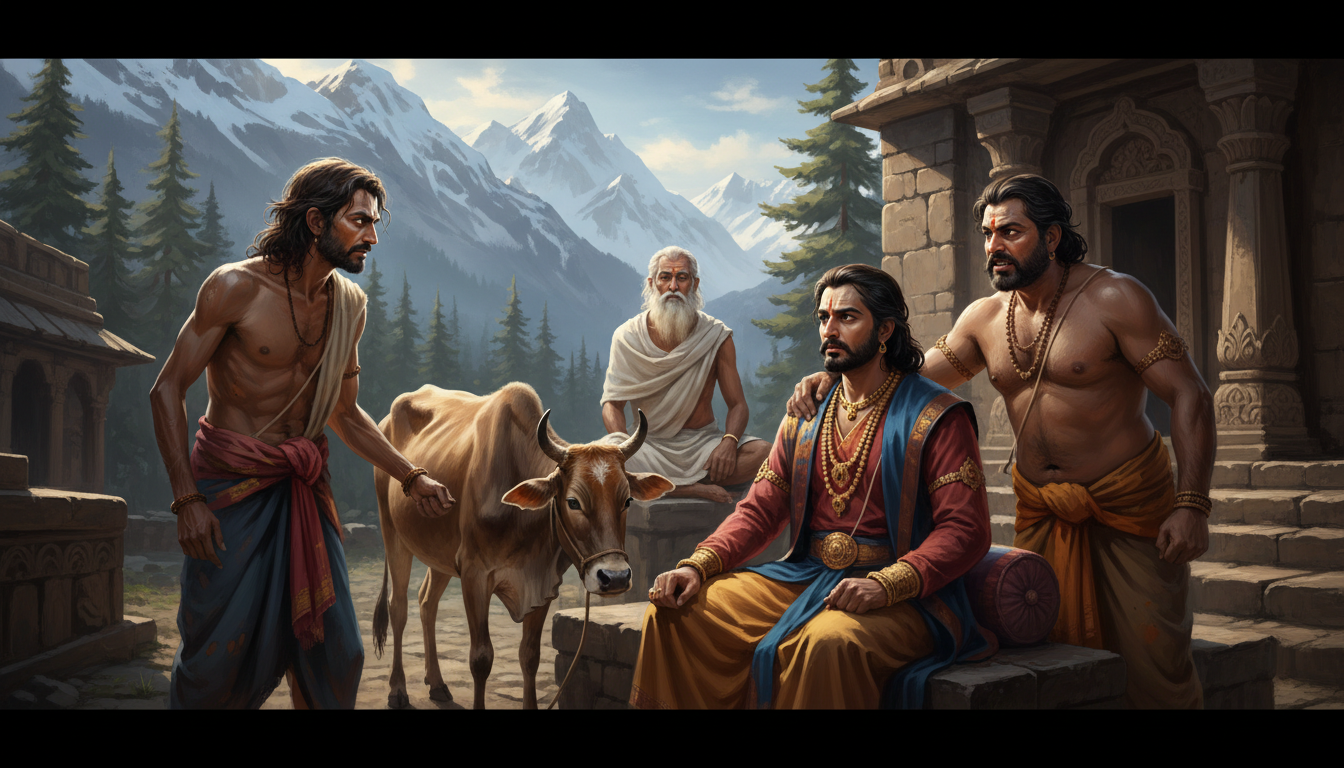
The Dispute You Mentioned in Passing
Bhishma had let a thing drop in the middle of a longer answer, the way a man does when he has told a story so often that he forgets his listener has not heard it, and Yudhishthira had been holding on to it ever since.
"Thou hadst referred," the king said, "to the dispute between Time, and Mrityu, and Yama, and Ikshvaku, and a Brahmana. It behoveth thee to narrate the story in full."
It is a strange list of litigants. Three are the powers that carry every creature out of the world, one is a king of the solar line, and one is not named at all.
"In connection with this subject," Bhishma said, "is cited the old history of what transpired between Surya's son Ikshvaku and a certain Brahmana, and Time, and Mrityu. Listen to me as to what occurred, and what was the conversation that took place between them, and the place where it happened."
He was careful about the place, which is a thing an old man is careful about.
"There was a certain Brahmana of great fame and pious behaviour. He was a Reciter. Possessed of great wisdom, he was conversant with the six Angas. He was of the Kusika race and the son of Pippalada, and he had acquired by his austerities a spiritual insight into the Angas. Residing at the foot of Himavat, he was devoted to the Vedas."
A Reciter is not a sacrificer, not a teacher, not an ascetic who stands in water. He says a mantra, silently, and then says it again, and his whole religion is the repetition. This one had chosen the Gayatri.
A thousand years passed over his head while he was engaged in the observance of vows and fasts.
The Goddess Who Was Not Answered
At the end of that thousand years the goddess showed herself to him.
Savitri, who is the mother of the mantra he had been saying, stood in front of the man who had been saying it, and told him the sentence that every ascetic in the world is working toward.
"I am gratified with thee."
And the Brahmana, continuing to recite the sacred mantra, remained silent, and spoke not a word to the goddess.
He did not break off. He had a count to keep, and the goddess of the verse could stand there until he had finished, and she did. She felt compassion for him and became highly gratified, and that progenitrix of the Vedas applauded the recitation in which he had been engaged.
Only after finishing the day's portion did he stand up, and bend his head, and prostrate himself at her feet.
"By good luck, O goddess, thou hast been gratified with me and shown thyself to me. If, indeed, thou art gratified with me, the boon I ask is that my heart may take pleasure in the act of recitation."
"What dost thou ask, O regenerate Rishi?" she said. "What wish of thine shall I accomplish? Tell me, O foremost of Reciters, and everything will be as thou wishest."
He was being offered anything, by the goddess of the verse, after a thousand years of earning it, and what he asked for was more of the same work.
"Let my wish about continuing my recitations go on increasing every moment. Let also, O auspicious goddess, the absorption of my mind into Samadhi be more complete."
"Let it be as thou wishest," she said sweetly. And then, desiring to do him good, she told him what was coming, so that he would not be surprised by it.
"Thou shalt go into the region of Brahma, which is uncreate and free from every fault. I go hence, but that which thou hast asked me shall happen. Go on reciting with restrained soul and rapt attention. The god Dharma will in person come to thee. Time, Mrityu, and Yama also will all approach thy presence. There will be a dispute here between them and thee on a question of morality."
Then she went back to her own abode, and the Brahmana continued engaged in recitation for a thousand celestial years more, restraining wrath, controlling himself, devoted to truth and free from malice.
I Will Not Cast Off This Body
Upon the completion of that observance, Dharma was gratified with him, and showed his person to him.
"O regenerate one, behold me who am Dharma. I have come here for seeing thee. Thou hast won the reward of this recitation in which thou hadst been engaged. Listen to me as to what that reward is. Thou hast won all the regions of felicity which appertain to either gods or men. Thou shalt ascend above all the abodes of the deities. O ascetic, cast off thy vital breaths, then, and go unto whatever regions thou pleasest. By casting off thy body thou wilt win many regions of felicity."
It is the standard settlement. The man has earned heaven, heaven is entered by dying, therefore die.
"What business have I with those regions of felicity of which thou speakest?" said the Brahmana. "O Dharma, go whithersoever thou pleasest. I will not, O puissant lord, cast off this body, which is subject to much happiness and misery."
He had named the terms of his own body correctly and then kept it anyway. Not a body of bliss. A body in which things go well and badly by turns, and he wanted that one.
"Thy body should certainly be cast off," said Dharma. "Do thou ascend to heaven. Or tell us what else should please thee, O sinless one."
"I do not wish to reside in heaven itself without this body of mine. Leave me, O Dharma."
"Without setting thy heart on thy body, cast it off and be happy. Go into regions that are free from the attribute of Passion. Indeed, going thither, thou shalt never have to feel any misery."
"O highly-blessed one, I take great pleasure in recitation. What need have I for those eternal regions of which thou speakest? I do not desire to go to heaven with even this body of mine."
That is the third refusal, and it gives the whole away. He was not clinging to his flesh and he was not afraid of dying. He did not want the prize. He had come to like the work better than the wages, which was the exact boon he had asked the goddess for, and this was what it looked like when it was paid out.
"If thou dost not wish to cast off thy body," said Dharma, "behold, O regenerate one, there is Time, and there is Mrityu, and there is Yama, who are all approaching thee."
Water for the Feet of Death
The son of Vivaswat, and Time, and Mrityu came up together, the three who snatch all creatures from the earth, and each made his announcement.
"I am Yama. I say unto thee that a high reward awaits thee for these well-performed penances of thine, and for this pious conduct that thou hast observed."
"Thou hast won a high reward, commensurate with this course of recitation that thou hast finished," said Time. "The time is come for thee to ascend to heaven. I am Time, and I have come to thee."
"O thou that art conversant with righteousness," said Mrityu, "know me for Mrityu herself in her proper form. I have come to thee in person, urged by Time, for bearing thee hence."
And the Brahmana greeted them like guests.
"Welcome to Surya's son, to Time possessed of high soul, to Mrityu, and to Dharma. What shall I accomplish for you all?"
Then, in that meeting, he gave them water to wash their feet, and the usual articles of the Arghya, and he was highly gratified, and he asked them again, "What shall I do for you all by exerting my own might?"
There is a great deal in that. Four powers had come to take him out of the world, and he treated their arrival as a call at a poor man's door, and did the small sequence a householder does: water, then the offering, then the question. He was not defying them and not negotiating. He had simply not accepted that this was a summons, and nothing in the etiquette of the three worlds let them correct him.
And it was exactly at that moment, with Death sitting on the ground having her feet washed, that a fifth person walked into the clearing.
A King Who Does Not Know the Word Give
King Ikshvaku, who had set out on a sojourn to the holy waters and shrines, came to that spot where the deities had been assembled together.
He did not know what he had walked into and it made no difference to his manners. The royal sage bowed his head and worshipped them all, and enquired after the welfare of every one of them. And the Brahmana gave the king a seat, and water to wash his feet, and the usual Arghya, exactly as he had given them to Death a moment before.
"Thou art welcome, O great monarch. Tell me all thy wishes. Let thy noble self tell me what I shall have to accomplish for thee by putting forth my might."
"I am a king," said Ikshvaku. "Thou art a Brahmana in the observance of the six well-known duties. I cannot ask. I will give thee some wealth. That is well known. Tell me how much I shall give thee."
"There are two kinds of Brahmanas, O monarch, and righteousness also is of two kinds, addiction to work and abstention from work. As regards myself, I have abstained from the acceptance of gifts. Give presents unto those that are addicted to the duty of acceptance. I shall not accept anything in gift. On the other hand, I ask thee, what is for thy good? What, indeed, shall I give thee? Tell me, and I shall accomplish it with the aid of my penances."
So the giver had been refused, and the man who never accepts had turned round and offered.
"I am a Kshatriya," said the king. "I do not know how to say the word Give. The only thing that we can say by way of asking is, Give us battle."
"Thou art content with the observance of the duties of thy order," said the Brahmana. "Similarly, I am content with the duties of mine. There is little difference between us. Do as thou pleasest."
"Thou saidst these words first, namely, I shall give thee according to my might. I therefore solicit thee. Give me the fruits of this recitation which thou hast gone through."
"Thou wert boasting that thy utterances always solicit battle," said the Brahmana. "Why then dost thou not solicit battle with me?"
"It has been said that Brahmanas are armed with the thunder of speech, and that Kshatriyas have might of arms. Hence, learned Brahmana, this wordy warfare has set in between thee and me."
Neither Will Take What the Other Offers
"Take the highest fruit of the recitations I have gone through," said the Brahmana. "Indeed, take half, without any scruple, of that fruit. Or, if thou wishest, take the entire fruits of my recitations."
And the king, who had asked for exactly this a minute earlier, drew back from it.
"Blessed be thou. I have no need for the fruits of thy recitations which I solicited. Blessings on thy head. I am about to leave thee. Tell me, however, what those fruits are."
"I have no knowledge of the fruits I have won. I have, however, given thee those fruits that I have acquired by recitation. These, viz., Dharma, and Time, and Yama, and Mrityu, are witnesses of the act of gift."
That is the sentence that shut the door. Four powers stood there named as witnesses to a completed gift, and so, in the record of the universe, the transfer had already happened.
"What will the fruits, that are unknown, of these thy observances do for me?" said the king. "If thou dost not tell me what the fruits are, let those fruits be thine, for without doubt I do not wish for them."
"I will not accept any other utterance from thee. Thou saidst, Give. I said, I give. I shall not falsify these words. Keep the truth. Be calm. If thou refusest to keep my word, O king, great will be thy sin due to falsehood."
And then the Reciter, who had been silent for two thousand years, argued, and it turned out that a man who says one verse for that long has thought about what a word is.
"It hath been heard by us that once on a time Truth and all religious observances were placed on a pair of scales. When both were weighed, that scale on which Truth was, was seen to be the heavier. Why, O king, dost thou wish to do an act that is stained with falsehood? Why wouldst thou falsify thy own words, Give me, which thou hast uttered? That person who does not give after having promised, and he also that does not accept after having solicited, are both stained with falsehood."
"To fight and to protect are the duties of Kshatriyas," said the king. "It is said that Kshatriyas are givers. How then shall I take anything from thee?"
"I never insisted on thee. I did not seek thy house. Thyself, coming here, didst solicit me. Why then dost thou not take?"
Dharma offered to settle it. Heaven itself arrived in embodied form and offered to settle it, and the king sent Heaven away. Neither man moved: two righteous persons deadlocked over which of them was to be allowed to be generous.
Two Men With Their Arms Round Each Other
At this time two individuals of very ungainly aspect came there.
Each had his arm upon the other's shoulder. Both were ill-dressed. And they were quarrelling, in the loud undefended way of men who have been at it down the whole length of a road, and they came into a clearing where four deities and a king and a thousand-year ascetic were standing in silence, and did not notice any of them.
"Thou owest me nothing. I really owe thee."
"Thou speakest falsely. I do owe thee a debt."
"If we dispute in this way, here is the king who ruleth individuals."
They were waxing very hot in the dispute, and then both of them turned on Ikshvaku at once, and what they asked him for was not a favour.
"See, O monarch, that none of us may become stained with sin."
That is the phrase they chose, in front of a man who had just spent an hour refusing a gift on the ground that taking it would stain him. Nobody remarked on it. A dispute had been brought to a king, and there is no provision anywhere for a king to say that he is busy.
"I owe my companion Vikrita, O monarch, the merits of the gift of a cow," said the first of them. "I am willing to pay off that debt. This Vikrita, however, refuses to take repayment."
"This Virupa, O monarch, oweth me nothing," said the other. "He speaks a falsehood with the appearance of truth."
A falsehood with the appearance of truth. Neither of them was what he appeared, and the king had no way of knowing it.
"Tell me, O Virupa, what is that which thou owest thy friend here," said Ikshvaku. "It is my resolution to hear thee, and then do what is proper."
One Cow, and Then Two
"Hear attentively, O king, all the circumstances in detail.
"This Vikrita had, in bygone days, for the sake of winning merit, given away an auspicious cow unto a Brahmana devoted to penances and to the study of the Vedas. Going unto him, O king, I begged of him the reward of that act. And with a pure heart, Vikrita made a gift to me of that reward.
"I then, for my purification, did some good acts. I also purchased two kapila cows with calves, both of which used to yield large quantities of milk. I then made a present, according to due rites and with proper devotion, of those two cows unto a poor Brahmana living by the unchha method.
"Having formerly accepted the gift from my companion, I desire, O lord, even here, to give him return twice the reward."
The arithmetic is exact, and that sort of accounting is done by only two kinds of people: the very scrupulous, and the ones building a trap. Vikrita gave one cow and earned the merit of it. Virupa asked for that merit and was given it. Then Virupa bought two brown cows in milk, with calves at foot, and gave them in due form to a Brahmana living on gleanings. Two for one, and he wants it recorded that he is handing back double.
"The circumstances being such, O tiger among men, who amongst us two shall be innocent, and who guilty, according to thy judgment? Disputing with each other about this, we have both come to thee. Whether thou judgest rightly or wrongly, establish both of us in peace. If this my companion does not wish to take from me in return a gift equal to what he gave me, thou shalt have to judge patiently, and set us both on the right track."
The king had spent the afternoon refusing to take what a Brahmana was pressing on him. He listened to the case, did not hear his own name in it, and gave judgment.
I Think Thou Deservest Punishment
"Why do you not accept payment that is sought to be made of the debt that is owing to thee?" the king said to Vikrita. "Do not delay, but accept payment of what thou knowest is thy due."
"This one says that he owes me," said Vikrita. "I say unto him that what I gave, I gave away. He doth not, therefore, owe me anything. Let him go whithersoever he wishes."
"He is ready to give thee. Thou, however, art unwilling to take. This does not seem proper to me. I think that thou deservest punishment for this. There is little doubt in this."
There it is. A king of the solar race, standing between a Brahmana whose gift he had refused for an hour and a stranger in rags, had just ruled that a man who will not accept what is offered deserves to be punished by the crown.
"I made a gift to him, O royal sage," said Vikrita. "How can I take it back? If I am guilty in this, do thou pronounce the punishment."
"If thou refusest to take when I am ready to give," said Virupa, "this king will certainly punish thee, for he is an upholder of justice."
"Solicited by him, I gave him what was my own. How shall I now retake that? Thou mayst go away. Thou hast my leave."
And the Brahmana of the Kusika race, silent through the whole of it, spoke at last, and needed one sentence.
"Thou hast heard, O king, the words of these two. Do thou take without scruple that which I have pledged myself to give thee."
The king heard it land.
"This matter is, indeed, as deep in importance as an unfathomable pit," he said. "How will the pertinacity of this Reciter end? If I do not accept what has been given by this Brahmana, how shall I avoid being stained with a great sin?"
He turned to the two disputants and dismissed them, and there was something worn in the way he did it.
"Go ye both, having won your respective objects. I should see that kingly duties, vested in me, may not become futile. It is settled that kings should observe the duties laid down for them. To my misfortune, however, the course of duties prescribed for Brahmanas has possessed my wretched self."
Know That We Two Are Desire and Wrath
"Accept, O king. I owe thee," said the Brahmana. "Thou didst solicit it, and I also have become pledged to give. If, however, thou refuse to take, I shall without doubt curse thee."
"Fie on kingly duties, the settled conclusion about the operation of which is even such," said Ikshvaku. "I should, however, take what thou givest, for only this reason, that the two courses of duty may be made exactly equal. This is my hand, that was never before stretched forth for the acceptance of gifts. It is now stretched forth, for acceptance and also for giving away. Give me what thou owest me."
"If I have won any fruits by reciting the Gayatri, accept them all."
And the water was poured, as it is poured over the palm at every gift that has ever been made in that country.
"These drops of water, behold, O foremost of Brahmanas, have fallen upon my hand," said the king. "I also desire to give thee. Accept my gift. Let there be equality between us."
Then Virupa spoke, and he was not speaking as a man in rags any more.
"Know, O king, that we two are Desire and Wrath. It hath been by us that thou hast been induced to act in this way. Thou hast made a gift in return to the Brahmana. Let there be equality between thee and this regenerate person in respect of the regions of felicity in the next world. This Vikrita really does not owe me anything. We appealed to thee for thy own sake.
"Time, Dharma, Mrityu, and we two, have examined everything about thee, here in thy very presence, by producing this friction between thee and that Brahmana. Go now, as thou choosest, to those regions of felicity which thou hast won by means of thy deeds."
The debt had never existed. The cow had never needed repaying. The two of them had staged a quarrel in front of a king because there was no other way to find out what that king actually believed, and the friction they were sent to produce was not between them at all. It was between Ikshvaku and the Reciter, and neither man could see it from inside.
So they set the same question in front of him wearing somebody else's clothes, and he answered it in four words. A man who refuses what is offered deserves punishment. Having heard himself say it, he could not go on.
"I have now told thee," said Bhishma from the arrows, "how Reciters obtain the fruits of their recitation, and what, indeed, is their end."
But that was not what he had told, and Yudhishthira, who had been sitting in the sand being lectured on kingly duty for weeks, would have known it. He had been told that Desire and Wrath do not come to a man as desire and wrath. They arrive ill-dressed, arm in arm, arguing about somebody else's cow, and ask him to be fair.
Dharma Lesson
A judge who rules honestly on a stranger's quarrel has already ruled on his own. Ikshvaku spent an afternoon refusing what a brahmana pressed on him and then declared, of a man in rags, that refusing an offered payment deserves punishment. Desire and Wrath do not arrive as desire and wrath; they arrive arguing about somebody else's cow and ask you to be fair.