Is the Man the Doer?
"In this world, O Bharata," said Yudhishthira, "acts good and bad attach themselves to a man for the purpose of producing fruits, to be enjoyed or endured. Is the man, however, to be regarded as their doer, or is he not to be regarded so? Doubt fills my mind on this question. I desire to hear it in detail from you, O grandsire."
He had reason to ask. He had come off a field where a hundred thousand men had done what they intended and got what nobody intended, and he was sitting beside an old man who had been the finest soldier in the world and was now pinned to the ground by arrows shot from behind a woman. If a man is the doer of his acts, then the king who was speaking had killed his own kinsmen. If he is not, then something else had, and it would be a great relief to know its name.
Bhishma did not answer with a doctrine. He answered with a story, which is his habit.
"In this connection is cited the old narrative of a discourse between Prahlada and Indra. The chief of the Daityas, Prahlada, was unattached to all worldly objects. His sins had been washed away. Of respectable parentage, he was possessed of great learning."
"I know who Prahlada was," said Yudhishthira.
"You know who he was when he was winning," said Bhishma. "This is afterwards."
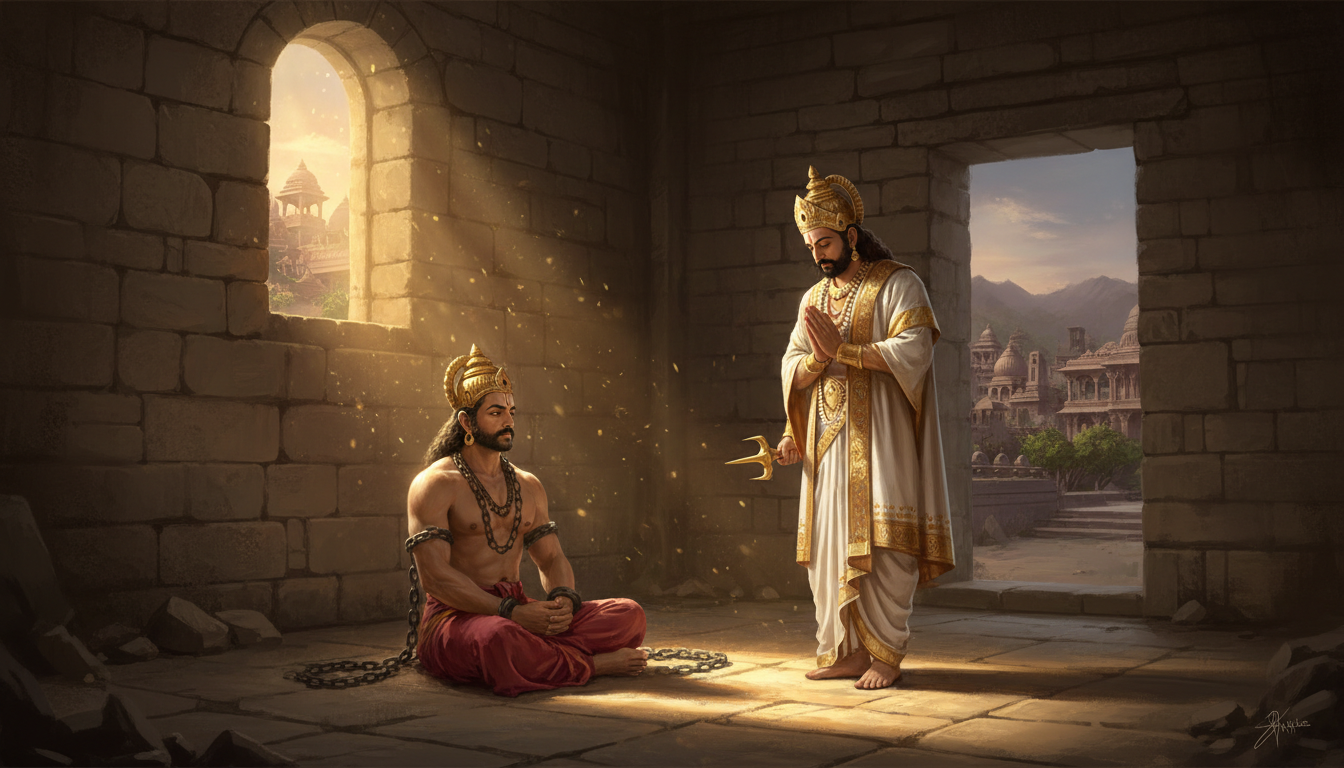
The Prisoner in the Empty Chamber
"Free from stupefaction and pride," said Bhishma, "ever observant of the quality of goodness, and devoted to various vows, he took praise and censure equally. Possessed of self-restraint, he was passing his time in an empty chamber.
"Understand what those last words mean before you go further. He had held the three worlds. He had had a court, and armies, and the tribute of everything under the sky. Now there was a room with nothing in it and a man sitting in the room, and that was the whole of his establishment.
"Conversant with the origin and the destruction of all created objects, mobile and immobile, he was never angry with things that displeased him and never rejoiced at the accession of objects that were agreeable. He cast an equal eye upon gold and a clump of earth."
"That is easily said of a man who has neither," said Yudhishthira.
"It is," Bhishma agreed. "It is also easily said of a man who has both. The difficulty is to say it of a man who has just stopped having gold and started having earth, in that order, in the same lifetime, and to have it be true. That is the case before us.
"Steadily engaged in the study of the Soul and in acquiring Emancipation, and firm in knowledge, he had arrived at fixed conclusions in respect of truth. Acquainted with what is supreme and what is not so among all things, omniscient and of universal sight, he was seated one day in a solitary chamber with his senses under complete control.
"That is a long description, and I have given you the whole of it on purpose. Every item in it is a thing that a man in his position could have claimed for himself falsely, and would have been believed, because who was left to contradict him? He said none of it. It is said of him.
"And it was then that Sakra approached him."
The Victor Comes to Wake Him
The king of the gods came in person, and Bhishma was careful to say why. He came desirous of awakening him.
That is a strange errand for a conqueror. Indra had beaten this man. He had taken the three worlds off him, put him in cords, and left him with an empty room. He had every reason to stay away and none at all to come. He came because something about the prisoner had got under his skin and would not come out, and he could not name it, and the only way to find out was to go and ask.
"O king," said Sakra, "I behold all those qualities permanently residing in you by which a person wins the esteem of all. Your understanding seems to be like that of a child, free from attachment and aversion. You know of the Soul. What, do you think, is the best means by which a knowledge of the Soul may be attained?"
Then he stopped being polite and said the thing he had come to say.
"You are now bound in cords. You have fallen off from your former position. You are brought under the sway of your foes and divested of prosperity. Your present circumstances are such as may well inspire grief. Yet how is it, O Prahlada, that you do not indulge in grief? Is this due, O son of Diti, to the acquisition of wisdom, or is it on account of your fortitude? Behold your calamities, and yet you seem like one that is happy and tranquil."
He had listed the man's ruin item by item, in front of him, in his own prison. It was not cruelty. It was an accounting, and the accounts did not balance, and Indra wanted them explained.
There are only two ways a defeated king sits quietly, and the king of the gods knew both of them. Either he has understood something, or he has hardened himself and is enduring by force, and the second kind can be broken by naming the losses one at a time, which is what Indra had just done. Prahlada did not flinch at any of the items. So it was the first kind, and Indra had no idea how it worked.
Two Kinds of Men and What Stupefies Them
Thus urged by Indra, the chief of the Daityas, endued with determinate conclusions in respect of truth, replied in sweet words indicative of great wisdom. He did not begin with his chains. He began a long way behind them.
"He who is unacquainted with the origin and the destruction of all created objects," said Prahlada, "is, in consequence of such ignorance, stupefied. He, however, who is conversant with these two things is never stupefied.
"All kinds of entities and non-entities come into being or cease in consequence of their own nature. No kind of personal exertion is needed for the production of such phenomena. In the absence, therefore, of personal exertion, it is evident that no personal agent exists for the production of all this that we perceive."
Indra had come to ask why a beaten man was not grieving, and was being told, before anything else, that there was no such thing as an agent anywhere in the universe.
"But though in reality the person never does anything," Prahlada went on, "yet through the influence of Ignorance a consciousness of agency overspreads itself upon him. He who regards himself as the doer of acts good or bad possesses a wisdom that is vitiated. Such a person is, according to my judgment, unacquainted with the truth."
There was no complaint in it, and that is what unsettled his visitor. A prisoner who says he is not the author of his own downfall is usually excusing himself. This one was not excusing anything. He was making a general statement about everybody in the room, and one of the two people in the room had just conquered the universe.
If the Person Were Really the Actor
"Consider the proof," said Prahlada. "If, O Sakra, the being called person were really the actor, then all acts undertaken for his own benefit would certainly be crowned with success. None of those acts would be defeated.
"Is that what you observe? Among even persons struggling their utmost, the suspension of what is not desired and the occurrence of what is desired are not to be seen. What, then, becomes of personal exertion?"
He put it as a question, and it is a question with no answer in it. Every man who has ever wanted anything has strained after it with everything he had, and the thing has come or not come by some rule of its own that took no notice of the straining.
"And in the case of some," said Prahlada, "we see that without any exertion on their part, what is not desired is suspended and what is desired is accomplished. This, then, must be the result of Nature.
"Some persons again are seen to present extraordinary aspects. Though possessed of superior intelligence, they have to solicit wealth from others who are vulgar in features and endued with little intelligence."
Any man who has stood in a hall and watched a clever man beg from a stupid one knows the picture. If achievement followed effort and merit, that scene could not occur, and it occurs every day in every kingdom.
"Indeed, when all qualities, good or bad, enter a person, urged by Nature, what ground is there for anyone to boast of his superior possessions? All these flow from Nature. This is my settled conclusion. Even Emancipation and knowledge of self, according to me, flow from the same source."
He had shut the last door as he went out of it. A man arguing that achievement is not his own usually keeps one thing back for himself, and the thing he keeps is his wisdom. Prahlada handed that over with the rest. The composure Indra had come across the worlds to ask about was not, by its owner's account, an accomplishment of its owner either.
The Crow That Announces the Food
"In this world," Prahlada continued, "all fruits, good or bad, that attach themselves to persons are regarded as the result of acts. I shall discourse to you in full on the subject of acts. Listen.
"As a crow, while eating some food, proclaims the presence of that food to the members of its species by its repeated cawing, after the same manner all our acts only proclaim the indications of Nature."
That is the whole of the teaching in one bird. The crow is not deciding to announce anything. It has found food, and the noise comes out of it, and other crows arrive. Nobody watching would say the crow had performed an act of generosity, or of folly, or of anything. It is simply what a crow does when there is food, and the cawing tells you what a crow is.
"He who is acquainted with only the transformations of Nature, but not with Nature that is supreme and exists by herself, feels stupefaction in consequence of his ignorance. He, however, who understands the difference between Nature and her transformations is never stupefied. All existent things have their origin in Nature.
"In consequence of one's certainty of conviction in this respect, one would never be affected by pride or arrogance."
And there, at last, was the answer to the question Indra had come with, though it had arrived by a road nobody could have predicted. Pride and grief are not two conditions. They are one error read from two ends. The man who cannot boast about his rise also cannot be broken by his fall, because he never held the deed to either of them.
Nothing in Me for Grief to Hold
"When I know what the origin is of all the ordinances of morality," said Prahlada, "and when I am acquainted with the instability of all objects, I am incapable, O Sakra, of indulging in grief. All this is endued with an end.
"Without attachments, without pride, without desire and hope, freed from all bonds and dissociated from everything, I am passing my time in great happiness, engaged in beholding the appearance and disappearance of all created objects."
In a bare room, in cords, watching things appear and disappear, and calling it great happiness. Indra said nothing.
It is worth noticing what he did not say. He did not say that he had been wronged, or that the cords were unjust, or that the war had gone against him by some trick. He did not say that he had been a good ruler and deserved better. He did not mention the war at all. The subject of his own defeat, which was the only subject his visitor had raised, simply did not come up in his reply, because in the account he was giving there was nobody it could have happened to.
"For one that is possessed of wisdom, that is self-restrained, that is contented, that is without desire and hope, and that beholds all things with the light of self-knowledge, no trouble or anxiety exists, O Sakra.
"I have no affection or aversion for either Nature or her transformations. I do not behold anyone now who is my foe, nor anyone who is my own."
The king of the gods was standing in front of him as he said it, and was included in it. He was not being forgiven, which would have been a kind of victory for him. He was being told, without heat, that the category of enemy had gone out of use.
"I do not, O Sakra, at any time covet either heaven, or this world, or the nether regions. It is not the case that there is no happiness in understanding the Soul. But the Soul, being dissociated from everything, cannot enjoy felicity. Hence I desire nothing."
Heaven was the thing Indra had. This world was the thing Indra had taken. The nether regions were what was left to a defeated asura. The prisoner had just named all three of them and declined all three.
The Conqueror Asks to Be Taught
Then the king of the gods did the thing that makes this an old story worth repeating rather than an argument between two people who disliked each other.
"Tell me the means, O Prahlada," said Sakra, "by which this kind of wisdom may be attained, and by which this kind of tranquillity may be made one's own. I solicit you."
He had come in as a captor with a question meant to unsettle a captive. He was now asking to be given something, and using the word that suppliants use.
Prahlada answered him plainly, and there was nothing mysterious in the list.
"By simplicity, by heedfulness, by cleansing the Soul, by mastering the passions, and by waiting upon aged seniors, O Sakra, a person succeeds in attaining to Emancipation."
Five things, and four of them are ordinary discipline, and the fifth is sitting at the feet of old men and listening.
And then he took even that back, or rather he set it in its place, because he was not going to end by handing his visitor a method and calling it an achievement.
"Know this, however, that one acquires wisdom from Nature, and that the acquisition of tranquillity also is due to the same cause. Indeed, everything else that you perceive is due to Nature."
So the doing is to be done, and the doer is still not the doer. Prahlada did not soften the contradiction or explain it away. He set the two halves down side by side and let his questioner carry them out of the room.
Indra Worships the Lord of the Daityas
"Thus addressed by the lord of the Daityas," said Bhishma, "Sakra became filled with wonder, and commended those words with a cheerful heart. The lord of the three worlds then, having worshipped the lord of the Daityas, took his leave and proceeded to his own abode."
Every word of that is worth weighing. He was filled with wonder, not with envy. He commended the words with a cheerful heart, and there was nothing in them that was comfortable for him. Then, having worshipped him, he asked leave to go, of a man in chains, in a room the visitor could have walked out of at any moment.
He left him bound. That should be said, because the story does not pretend otherwise. Nothing was restored. There was no reversal, no unbinding, no return of the three worlds. The most powerful being in the universe came, listened, bowed, and went home to the palace he had won, and behind him the chamber was as empty as before and the man in it was as content.
"That is my answer to your question, O Yudhishthira," said Bhishma. "You asked whether a man is to be regarded as the doer of his acts. Here is a man who says he is not, and who was not saying it in order to escape the reckoning for anything, since he had already paid the whole of it.
"The one who believes he is the author of his fortune must also be the author of his ruin, and will be crushed by the second belief exactly as far as he was inflated by the first. Prahlada put down both at once, and what was left could not be reached by any misfortune, because there was nothing in him for a misfortune to take hold of.
"Indra had the three worlds and went away wanting something. Prahlada had a room, and did not."
Dharma Lesson
Pride and despair are the same mistake read from two ends, since both require a man to believe he is the author of what happened to him. Prahlada gives up the credit for his rise and is therefore untouched by the bill for his fall. The conqueror leaves the room wanting something, and the prisoner does not.