Bali in the Nooses of Varuna
The prisoner who would not be mocked, and the god who let him be
What Is Good for a Ruined Man
The old man on the bed of arrows had been answering questions for many days, and the questions were not getting easier. Yudhishthira sat down again in the trampled grass at Kurukshetra, where the field still smelled of ash and horses, and asked the one he had been carrying since the war ended.
"Grandsire, what is good for a man who has sunk into dire distress? When his friends are gone, when his kingdom is gone, what remains that is worth his taking up? You are the foremost of our instructors in this world. I ask you, and it is right that you should tell me."
Bhishma did not move his head. "For one who has been deprived of sons and wives and every kind of pleasure and of wealth besides, and who has been plunged into calamity," he said, "fortitude is the highest good. The body of a man who keeps his fortitude is never wasted. Grieflessness carries happiness inside it, and health also, which is the better possession, and out of that health a man may acquire prosperity a second time. He who holds to righteous conduct while the affliction is on him gets back in the end prosperity, patience, and the perseverance to finish whatever he sets his hand to."
"It is easily said, grandsire."
"Then hear it said by one who had more to lose than you," said Bhishma. "There is an old story of a conversation between Vali, son of Virochana, and Vasava who is Indra, and it was held in a cave by the sea, with a thunderbolt raised over the speaker's head. Listen, and judge for yourself whether it is easily said."
The Worlds Put Back in Order
The great battle between the gods and the asuras had ended (said Bhishma) with a vast number of the Daityas and the Danavas fallen. Vali became king over what was left of them. Then Vishnu deceived him, and the sovereignty of all the worlds passed back into the hands of the gods, and he of the hundred sacrifices was invested once more with the rule of heaven.
With the gods restored, the four orders of men returned to the practice of their proper duties, and the three worlds swelled with prosperity until the Self-born himself was glad at heart. And Sakra, seeing everything blooming under him, resolved to look at what was his. He mounted Airavata, that four-tusked prince of elephants, and rode out to make a progress through all the worlds, and with him went the Rudras and the Vasus, the Adityas and the Aswins, the celestial Rishis, the Gandharvas, the Siddhas, and every superior order of beings that heaven contains. Music went before him. The regions brightened where he passed.
There is no more dangerous hour in a man's life than the hour when everything has gone right for him, and no one had told the king of the gods so.
The Cave on the Sea Shore
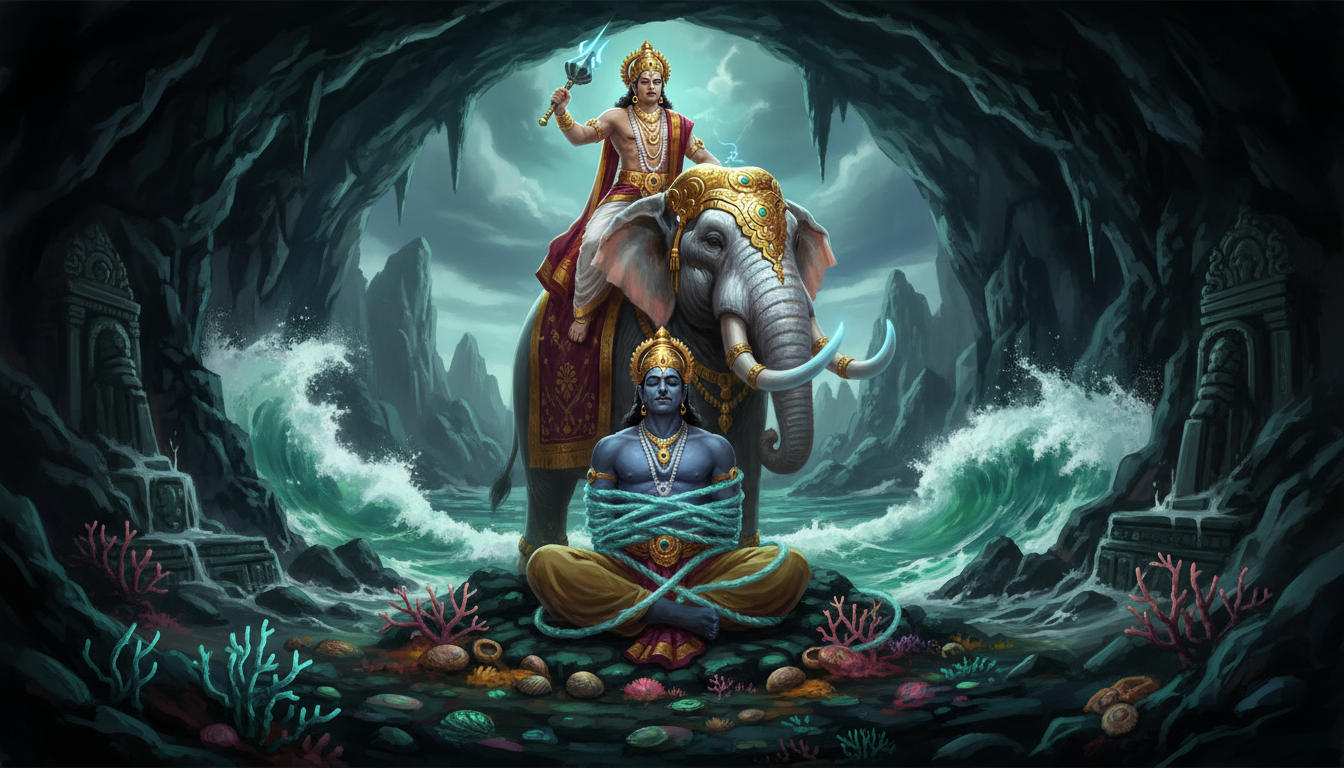
One day, while he was thus engaged, the wielder of the thunderbolt came down along the shore of the sea, and there, inside a cave in a mountain that stood at the water's edge, he saw the son of Virochana. Vali was bound. The nooses of Varuna were on him, cord over cord, and the marks of the thunderbolt were on his body. He was sitting in the half dark with the sea sounding outside, and he was neither weeping nor raging nor hiding his face.
Indra brought the elephant close and looked down at him from its back, and the whole assembly of the celestials looked down with him, and the prisoner did not stand up and did not look away.
"How is it, Daitya, that you are so unmoved?" said Indra. "Is it your heroism? Is it that you waited with reverence upon aged persons? Is it that penance has cleansed your mind? Whatever the cause, this frame of mind is certainly hard to come by. You have been hurled down from the highest position there is. You are stripped of every possession. You have been brought under the sway of your foes. What is it that you have taken hold of, son of Virochana, that you do not grieve when the occasion is exactly an occasion for grief?
"Once you were invested with the sovereignty of your order and there was no pleasure in the worlds that was not yours for the asking. Now your wealth is gone, your jewels are gone, your kingship is gone. You sat on the throne of your father and your grandfathers, and you were a god there. Today your enemies have stripped you, and you look at it and do not grieve. You are bound in Varuna's noose. You have been struck with my thunderbolt. Your wives have been taken away, and your treasure with them. Tell me why you are not sorry. Who else but such as you could carry the burden of simply going on living, after being shorn of the sovereignty of the three worlds?"
He said a good deal more in that manner, asserting his own superiority all the while, and none of it seemed to reach the prisoner. When it was finished, Vali answered him without any fear at all.
What I Am Now You Will Be
"Calamities have oppressed me," said Vali, "and you stand over me boasting. What do you gain by it? Today I see you in front of me with the thunderbolt raised in your hand. You could not carry yourself so once. By some means you have come by that power now. Who else but you would trouble to say such things to a man in cords?
"Understand this much. The person who is able to punish and shows compassion instead to a heroic enemy vanquished and brought under his hand, that person is truly the superior one. When two fight, victory is a doubtful thing. One of the two will win and the other will lose. Chief of the gods, do not let your disposition be what it is now. Do not imagine that you have become sovereign of all creatures by conquering them with your might and your prowess.
"That we became what we were was not the result of any act of ours. That you have become what you are is not the result of any act of yours. What I am now, you will be in the future.
"Do not slight me, thinking you have done some exceedingly difficult thing. A man gets happiness and misery one after the other in the course of Time. You obtained the sovereignty of the universe in the course of Time, not because of any special merit in you. It is Time that led me along his road. That same Time is leading you. That is the whole reason why I am not what you are today, and you are not what we are.
"Dutiful service to parents, worship of the deities, the practice of every good quality: none of these can hand a man happiness. Neither knowledge, nor penance, nor gifts, nor friends, nor kinsmen can rescue one whom Time has afflicted. Men cannot avert an impending calamity by a thousand means. Intelligence and strength go for nothing in these cases. There is no rescuer of men whom Time's course has assailed.
"That you regard yourself as the actor, Sakra, is the root of all sorrow."
The Roll of the Swept Away
"Some hold you high," Vali went on, "as one who acquired the sovereignty of the universe by his own acts. For all that, how should one like me, who knows the course of the world, grieve because Time has afflicted him? Shall my understanding go to pieces like a wrecked vessel at sea because a calamity has come upon me? Myself, yourself, and all who will be chiefs of the gods hereafter must go the road that hundreds of Indras have gone before you. In Time's course many thousands of Indras and of deities have been swept off, age after age.
"You think this seat immutable and eternal because your understanding is of the common kind. It belonged to numberless persons before you. Passing over them, it has now come to you. It will stay with you some while and then show what it is. Like a cow leaving one drinking ditch for another, it will desert you for somebody else.
"So many sovereigns have gone before you that I do not venture to count them. I do not see them now, those who once enjoyed this earth with her trees and her plants, her gems, her living creatures, her waters and her mines. Prithu is gone, and Aila, and Maya, and Bhima, and Naraka, and Samvara. Aswagriva is gone, and Puloman, and Swarbhanu whose standard was of immeasurable height. Prahlada is gone. Namuchi, whom you know better than most, is gone. Daksha, Vipprachitti, Virochana who was my own father, Hrinisheva, Suhotra, Bhurihan, Vrisha, Rishava, Kapilaswa, Virupaka, Vana, Kartaswara, Vahni, Viswadanshtra, Varaha, Ruchiprabha, Viswajit, Pratirupa, Vrishanda, Vishkara, Madhu, Hiranyakasipu, the Danava Kaitabha, and many more whose names we have only heard, belonging to remoter and remoter ages: all of them left the Earth.
"Time proved stronger than every one of them. All of them had worshipped the Creator in hundreds of sacrifices. You are not the one person who has done so. All of them were devoted to righteousness. All of them could roam through the skies. Not one of them ever showed his back in battle, and we have never heard that any of them, having engaged in battle, was defeated. All were firm in the vow of truth. All were masters of a hundred illusions and could take whatever form they wished. All were possessed of great learning and devoted to the Vedas and the rites of the Vedas. All had reached the highest affluence, and not one of those high-souled sovereigns carried the least tincture of pride on account of his sovereignty. They were liberal; they gave each man what each man deserved; they behaved properly towards all creatures. They scorched all things with their energy and blazed with splendour.
"And Time swept them all off. As for you, Sakra, it is plain enough that when you have enjoyed the earth and must leave her, you will not be able to control your grief."
I Am Not the Actor
"Cast off this appetite you have for the objects of your affection and enjoyment," said Vali. "Cast off the pride that is born of prosperity. Do that, and you will be able to bear the grief that follows the loss of sovereignty. When the hour of sorrow comes, do not give way to sorrow; when the hour of joy comes, do not rejoice. Disregard both the past and the future and live contentedly with what is present. Time that never sleeps came upon me while I was heedful of all my duties. Turn your heart to the ways of peace, Indra, for that same Time will very soon come over you.
"You pierce me with your words and you seem bent on putting fear into me. Finding me collected, you think highly of yourself. Time assailed me first. It is even now standing behind you. I was vanquished by Time, and it was for that reason that you afterwards succeeded in vanquishing me, and that is what you are roaring about. When I used to grow angry, what person on earth could stand in front of me in battle? Time is stronger. He has overwhelmed me. That is the only reason, Vasava, that you are able to stand before me now.
"Those thousand celestial years that are the measure of your sway will come to an end. You will fall, and your limbs will be as miserable as mine are, though today you are invincible and blaze with unrivalled splendour. The Adityas, the Rudras, the Sadhyas, the Vasus and the Maruts were all vanquished by me, and you know it. In the great encounter between the gods and the asuras the assembled deities were routed by the fury of my attack, and you know that too. Mountains with their forests and everything that lived in those forests we hurled again and again, and many were the mountain summits with craggy edges that I broke upon your head.
"What can I do now? Time cannot be resisted. If it could, do not imagine that I would not have ventured to kill you with that thunderbolt of yours, or with a blow of my fist. But this is not my hour for the display of prowess. The hour that has come is one in which I must adopt tranquillity and tolerate everything. That is why I put up with all this insolence of yours. Know, however, that I am less able to bear insolence than you are.
"You brag before a man whose time has matured, who is surrounded on every side by Time's conflagration and bound strongly in Time's cords. Look there. That dark one stands there, whom no one in the world can resist, of fierce form, and he has tied me up like a beast tied with a rope. Gain and loss, happiness and misery, lust and wrath, birth and death, captivity and release: these are all met with in Time's course. I am not the actor. You are not the actor. He is the actor, and he is omnipotent. That Time is ripening me for the fall, as a fruit that has come out on a tree is ripened. Knowing what I know of Time, it does not become me to grieve because Time has assailed me. Grief does nobody any good. The grief of a man who grieves never lifts his calamity from him; it only eats up his power. That is why I do not grieve."
Time Is Cooking All Things
The thousand-eyed chastiser of Paka held the thunderbolt over the prisoner a moment longer. Then he restrained his wrath and lowered his arm.
"Look at this arm of mine," he said, "raised and armed with the thunderbolt, and look at those nooses of Varuna on you. Whose understanding would not be shaken by the sight, including the Destroyer's own, who compasses the death of all beings? Yours has not been shaken. You are unmoved today, and it is your fortitude that has done it.
"Seeing that everything in this universe is fleeting, who that is clothed in a body would dare to put his confidence in that body or in the objects of his desire? I know as well as you do that this universe is not eternal, that it has been thrown into Time's conflagration, which is dreadful though hidden from view, which burns continuously, and which is truly endless. Everyone here is assailed by Time. Nothing among beings, subtle or gross, has any immunity from Time's sway. All things are being cooked in Time's cauldron. Time has no master. Time is heedful. Time is always cooking all things within itself, and no one who has once entered the domain of Time, which goes on ceaselessly, escapes out of it again. Embodied beings may be heedless of Time, but Time is broad awake behind them. No one has ever been seen to drive Time away from him. Ancient and eternal, and the very embodiment of justice, Time is uniform in respect of all living creatures.
"Like a usurer adding up his interest, Time adds up its small portions, the kalas and the lavas and the kashthas and the kshanas, the months, the days, the nights. Like the current of a river that has got at the roots of a tree and washes them away, Time gets at the man who says, 'This I will do today, but this other thing I will do tomorrow,' and sweeps him off. Time sweeps one away, and men say, 'I saw him a little while ago. How is it that he is dead?' Wealth, comforts, rank, prosperity, all of it falls to Time. Time comes up to every living creature and takes his life away. All things that raise their heads proudly are destined to come down. That which exists is only another form of what does not exist. Everything is transitory and unstable.
"Such a conviction, however, is difficult to arrive at. Yours is arrived at. You do not even mentally go back over what you were a little time ago."
The Nooses That Will Loosen of Themselves
"People given to jealousy and vanity and greed," Indra said, "to lust, wrath, and fear, to desire and heedlessness and pride, let themselves be stupefied, and one who is being dragged along by Time is not conscious of the noose that has been thrown round his neck. You are acquainted with the truth of existence. You are possessed of learning and endowed with wisdom and penance. You behold Time as clearly as if it were a myrobalan fruit lying on the palm of your hand. Son of Virochana, you are of cleansed soul and a thorough master of yourself. You have enjoyed every kind of happiness and been attached to none of it, and so nothing of it has stained you. You wait only upon your own soul, which has neither joy nor sorrow in it. You are the friend of all creatures and the enemy of none, and your heart is set upon tranquillity.
"Seeing you like this, my heart inclines to compassion towards you. I have no wish to afflict an enlightened person by keeping him in chains. Abstention from injury is the highest religion. I feel compassion towards you.
"These nooses of Varuna with which you are bound will loosen in Time's course through the misconduct of men. Blessed be you, great asura. When the daughter-in-law sets the aged mother-in-law to work, when the son through delusion commands his father to work for him, when the four orders transgress every restraint that was laid on them, when the refuse of houses is carried on plates and vessels of white brass and offerings meant for the deities are borne in forbidden vessels, then these bonds of yours will begin, one by one, to loosen.
"From us you have nothing to fear. Wait quietly. Be happy. Be free of all sorrow. Let your heart be cheerful. Let no illness be yours."
He said this, and the divine Indra, having the prince of elephants for his vehicle, left that place. He did not strike, and he did not free him; he left the cave and the sea behind and did not look back, and Vali sat on in the half dark exactly as he had sat before.
The Fortitude That Bhishma Meant
Having vanquished all the asuras, the chief of the gods rejoiced and became the one sole lord of all the worlds. The great Rishis hymned his praises. The deity of fire began once more to carry the libations of clarified butter poured into his visible form, and the great god took charge of the nectar committed to his care. With his praises sung by the foremost of Brahmanas in their sacrifices, Indra blazed with splendour, and his wrath was pacified and his heart quiet, and he went back to his own house in heaven and passed his days there in great happiness.
Bhishma stopped. The lamps had been lit along the edge of the field while he spoke.
"You asked me what is good for a man who has lost everything," he said. "You have heard the answer from a Daitya in Varuna's cords, which is the only mouth in which such an answer can be tested. He did not say that his loss was just. He did not say it was unreal. He said that the same power that took his kingdom from him had given it to him in the first place, and that a man who has understood this has nothing left in him for defeat to take hold of.
"Notice also what happened to the other one. Indra came there to gloat, with the thunderbolt in his hand and the whole of heaven at his back, and he went away unable to strike. That is what fortitude does. It does not only preserve the man who has it. It disarms the man standing over him.
"You have got your kingdom back, son of Kunti, and you are sitting here like a man who has lost one. Whichever of the two you are, this is the story you need."
Yudhishthira sat with that for a while, and the sea in the story went on sounding somewhere behind his thinking, and he asked no further question that evening.
Dharma Lesson
A man who understands that Time and not his own arm produced his rise has nothing left in him for defeat to take hold of. Bali, stripped of kingdom and wives and struck with the thunderbolt, could not be shamed, and the god standing over him with the whole of heaven at his back found he could not gloat. Fortitude preserves the man who holds it and disarms the man standing above him.