When Forgiveness Is Not a Virtue
An angry queen quotes an asura grandfather at a patient king
Evening at Dvaitavana
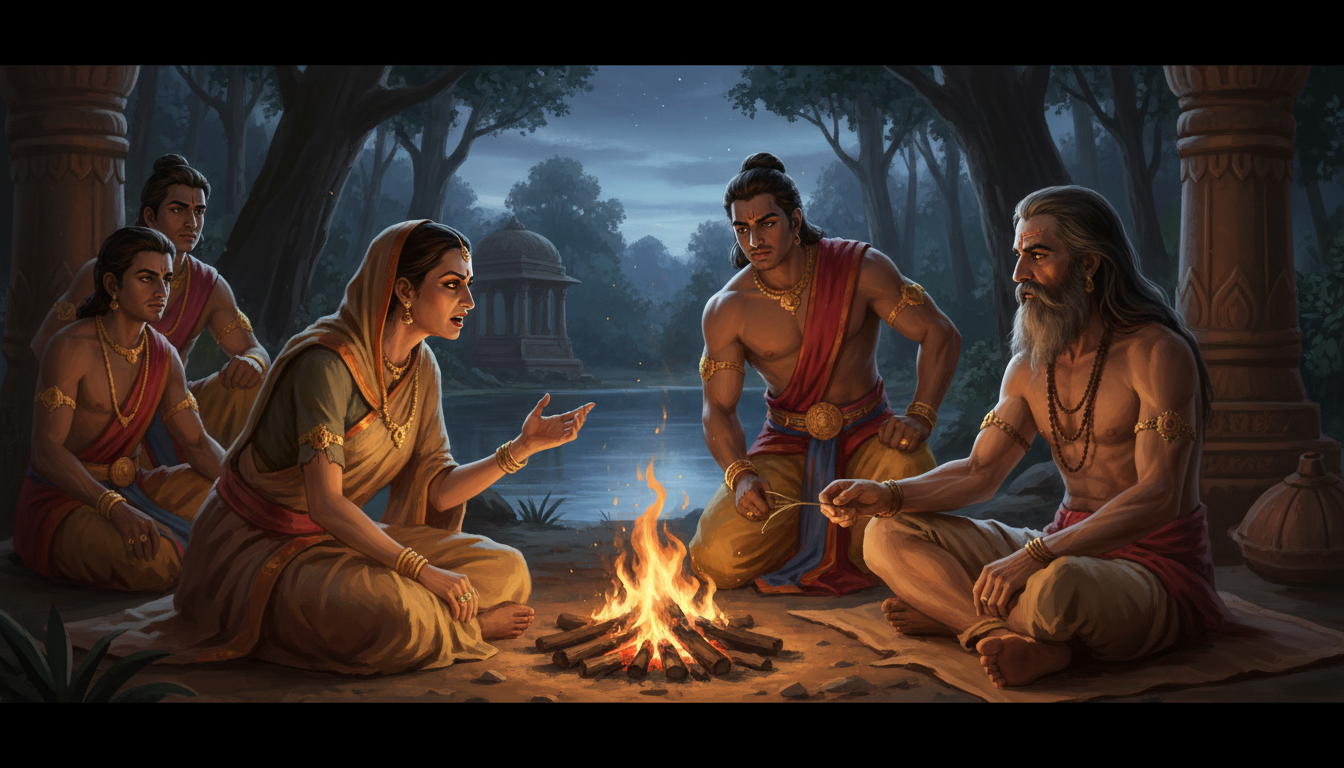
Vaishampayana said: In the woods, in the evening, the sons of Pritha sat with Krishna of the dark skin and talked, and their talk was full of sorrow and grief.
She was handsome and she was well informed, and she was dear to her lords and devoted to them, and it was she who broke the quiet.
"That sinful and cruel and wicked-minded son of Dhritarashtra certainly feels no sorrow for us," Draupadi said to Yudhishthira. "He sent thee into the woods dressed in deer-skin, and myself with thee, and he feels no regret at all. The heart of that wretch of evil deeds must be made of steel, that he could stand there and address thee in words so harsh, thee, his virtuous eldest brother. He has brought thee, who deservest to enjoy every happiness and never such woe as this, into distress, and he sits with his friends and is glad about it."
She had been waiting some days to say it. The camp was quiet, the fires of the brahmanas were burning at a distance under the trees, and her husbands were where she could see all five of them at once, which had a good deal to do with what came next.
Only Four Did Not Weep
"O Bharata," she said, "when thou hadst dressed in deer-skin and hadst set out for the woods, only four persons in that whole city did not shed tears."
She counted them for him on her fingers, and she got them right, and there were exactly four.
"Duryodhana. Karna. The evil-minded Shakuni. And Dushasana, that bad and fierce brother of Duryodhana. With the exception of these, O thou best of the Kurus, all the other Kurus were filled with sorrow and shed tears from their eyes."
Four men out of a whole city. It is a fact worth holding on to, because it tells you what kind of quarrel this was. The city had wept. The elders had wept. Bhishma had wept, and Drona, and Vidura, and the women at the windows, and the men in the street. The whole apparatus of the Kuru house had stood there in tears while four men did the thing it was weeping about, and not one of the weepers had put out a hand.
Draupadi had watched all of it from inside the procession, and she had drawn the conclusion that tears are cheap, and that a house full of people who are sorry is not the same as a house with anyone in it who will act.
The Ivory Seat and the Kusa Grass
"Beholding this thy bed, and recollecting what thou hadst before, I grieve for thee, O king, who deservest no woe and wast brought up in every luxury.
"I remember that seat of ivory in thy court, decked with jewels. Then I look at this seat of kusa grass, and grief consumes me. I saw thee surrounded in thy own hall by kings. What peace can my heart know in not beholding thee such now? I beheld thy body, effulgent as the sun, and smeared with sandal paste; grief deprives me of my senses in beholding thee now besmeared with mud and with dirt. I saw thee dressed in silken clothes of pure white, and I behold thee now dressed in rags.
"Food of every kind, pure food, was carried out of thy house on plates of gold, for brahmanas by the thousand. Food of the best kind was given by thee to ascetics, both the houseless and those living in their own homes. Living in thy mansion thou hadst filled plates by the thousand with food of every kind, and worshipped the brahmanas, gratifying every wish of theirs. What peace, O great king, can my heart know in not beholding all this now?
"And these thy brothers, endued with youth and decked with ear-rings, were formerly fed by cooks with food of sweet flavour, dressed with skill. I behold them all now, so undeserving of woe, living in the woods and upon whatever the wood may yield. My heart knows no peace."
She was not making a list of luxuries. She was making a list of the gifts he could no longer give, which was the wound that would actually reach him, and she knew it.
Why Does Your Anger Not Blaze
Then she turned the question on him, and asked it once for each man in the camp, and would not let it go.
"Thinking of this Bhimasena living in sorrow in the woods, does not thy anger blaze up, even now, when it is time? He performs everything unaided. He is ready to slay all the Kurus in battle. He bears all this sorrow only because he is waiting for the fulfilment of thy promise.
"This Arjuna, though possessed of only two hands, is equal in the lightness of his hand to that Arjuna who had a thousand arms. He is like Yama himself at the end of the Yuga. It was by the prowess of his weapons that all the kings of the earth were made to wait upon the brahmanas at thy sacrifice. Why dost thou not feel indignant, beholding that tiger among men, worshipped by both celestials and Danavas, so anxious? He vanquished celestials and men and serpents from a single car. He took their treasures from the kings of the earth by force. At one impetus he can throw five hundred arrows. Why does thy wrath not blaze at the sight of him in exile?
"Why does it not blaze at the sight of Nakula, so fair and able-bodied and young, the foremost of all swordsmen? Why dost thou pardon the foe at the sight of Madri's son, the handsome and brave Sahadeva? Why also dost thou pardon him at the sight of myself in exile, who was born in the race of Drupada, who am the sister of Dhrishtadyumna, and the daughter-in-law of the illustrious Pandu, and the devoted wife of heroes?
"Truly, O best of the Bharatas, thou hast no anger, or thy mind would be moved at the sight of thy brothers and of me. It is said that there is no Kshatriya in the world who is bereft of anger. In thee I now behold a refutation of the proverb. That Kshatriya who does not discover his energy when the opportunity comes is ever disregarded by all creatures."
Vali's Question
"On this subject," Draupadi said, "the ancient story of the conversation between Prahlada and Vali, the son of Virochana, is quoted as an example."
And it should be noticed what she was doing, because it is not a small thing. She was arguing dharma with the man reputed to know the most of it in the world, and she did not argue from her own grievance. She reached for an authority, and the authority she reached for was an Asura: Prahlada, chief of the Asuras and the Danavas, possessed of great wisdom and well versed in the mysteries of the science of duty, whose righteousness was so unarguable that even the gods conceded it.
"One day Vali asked his grandfather this question. 'O sire, is forgiveness meritorious, or is might and energy the more meritorious? I am puzzled as regards this. Enlighten me, who ask thee. O thou conversant with all duties, tell me truly which of these two is the better. I will strictly obey whatever thy command may be.'
"And his wise grandfather, conversant with every conclusion, replied upon the whole subject to the grandson who had sought at his hands the resolution of his doubt.
"'Know, O child, these two truths with certainty,' said Prahlada. 'Might is not always meritorious, and forgiveness also is not always meritorious.'"
Yudhishthira was listening. He had been listening from the beginning, and he had not interrupted once, and a lesser man would have stopped her at the word Asura and asked what a chief of the Danavas could possibly teach the son of Dharma. He let her go on, because he had noticed what she had chosen. Prahlada had been on the losing side of everything. He had been thrown from heights and burned and given poison by his own father for holding to what he held, and had forgiven all of it and lost nothing by the forgiving. If any authority in the three worlds had earned the right to say where patience stops being a virtue, it was that one.
The Man Who Always Forgives
"'He that forgives always suffers many evils,'" Draupadi went on, in Prahlada's words. "'Servants and strangers and enemies all disregard him. No creature ever bends down to him. Therefore it is, O child, that the learned do not applaud a constant habit of forgiveness.
"'The servants of an ever-forgiving person disregard him, and contract numerous faults. These mean-minded men also seek to deprive him of his wealth. Vile-souled servants appropriate to themselves his vehicles and his clothes and his ornaments and his apparel, his beds and his seats, his food and his drink and every other article of use. They do not give to others the things they are directed by their master to give. Nor do they even worship their master with the respect that is his due. And disregard in this world is worse than death.
"'O child, sons and servants and attendants, and even strangers, speak harsh words to the man who always forgives. Persons who disregard the man of an ever-forgiving temper even desire his wife, and his wife also becomes ready to act as she wills. And servants who are fond of pleasure, if they do not receive even slight punishments from their master, contract all sorts of vices, and the wicked always injure such a master. These and many other demerits attach to those that are ever-forgiving.'"
It is a hard passage, and she recited it without softening a word of it, in a forest camp, to a husband who had lost a kingdom by not saying no.
The Snake in the House
"'Listen now, O son of Virochana, to the demerits of those that are never forgiving,'" she continued, and she gave that side its full weight too, because Prahlada had.
"'The man of wrath who, surrounded by darkness, always inflicts by his own energy various kinds of punishment upon persons whether they deserve it or not, is necessarily separated from his friends in consequence of that energy of his. Such a man is hated by relatives and strangers alike. Because he insults others, he suffers loss of wealth, and reaps disregard, and sorrow, and hatred, and confusion, and enemies. The man of wrath, in consequence of his ire, inflicts punishment upon men and obtains harsh words in return. He is divested of his prosperity soon, and even of his life, not to speak of friends and relatives.
"'He that puts forth his might upon his benefactor and upon his foe alike is an object of alarm to the whole world, like a snake that has taken shelter in a house is to the people who live in it. And what prosperity can he have who is an object of alarm to the world? People always do him an injury when they find a hole.
"'Therefore should men never exhibit might in excess, nor forgiveness on all occasions. One should put forth his might and show his forgiveness on the proper occasions. He that becomes forgiving at the proper time, and harsh and mighty also at the proper time, obtains happiness both in this world and in the other.'"
The Occasions of Forgiveness
"'I shall now indicate in detail the occasions of forgiveness, as they are laid down by the learned, and which should ever be observed by all. Hearken unto me as I speak.
"'He that has done thee a service, even if he is guilty of a grave wrong to thee, should be forgiven, recollecting his former service. Those also that have offended from ignorance and folly should be forgiven, for learning and wisdom are not always easily attainable by man. They that have offended thee knowingly and then plead ignorance should be punished, even if their offences are trivial. Such crooked men should never be pardoned. The first offence of every creature should be forgiven. The second offence should be punished, even if it be trivial. If, however, a person commits an offence unwillingly, it has been said that his plea should be examined by a judicious enquiry, and that he should be pardoned.
"'Humility may vanquish might, and humility may vanquish weakness. There is nothing that humility may not accomplish. Therefore humility is truly fiercer than it seems. One should act with reference to place and to time, taking note of his own might or weakness. Nothing can succeed that has been undertaken without reference to place and time. Therefore do thou ever wait for place and time. And sometimes offenders should be forgiven from fear of the people. These have been declared to be the times of forgiveness. On occasions besides these, might should be put forth against transgressors.'"
Then Draupadi stopped quoting, and applied it, which was the whole reason she had begun.
"I therefore regard, O king, that the time has come for thee to put forth thy might. To those Kurus, the covetous sons of Dhritarashtra, who injure us always, the present is not the time for forgiveness. It behoveth thee to put forth thy might. The humble and forgiving person is disregarded, while those that are fierce persecute others. He, indeed, is a king who has recourse to both, each according to its time."
Anger Kills Even Preceptors
"Anger is the slayer of men," Yudhishthira said, "and is again their prosperer. Know this, O thou possessed of great wisdom, that anger is the root of all prosperity and of all adversity. He that suppresses his anger earns prosperity. The man who always gives way to it reaps adversity from that fierce anger of his.
"It is seen in this world that anger is the cause of the destruction of every creature. How then can one like me indulge in a thing so destructive of the world? The angry man commits sin. The angry man kills even his preceptors. The angry man insults even his superiors in harsh words. The man that is angry fails to distinguish between what should be said and what should not. There is no act an angry man may not do, and no word an angry man may not utter. From anger a man may slay one that deserves not to be slain, and may worship one that deserves to be slain. The angry man may even send his own soul to the regions of Yama.
"Beholding all these faults, the wise control their wrath. And, O daughter of Drupada, reflecting upon all this, my anger is not excited.
"One who does not act against a man whose wrath has been roused rescues himself and the other man both from a great fear; in fact he may be regarded as the physician of the two. And if a weak man, persecuted by others, foolishly becomes angry with men mightier than himself, he becomes the cause of his own destruction, and for one who thus deliberately throws away his life there are no regions hereafter to gain.
"O thou of fair hips, the angry man does not see things in their true light. The angry man does not see his way, nor does he respect persons. Those that are regarded by the learned as possessed of true force of character are certainly those who are wrathful in outward show only. The man overwhelmed with wrath does not easily acquire generosity, or dignity, or courage, or skill, or the other attributes that belong to real force of character.
"The ignorant always regard anger as equivalent to energy. It is not. A man by forsaking anger can exhibit proper energy, whereas it is highly difficult for the angry man to exhibit his energy at the proper time. Men of learning and of true insight call him possessed of force of character who by his wisdom can suppress his risen wrath. Truth is more beneficial than untruth, and gentleness than cruel behaviour. How can one like me, therefore, even for the purpose of slaying Duryodhana, exhibit an anger that has so many faults in it, and that the virtuous banish from their souls?"
Forgiveness Is the Earth
"If among men there were no persons equal to the earth in forgiveness," he went on, "there would be no peace, but continued strife caused by wrath. If the injured returned their injuries, if one chastised by his superior chastised his superior in return, the consequence would be the destruction of every creature. If the man who has ill speeches from another returns those speeches; if fathers slay sons, and sons fathers; if husbands slay wives, and wives husbands; then how, O Krishna, can birth take place in a world where anger prevails so? For the birth of creatures is due to peace. And it is because there are in the world men who are forgiving like the earth, that creatures derive their life and their prosperity.
"The illustrious and forgiving Kashyapa sang verses upon this. Forgiveness is virtue, forgiveness is sacrifice, forgiveness is the Vedas, forgiveness is the Shruti. Forgiveness is Brahma, forgiveness is truth, forgiveness is stored ascetic merit, and by forgiveness is it that the universe is held together. Forgiveness is the might of the mighty. How, O Krishna, can one like us abandon a thing in which Brahma and truth and wisdom and the worlds are established?"
Then he named the men he was counting on, and the list is the whole of his policy.
"Our grandsire, the son of Santanu, will worship peace. Krishna the son of Devaki will worship peace. The preceptor Drona will speak of peace, and Vidura called Kshatri; Kripa and Sanjaya also will preach it; and Yuyutsu, and Drona's son, and our grandsire Vyasa, every one of them speaks always of peace. Urged by these toward peace, the king Dhritarashtra will, I think, return us our kingdom. If, however, he yields to temptation, he will meet with destruction. A crisis has come in the history of the Bharatas, O lady, and this has been my certain conclusion for some time.
"Suyodhana does not deserve the kingdom, and therefore he has been unable to acquire forgiveness. I deserve the sovereignty, and therefore forgiveness has taken possession of me."
Draupadi heard him out, and she was not consoled, and she did not pretend to be.
"I bow down unto Dhatri and Vidhatri," she said, "who have thus clouded thy sense."
And the fire burned lower, and neither of them had moved the other, and both of them had been right, and there were still twelve years to go.
Dharma Lesson
Neither forgiveness nor force is a virtue in itself; the whole of the art is knowing which one the hour is asking for. Prahlada teaches that the man who forgives always is robbed in his own house and the man who is fierce always is feared like a snake in the rafters, and both lose everything they were trying to keep.