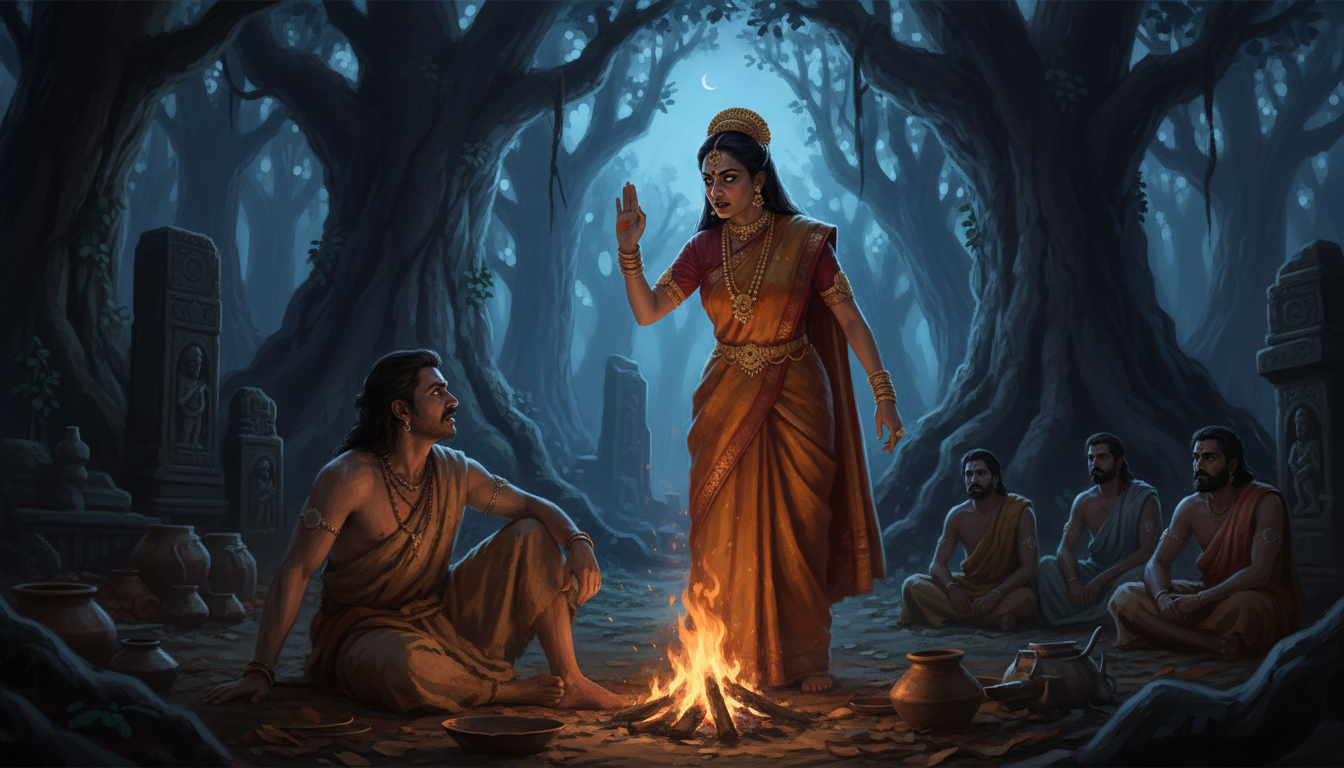
The Queen Who Put God on Trial
A bird on a string, and a child breaking its toys
I Bow Down to Dhatri and Vidhatri
In the Dvaitavana wood, on an evening like all the other evenings, Draupadi came and sat down in front of her eldest husband and opened with a bow.
"I bow down unto Dhatri and Vidhatri," she said, "who have thus clouded your sense."
It was not a devotion. It was the salute a duellist gives before the first cut, and Yudhishthira, who had known her a long time, understood it as such and waited.
"Regarding the burden you are to bear, you think differently from the ways of your fathers and your grandfathers. Men are placed in different situations of life by their acts, and acts therefore produce consequences that cannot be escaped; only a fool desires release from them.
"It seems to me that a man can never attain prosperity in this world by virtue, by gentleness, by forgiveness, by straightforwardness, or by the fear of censure. If this were not so, O Bharata, this insufferable calamity would never have overtaken you, who so little deserve it, nor these brothers of yours of such great energy.
"Neither in the days of your prosperity nor in these days of your adversity have you ever known anything so dear to you as virtue. You have held it dearer than your life. That your kingdom is for virtue alone and your life is for virtue alone is known to the brahmanas, and to your superiors, and even to the celestials.
"I think you could abandon Bhimasena, and Arjuna, and these twin sons of Madri, and myself along with them. I do not think you could abandon virtue."
The Plates of Gold
"I have heard," she went on, "that the king protects virtue, and that virtue, protected by him, protects him in return. I see that virtue does not protect you.
"Like a shadow that follows a man, your heart with singleness of purpose has always sought virtue. You never disregarded your equals, or your inferiors, or your superiors. You obtained the entire world and your pride did not increase by so much as a hair. You worship the brahmanas and the gods and the Pitris with Swadhas and every other form of offering. You have gratified the brahmanas by fulfilling every wish of theirs."
Then she began to name particulars, because she had run that household and she knew what had gone out of it.
"Yatis and Sannyasins and mendicants living in their own houses have always been fed at your table off plates of gold, and it was I who distributed the food among them. To the Vanaprasthas you gave gold and food always. There is nothing in your house that you may not give away to a brahmana. In the Viswadeva sacrifice performed in your house for your own peace, the consecrated things are offered first to guests and to all creatures, and you live yourself on whatever is left after the distribution. Ishtis, Pashubandhas, the sacrifices for the fruition of desire, the ordinary religious rites of domesticity, the Paka sacrifices, and sacrifices of every other kind, are performed continually in your house. And even here, in this great forest, solitary and haunted by robbers, in exile and stripped of your kingdom, your virtue has not diminished by one particle.
"The Aswamedha, the Rajasuya, the Pundarika, the Gosava, those grand sacrifices that require enormous gifts, have all of them been performed by you.
"And then, impelled by a perverse sense, in that dire hour of a losing match at dice, you staked and lost your kingdom, your wealth, your weapons, your brothers, and myself.
"Simple, gentle, liberal, modest, truthful. How, O king, could your mind be attracted to the vice of gambling? I am nearly out of my senses, and my heart is overwhelmed with grief, beholding this distress of yours and this calamity."
The Wooden Doll and the Wire
"An old history is cited as an illustration," she said, "for the truth that men are subject to the will of God and never to their own wishes.
"The Supreme Lord and Ordainer of all ordains everything concerning the weal and woe, the happiness and the misery of all creatures, even before they are born, guided by the acts of each, which are like a seed destined to sprout into the tree of a life.
"As a wooden doll is made to move its limbs by the man who pulls the wire, so are creatures made to work by the Lord of all. Like space, which covers every object, God pervades every creature and ordains its weal or its woe. Like a bird tied with a string, every creature is dependent upon God. Everyone is subject to God and to nothing else. No one can be his own ordainer.
"Like a pearl upon its string, or a bull held fast by the cord passing through its nose, or a tree that has fallen from the bank into the middle of the stream, every creature follows the command of the Creator, because it is imbued with his Spirit and established in him. Man himself, dependent on the Universal Soul, cannot pass a single moment independently. Enveloped in darkness, creatures are not the masters of their own weal or woe. They go to heaven or to hell urged by God himself. Like light straws dependent on strong winds, all creatures are dependent on God."
She was building something, and she built it carefully, with the images laid one on top of another: the doll, the bird, the pearl, the bull, the drifting tree, the straw. Six pictures of a thing that does not move itself. The Pandavas sat in the leaf-light and listened to their wife construct the case for the defence of every man who had ever done anything.
A Child With a Toy of Soft Earth
"And God himself, pervading all creatures and engaged in acts right and wrong, moves in the universe, though no one can point and say, 'This is God.'
"This body with its physical attributes is only the means by which the Supreme Lord makes every creature reap fruits that are good or bad. Behold the power of the illusion that has been spread by God, who, confounding creatures with his illusion, makes them slay their fellows. Truth-knowing Munis behold these things differently. They appear to them in another light, as the rays of the sun do, which to ordinary eyes are only a pencil of light, but which to more penetrating eyes are seen to be fraught with the germs of food and drink. Ordinary men behold the things of the earth otherwise.
"It is God who makes them all, adopting different processes in their creation and their destruction. The Self-create Grandsire, spreading illusion, slays his creatures by the instrumentality of his creatures, as one may break a piece of inert and senseless wood with wood, or stone with stone, or iron with iron.
"And the Supreme Lord, according to his pleasure, sports with his creatures, creating them and destroying them, like a child with his toy of soft earth.
"O king, it seems to me that God behaves toward his creatures like a father or a mother. And it seems to me also that, like a vicious person, he bears himself toward them in anger."
That is the sentence in which the argument turns. She had said the pious thing and the impious thing in the same breath, and she did not withdraw either of them, and she went on.
Then God Is Stained With Every Act
"Beholding superior and well-behaved and modest persons persecuted, while the sinful are happy, I am sorely troubled.
"Beholding this distress of yours and the prosperity of Suyodhana, I do not speak highly of the Great Ordainer who suffers such inequality. What fruits does the Great Ordainer reap by granting prosperity to Dhritarashtra's son, who transgresses the ordinances, who is crooked, who is covetous, and who injures virtue and religion?"
And then she closed the trap she had been building since the wooden doll.
"If the act done pursues the doer and no one else, then certainly it is God himself who is stained with the sin of every act.
"If, however, the sin of an act done does not attach to the doer, then it is might, and not God, that is the true cause of acts. And I grieve for those that have no might."
There it was, laid out on the ground of the Dvaitavana forest by a woman in bark cloth: either the Ordainer is the author of every crime committed in the world, including the one committed against her in the Kuru hall, or else there is no Ordainer in the matter at all, and the world is run by whoever is strongest that afternoon, and the weak are simply owed nothing.
She had grieved for those that have no might because for a period of some hours in Hastinapura she had been one of them, in a single cloth, with her hair in a man's fist, in front of an assembly of kings who found the arrangement legally interesting.
Nobody in the epic pushes the question further than this. Nobody is permitted to.
The Language of Atheism
"Your speech, O Yajnaseni, is delightful, and smooth, and full of excellent phrases," Yudhishthira said. "We have listened to it carefully. You are speaking, however, the language of atheism.
"O princess, I never act out of any concern for the fruits of my actions. I give away because it is my duty to give. I sacrifice because it is my duty to sacrifice. I accomplish to the best of my power whatever a person living in domesticity ought to do, and it is nothing to me whether those acts have fruits or not. I act virtuously not from a desire to reap the fruits of virtue, but so as not to transgress the ordinances of the Veda, and because I have seen how the good and the wise conduct themselves. My heart is naturally attracted toward virtue.
"The man who wishes to reap the fruits of virtue is a trader in virtue. His nature is mean and he should never be counted among the virtuous, and he does not obtain the fruits either.
"You have seen with your own eyes the great ascetic Markandeya come to us. It is by virtue alone that he has acquired immortality in the flesh. Vyasa, and Vashishtha, and Maitreya, and Narada, and Lomasa, and Shuka, and the other Rishis, have all become pure of soul by virtue alone, and you have seen them with your own eyes, furnished with the prowess of celestial asceticism, competent to curse or to bless with effect, and superior to the very gods.
"Religion is the only raft for those who wish to go to heaven, as a ship is for merchants who wish to cross the ocean. If the virtues practised by the virtuous had no fruits, this universe would be enveloped in an infamous darkness. No one would pursue salvation. No one would seek to acquire knowledge, or even wealth. Men would live like beasts.
"Do not doubt, and do not censure God, and do not act with a foolish heart. Let your doubt be dispelled like mist, O Krishnaa, and let your scepticism give way to faith."
Know Me to Be Only Raving
She heard him out. Then she gave him the retraction he had asked for, and gave it in a form that conceded nothing.
"I do not ever disregard or slander religion, O son of Pritha. Why should I disregard God, the lord of all creatures? Afflicted with woe, know me, O Bharata, to be only raving.
"I will indulge in lamentations once more. Listen to me with attention."
And what followed was not lamentation. It was the counter-teaching, and she had been holding it back until he had committed himself.
"Every conscious creature should certainly act in this world. It is only the immobile, and no other creatures, that can live without acting. The calf, immediately after its birth, sucks the mother's teat. Persons feel pain in consequence of incantations performed over their statues. It seems to me, O Yudhishthira, that creatures derive the character of their lives from the acts of their former lives.
"Among mobile creatures, man differs in this respect, that he aspires to affect his course of life in this world and in the other by means of his acts. If a creature does not act, its course of life is impossible. In the case of a creature there must therefore be action, and not inaction.
"You also should act, and not incur censure by abandoning action.
"Cover yourself up, as with an armour, with action."
Destiny and Chance Are the Two Worst Creeds
"There may or may not be one man in a thousand who truly knows the utility of work," she said. "But one must act, if only to protect and to increase what one has; for if a man never seeks to earn and only continues to spend, then his wealth, even if it were a hoard as huge as Himavat, would soon be exhausted.
"All the creatures in the world would have been exterminated if there were no action. If acts bore no fruits, creatures would never have multiplied. It is seen that creatures sometimes perform acts that have no fruits at all, for without acts the course of life itself would be impossible.
"Those persons in the world who believe in destiny, and those again who believe in chance, are both of them the worst among men. Only those who believe in the efficacy of acts are worthy of praise.
"He who lies at his ease without activity, believing in destiny alone, is soon destroyed like an unburnt earthen pot in water. And he who believes in chance, sitting inactive though he is capable of activity, does not live long, for his life is one of weakness and helplessness.
"If a person accidentally acquires wealth, that is said to come from chance, for no one's effort brought it about. Whatever good fortune a person obtains in consequence of religious rites is called providential. The fruit that a person obtains by acting himself, which is the direct result of his own acts, is regarded as the proof of personal ability. And the wealth that comes spontaneously and without cause is called a spontaneous acquisition.
"Intelligent men know by their intellect that oil may be had from sesame, and curds from milk, and that food may be cooked by igniting fuel. They know the means for accomplishing these things, and knowing them, they set themselves to work with the proper appliances, and creatures support their lives by what is achieved in this way. If a work is executed by a skilled workman, it is executed well; from the differences in the thing itself, another work may be known to be the work of an unskilful hand.
"If a person were not, in the matter of his own acts, himself the cause of them, then sacrifices would bear no fruit in his case, and no one would be a disciple and no one a master. It is because a person is himself the cause of his work that he is applauded when he succeeds, and censured when he fails. If a man were not himself the cause of his acts, how could any of that be justified?"
The Tiller and the Clouds
"For all this, however, a person should act. This is the conclusion of Manu himself. The person that does not act certainly succumbs, O Yudhishthira. The man of action in this world generally meets with success. The idle never achieve it. If success becomes impossible, then one should seek to remove the difficulties that bar the way to it. And if a person works hard, his debt to the gods is cancelled, whether he achieves success or not.
"Misery has overtaken us at this moment. If you betake yourself to action, that misery will certainly be removed. And if you meet with failure, then that itself will be a proof to you and to Vrikodara and Vivatsu and the twins that you are unable to snatch the kingdom back from the foe. The acts of others are seen to be crowned with success. It is probable that ours will be also. How can anyone know beforehand what the consequence will be? Having exerted yourself, you will know what the fruit of your exertion is.
"The tiller tills the soil with the plough and sows the seeds in it. Then he sits silent, for after that it is the clouds that are the cause of the seeds growing into plants. If the clouds do not favour him, the tiller is absolved of all blame. He says to himself, 'What others do, I have done. If in spite of that I meet with failure, no blame can attach to me.' And thinking so, he contains himself and never indulges in self-reproach.
"No one should ever despair, O Bharata, saying, 'I am acting, and yet success is not mine.' For there are two other causes besides exertion. Whether there is success or failure, there should be no despair, for success in acts depends upon the union of many circumstances. If one important element is wanting, success does not become commensurate, or does not come at all. But if no exertion is made, there can be no success, and there is nothing to applaud in the absence of all exertion.
"With carefulness and vigilance should a man set himself to work, and his chief guide should be his own prowess. No man should ever disparage himself, for the man who disparages himself never earns high prosperity."
On Her Father's Lap
Then she told him where she had got it, and the answer explained a great deal about the woman who had just held a theological argument on both sides of the field and won it twice.
"My father formerly kept a learned brahmana with him," she said. "O bull of the Bharata race, it was he who said all this to my father. Indeed, these instructions as to duty, uttered by Brihaspati himself, were first taught to my brothers. It was from them that I heard them afterwards, while I was in my father's house.
"And at the intervals of business, when I went out of the inner apartments and sat upon my father's lap, that learned brahmana used to recite these truths to me, and console me sweetly with them."
So the doctrine of exertion had come to Drupada's daughter in the way such things come to daughters: sideways, overheard, delivered as comfort to a child sitting on a knee while the men of the house received it as instruction. She had kept it for twenty years and produced it in a forest, on an evening when it was needed, against a husband who was the most learned man in the encampment.
She had done two things in one sitting. She had refused to say that the arrangement of the world was just, and she had refused to let that refusal become an excuse for sitting still. The Ordainer might be a child breaking clay toys, or he might be the giver of every fruit; on that she had said her piece and was not going to pretend to be satisfied. But the plough belongs to the tiller either way, and the clouds are nobody's business.
Behind her, in the dark at the edge of the firelight, Bhimasena had been listening to every word. He sighed once, in wrath, and got up and walked over to the king.
Dharma Lesson
The honest complaint against heaven and the resolve to keep working are not opposites; Draupadi holds both, and only the second is in anyone's hands. She will not call the arrangement of the world just, and she will not let that verdict become a licence for sitting still. The tiller ploughs and sows and then leaves the clouds to the clouds.